Skin clinic software Australia: 6 best picks, AUD prices
Skin clinic software in Australia costs a two-practitioner practice between A$84...

Last Updated: Sep 22, 2026
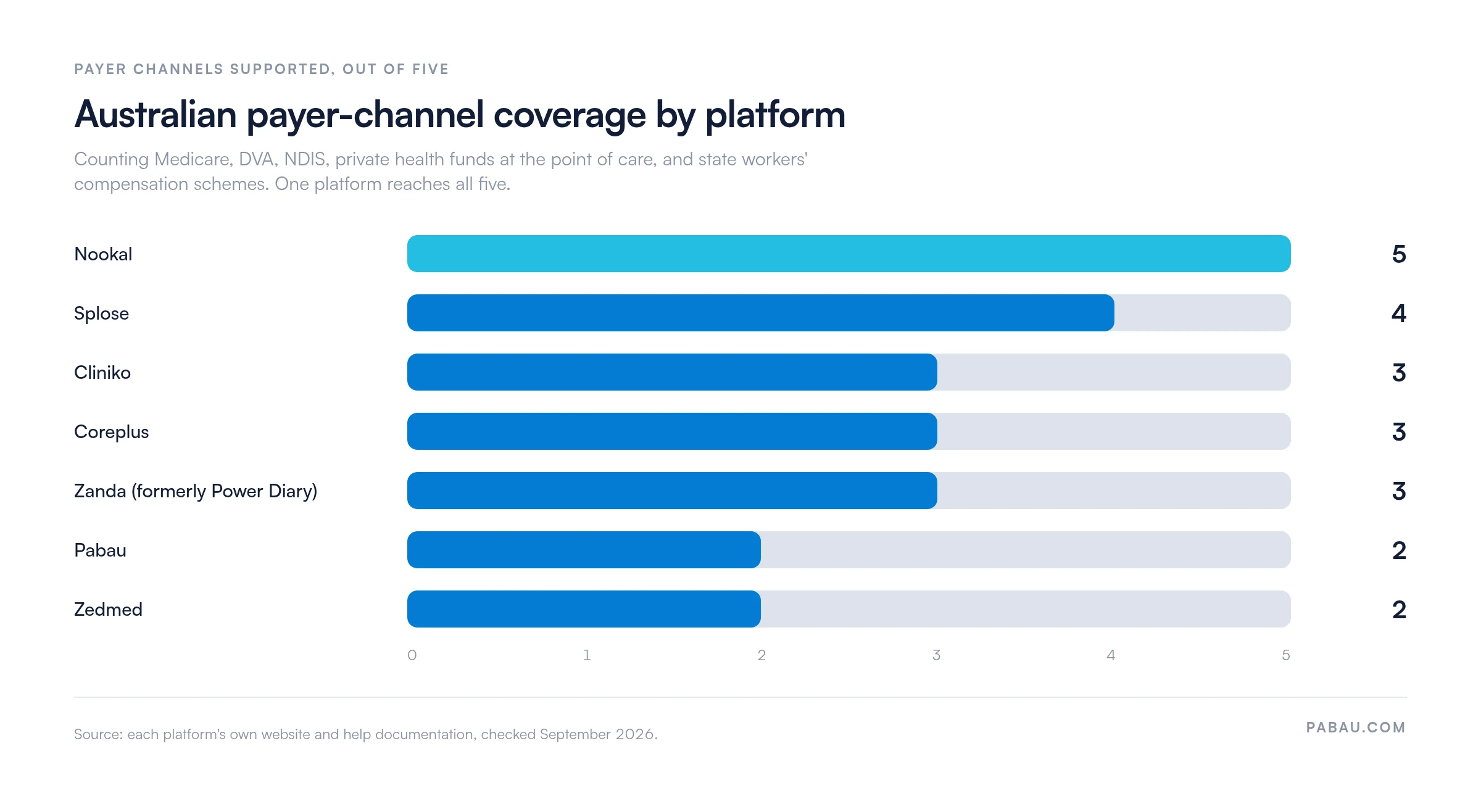
The best allied health software Australia practices can buy is the one that lodges claims with every payer they bill, and Nookal reaches the most. In our Claims-Readiness Matrix, Nookal is in fact the only one of seven platforms to reach Medicare, DVA, NDIS, health funds and state workers’ compensation.
However, the right pick still depends on your funding mix. Splose suits an NDIS-heavy caseload, and Zanda is a low-cost start for a solo practitioner billing Medicare and health funds. Meanwhile, Pabau, the all-in-one practice management platform we build, fits a multi-discipline practice billing mostly Medicare and DVA.
Practice management software runs a practice’s appointments, clinical records and billing. All seven platforms here handle those three competently, so claiming is what separates them. Pick one that stops at invoicing, and then someone retypes patient, provider and referral details into a payer portal every afternoon.

1. Nookal — the only platform here that reaches all five Australian payer channels, workers’ compensation included.
2. Splose — the strongest fit for NDIS-heavy caseloads, building the bulk payment file the myplace portal imports.
3. Cliniko — a simple pick for small teams claiming Medicare, DVA and health funds without a terminal.
4. Coreplus — bundles free Medicare and DVA claiming into its Plus plan for mixed-discipline teams.
5. Zanda — a low-cost start for solo practitioners, with free Medicare claiming and no DVA lodgement fee.
6. Pabau — one patient record for scheduling, notes and Medicare, DVA and health fund claims across disciplines.
7. Zedmed — adds ECLIPSE claiming and on-premise hosting for allied health inside a medical practice.
The best allied health practice management software Australia offers depends on your payer mix more than its feature list. Nookal covers the most channels, Splose leads on NDIS, and Zanda is a low-cost solo start.
The Claims-Readiness Matrix below scores whether each claim leaves the software. We checked every platform against its own site and documentation on October 1, 2026.
Counted as bars, the spread is wider than features suggest.
For a single discipline, see our roundups for physiotherapy practices and podiatry practices.
Start from where last month’s revenue came from, then match it to the platform that keeps that payer inside the software.
Team size changes the maths second. For example, a solo practitioner pays AUD $29 a month on Zanda’s Starter plan, or US$45 on Cliniko. On the other hand, Cliniko’s flat US$95 band for two to five practitioners gets cheaper per head as the team grows.
Splose and Coreplus give admin staff free seats, which keeps a reception-heavy team cheaper. Past eight practitioners, Coreplus quotes a discounted Group rate and Nookal quotes Enterprise. The reviews below run widest claims coverage first.
Nookal reaches all five Australian payer channels, including WorkCover Queensland, WorkSafe Victoria, TAC and icare.
Nookal has the widest coverage in the Claims-Readiness Matrix, claiming Medicare and DVA natively and reaching NDIS and state injury schemes through HICAPS Digital Claims.
Nookal’s support documentation names the schemes rather than gesturing at them. For example, HICAPS Digital Claims, formerly LanternPay, covers the Transport Accident Commission of Victoria, WorkSafe Victoria and WorkCover Queensland. Separate articles cover icare and NDIS agency-managed, plan-managed and global plan-managed claims.
That last distinction is worth reading twice. NDIS plan-managed claims go to the plan manager, while agency-managed claims go to the NDIA. Nookal documents both paths separately, and on a successful claim the paid amount posts to the invoice automatically.
However, the trade-off is cost per claim. Nookal charges Medicare claim lodgement from AUD $0.10 per claim on top of the subscription. Nevertheless, multiple claims for one patient can be combined to reduce that cost.
Nookal publishes Australian dollar prices that exclude GST, and charges claim lodgement separately. A practice submitting a few hundred Medicare claims a month should therefore add that line to the comparison.
Splose builds the NDIS bulk payment request file that the myplace provider portal imports directly.
Splose claims NDIS, Medicare, DVA and private health funds, and its NDIS bulk upload file makes it the best fit for an NDIS-heavy caseload. The vendor sells itself as practice management software for allied health professionals rather than a general medical system.
Splose’s NDIS bulk upload report creates a bulk payment request file for import into the myplace provider portal. In fact, Splose states the file is compliant with PACE. Batch invoicing feeds the same report, so a month of community visits claims in one pass.
Meanwhile, a separate HICAPS integration handles NDIA-managed participants. Splose’s own wording is that HICAPS puts claims processing for NDIA-managed participants directly in your hands. In addition, claim status stays visible in real time.
Medicare and DVA run through Tyro Health, as they do almost everywhere else. Splose names no state workers’ compensation scheme. Therefore, an injury-referral practice should look at Nookal. NDIS-funded work concentrates in occupational therapy software shortlists for exactly this reason.
Splose charges per practitioner and gives every non-practitioner role a free seat. That suits a practice with more admin staff than clinicians. Prices are in Australian dollars and exclude GST.
Splose’s pricing page also announces a price change for Australia and New Zealand from November 1, 2026. Therefore, confirm the current figure before you sign.
Cliniko is cloud practice management software that claims Medicare, DVA and private health funds through Tyro Health.
Cliniko claims Medicare, DVA and private health funds through Tyro Health with no terminal, but it invoices NDIS work rather than submitting it.
It is cloud-based practice management software for allied health practices, covering scheduling, treatment notes, invoicing and online bookings. It suits a solo practitioner or small team billing Medicare bulk bills.
Cliniko’s own connected-app page is direct about the claiming route. Medicare and DVA claims process online with no terminal required, and private fund claims go through HealthPoint.
NDIS is where the wording matters. Cliniko’s help center covers setting up billable items so invoices comply with NDIS requirements. Those instructions follow the funding-period changes that started on May 19, 2025. However, compliant invoicing is not a submission channel.
Cliniko’s DVA flow shows how little manual work a claiming integration can leave. A staff member raises the invoice, clicks the DVA claim link, and then Cliniko pre-fills what it already holds. With a DVA payment allocation configured, the payment lands against the invoice on approval.
Cliniko prices by practitioner band, and states its prices in United States dollars. An Australian practice therefore carries the exchange rate. In addition, SMS credits cost 10 cents per message on top.
Coreplus is built around physical therapy, psychology, exercise physiology and podiatry workflows in one platform.
Coreplus claims Medicare and DVA on its Plus plan and health funds through Tyro Health, while its NDIS support stops at plan tracking and invoicing.
The platform targets physical therapy, psychology, exercise physiology and podiatry rather than allied health in general. It also lists profession-specific setups for chiropractors, dietitians, speech pathologists, osteopaths and audiologists.
Claiming is where Coreplus makes an unusual choice. Instead of core features, Medicare and DVA claiming are add-ons. Both come free on the Plus plan at AUD $49 per user per month. The Core plan at AUD $35 carries limited add-on integrations instead.
Private health fund claiming runs through the Tyro Health add-on. The terminal pairs with the patient’s invoice, so the rebate lands instantly. Its help center states plainly that Coreplus is not integrated with HICAPS or ECLIPSE.
NDIS support exists, but it is narrower than it first looks. For example, Coreplus tracks plan start and end dates and allocates funding types. It also monitors fund usage and builds a customized NDIS invoice addressed to the plan manager. Overall, Coreplus names no claim submission channel.
Coreplus prices in Australian dollars excluding GST. The SMS rate drops from 15 cents to 10 cents on the Plus plan. Free administrative seats on both plans keep a reception-heavy practice cheaper than a per-user headline suggests.
Zanda, formerly Power Diary, lodges DVA claims with no per-claim fee on top of the subscription.
Zanda claims Medicare, DVA and private health funds with no fee for lodging DVA claims, but it bills NDIS work rather than claiming it.
Power Diary now trades as Zanda, and powerdiary.com redirects to zandahealth.com. Therefore, reviews that still say “Power Diary” are describing a brand that has been renamed.
Zanda’s claiming story is competitive at the low end. For example, its Australian pricing page lists Medicare claiming as free on every account, through a direct integration with no third party. Integrating a Zanda account with DVA is free too, and HealthPoint fund claims run through Tyro Health.
However, registration is still a paper step. Zanda’s documentation notes that DVA online claiming needs an Online Claiming Provider Agreement, form HW027. You submit it once per practitioner provider number. Zanda then auto-populates the patient, provider and referral details.
Because Zanda only bills NDIS work, an agency-managed caseload still means entering payment requests in the myplace portal by hand. For a solo practitioner billing Medicare and health funds, that trade-off is easy. To an NDIS provider, it is the whole decision.
Zanda publishes Australian dollar prices excluding GST, so a two-practitioner Growth practice pays AUD $88 per month. Additional SMS messages cost 15 cents each, and replies are free to receive.
Pabau submits Medicare, DVA and private health fund claims through Tyro Health from the record that already holds the appointment.
Pabau claims Medicare, DVA and private health funds through Tyro Health from the invoice just raised. However, Pabau names no NDIS or workers’ compensation channel for Australia.
Pabau suits an Australian allied health practice running several disciplines, where the billing is mostly Medicare and DVA.
The sequence on Pabau’s own feature page is specific. A staff member adds the insurer and policy details to the patient record, then raises the invoice. Pabau then routes it to the right third party and checks the required fields before submission. From there, the claim tracks through five states.
Those five states are pending, submitted, processing, paid and error. Besides, Pabau captures assignment of benefit electronically, which matters for bulk-billed items. However, the pipeline does not suggest item numbers or run clinical decision support. Coding therefore stays with the practitioner.
Pabau’s Australian integrations page also names private health fund claiming alongside Medicare and DVA. Splose or Nookal still serve an NDIS-heavy caseload or a workers’ compensation referral stream better, exactly as the table above shows.
Pabau publishes plan tiers rather than dollar figures, because the price depends on your region and user count. Annual billing saves up to 20%, and every tier includes the full platform. You can see the tiers on Pabau’s pricing page.
Zedmed adds ECLIPSE claiming, which matters when a practice also bills specialist in-patient work.
Zedmed claims Medicare, DVA and ECLIPSE but names no NDIS or HICAPS integration, so it suits allied health inside a mixed medical practice.
The platform comes from general practice and specialist software rather than allied health. Its own site, however, still names allied health as a supported profession. Zedmed offers structured clinical notes built for allied health, as well as billing for Medicare and private health funds.
Zedmed’s claiming answer is short. Zedmed supports all major claiming including Medicare, DVA and ECLIPSE, although the ECLIPSE workflow is aimed at specialists.
Deployment is the genuine differentiator here. Zedmed runs on-premise or in the cloud, with data stored in ISO 27001 certified data centers located in Australia. As a result, a practice with a policy against cloud hosting has very few other options on this list.
Zedmed publishes no prices for either deployment and asks practices to get in touch for a quote. Budget for a scoping conversation rather than a self-service signup.
A claim moves through allied health software in four steps, and only step three differs by platform. Steps one, two and four look much the same wherever you go.
Set side by side, the five routes at step three explain most of the differences in this comparison.
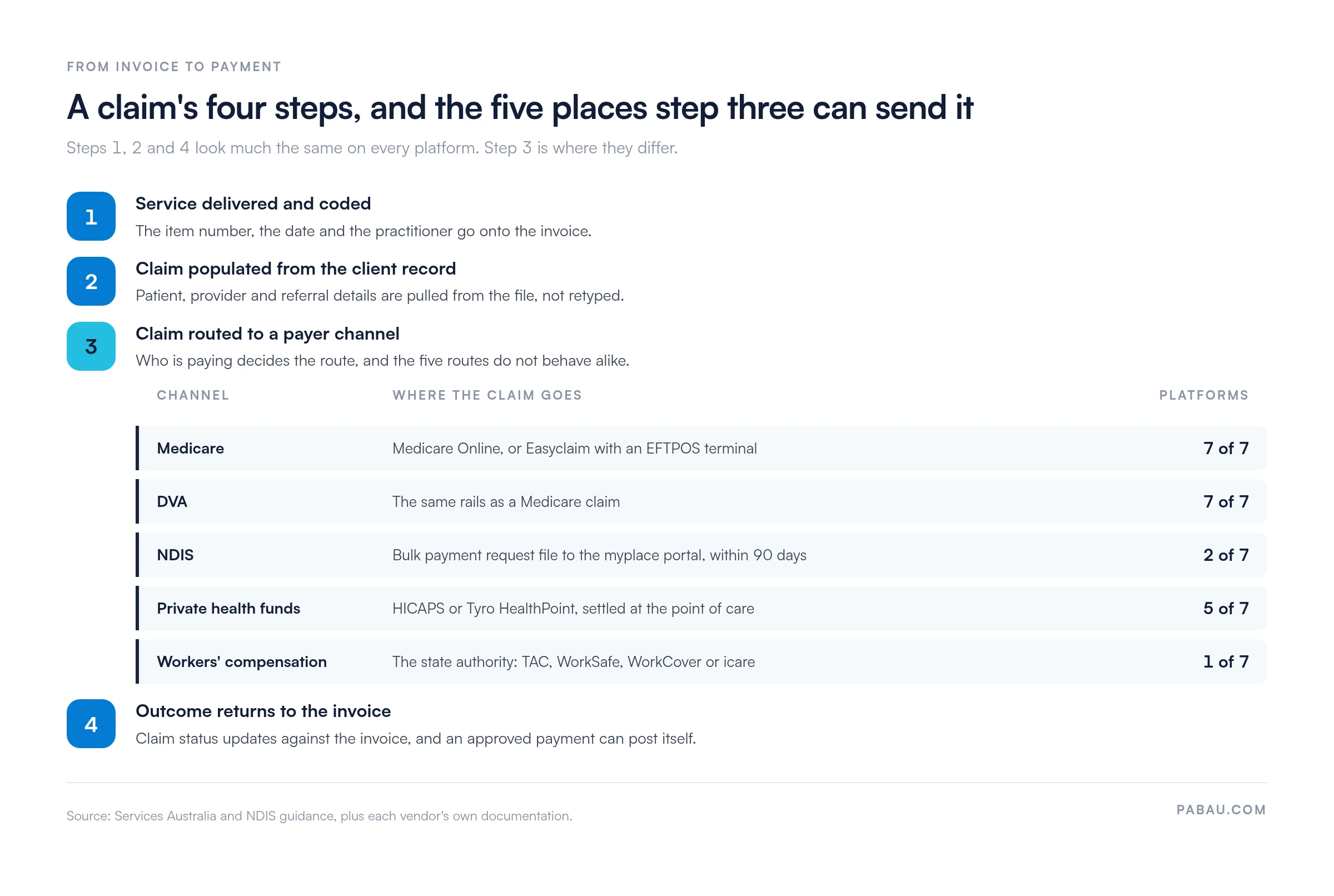
An Australian allied health practice deals with five payer channels, and each one behaves differently.
Two of those deserve a footnote. ECLIPSE handles Simplified Billing claims and patient claims for in-patient services. As a result, an out-of-hospital practice rarely touches it. Certified Medicare claiming is an accreditation rather than a setting. Services Australia registers the provider first, because no software can lodge on their behalf without that registration.
Services Australia registers online claiming against each allied health provider’s number rather than against the practice. A five-practitioner team therefore files five agreements, whichever platform it picks.
When we onboard an Australian practice, we collect every provider number first, because each practitioner’s claiming waits on their own registration. Therefore, budget time for that paperwork before you set a go-live date.
Claiming requests the rebate from Medicare, a health fund or the NDIA, while payment collects the patient’s share by terminal or online link.
Among the online payment platforms Australia’s allied health practices use, two recur across this list. Tyro Health handles the terminal at the counter, whereas Stripe handles payments online. Here is what each vendor’s own site names.
HICAPS shows up on the claiming side rather than the payment side, through Nookal’s HICAPS Digital Claims and Splose’s NDIS integration. If your front desk already runs a HICAPS terminal, ask the vendor how it pairs before you switch.
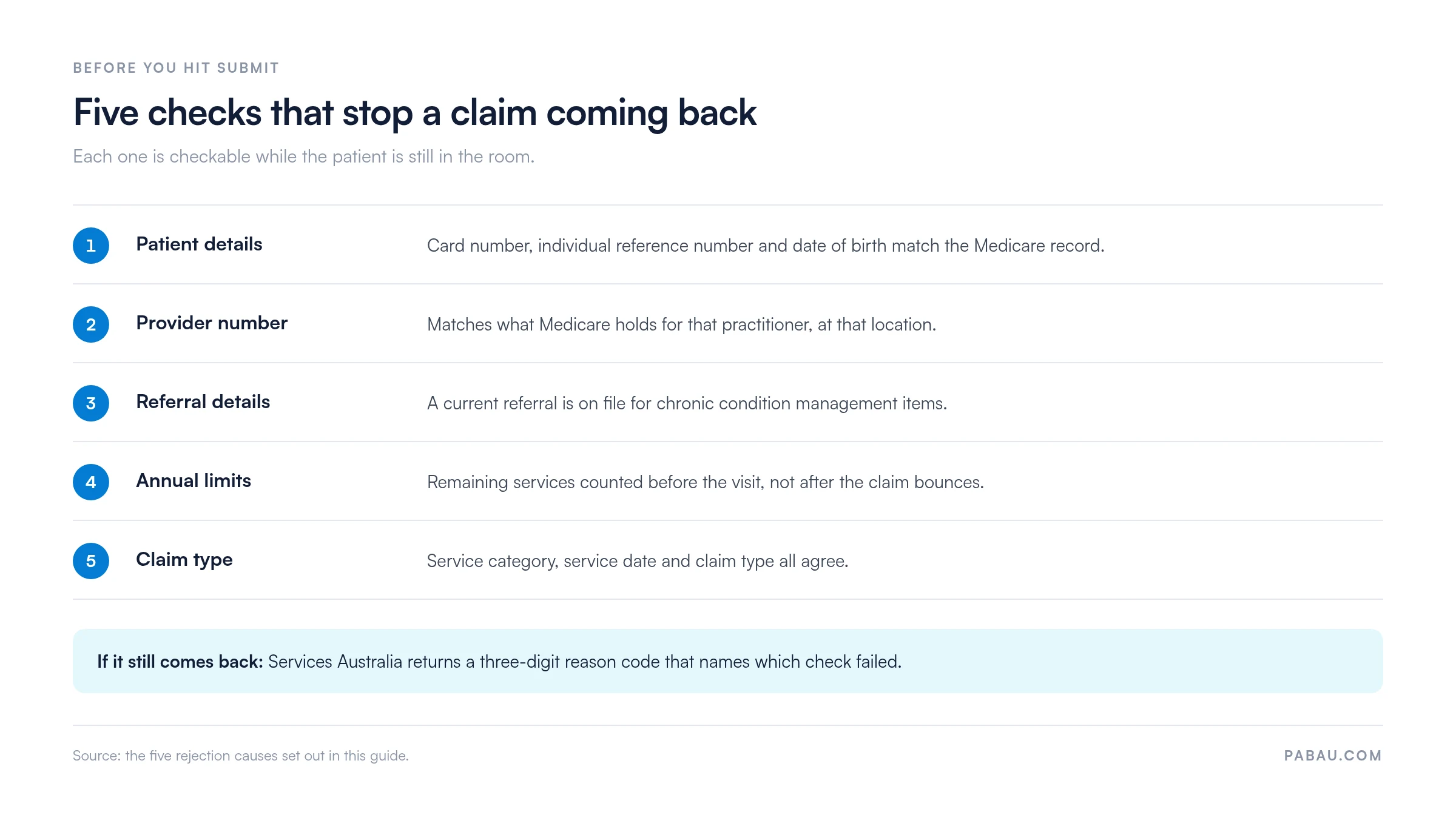
Most rejections trace to five causes, and each one is checkable before you hit submit. Services Australia returns a three-digit reason code that tells you which one you hit.
Fixing a rejection afterwards costs more than checking it upfront. A rejected claim lands back in someone’s afternoon, and the patient has already left. The card below turns those five causes into checks you can run before you submit.
Allied health bills Medicare chronic condition items, DVA, NDIS, health funds and workers’ compensation, a payer mix GP software is not built around. Allied health software centers on those payers instead.
GP systems such as Best Practice and MedicalDirector form a separate category. In contrast, the patient management software Australia’s general practices run centers on GP item numbers, prescribing and pathology.
So what is allied health in Australia? Healthdirect, the government-funded health information service, defines allied health professionals as healthcare workers who are not doctors, nurses or dentists.
Common allied health examples include physiotherapists, occupational therapists, speech pathologists, podiatrists, psychologists, dietitians, osteopaths and chiropractors. Some of those professions are regulated through Ahpra, whereas others self-regulate through a professional body.
The Australian Digital Health Agency treats practice management software as one shared category. Its subtitle covers general practice, allied health and private specialists. That framing helps procurement, but it misleads a practice building a shortlist.
Look at what the same category has to cover. A general medical program needs real-time prescription monitoring, an Active Script List connection and pathology informatics. An allied health practice needs none of that, and it needs NDIS plan tracking that no GP system carries.
The other split is the record itself. An allied health patient may see a physical therapist, an exercise physiologist and a dietitian under the same funded plan. Software for rehab practices keeps those episodes on one timeline instead of three charts.
Allied health care Australia-wide is funded through six payer streams, and each one sets its own limits and paperwork.
| Payer | Disciplines it funds | Limit or rule | What the software tracks |
|---|---|---|---|
| Medicare chronic condition management | Physiotherapy, podiatry, dietetics, exercise physiology and other eligible allied health | Five individual services a year, or 10 for Aboriginal and Torres Strait Islander patients, under a GP plan | The GP referral and the running service count |
| Medicare Better Access | Psychology, plus eligible occupational therapists and social workers | 10 individual and 10 group sessions a calendar year, under a mental health treatment plan | The treatment plan, the referral and the session count |
| DVA | Allied health for Veteran Gold Card holders, and for White Card holders’ accepted conditions | A D904 referral covers up to 12 sessions or one year, whichever ends first | Card type, referral expiry and sessions used |
| NDIS | Therapy supports such as occupational therapy, speech pathology, physiotherapy and psychology | Paid from the participant’s plan. Agency-managed supports need a registered provider | Plan dates, funding category and management type |
| Private health funds | Extras cover for disciplines such as physiotherapy, chiropractic, podiatry and psychology, depending on the policy | Annual limits and rebates set by each policy | Fund, member number and the on-the-spot rebate |
| State injury schemes | Treatment linked to an accepted workers’ compensation or transport accident claim | Approval rules set by each authority, such as WorkSafe Victoria, icare or the TAC | Claim number and the approved services |
Limits come from Services Australia’s MBS billing rules, the Better Access initiative and DVA’s allied health treatment cycle guide. A psychology practice tracks Better Access session counts, whereas an NDIS therapy team tracks plan dates and funding categories.
That is why discipline narrows the shortlist before price does.
No fully featured free allied health software exists in Australia, because every platform we checked charges a subscription once its free trial ends.
The published trials vary. Cliniko offers 30 days, and Splose similarly runs a free trial. Meanwhile, Zanda offers 14 days with a 12-month money-back guarantee. Coreplus instead offers an untimed trial with no credit card required.
A trial also tells you less than it seems about claiming. Medicare, DVA and HICAPS access needs provider registration and, in DVA’s case, a signed HW027 form. That paperwork outlasts most trial windows, so test the scheduling and notes during the trial and plan the claiming separately.
Pabau takes a different route and offers structured onboarding instead of a trial. A dedicated Client Coordinator migrates your records and configures the claiming. That is the part a self-serve trial leaves you to work out alone.
Most feature lists for patient management systems repeat the same eight items, and every platform here has all eight. Run the list below instead, because these questions separate them.
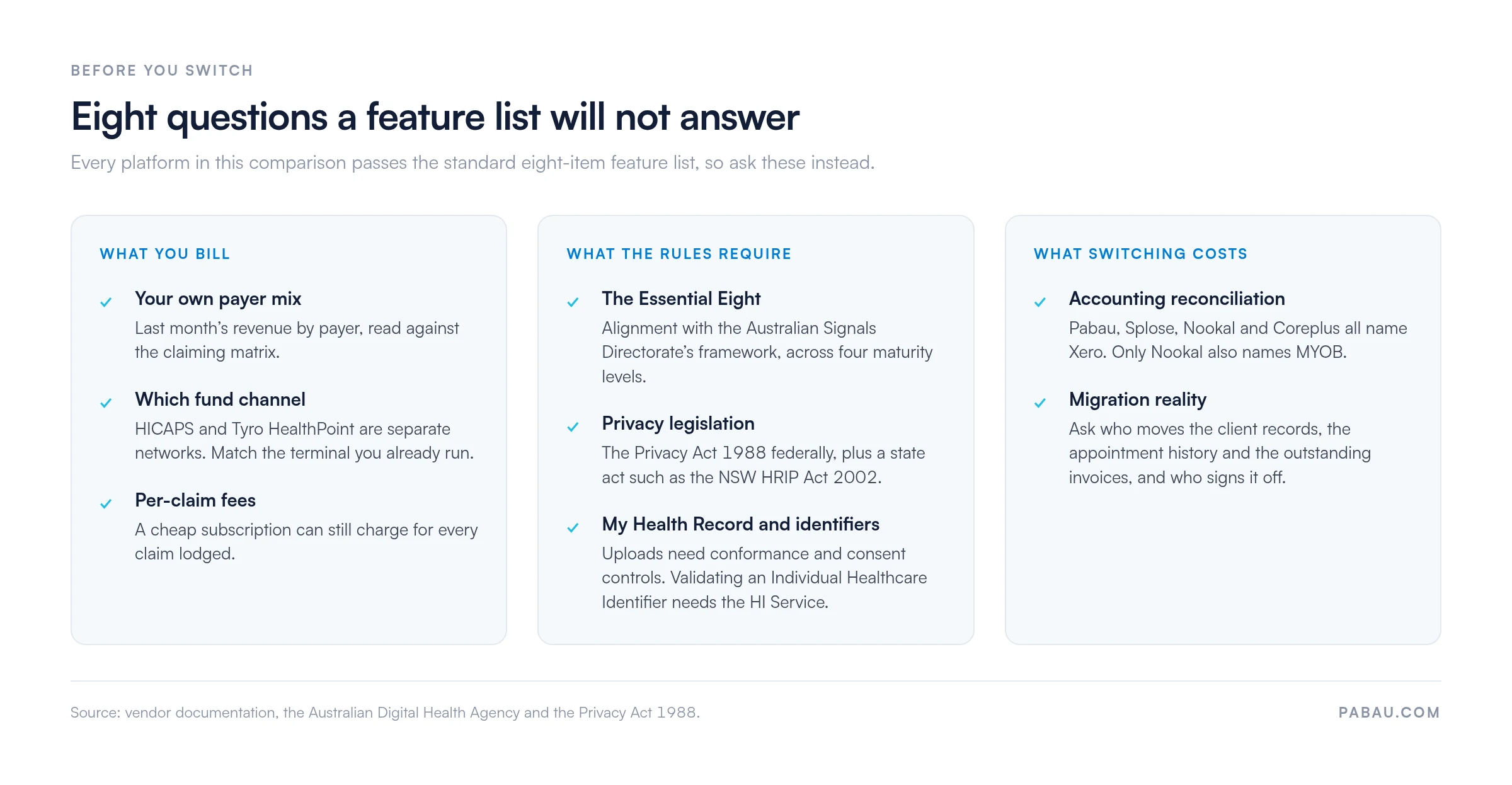
Two allied health requirements sit outside the standard feature list. The Agency points allied health systems at the Nutrition Care Process Terminology and the NAHCC Allied Health Minimum Data Set. Neither one appears on any vendor comparison page we read.
Plenty of Australian practices keep the diary in one tool and the claiming in another. Then, at the end of the day, someone reconciles the two by hand.
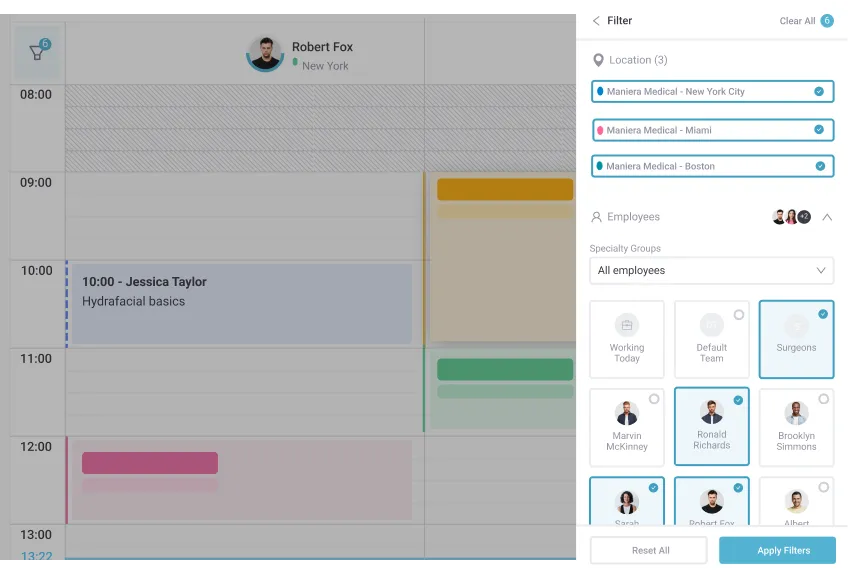
Pabau keeps the appointment, treatment note, photo and invoice on one patient record. A practitioner working across two sites sees one calendar, filtered by location or by practitioner. Consequently, front desk staff stop cross-checking three diaries.
On the claiming side, Pabau connects to Medicare, DVA and private health funds through Tyro Health for Australian practices. Claims submit digitally from the patient’s invoice, and every claim’s outcome tracks in the same dashboard as the appointment.
The outcome is fewer places to look when a claim stalls. Every Pabau subscription includes every feature. As a result, a solo podiatrist and a six-site physical therapy group get the same claiming, records and reporting.

Pabau connects to Medicare, DVA and private health funds through Tyro Health. An Australian allied health practice submits claims from the invoice it just raised. Every claim’s status tracks in the same dashboard as the appointment.

Pick the platform that matches your claiming mix, not the one with the longest feature list. For example, an NDIS-heavy occupational therapy practice belongs on Splose or Nookal. A solo practitioner billing Medicare and health funds can start on Zanda for AUD $29 a month.
If your revenue crosses three or more payers, coverage is worth paying for. Nookal is the only platform here that reaches the state injury schemes. Switching later also means redoing every claiming registration.
The trade-off worth remembering is breadth against depth. A platform that only claims Medicare and DVA can still be the right answer for a multi-specialty practice. Conversely, paying for a fifth payer channel you never bill is money out the door.
Book a demo to see how Pabau handles Medicare, DVA and private health fund claiming alongside multi-practitioner scheduling.

Comparing platforms for a rehab caseload? Best physical therapy practice management software ranks the options on documentation and scheduling depth.
Running a chiropractic practice? Chiropractic practice management software covers the workflows a high-volume adjustment schedule needs.
Osteopathy practice still on paper notes? Osteopathy practice management software explains what changes when treatment notes move onto one patient timeline.
Treating athletes alongside a general caseload? Sports medicine software compares the platforms built for return-to-play tracking.
Thinking about dropping payer contracts? Cash-based physical therapy sets out the economics before you change your billing model.
Five individual services per calendar year, under a GP chronic condition management plan. Aboriginal and Torres Strait Islander patients can claim 10. Up to eight group services sit on top of that. Your software should show the running count before you book the sixth visit.
Yes. Provider numbers are location and profession specific, so a practitioner working at two sites holds one for each. A two-site physiotherapist therefore carries two provider numbers and two claiming setups.
Only for agency-managed participants, whose supports must come from a registered provider. Plan-managed and self-managed participants can use an unregistered practice. That distinction decides whether the bulk payment request file matters to you, or whether you simply invoice the plan manager.
Seven years from the last service for an adult, and until a child turns 25. New South Wales, Victoria and the ACT set those minimums in legislation. Check how a platform exports and archives old records before you switch away from it.
Nookal suits most mixed payer mixes, because it is the only allied health software here that reaches all five Australian payer channels. An NDIS-heavy practice does better on Splose. A solo practitioner billing Medicare and health funds can start on Zanda from AUD $29 a month.
Australia’s national electronic health record is My Health Record, run by the Australian Digital Health Agency. Practices still keep full clinical notes in their own practice software. Conformant software can view and upload to My Health Record, and the Agency lists those products on its register of conformity.