Cytocare consent form
Cytocare is a hyaluronic acid-based mesotherapy skin booster from Revitacare, in...

1
Last Updated: Oct 27, 2026

Med spas need four coverage types at minimum: professional liability, general liability, cyber liability, and commercial property.
A standard salon or retail policy excludes professional services, so every clinical claim falls outside it.
Medical directors often need their own malpractice policy, depending on state law and how they are classified.
Occurrence policies cover an incident whenever the claim arrives. Claims-made policies cost less but need tail coverage when you switch carriers.
Timestamped consent forms and audit trails from software like Pabau give you the documentation an insurer and a defense attorney both ask for.
Med spas need four policies at minimum: professional liability, general liability, cyber liability, and commercial property. A salon or retail policy covers none of the clinical work, because it excludes professional services outright. Because data risk also sits in the software holding patient records, our guide to the best med spa software checks each platform for HIPAA compliance.
Below you will find what each policy does, what the premiums run, and who on your team has to be named. The exclusions that turn a claim into a denial come later, along with the documentation habits that keep your premium down.
Med spas sit at an unusual intersection. They are beauty businesses and medical facilities at the same time, so your insurance has to answer to both worlds.
A standard commercial policy protects a salon or a retail shop. It does not cover the medical risk a med spa carries. Laser hair removal, neurotoxin injections, dermal fillers, and IV therapy each create clinical liability that general business insurance leaves out.
The result is a layered coverage problem. Your compliance obligations cross from state business licensing into healthcare regulation, and your insurance has to reflect both. Most standard commercial policies exclude professional services, which means any claim arising from a clinical procedure is not covered.
No single policy covers all four. A properly structured med spa runs several policies together, each built for one category of risk.
Here is what each core policy protects against, and whether it is legally required or strongly recommended.
Professional liability and medical malpractice are related but not identical. Malpractice covers clinical acts by licensed medical professionals, such as a physician administering a neurotoxin injection. Professional liability is broader. It covers errors and omissions by any licensed or certified professional on your team, including estheticians performing chemical peels.
Most med spa insurers bundle the two into one policy. Confirm what yours covers procedure by procedure. If you offer IV therapy, weight loss injections, or laser treatments, check that each is named in the policy language. A high-risk carve-out can quietly remove them.
General liability covers non-clinical incidents on your premises. A client slips on a wet floor, a bag gets damaged, or someone brings an advertising injury claim. Most commercial leases require it, and it is often a condition of your state business license.
It does not touch clinical errors. That is exactly why it sits alongside a professional liability policy rather than replacing one.
Med spas hold protected health information, known as PHI, from the moment they store treatment records, intake forms, or before-and-after photos digitally. Under HIPAA, a breach triggers mandatory notification to affected patients. Larger breaches also require notification to the HHS Office for Civil Rights.
Notification and remediation can run into tens of thousands of dollars before anyone files a lawsuit. Cyber liability covers those notification costs, forensic investigation, credit monitoring, and regulatory defense.
Working out med spa HIPAA compliance comes first. Insuring the breach cost comes second. If you use cloud-based practice management software, ask your insurer whether your vendor’s security controls change your premium.
Coverage has to follow every person performing a clinical or quasi-clinical procedure, not only the medical director. Here is how it usually maps to each role.
The medical director is the most common source of an uninsured claim. In some states, a medical director working as an independent contractor is not covered by the entity’s malpractice policy. In others, an employed medical director is.
The answer turns on state law, the director’s classification, and the policy language itself. Get written confirmation from your insurer before you assume your medical director is covered. If you are still hiring a medical director, put the insurance structure in the offer conversation.
The structure you pick affects your coverage long after the policy term ends. It is the most misunderstood part of med spa insurance.
Occurrence policies cost more each year and remove the need for tail coverage. Claims-made policies carry a lower annual premium. But if you close the practice, switch carriers, or cut coverage, you have to buy an extended reporting period to cover late-filed claims.
The National Association of Insurance Commissioners publishes state-level malpractice claim data. It is a reasonable way to gauge realistic tail exposure for your procedure mix.
There is no single figure, because premiums move with too many variables. Industry estimates put the general ranges below. Treat them as a starting point for budgeting rather than a quote.
Plotted against each other, one policy clearly dominates the budget.
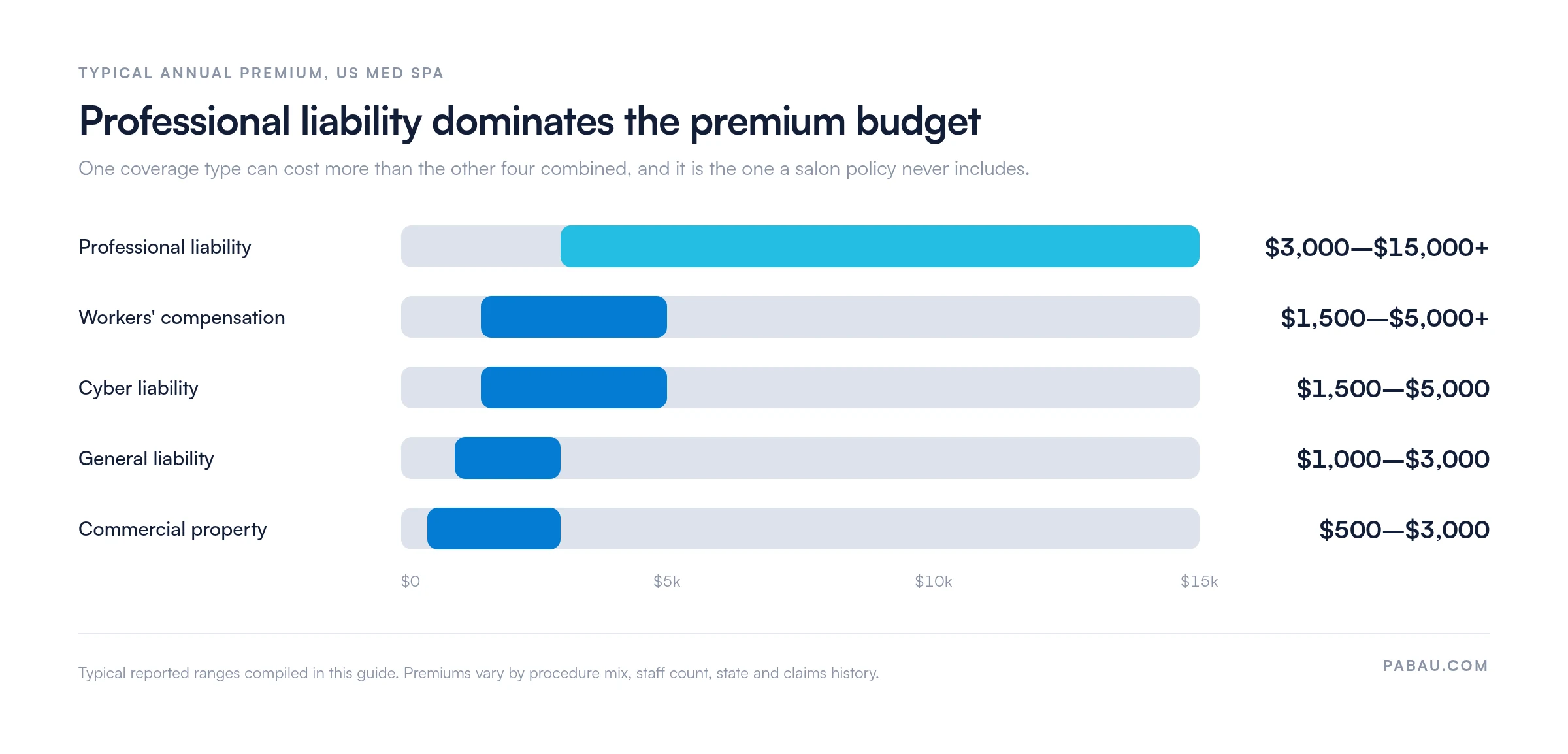
High-risk procedures push professional liability premiums up sharply. Underwriters flag lasers, injectables, and IV therapy as higher-risk categories, and the premium reflects that. Med spas with no prior claims and documented quality control usually get better rates.
Most exclusions only surface when a claim is denied. Work through this checklist against your current policy before you assume you are covered.
Med spa insurance is not one-size-fits-all across the country. State rules on ownership, clinical supervision, and which procedures need physician involvement all change the coverage structure you need.
In states with strict corporate practice of medicine laws, a physician or professional medical corporation has to own the entity. The insurance structure is then tied to physician ownership.
Where non-physician ownership is allowed, often through an MSO structure, the liability chain runs differently. Your policy has to match the arrangement you operate under.
The American Medical Association reports that 36 states lack regulatory oversight of med spas. Confirm the current ownership and supervision rules in your state with a healthcare attorney, not a broker. A broker can structure a policy. Only an attorney can tell you whether the entity underneath it is sound.
States with stricter healthcare privacy rules may ask for evidence of your data handling protocols at license renewal. Your cyber coverage should line up with what they ask for.
Not every broker understands the crossover between healthcare and aesthetics. A broker who sells retail or general healthcare policies may not know that IV therapy is sometimes excluded. They may also miss that lasers need a specific equipment endorsement.
The American Med Spa Association (AmSpa) lists member resources, including insurance partners who know the aesthetic medicine space. It is a practical place to start a shortlist.
Insurers price what they can verify. A practice that can produce a signed consent form, a timestamped treatment note, and a photo record presents one risk profile. A practice that cannot presents another.
Most med spas build that record by hand, which means it is only as complete as the busiest day allowed. Practice management software like Pabau captures it as a by-product of the appointment instead.
None of this replaces adequate coverage. But insurers and defense attorneys both point to documentation as the most effective way to cut clinical liability exposure. Pabau is built so that record accumulates during normal practice workflow, not in a separate admin session.
If you are still choosing the system that holds it, our guide to medical spa EMR software compares what each one records. You can also see how the documentation tools fit the rest of our medical spa software.

Pabau gives med spas digital consent forms, full audit trails, and HIPAA-supporting record storage. That is the documentation layer insurers and defense attorneys ask to see.

Buy the four core policies, then spend your time on the exclusions page rather than the premium. A cheap quote almost always means a narrow one, and the narrowness only shows up at claim time.
The trade-off worth remembering is occurrence versus claims-made. Paying more each year for occurrence coverage buys you out of the tail problem. That matters most if you ever plan to sell or close.
Whatever you buy, your documentation is the part you control. Book a demo to see how Pabau keeps consent forms, treatment notes, and audit trails ready before anyone asks for them.

Need to pin down your HIPAA obligations? Do med spas have to be HIPAA compliant? walks through the data protection duties that apply to aesthetic practices.
Hiring your first medical director? How to hire a medical director for your med spa covers the employment, supervision, and liability questions to settle first.
Structuring your ownership legally? MSO structures for med spas explains how management services organizations separate clinical and business operations.
Auditing compliance alongside your policy? Medical spa compliance checklist gives you the regulatory review to run next to your insurance audit.
Operating in California? California med spa licensing laws sets out the physician-ownership rules that shape how your entity is insured.
A med spa needs at minimum professional liability (malpractice) insurance, general liability insurance, and workers’ compensation. Cyber liability and commercial property coverage are strongly recommended for any spa storing digital patient records or using expensive laser equipment. Together, these four to six coverage types address the dual medical-and-business risk profile of a medical spa.
Professional liability premiums for med spas typically range from $3,000 to $15,000 or more per year. The figure moves with your procedure mix, staff count, location, claims history, and whether the policy is occurrence or claims-made. High-risk procedures like laser treatments and injectable therapy push premiums toward the higher end of that range.
Many insurers require a licensed medical director to be named on the policy before they will bind professional liability coverage for a med spa. State law may also require physician oversight as a condition of operating legally, which is a separate requirement from insurance. The two are related but distinct obligations.
Estheticians performing services at a med spa are often covered under the entity’s professional liability policy, but individual coverage is generally recommended. An esthetician classified as an independent contractor may not be covered under the spa’s entity policy at all. In that case they should carry their own.