Healthcare workforce planning: a practical guide for practice leaders
Healthcare workforce planning is the structured process of matching clinical cap...

Last Updated: Oct 13, 2026

Buying a medical practice hands you an established patient base, working staff, and revenue from week one. Due diligence is what tells you whether those numbers hold.
Valuation usually runs on EBITDA multiples, asset values, or market comparables, and goodwill is the line item buyers and sellers argue over hardest.
Most buyers choose an asset purchase, because it limits their exposure to liabilities the seller never disclosed.
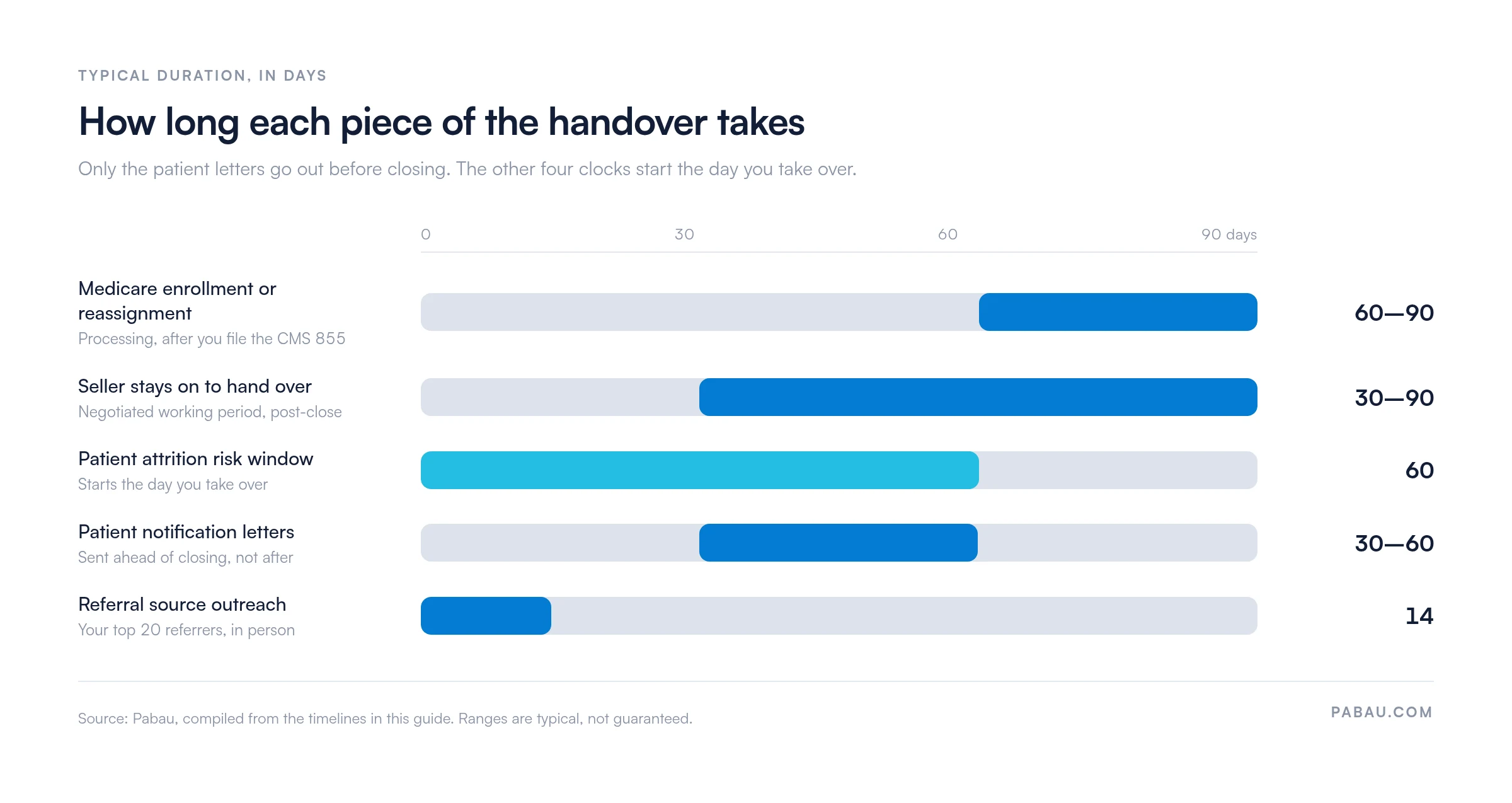
Medicare billing privileges do not travel with the practice, and processing a new enrollment takes 60 to 90 days.
The first 60 days after closing carry the highest risk of patient attrition, so the handover plan matters as much as the purchase agreement.
Buying a medical practice gives you an established patient panel, a trained team, and revenue from week one. It also gives you whatever the seller never wrote down. Price gets most of a buyer’s attention, but the handover decides how the deal turns out. Staff, patients, records, and billing all have to move without breaking.
Buyers who treat that as paperwork lose patients in the first 60 days, exactly when the loan payments begin. What follows is the purchase step by step, from sourcing a practice through your first quarter as the owner.
Buying wins on speed. Starting from scratch takes far longer than most physicians expect. Credentialing alone can run 90 to 180 days, and that is before your first insured patient.
An acquisition skips most of that runway. You inherit an active patient panel, contracted payers, a working team, and equipment already in the building.
Speed comes at a cost, though. You also inherit the seller’s problems. That can mean aging systems, staff already halfway out the door, or one insurer holding 60% of revenue. Weigh both sides before you go looking.
For most physicians, ownership arrives sooner through an acquisition than through a build. The trick is knowing exactly what you are buying before you sign, and that starts with finding the right practice.
Look through professional networks first, because the strongest opportunities rarely reach a public listing.
Specialty society contacts, hospital medical staff offices, and colleagues nearing retirement produce more usable leads than any search site. Structured sourcing still helps, so work these five channels in parallel.
Whichever channel you work, set your filters before the first call. Decide on geography, specialty, target size by revenue or patient volume, and the clinical criteria you will not bend on.
Sellers take a prepared buyer more seriously, and you waste less of your own time on practices that were never going to fit.
Three methods do almost all the work: earnings, assets, and market comparables. Valuation is a negotiation anchored by whichever method you both accept, which is why buyers and sellers so rarely open at the same figure. Each method suits a different kind of practice.
The arithmetic is simple once you agree on inputs. Say a two-physician family medicine practice adjusts out to $310,000 of EBITDA. At a 2x multiple, the earnings-based figure lands near $620,000, before anyone argues about equipment or receivables.
Move the multiple to 3x and the same practice is worth $930,000, which is why the multiple gets fought over harder than the earnings do. An independent medical practice valuation is what keeps that argument grounded.
Goodwill splits into two kinds, and only one of them is yours after closing. Personal goodwill follows the departing physician’s reputation and relationships. Enterprise goodwill sits with the brand, the systems, and the location.
Personal goodwill is worth less to you, because it can walk out the door with the seller. States also treat the split differently for tax purposes, so the allocation changes what each side takes home. Work through it with a healthcare-focused CPA before you accept any goodwill number.
An asset purchase limits what you take on. You buy named assets, such as equipment, patient charts, the trade name, and specific contracts. Only the liabilities you agreed to in writing come with them.
A stock purchase works differently. You buy the legal entity itself, so every liability comes with it, including the ones nobody has discovered yet. That asymmetry explains why asset deals dominate medical transactions.
Sellers usually push the other way, since a stock sale often gets better capital gains treatment. Your tax position and the deal specifics decide the outcome, so bring in a healthcare attorney early.
Diligence exists to test whether the seller’s numbers survive a change of owner. Deals fall apart here, or they get repriced. Buyers who read only the income statement miss the operational detail that decides whether those numbers hold once the selling physician leaves.
Payer concentration deserves more attention than it usually gets. A practice pulling 70% of revenue from one commercial payer faces renegotiation risk the moment ownership changes.
That contract may not survive reassignment at all. Confirm transferability with each payer before closing, in writing.
Malpractice coverage needs one specific check. Find out whether the seller’s policy is occurrence-based or claims-made.
A claims-made policy stops covering claims filed after it lapses, so someone has to buy tail coverage. Settle who pays for it while you still have leverage, and budget for it either way.
Run an accounts receivable aging report and calculate the share over 90 days before you make any offer. If more than 15% of AR sits past 90 days, either negotiate the price down or write a write-down adjustment into the purchase agreement. Aged AR rarely collects at full face value under a new owner.
Most acquisitions need outside money, and four routes cover almost every deal. Which one fits depends on practice size, your personal credit, and whether the seller will carry part of the price.
Whichever route you take, pair it with a medical practice business plan that projects cash flow 24 to 36 months past closing.
Lenders want to see how the practice performs once the selling physician is gone, not how it performed under them. Build the compliance timeline into those projections too, because several of those clocks start the day you close.
Three compliance areas need action at or before closing. The statutes behind them carry criminal penalties and exclusion from Medicare and Medicaid. Put them at the top of your closing checklist, not the bottom.
When ownership changes hands, HIPAA requirements govern how the records move. Patients have to be told about the change, and protected health information can only transfer in ways the original notice of privacy practices allows.
Put that notification into your transition schedule early, since the letters go out well before closing day.
The Stark Law (42 U.S.C. § 1395nn) bars physician self-referral to entities they hold a financial relationship with, subject to limited exceptions. The Anti-Kickback Statute (AKS) bars offering or accepting anything of value to induce referrals for federally reimbursed services.
Both reach directly into how you structure the purchase. Earnouts, price adjustments tied to referral volume, and ongoing management fees all invite scrutiny.
Start with the OIG’s physician compliance guidance to understand what is permissible, then have counsel review the terms.
In an asset purchase, Medicare billing privileges stay behind. You file the relevant CMS Form 855 to enroll or reassign, per CMS Medicare enrollment guidance.
Processing times vary, so plan on 60 to 90 days at minimum. Billing Medicare before enrollment completes creates false claims exposure, which makes a billing continuity plan part of the pre-closing work.
DEA registration works the same way. It does not transfer with a practice sale, so the buying physician applies for a new registration.
Factor that into the credentialing schedule, especially in pain management, psychiatry, and primary care.
Patients leave when they feel unsure about their care, and staff leave when they feel unsure about their jobs.
Both happen fastest in the 60 days after closing, which makes this the period a transition plan is written for. Most of the work also runs on clocks you cannot compress, as the timings below show.
Choosing and migrating the practice management system belongs on the pre-closing list, next to the legal work. Acquired practices tend to run on aging software with years of workarounds baked in.
Those workarounds live in your staff’s heads, not in any manual. The change of ownership is the cleanest moment you will ever get to replace it.
Move scheduling, records, billing, communications, and consent forms onto a single practice management app before day one. Your team then learns one system, rather than learning it while reassuring nervous patients.
Plan the EHR integration around the same window, so patient history and billing data land together rather than in two separate migrations.
Systems are the easier half. Patients and staff need to hear from you directly, and the sequence matters more than the wording.
Get through that list and the acquisition has given you what you paid for: a working practice with its patients still attached. Year one is then a growth question rather than a rescue.
Experienced buyers still repeat the same six errors. Each one is cheap to avoid and expensive to discover late.
Most practices you buy are running on software the seller picked years ago. The staff know its quirks and its workarounds, and you do not.
That is a slow, expensive way to learn a business you have just paid for. It also eats the weeks you should be spending with patients.
Practice management software like Pabau moves the whole record into one place before you open the doors. Our onboarding team handles the data migration, so patient records, appointment history, and inventory arrive intact.
You also get the Pabau Portal, which documents each setup step, plus a dedicated Client Coordinator who works through it with you.
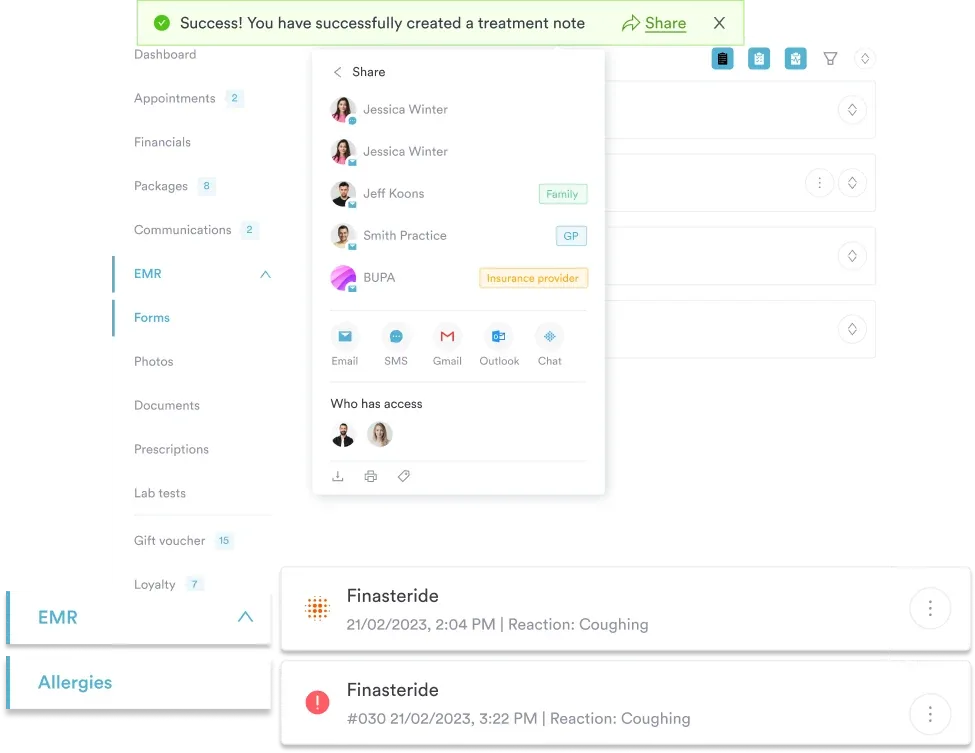
Once the data lands, setup covers booking rules, digital intake forms, patient communications, and payment flows. Do that before closing and your team spends the first month treating patients instead of guessing at software.
Reminders keep going out, and forms reach patients ahead of the visit. Your front desk can see who is booked, who has paid, and who still owes a form.

Pabau’s onboarding team migrates patient records, appointment history, and inventory from the seller’s system. We configure booking rules, intake forms, and payment flows before you take over.

A good attorney will catch most of what you miss in the purchase agreement. Nobody plays that role for the handover, so it falls to you. Line up the payer confirmations, the enrollment filings, the staff conversations, and the system migration before you sign.
Skip that work and the practice you bought slowly becomes a different one. Patients drift to whoever answers the phone faster, and the revenue you paid a multiple for goes with them.
Settle the operational side early and the first quarter turns into ordinary practice management, which is exactly what you wanted when you started looking. Book a demo to see how Pabau moves records, forms, and billing onto one system before your first day as owner.

Still deciding how to structure ownership? Group practice vs private practice weighs the income, autonomy and risk trade-offs before you commit to a model.
Planning how the practice will run once it is yours? Medical practice operations covers the day-to-day systems that keep a schedule full and a team on time.
Need a framework for the first year of ownership? Practice management essentials sets out the operational foundations every new owner needs in place early.
Ready to build on the patient base you inherited? How to grow a medical practice shows how established practices add referrals and new patient volume.
There is no fixed timeline, and the parts you control are rarely the ones that set it. Sourcing and negotiation can run for months. After closing, Medicare enrollment or reassignment still needs 60 to 90 days to process, so the practical handover extends well past the signing date.
It depends on the state. Many states apply the corporate practice of medicine doctrine, which bars non-physicians and general corporations from owning a practice or employing physicians. Investors in those states usually work through a management services organization that handles the business side while a licensed physician owns the clinical entity.
Less than most buyers assume. Price, structure and timing are usually non-binding, so either side can still walk. The confidentiality, exclusivity and expense clauses normally are binding, which means you may be locked out of other deals for the exclusivity period. Read those three clauses closely before signing.
Your individual NPI stays with you for life, so that one never changes. The practice itself is different. If you form a new legal entity in an asset purchase, that entity needs its own organizational NPI before it can bill. Apply through NPPES early, because enrollment depends on it.