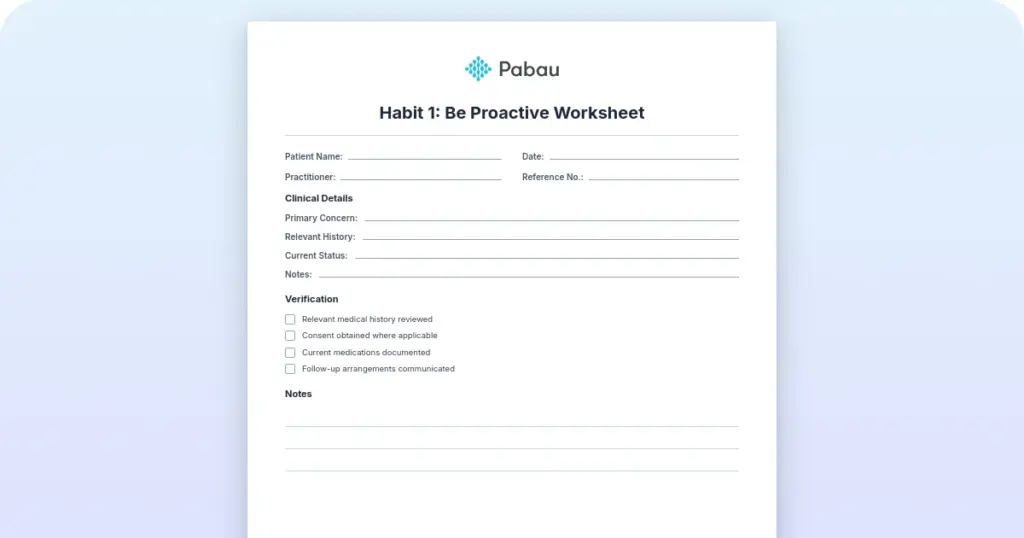
All about me worksheet for adults
An all about me worksheet for adults is a guided self-reflection form that maps ...

5
Last Updated: Oct 14, 2026

The wheel of health is a whole-person assessment tool from Duke Integrative Medicine, built around one center and seven self-care areas.
Prevention and screening are not one of the seven. They sit in the outer professional care ring, which you and your clinician handle together.
Clients score each self-care area from 1 to 10, then join the marks to see which spoke is short.
An uneven wheel points to a trade-off rather than a failure, so pick one or two low areas to work on.
Practice management software like Pabau stores each score in the client record, so you can compare this wheel with the last one.
A printable wheel with the seven self-care areas marked out and a 1 to 10 scale on every spoke. There is space to record the professional care already in place, plus the two areas the client will work on next.
Download templateThe wheel of health is a visual self-assessment from Duke Integrative Medicine. You score seven areas of self-care from 1 to 10, then join the marks to see how balanced your health is. Around those seven sits a ring of professional care, covering prevention and treatment with your clinician.
Copies of the template floating around online often show eight slices, with prevention and screening as the eighth. Duke’s model does not work that way. Prevention belongs to the outer ring, because you and your clinician decide it together.
Health coaches, integrative and functional medicine clinicians, and therapists use it at a first appointment and again a few months later.
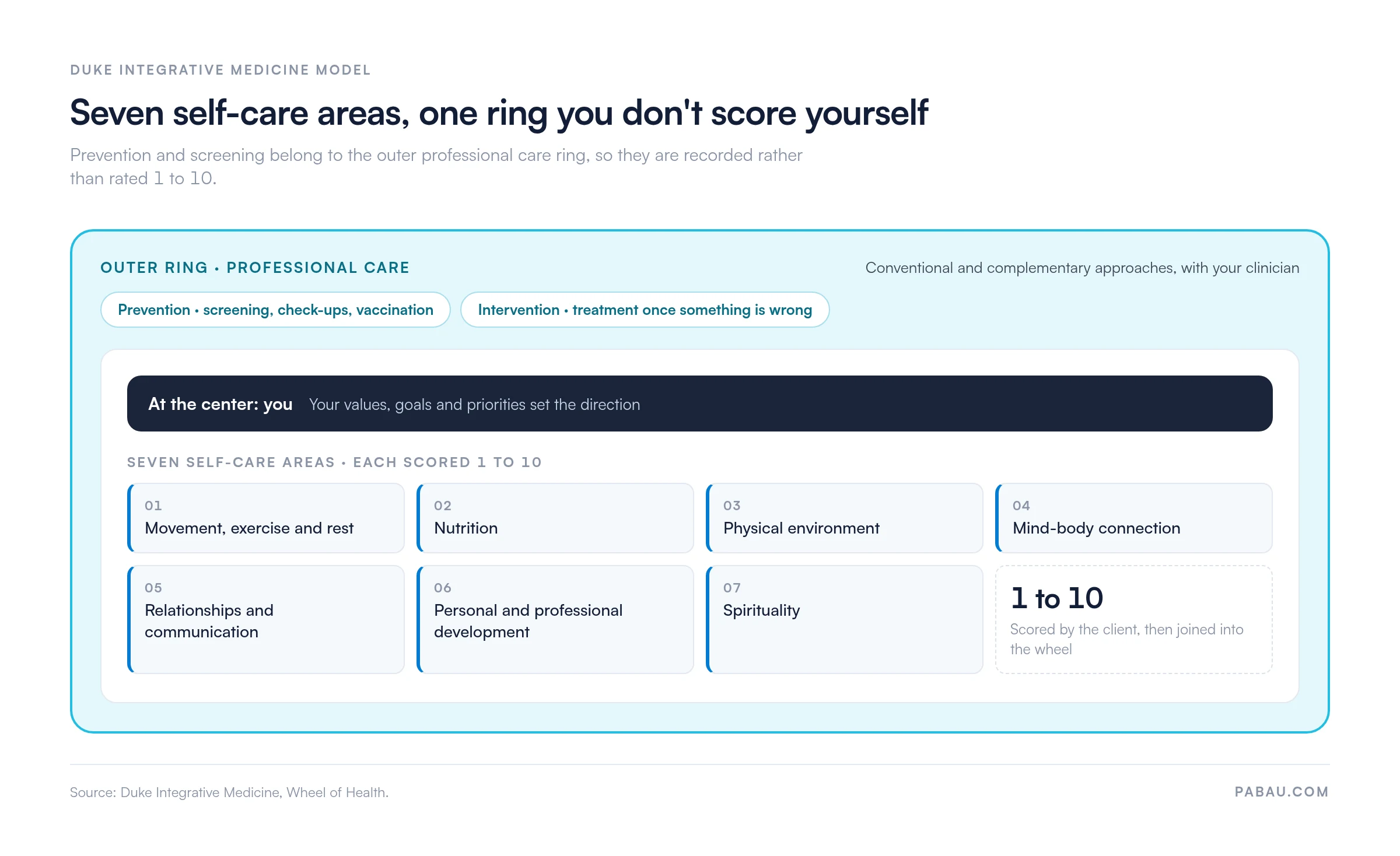
Seven self-care areas, each scored by the client, sitting inside one ring of professional care. Duke puts you at the center, because your values and goals set the direction for all seven.
The ring around the seven areas is professional care, and it has two halves. Prevention covers screenings, vaccinations, and check-ups. Intervention covers the treatment you get once something is wrong. Duke draws both conventional medicine and complementary therapies inside that ring.
Clients do not self-score the ring, because access, coverage, and clinical judgment are not theirs alone to rate. Record what is already in place instead: the last screening, current prescriptions, and the practitioners the client sees. The three layers stack up like this.
Scoring takes five to ten minutes. Work through it with a client, or hand them the sheet to fill in before the session.
Read the shape, not the total. A wheel with one short spoke rolls badly, however high the other six scores are.
Balanced wheel: Most scores land between 6 and 8. That is stability with room to improve, and it calls for no dramatic change.
Uneven wheel: A 9 in movement next to a 3 in relationships shows a trade-off. One area has been getting the attention, and another has been paying for it.
Low across the board: If most scores sit below 5, look at stress and workload first. Start with the single area the client controls most directly.
Thin professional care ring: If there has been no check-up or screening in years, that booking is the first action, whatever the seven scores say.
Nobody scores 10 across the board, and chasing it wastes the exercise. The useful reading is which trade-offs the client is making on purpose.
Mostly at a first appointment, as a way to open the conversation past the presenting problem.
Practitioners who send the wheel out through patient intake software get the scores back before the appointment starts. Health coaches running a full caseload usually keep the results in a coaching client management system, next to their session notes.
Pick the two lowest areas the client can influence, then write one specific goal for each. Scoring is the easy half. The wheel only pays off when a low number turns into something the client does next week.
The SMART framework keeps those goals honest:
A goal like “improve my relationships” is too vague to act on. A workable version names the call, its length, the day of the week, and the date you rescore. If a client freezes at this point, a set of goal setting worksheets gives them a structure to fill in.
Two areas at a time is the ceiling. Working on all seven at once is how the exercise gets abandoned by week three.
On paper, the wheel works once. It gets scored, discussed, and filed in a drawer, and the next one is scored from scratch. Comparing the two means digging out the first sheet.
Practice management software like Pabau turns it into a form that lives in the client record. You build the seven areas as scored fields, send the form before the appointment, and the scores arrive already attached to the client. Every later wheel then stacks up against the first one.
For a coaching or therapy practice, that record is the point of running the assessment at all. A therapy practice management system keeps the scores, the notes, and the goals on one client timeline.
Pabau’s medical records management also holds the completed template itself, so you can show what the client saw and when.
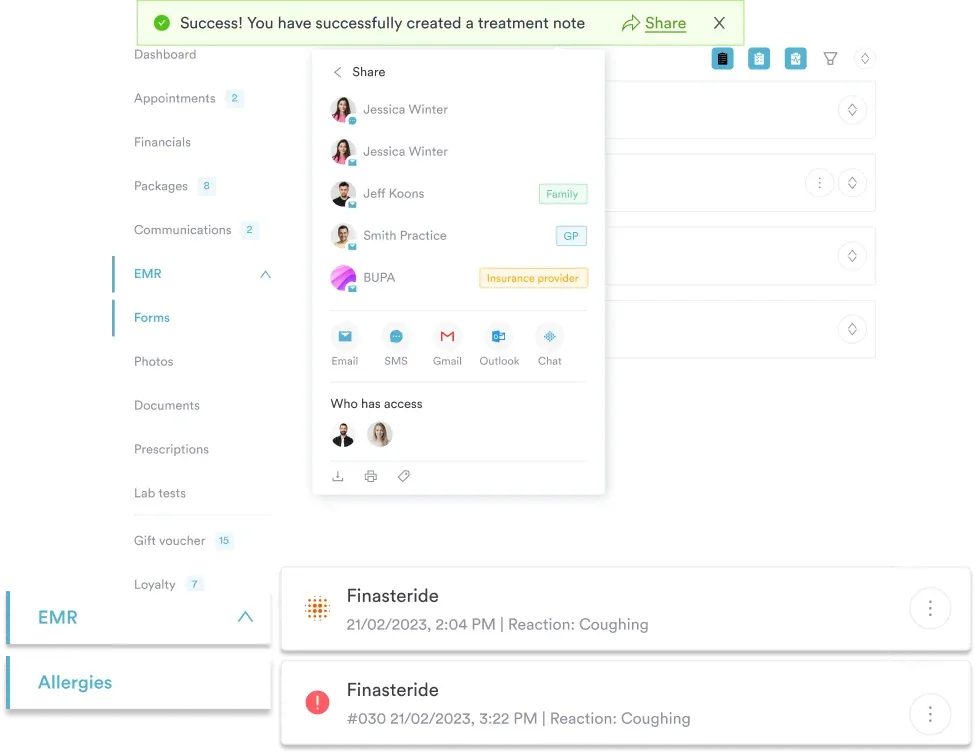

Pabau turns the assessment into a digital form inside the client record. Book a demo to see how the scores, notes, and goals sit together.

The wheel earns its place because it makes a trade-off visible in about ten minutes. A client who has been insisting that work is fine can see the short spoke for themselves.
Get the structure right and it keeps that value. The client scores seven areas, leaves the professional care ring to a clinician, and books a date to score it again.
The second wheel is where the work shows. Book a demo to see how Pabau stores each score in the client record and puts the two wheels side by side.

Looking for the eight-dimension model? 8 dimensions of wellness worksheet covers the framework the wheel of health is most often confused with.
Need a shorter self-care check? Self-care inventory gives clients a habit-level score between full wheel assessments.
Building your intake pack? Coaching intake form collects history, goals, and consent before the first session.
Clients dropping out mid-program? How to structure coaching programs that clients actually finish walks through pacing and check-in points.
Tracking sessions on paper? Coaching log keeps dates, focus areas, and agreed actions in one place.
The wheel of health is a visual self-assessment from Duke Integrative Medicine. You score seven self-care areas from 1 to 10, then join the marks. Those seven are movement and rest, nutrition, physical environment, mind-body connection, relationships, development, and spirituality. A professional care ring sits around them.
Duke puts prevention and screening in the outer professional care ring, not among the self-scored areas. A screening depends on your clinician and your coverage, so a 1 to 10 score would mix your habits with decisions you do not control.
Rate each of the seven areas from 1 to 10, mark the score on its spoke, then join the marks. Record your professional care separately.
Yes. The template is free to download, print, and fill in by hand. You can also rebuild it as a digital form inside your practice software.
Yes. Health coaches, physicians, therapists, and wellness practitioners all use it at intake and at review appointments. It works for personal use too.
Both are assessment wheels. The wheel of life covers broad life domains such as career and money. The wheel of health stays on health, and it names a professional care ring that the wheel of life has no equivalent for.
Every three to six months. That is long enough for a habit change to show up in a score, and short enough that the client still remembers the first wheel.