Mental health self-care checklist
A mental health self-care checklist is a structured daily tool for tracking the ...

6
Last Updated: Oct 20, 2026

The Wheel of Awareness is a mindfulness practice developed by Dr. Dan Siegel, grounded in interpersonal neurobiology.
The wheel has three parts: the hub (open awareness), the rim (all knowns, from senses to relationships), and spokes (attention moving between them).
Therapists use the Wheel to help clients build emotional regulation, self-awareness, and mental integration.
The free download is a one-page fillable worksheet: name and date fields, the four rim segments, brief usage guidance, and a notes box.
Pabau’s digital forms and client portal let therapists attach the completed worksheet to session notes and document outcomes over time.
A one-page fillable worksheet with name and date fields, a short introduction, the four segments of the rim, and brief usage guidance. It closes with an open notes box for recording what the client observed.
Download templateThe Wheel of Awareness is a guided mindfulness practice that gives clients four named places to look, in a fixed order. UCLA psychiatrist Dr. Dan Siegel built it around a simple shape. A hub of open awareness sits at the center, a rim holds all you can notice, and a spoke of attention moves between them.
Most clients feel distress long before they can name it. Ask how they feel and you get “fine” or “stressed”. The wheel answers that with a route, so the exercise runs the same way in every session.
Below you’ll find the model, a five-step way to run it, the snags worth planning for, and what sits on the free worksheet.
The Wheel of Awareness is a guided practice that walks a client’s attention through four domains of experience. Those domains are the outside senses, the body’s interior, mental activity, and the sense of connection to others.
Dr. Dan Siegel developed it as part of interpersonal neurobiology (IPNB), his framework linking brain science, psychology, and contemplative practice.
Structure is what separates the wheel from a general meditation. Instead of clearing the mind, clients move attention like the spoke of a wheel. They start at a hub of open awareness, then sweep the rim’s four segments in order. The metaphor is concrete, so the same practice runs the same way next week.
Naming the four domains gives a client words for states they could previously only describe as bad. The words come first. Then comes the ability to catch a feeling early enough to act on it.
The wheel has three parts, and each one gives you something different to work with in session. The diagram below is the version worth sketching, since the worksheet leaves the drawing to you.
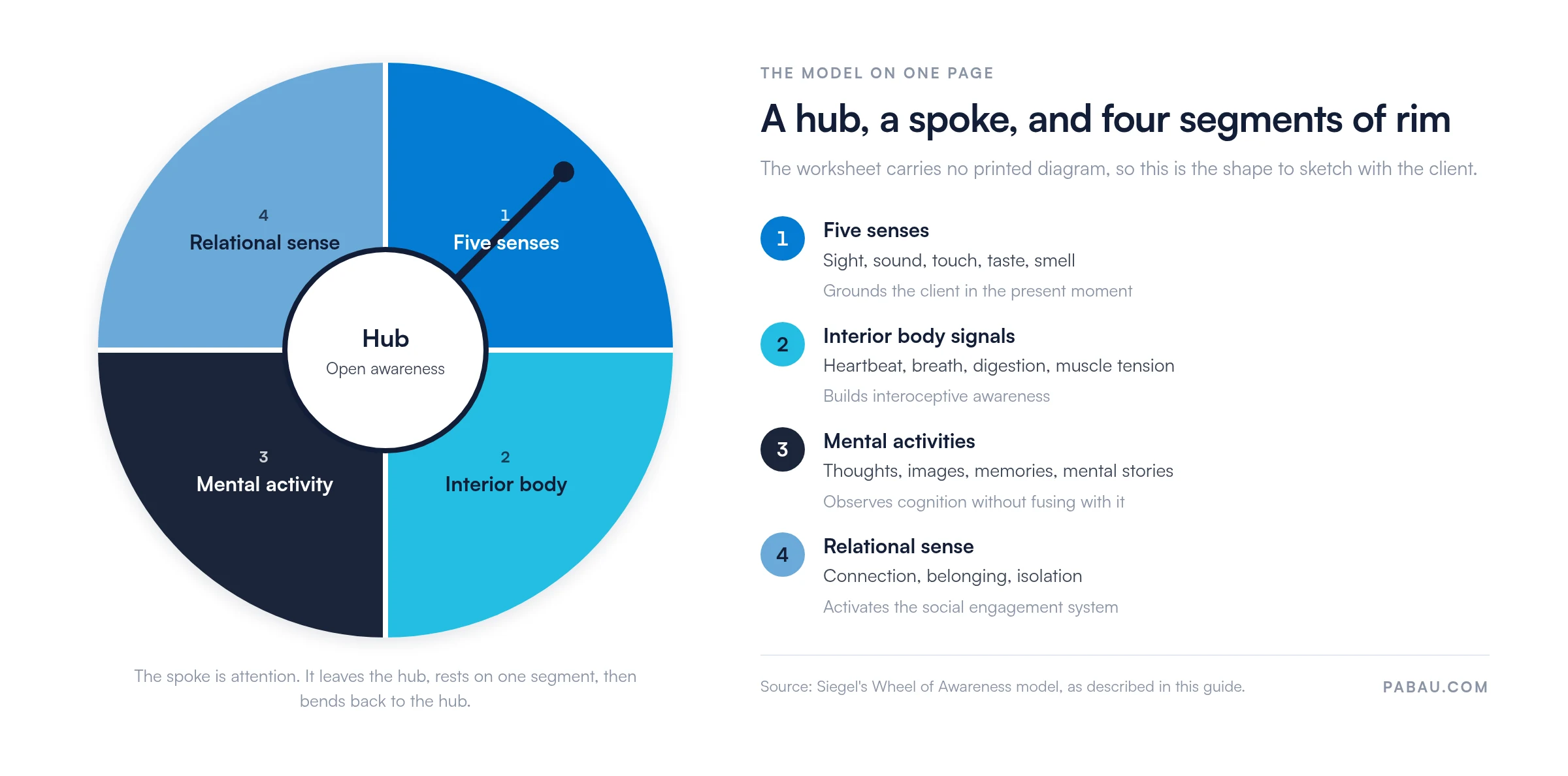
Each segment targets a different awareness domain. Clients sweep all four in the order shown above, one at a time:
Every sweep works attention through the prefrontal cortex and body awareness through the insular cortex. The circuits linking those regions strengthen with practice, so clients catch emotional signals earlier.
Interpersonal neurobiology supplies the reasoning here. Its core claim is that the brain grows through connection, and that integrating separate neural networks underpins mental health.
Siegel argues that mindfulness reshapes brain structure, strengthening the prefrontal regions tied to emotional regulation and self-awareness.
That mechanism also explains the fit with anxiety, trauma, and mood disorders. All three involve dysregulation of the same systems the practice trains.
Most of what goes wrong in a first sweep is preventable. Work through this list before you introduce the practice to a client:
The worksheet condenses this arc into four short prompts. Your job as facilitator is pacing. Guide the sequence, keep your voice steady, and treat tension or discomfort as information rather than a problem to fix.
A full practice takes 20 to 30 minutes. Short on time? Run one or two segments instead, or stretch to 45 minutes when a segment opens something up.
Four snags account for most of the frustration therapists report with the practice:
The wheel travels well across modalities. Therapists in psychiatry and psychology practices use it with very different presentations, and the emphasis shifts each time:
A client who cannot name a feeling at all may need a simpler starting point. A mental health check-in covers mood, sleep, and stress on paper, which gives you something to build the sweep on later.
Clinical safety note: the Wheel of Awareness is generally safe and well tolerated by clients in therapy. Where readiness is in doubt, do the stabilization work first and come back to it.
The download is a single fillable page, built for the client to follow while you facilitate. Here is what sits on it, top to bottom:
The page carries no printed wheel diagram. Sketch the circle with the client instead, or draw it on a whiteboard as you work through the segments. Many clients remember the shape better for having drawn it themselves.
Because the notes box is deliberately open, you decide what it captures. Ask the client to name the segment that felt most vivid and the one that felt blank. Those two answers give you a starting point for next week.
Print it for paper-based sessions, share it through your client portal, or send it ahead as pre-session reading. Pair it with the five-step sequence above when you want the fuller facilitation detail.
Three features of the wheel format do the clinical work:
Practice management software like Pabau keeps the worksheet and the session record in one place. With digital forms, you can send the sheet before the appointment and capture the client’s answers straight into their file. That holds whether you work alone or in a multi-clinician mental health practice.

Across a course of sessions, that record shows which segments the client finds easiest and which stay hard. You can also watch for the markers that matter, such as longer stretches at the hub or more tolerance for the relational segment. Each one feeds your treatment planning and shows the client evidence of change.
Pabau Scribe, our AI scribe, drafts the session note from the conversation. The summary of the practice lands in the client’s record without you transcribing it by hand. Documentation stays thorough, and more of the hour stays with the client.

Attach worksheets to client records, document practice frequency, and track emotional regulation outcomes in one secure clinical platform.

The Wheel of Awareness earns its place by turning a vague instruction into a route the client can follow. Asking someone to notice what they are experiencing becomes four named places to look, taken in order. Start with one or two segments rather than the full sweep, and let the client set the pace.
The trade-off worth remembering is that structure does not guarantee safety. Assess readiness before you begin, and keep the client in charge of which segments they visit and for how long.
Whatever pace you set, the practice compounds only when you record it. Book a demo to see how Pabau attaches the worksheet to each session note and keeps a client’s awareness work in one running record.

Want a strengths-based exercise for the same client? Positive psychology worksheet gives you a structured way to build on what the sweep surfaces.
Need to check readiness before you start? SCID assessment walks through the structured diagnostic interview clinicians use to screen new clients.
Writing the session up afterwards? PIE note shows how to record the problem, the intervention, and the evaluation in a few lines.
Turning the practice into a routine between sessions? Personal wellness plan helps clients build daily habits around what they noticed.
Short daily practice beats one long weekly sitting for most clients. Two or three times a week still builds the skill. Set a brief version as homework, then run the full sweep together in session.
Yes. Siegel’s website publishes free recordings, including a 20-minute basic version, a 30-minute full version, and a seven-minute short one. The short recording suits clients practicing between appointments.
A body scan stays inside the body. The wheel covers that ground in one segment, then adds the outside senses, mental activity, and relational connection. Clients who already do body scans usually find the last two segments unfamiliar.
Yes, with shorter segments and plainer wording. Thirty to sixty seconds per segment holds attention better, and plain language about what the body is doing lands better than clinical terms. Keep the order the same every time.
No certification is required to run the practice with clients. It comes from Siegel’s book Aware, and deeper interpersonal neurobiology training exists for clinicians who want it. Running the sweep on yourself matters more than any credential.