Medication tracker template: Free PDF for clinicians and caregivers
A medication tracker is a form that records each medication a patient takes, whe...

2
Last Updated: Oct 12, 2026

A vaccination declination form records a patient’s informed refusal of a vaccine you offered. It protects the patient’s autonomy and your documentation at the same time.
The required fields are patient name, vaccine name, date, reason for refusal, and signatures from both the patient and the provider.
OSHA requires hepatitis B declination records for workers exposed to bloodborne pathogens, under 29 CFR 1910.1030.
Accreditation standards require hospitals to run an annual influenza vaccination program and track each worker’s vaccination or declination status.
Digital forms in practice management software like Pabau send the signed declination straight to the patient’s chart, then flag the next visit for a re-offer.
A ready-to-use form covering patient identification, the vaccine offered, and a reason-for-refusal checkbox. It also carries a counseling confirmation line and signature blocks for the patient and the provider.
Download templateA vaccination declination form is the record you keep when a patient or a staff member refuses a vaccine you offered. It names the vaccine, the date, the reason for the refusal, and the people who signed.
What the form has to contain depends on which vaccine you offered. One version is a federal obligation and one comes from accreditation standards. A third depends on your state, and the rest are simply a patient’s choice at a single visit.
A vaccination declination form is a medical record documenting a patient’s informed refusal of a recommended vaccine. It captures one decision on one date. The patient understands the benefits and risks, has had a chance to ask questions, and declines anyway.
A vaccine exemption form is a different document. An exemption is a permanent exclusion granted under state law, while a declination records a single refusal you can revisit at the next appointment.
The form does three jobs. It demonstrates informed consent, because the patient chose deliberately and with full knowledge. It protects the provider if the patient later develops a disease the vaccine might have prevented. It also creates a continuity record, so the next clinician knows to follow up.
Completing the form correctly is what makes it hold up under a clinical audit or a legal review. Five steps cover it.
File the original or a scanned copy in the patient’s medical record, alongside the rest of their immunization documentation. Retention rules vary by state and by employer policy. For occupational exposures, federal OSHA requires the records for the duration of employment plus 30 years.
It matters because a signed record is the only durable evidence that the vaccine was offered and refused. That evidence does three separate jobs.
Seven data elements cover the clinical, legal, and regulatory requirements.
State and employer policies may add fields. Common additions are contact information for follow-up, the specific risk factor behind a medical contraindication, and a parental attestation for minors. Check your state health department’s guidance and your employer’s compliance requirements before you finalize the form.
A generic form covers routine practice. Occupational health and hospital settings need vaccine-specific variants, because the trigger and the required references differ by vaccine. The table below sorts the four cases by what actually creates the obligation.
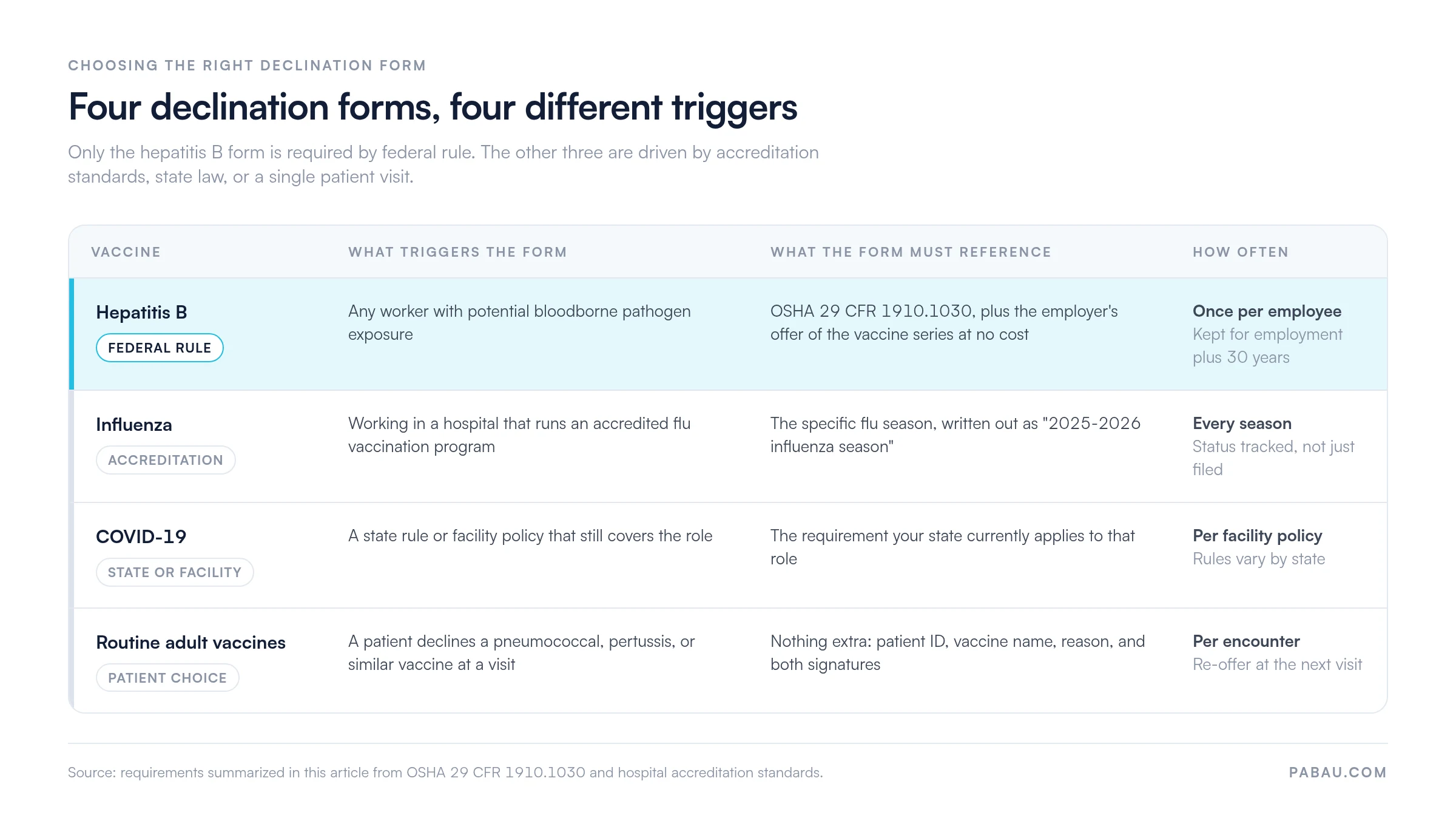
Declination forms sit where patient autonomy meets public health regulation. Four boundaries are worth knowing before you hand one over.
When in doubt, consult your organization’s compliance officer or legal counsel about form content and signature requirements in your jurisdiction.
Two steps finish the job once the form is signed. First, scan the original or keep it as a PDF in the patient’s medical record, filed under immunizations or preventive care. Second, add a clinical note.
The note can be short. “Patient offered [vaccine name] on [date]. Patient declined. Risks and benefits discussed. Declination form signed.” That entry is what the next provider reads first, before anyone opens the attachment.
Clinical documentation tools can structure that note into the record for you, which takes out the retyping step. Many practices also link the signed form to a recall workflow. A flag then appears at the patient’s next visit, reminding the clinician to re-offer the vaccine.
The conversation before the form matters as much as the form. The CDC’s provider resources on vaccine conversations point toward a structured approach. Start with an open question, such as what concerns the patient has about this particular vaccine.
Then listen for the specific reason behind the hesitation. It may be fear of side effects, religious belief, a prior bad reaction, or general skepticism. Address that reason with evidence, and offer the vaccine again at the next visit. Declination is rarely permanent.
Reaching for the form first signals that the clinician has already given up. Five minutes spent on the patient’s reservation, plus some genuine education, sometimes changes the decision before the form is needed at all.
Document the counseling conversation in the patient chart before you introduce the form. Write down what you discussed, including the vaccine’s benefit, the specific risk, and the alternatives. A declination form that sits on top of that note reads as considered rather than reactive.
Most practices still run declinations on paper. Someone prints the form, the patient signs it at the front desk, and it waits in a tray until a staff member scans it in. Days can pass between the signature and the filing, and that is when records go missing.
Practice management software like Pabau replaces that sequence with a digital form. The patient completes and signs it on a tablet, or from a link sent before the visit. The signed record then lands in their chart on its own. No paperwork waits in a tray to be scanned.
From there the record can drive the follow-up. Set a recall reminder against the patient, so the clinician sees the previous refusal and re-offers the vaccine at the next appointment. Every subscription includes the digital forms and the recall tools, so there is no separate module to buy.

Stop chasing handwritten forms. Pabau’s digital forms route straight to the patient’s chart and trigger recall reminders for the next immunization visit.

The form itself is the easy part. Knowing which version you owe, and to whom, is what trips practices up. Hepatitis B is a federal obligation with a 30-year retention tail. Influenza is an accreditation obligation you have to track, not just file away.
So build the general form once, then keep the two occupational variants ready and dated. Document the counseling before the signature, and the record will explain itself to whoever reads it later, including a surveyor.
Handle all of that on paper and you are betting on a scanning queue. Book a demo to see how Pabau files a signed declination straight to the chart and schedules the next offer for you.

Need to strengthen informed consent workflows? Group therapy informed consent template outlines how to document patient understanding across clinical encounters.
Looking for a broader patient intake framework? Going paperless saves time and protects records – vaccination declinations are one of many forms that benefit from digital capture.
Want to build a compliance checklist for your team? Medical compliance essentials covers documentation standards that apply across clinical and aesthetic practices.
A vaccination declination form is a medical document that records a patient’s informed refusal of a recommended vaccine. It carries the patient’s identification, the vaccine offered, the date, and the reason for refusal. Both the patient and the provider sign it, confirming the risks and benefits were discussed first.
No. A patient cannot be forced to sign a declination form, because coercion voids informed consent. If you decline a vaccine offered by your employer or your provider, they may still ask you to sign so there is a record. You can decline the form as well. The clinician documents the refusal in the chart either way.
Not in the sense of committing you to refuse the vaccine forever. It documents your decision on that date, and you can request the vaccine at a future visit. The form does matter legally for the provider, because it shows that informed consent was obtained.
The standard categories are personal or philosophical belief, religious exemption, and medical contraindication such as an allergy or a health condition. You can also write your own reason, or explain it in your own words during the counseling conversation. Providers should document whatever you state.
Not as a Joint Commission requirement. The Joint Commission requires accredited hospitals to run an annual influenza vaccination program and to track each worker’s vaccination or declination status. A signed form is how most employers record that refusal, but the standard asks for tracked status rather than a signature.
A declination documents a single refusal on a single date, and you can change your mind later. An exemption is a legal status under state law that excludes you from a vaccine requirement. Exemptions are permanent, while declinations are temporary.