Nitrates medication list
A nitrates medication list is a point-of-care reference that sets out the main c...

Last Updated: Oct 6, 2026
An ulcerative colitis medication list groups every drug used to treat UC by class, dose, route, and treatment phase. Six classes cover the field: aminosalicylates, corticosteroids, immunomodulators, biologics, JAK inhibitors, and S1P receptor modulators.
The split that decides most prescribing is induction versus maintenance. Induction ends an acute flare, usually over 8 to 12 weeks. Maintenance prevents the next one and runs indefinitely. Corticosteroids belong to induction only, and immunomodulators are too slow for it. The other four classes do both jobs.
The free chart below turns that into one printable reference, built from FDA labeling and Crohn’s and Colitis Foundation treatment guidance. Each row carries the brand names, formulations, dose range, route, indication, and the baseline labs to order before the first dose.

An ulcerative colitis medication list organizes drugs by class: aminosalicylates (5-ASA), corticosteroids, immunomodulators, biologics, JAK inhibitors, and S1P modulators.
Every UC drug belongs to induction therapy, maintenance therapy, or both, and escalation follows a stepwise sequence.
Corticosteroids induce remission and never maintain it, so every course needs a taper date on the record.
Biologics and JAK inhibitors need baseline TB and hepatitis B screening, then lab monitoring every three months.
Practice management software like Pabau keeps medication history, taper dates, and monitoring schedules in one client record.
Every UC drug class in one printable reference, with brand names, formulations, dose ranges, and routes. Each row also marks the induction or maintenance indication and the monitoring each drug needs.
Download templateStep 1: Print it or open it on a tablet. The layout is formatted for office printing and for review beside the patient during a consultation.
Step 2: Work class by class. The first section lists every drug by class, with brand name, available formulations, and typical dose range on one row.
Step 3: Read the indication column before the dose column. It marks whether a drug treats an acute flare, holds remission, or does both. That is what stops a steroid becoming a long-term prescription.
Step 4: Order the baseline labs it names. Before any biologic or immunomodulator, the chart lists the required tests. TB screening, hepatitis B serology, CBC, and liver function come first, along with the repeat interval.
Step 5: Read the warning column. JAK inhibitors carry black box warnings for serious infections and malignancy. Thiopurines combined with an anti-TNF biologic raise hepatosplenic T-cell lymphoma risk. Both sit next to the drug rather than in a separate safety manual.
Aminosalicylates are the cornerstone of mild-to-moderate UC treatment. Mesalamine, sulfasalazine, balsalazide, and olsalazine all act topically on the colonic mucosa to reduce inflammation. They are usually the first drug prescribed at diagnosis, and the foundation of long-term maintenance.
Indication: Induction and maintenance. Monitoring: Baseline creatinine and CBC, repeated annually or if symptoms persist. Safety note: Mesalamine is generally safe, though interstitial nephritis and hepatotoxicity have been reported rarely. Use digital intake forms in practice management software like Pabau to capture baseline renal function, and flag any significant drop in eGFR.
Corticosteroids are rapid anti-inflammatory agents reserved for acute flare induction. Prednisone, budesonide, and hydrocortisone are not maintenance therapy. Each course should be tapered off within 8 to 12 weeks to avoid osteoporosis, immunosuppression, and adrenal insufficiency.
Indication: Induction only, never maintenance. Monitoring: Blood pressure, fasting glucose, and mood changes. Document the taper schedule clearly. Medical records management should hold both the intended taper date and its completion, which is what prevents accidental chronic use.
Thiopurines and methotrexate are steroid-sparing agents used for maintenance. They suit patients who fail 5-ASA monotherapy or become steroid-dependent. Onset is slow, at 6 to 12 weeks, so they cover the taper rather than the flare.
Indication: Maintenance and steroid-sparing. Monitoring: TPMT or NUDT15 genotyping before treatment, then baseline CBC, liver function tests, and creatinine. Repeat CBC and LFTs every 8 to 12 weeks for the first six months, then quarterly. Contraindication: Never combine with an anti-TNF biologic without expert guidance, because of hepatosplenic T-cell lymphoma risk.
Biologics are monoclonal antibodies, and each one targets a single immune pathway. They induce and maintain remission in moderate-to-severe UC once 5-ASA and corticosteroids fail. Four classes are in use: anti-TNF, anti-integrin, anti-IL-12/23, and selective anti-IL-23 agents.
Anti-TNF agents (infliximab, adalimumab, golimumab): These block tumor necrosis factor, the main inflammatory driver in UC. Infliximab (Remicade) is an IV infusion. Adalimumab (Humira) and golimumab (Simponi) are subcutaneous. Onset is fast at 2 to 4 weeks, and biosimilars exist for all three.
Anti-integrin agents (vedolizumab): Vedolizumab blocks alpha4beta7 integrin, which stops T-cell migration to the gut. Being gut-selective, it carries fewer systemic effects than an anti-TNF. Standard IV maintenance runs every 8 weeks after induction. Every 4 weeks is an off-label escalation option for partial responders. Onset is slower, at 6 to 8 weeks.
Anti-IL-12/23 agents (ustekinumab): Ustekinumab (Stelara) binds the p40 subunit shared by IL-12 and IL-23, so it blocks both cytokines. Dosing combines an IV induction with subcutaneous maintenance.
Selective anti-IL-23 agents (risankizumab, mirikizumab): These bind the p19 subunit of IL-23 only, which makes them a distinct class from ustekinumab. Risankizumab (Skyrizi) and mirikizumab (Omvoh) are the newer agents here, and both are approved for induction and maintenance.
Indication: Induction and maintenance. Baseline requirements: TB screening by tuberculin skin test or interferon-gamma release assay. Then hepatitis B surface antigen and core antibody, CBC, CMP, and an HIV test where indicated. Monitoring: CBC before each infusion or injection, and LFTs quarterly. Black box warning: Serious infections, lymphoma, and demyelinating disease. Use medical forms to capture every screening result before the first dose.
JAK inhibitors are oral small molecules that inhibit Janus kinase signaling. Blocking that pathway shuts down several inflammatory cascades at once. Tofacitinib and upadacitinib are FDA-approved for both induction and maintenance.
Indication: Induction and maintenance. Black box warning: Serious infections, lymphoma, cardiovascular events, and both venous and arterial thrombosis. Baseline: CBC, CMP, lipid panel, and TB screening. Monitoring: CBC, CMP, and lipids before treatment, then quarterly. Do not start one in a patient with active tuberculosis or untreated latent TB.
S1P receptor modulators are the newest oral class. They sequester lymphocytes in lymphoid tissue, which keeps them from infiltrating the gut. Ozanimod (Zeposia) was approved in 2021 and etrasimod (Velsipity) in 2023. Both put induction and maintenance in a tablet rather than an infusion chair.
Indication: Induction and maintenance. Monitoring: Baseline CBC, CMP, and an ECG to rule out bradycardia or AV block. Then LFTs and a lymphocyte count every three months. TB screening is not required, because the mechanism does not suppress immunity as broadly as a biologic. Coverage and price still vary between payers as of 2026.
Route often decides the prescription. Left-sided disease may respond to a rectal formulation, while another patient will accept a daily tablet but refuse an infusion. This view groups the same drugs by the routes they come in.
Reading the table across rather than down answers the question a patient usually asks first. Only two classes offer a rectal option, and only the biologics need a needle every time.
Beyond 5-ASA, every UC drug needs baseline labs and a monitoring schedule before the first dose. The table below summarizes the safety parameters by class, so adverse events get caught early.
Print this table for the medication room. Pair the chart with a medication log template, so each dose and each lab draw gets a dated entry. Automated recalls for the repeat draws are what stop a quarterly CMP from slipping to six months.
Mixing up induction and maintenance is the most common error in UC management. Induction treats the acute flare over roughly 8 to 12 weeks. Maintenance holds remission indefinitely. The drugs and the doses differ between the two, which is why the chart separates them.
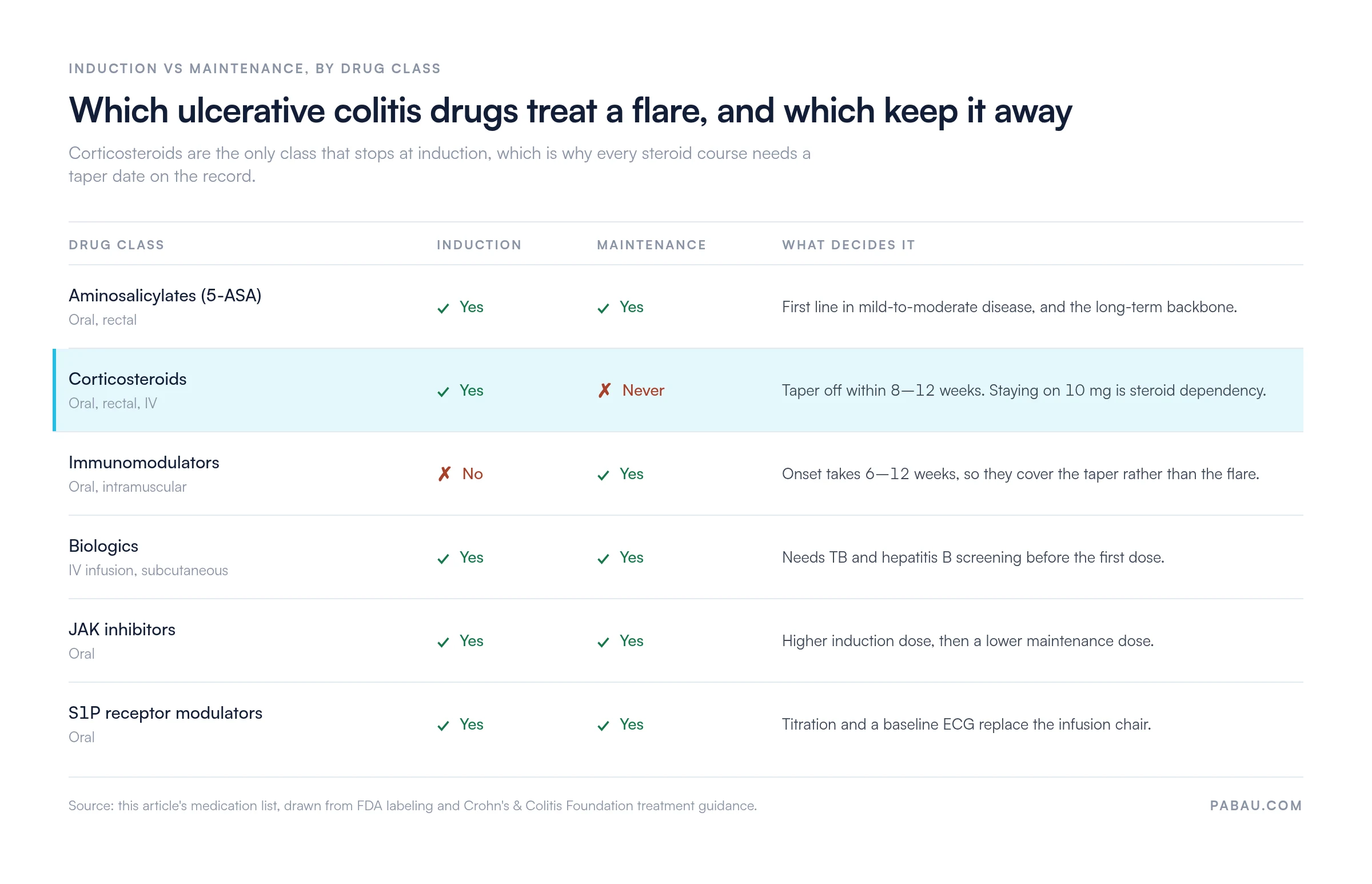
Induction goals: suppress inflammation quickly, bring the patient into clinical remission, and set up long-term maintenance. First line is usually 5-ASA plus a prednisone taper over 8 to 12 weeks. Escalate to a biologic or a JAK inhibitor if that fails.
Maintenance goals: prevent relapse, hold remission, and keep cumulative drug toxicity low. First line is 5-ASA monotherapy, oral or rectal. From there you add or switch to a biologic, a JAK inhibitor, or an S1P modulator. Corticosteroids never feature, because long-term use carries serious harms.
The classic mistake is leaving a patient on prednisone 10 mg daily for months because it works. That is steroid dependency rather than maintenance. Taper the steroid while you introduce a steroid-sparing agent. Record the intended taper date in the medication plan, so every staff member knows when to reassess.
Evidence from peer-reviewed literature supports stepwise escalation over shortcuts. The sequence runs 5-ASA first, then a corticosteroid for induction, then a biologic or JAK inhibitor for maintenance. That order produces the best remission rates at the lowest cumulative toxicity.
Most practices spread a UC medication history across three places. The clinical note holds the reasoning, a paper plan holds the taper, and the lab portal holds the results. When a patient calls mid-flare, someone has to reassemble the sequence from all three.
Pabau keeps the drug class, dose, start date, and taper end date on the client record itself. Digital forms capture the baseline TB and hepatitis B results before the first biologic dose. The screening then sits alongside the prescription rather than in somebody’s inbox.
Automated reminders run the monitoring calendar for you. Set a CBC at eight weeks and a CMP every three months, and the recall fires without anyone watching a whiteboard. You get fewer missed labs, and a medication history that reads in order when the next prescriber opens it.

Pabau holds each patient’s drug class, dose, and taper date on one client record, with baseline labs captured through digital forms. Automated reminders prompt the next CBC or liver panel before it slips.

Reading a UC medication list well starts with one question. Is this drug here to end a flare, or to prevent the next one? The dose, the route, and the monitoring schedule all follow from the answer.
The errors that hurt patients are rarely exotic drug choices. A prednisone course with no taper date does more harm than a suboptimal biologic. So does a first dose given before the hepatitis B result came back. Keep the chart where the prescribing happens, and both mistakes get harder to make.
Download the chart, print it for the medication room, and put the monitoring intervals into the system that already holds your recall list. Book a demo to see how Pabau tracks taper dates, baseline labs, and repeat monitoring for every UC patient on your list.

Need to record each dose as it is given? Medication log gives you a dated row for every administration, missed dose, and dose change.
Building a one-drug reference for your team? Drug card breaks a single medication down into mechanism, dosing, and nursing considerations.
Documenting a reaction to a biologic? Adverse reaction form captures the timeline, the suspected agent, and the action taken.
Need the exam that comes before the prescription? Gastrointestinal assessment covers inspection, auscultation, palpation, and the red flags to escalate.
Handing a patient a dosing plan for home? Medication schedule sets out times, doses, and refill dates in a printable grid.
The best UC medicine depends on disease severity and response to prior treatment. Mild-to-moderate disease typically responds to mesalamine (5-ASA) as monotherapy or combined with topical corticosteroids. Moderate-to-severe disease, or 5-ASA failure, calls for escalation. The options are IV biologics such as infliximab, vedolizumab and ustekinumab, or oral JAK inhibitors.
No ulcerative colitis disease-modifying medications are available over-the-counter. Every UC drug class needs a prescription and monitoring, from aminosalicylates through to biologics and JAK inhibitors. Anti-diarrheal agents such as loperamide are sold over the counter, but they only ease symptoms. They do nothing for the inflammation, and they are contraindicated during active disease.
As of 2026, S1P receptor modulators (ozanimod, etrasimod) represent the most recent FDA approvals for UC induction and maintenance. These oral agents offer an alternative to IV biologics for patients preferring oral therapy. JAK inhibitors (upadacitinib approved March 2022) are also recent additions. More selective JAK1 inhibitors and complement-targeting biologics are in development, though approval timelines vary.
No UC medications cure the disease; only surgical colectomy (complete removal of the colon) is curative. Every drug treatment aims to induce remission and then hold it, which reduces inflammation and symptoms. Many patients reach long-term steroid-free remission on a biologic or a JAK inhibitor. Stopping the drug usually brings a relapse. Colectomy is reserved for intractable disease, dysplasia, or cancer risk.