Getting along with siblings worksheet
A getting along with siblings worksheet is a printable that helps children and t...

2
Last Updated: Oct 23, 2026

Trypophobia is an aversion to clusters of small holes or bumps, and the DSM-5 does not list it as a diagnosis.
The downloadable form runs in two sections, and only Section I produces a number.
Section I rates ten image descriptions from 1 to 5, so totals land between 10 and 40.
Section II adds six yes or no questions for context, and you never add them to the Section I total.
The form is informal, so treat a high score as the start of a conversation rather than a diagnosis.
A printable two-section form. Section I gives you ten image descriptions to rate from 1 to 5. The scoring bands cover a total out of 40. Section II adds six yes or no reflection questions.
Download templateA trypophobia test asks you to look at clusters of small holes and rate how much they bother you. The download on this page does that in writing, with ten image descriptions and a 1 to 5 scale. Add the ten ratings and you get a total between 10 and 40, which falls into one of three bands.
Trypophobia has no DSM-5 entry, so no score can confirm it, and the PDF says as much in its own instructions. What the score gives you is a concrete starting point for the conversation that follows.
Here is how to run the form, read the result, and act on it.
Trypophobia is a strong aversion to visual patterns of small holes, bumps, or repeating clusters.
The word comes from the Greek trypo, meaning hole, and phobos, meaning fear. Honeycomb, lotus seed pods, coral, sponges, and clustered skin texture are the triggers people report most often.
The DSM-5 does not list it as a standalone diagnosis. Clinicians who need a code usually document it under specific phobia or a wider anxiety category.
The choice depends on how much distress and avoidance the patient describes. Where the presentation stays vague, coders often land on unspecified anxiety disorder instead.
Research on the subject does exist. Le, Cole and Wilkins published the Trypophobia Questionnaire in the Quarterly Journal of Experimental Psychology in 2015.
That questionnaire is the validated instrument in this literature. The form on this page is an informal screen instead. It borrows the same idea, rating discomfort against cluster imagery, without claiming the same standing.
Section I is the scored half. It gives you ten written image descriptions, from a honeycomb filled with honey to a cracked mud surface. You picture each one and rate your discomfort from 1 to 5.
A 1 means no discomfort at all, and a 5 means an overwhelming reaction. Adding the ten ratings gives a total between 10 and 40.
Section II works differently. It asks six yes or no questions about avoidance, physical symptoms, panic, preoccupation, and daily impact.
Those answers carry no points at all. You read them alongside the Section I total, and you never fold them into it.
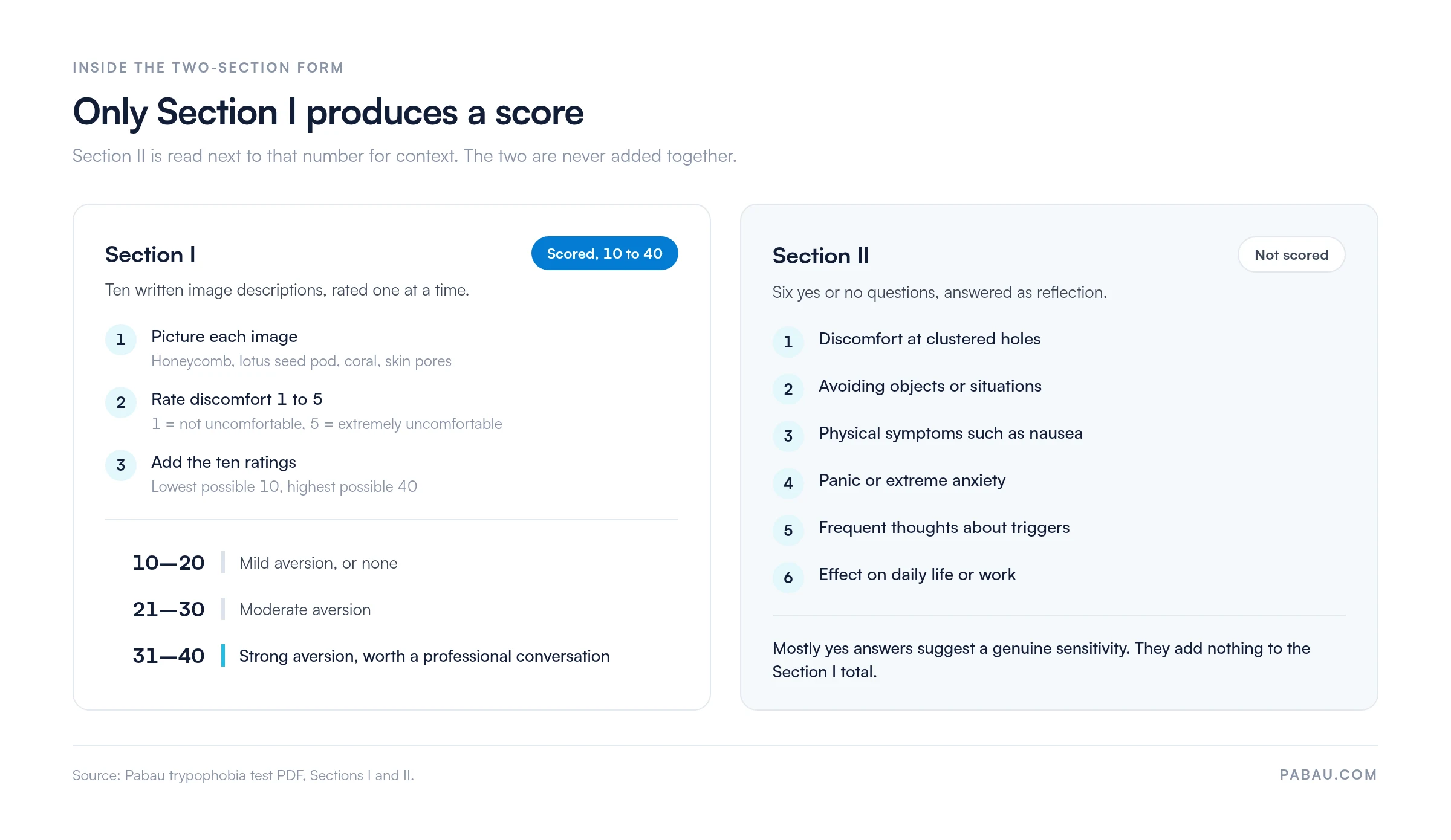
That split matters once you start using the form. A patient can total 18 in Section I and still answer yes to five questions in Section II. The number reads as mild while the answers describe something harder, and the second half is what catches it.
The whole form takes about five minutes. These five steps keep the result consistent between patients and between appointments.
Re-run the form at four to eight week intervals if treatment starts. Comparing two totals tells you more than any single sitting does.
Trigger imagery varies in how strongly it lands. The patterns people name most often group into four families.
Nobody reacts to all of them. That is why Section I runs through ten separate images rather than one. A patient who freezes at coral but shrugs at bubble wrap still ends up with a usable total.
Reactions to cluster patterns tend to fall into five groups. Watching for all five gives you a fuller picture than the score alone.
The form does not score these categories. Section II picks up most of them as yes or no answers. The detail behind each yes belongs in your notes rather than in the total.
The PDF prints its three bands directly under Section I, so patients can read their own result. Here is what each band suggests.
Notice how high the top band sits. A total of 31 means the patient averaged more than three out of five across all ten images. Nobody reaches that band on one bad reaction alone.
Flag any Section I total of 31 or higher for a same-day conversation about referral. Record the number, the six Section II answers, and what you agreed to do next. The next clinician then sees your reasoning, not just a figure on a scanned sheet.
The form was written to work in a practice and at a kitchen table. Five groups tend to reach for it.
There are three sensible ways to deploy it, and the right one depends on how your practice already runs intake.

Trypophobia rarely needs urgent care. A few thresholds do warrant a proper mental health assessment, whatever the score says.
Refer when the aversion drives avoidance of work, study, or healthcare. Patients who cancel dermatology appointments to dodge trigger imagery are the clearest example. Refer as well when intrusive images disturb sleep or eat into concentration during the day.
Anxiety disorders, obsessive compulsive disorder, and depression change the picture too. Where any of those sit alongside the aversion, send the patient to someone who treats phobia and anxiety regularly. Exposure work usually starts with a ranked list of triggers. A fear hierarchy worksheet gives the patient that ladder to climb.
Whatever you decide, write the referral conversation into the record on the day. A score with no note beside it tells the next clinician very little.
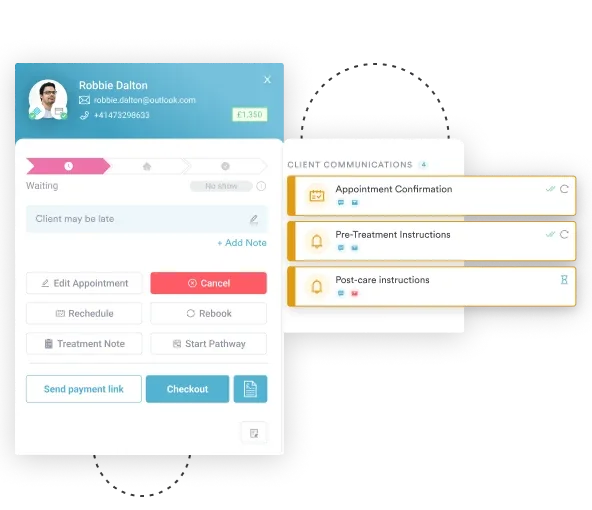
On paper, this form costs more admin than it looks like it should. Someone prints it, the patient fills it in at reception, and a staff member adds the ten ratings by hand. The sheet gets scanned into the file, and the number ends up somewhere nobody thinks to search.
Practice management software like Pabau moves that work upstream. The form goes out with the intake pack, the patient completes it on their phone, and the questionnaire scores itself. The total lands in the client record beside the treatment notes, where the next clinician will look for it.
Automations then do the chasing. A total of 31 or higher can raise a task for the practitioner. It can also book the eight-week re-test or send the patient their next steps. Nobody has to remember who scored what, and no referral waits on a sticky note.

Pabau’s digital forms send the trypophobia test out before the appointment and score Section I automatically. The result lands in the client record, and a high total can trigger a follow-up task straight away.

The honest read on this form is that it is a conversation starter with a number attached. A total of 34 tells you the patient’s reaction is strong. It does not tell you what that reaction costs them day to day. Section II and the conversation after it do that.
So lean on the score for what it does well. It gives you a repeatable baseline and makes a vague complaint concrete. Eight weeks later, you have something to compare against. Treat any total in the 31 to 40 band as a prompt to discuss referral, not as a verdict.
Get the delivery right and the form stops feeling like paperwork. Book a demo to see how Pabau sends the screen ahead of the appointment. Each score files straight into the client record.

Need to map what sets a patient off? Anxiety triggers worksheet gives you a structured way to record triggers, early warning signs, and the coping response that follows.
Screening for anxiety alongside the phobia? GAD-7 anxiety assessment template is the seven-item measure most practices use to size up generalized anxiety at intake.
Building an exposure plan from the result? Interoceptive exposure worksheet walks a patient through deliberate exposure to the body sensations that come with panic.
Is dread of the next encounter the problem? Anticipatory anxiety worksheet helps a patient separate the feared scenario from what tends to happen.
Researchers still disagree. One line of work ties the reaction to the visual properties of clustered patterns, which the eye finds hard to process. Another links it to disgust and disease avoidance. More recent work points to learned association.
The wording suits teenagers and adults. Younger children struggle to imagine a described image and rate it from 1 to 5. For them, use a clinician-led conversation and a validated pediatric anxiety measure instead.
Mild aversion often fades with ordinary exposure and no treatment at all. Strong aversion that drives avoidance tends to stick, because dodging the trigger keeps the reaction intact. That pattern is where therapy helps most.
Gradual exposure is the usual route, often inside cognitive behavioral therapy. The patient works up a ranked list of triggers at a pace they set. Breathing and relaxation skills support that work between sessions.
Yes. The same ten ratings and six questions work as a digital intake form. A digital version adds up Section I and files the result against the patient record. Nobody has to scan a signed sheet.