Journal prompts for mental health
Journal prompts for mental health are guided questions that help people process ...

2
Last Updated: Oct 13, 2026
A grief worksheet for adults is a structured therapeutic tool that guides someone through bereavement with reflection prompts, coping exercises, and emotional processing techniques. It gives shape to feelings that are hard to name, and it works alongside therapy or on its own at home.
The free PDF below covers all five stages of grief, emotion identification, CBT-based coping exercises, journaling prompts, and self-compassion work. Download it, print it, and work through it at whatever pace the loss allows. There is no signup, and no correct timeline for finishing it.
Five sections: where you are in the stages of grief, naming the emotion underneath, CBT coping exercises, journaling prompts, and self-compassion statements. Print it, or work through it section by section in a therapy session.
Download template
A grief worksheet for adults brings cognitive reframing, journaling, and the stages-of-grief framework into one printable form.
The same worksheet serves standard bereavement, complicated grief, anticipatory grief, and disenfranchised grief, but different sections carry the weight.
Breaking grief into small written prompts lowers the overwhelm, because you answer one question instead of facing the whole loss.
Grief that still interrupts daily functioning after 12 months may meet the DSM-5-TR criteria for prolonged grief disorder.
Therapists using practice management software like Pabau can send the worksheet through the Client Portal, so patients have it between sessions.
A grief worksheet gives your experience somewhere to go. Putting feelings into words surfaces patterns you cannot see from inside them, and it turns a formless day into one specific task.
That matters most on the days when grief flattens motivation. A prompt asks one question, and answering it stays achievable on a day when little else does.
Grief counselors, clinical social workers, and therapists keep worksheets in their standard toolkit. The form does some of the processing between appointments, so session time goes further.
Elisabeth Kubler-Ross’s five-stage model remains the most recognized framework for adult grief. Denial, anger, bargaining, depression, and acceptance are not a queue. People move through them in any order, skip some entirely, and revisit others years later.
A good worksheet asks where you are without judging the answer. If the stages are the part you want to work on first, our stages of grief worksheet takes that framework on its own.
Grief takes more than one shape, and the shape changes which prompts help. The table below maps the four types this worksheet covers to the sections that do the most work for each.
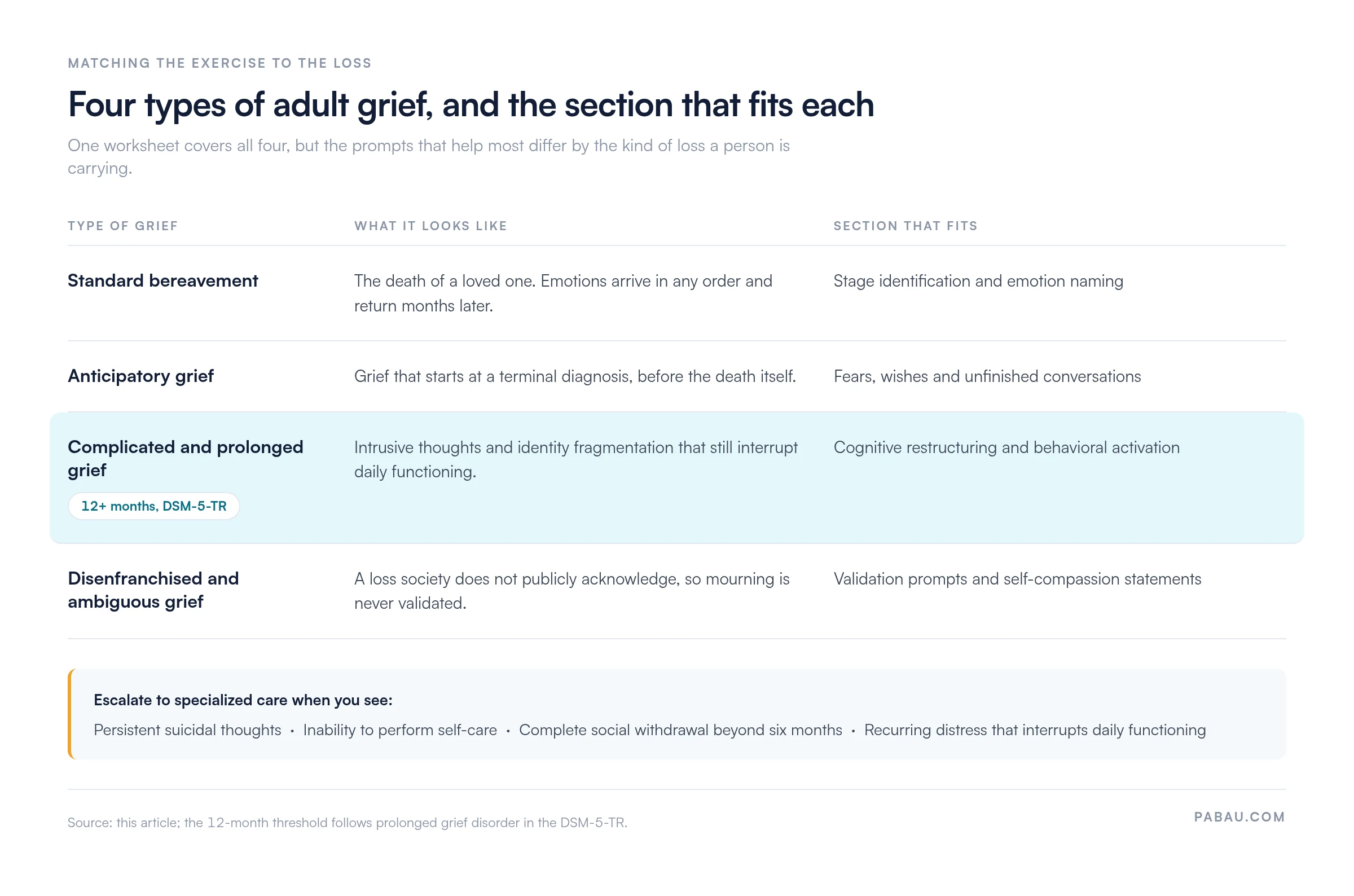
When grief still interferes with daily functioning past 12 months, it may meet the DSM-5-TR criteria for prolonged grief disorder. Intrusive thoughts about the person, a fractured sense of identity, and no imaginable future without them are the markers.
The exercises here work on the thought itself. Cognitive restructuring moves “I cannot survive this” toward “I am surviving this, hour by hour”. Behavioral activation then rebuilds contact with ordinary life. Clinicians screening for this pattern often start with the inventory of complicated grief.
A terminal diagnosis starts the grieving before the death does. Anticipatory grief makes room for fears, wishes, and the conversations nobody has had yet.
The prompts for this type ask caregivers and patients to do two opposite jobs at once. You stay present with the person in front of you, while preparing for their absence.
Some losses get no funeral and no sympathy card. A secret relationship ends, fertility treatment fails, an ex-partner dies, or a family cuts contact. The mourner’s right to grieve is never validated out loud, which adds a second injury to the first.
So the worksheet says it plainly. This loss counts, and the self-compassion prompts that follow are built on that. Grievers in this position have usually absorbed the message that their loss does not matter.
Each section of the file handles one phase of processing, so you can start where you are rather than at page one.
Expressive writing about emotional experience reduces distress, a finding associated with the research of James Pennebaker. The prompts are specific rather than open-ended, because a blank page is hard to face while grieving.
The section opens with three questions.
Cognitive-behavioral techniques interrupt rumination and rebuild emotional regulation. Thought records catch a grief-triggered thought and test it against evidence. Behavioral activation schedules one activity that carries meaning or contact with another person.
The section closes with self-compassion statements written for grief. One of them reads, “I am grieving someone I love deeply, and that love is not going anywhere.”
Follow five steps, whether you are a therapist introducing the form in session or someone working through it alone.
If your therapist works from a digital practice management system, ask whether they can send the worksheet to your patient portal. Then it sits with your appointments rather than folded in a drawer.
Handing a patient a structured grief worksheet tells them their loss deserves skilled attention. Delivering it digitally raises the odds it comes back completed, because there is no printing, scanning, or remembering to bring it in.
Most therapy practice management software can attach a form to an appointment and chase the patient for it. That keeps grief work moving between sessions without adding a task to your list.

A patient who has already written down what they need arrives with a starting point. Completed worksheets also work as clinical documentation, with the patient’s permission, so you can track how the picture changes month to month.
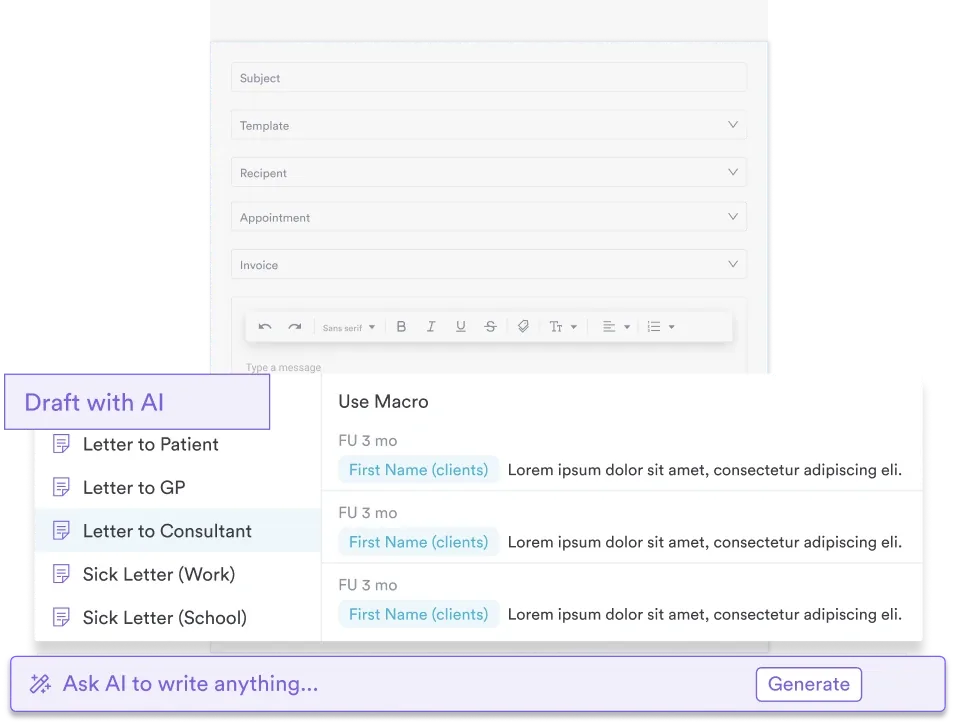
Grief sessions ask for your whole attention, which is hard to give while composing the note in your head. Letting the software draft the write-up afterward keeps you in the room.
Sitting with other people’s losses week after week has a cost. Secondary trauma and therapist burnout are occupational risks in this work, not signs that you are doing it badly.
Worksheets help here too. They move part of the reflective work onto the patient’s own time, which lightens what you carry into each hour. Supervision and scheduled recovery time do the rest.
Clear therapeutic agreements matter as much. Grief work often touches trauma, suicidality, and family conflict, so document consent and the limits of confidentiality before you start.
A worksheet is a tool, not an assessment. Refer to specialized grief counseling or psychiatric care when you see persistent suicidal thoughts or an inability to manage basic self-care.
Complete social withdrawal past six months and recurring distress that stops daily functioning belong in the same category. Clinicians who work with acute presentations often lean on structured crisis intervention strategies rather than improvising in the moment.
Mind, Cruse Bereavement Support, and the National Institute of Mental Health all publish guidance for grievers and for the clinicians supporting them.
Most grief-focused practices still email the worksheet as an attachment, or hand over a printed copy at the end of a session. The completed version comes back on paper, or never comes back, and the reflection sits outside the patient’s record.
Pabau, our practice management software, sends the worksheet from the appointment itself. The patient opens it in the Client Portal, completes it on their phone, and the answers file straight onto their record.
Automated reminders chase the ones who have not opened it, so you are not sending the follow-up yourself. Pabau Scribe, our AI scribe, then drafts the session note, which leaves your attention where it belongs.
So a grief worksheet stops being an attachment you hope someone opens. It becomes part of the record you review before the next appointment.

Pabau sends therapy worksheets through the Client Portal, chases the ones left unopened, and files completed answers onto the patient record. Your session time goes to the patient, not to admin.

Grief does not run to a schedule, and a worksheet will not make it shorter. What it does is give the next hour a shape, which on some days is the whole job.
Download the file, work through one section, and come back when you are ready for the next. If a section brings up more than you can hold alone, that is the signal to bring it to a therapist.
For clinicians, the trade worth remembering is that delivery decides completion. An unopened worksheet does no work at all. Book a demo to see how Pabau gets grief worksheets into patients’ hands and the answers back into their records.

Prefer a seven-stage model? 7 stages of grief template treats shock and testing as stages in their own right.
Working on emotional regulation? DBT therapy worksheet covers distress tolerance skills that pair well with grief work.
Starting with a new patient? Adult counseling intake form captures history and risk before the first session.
A grief worksheet is a structured therapeutic tool that guides emotional processing through prompts, exercises, and reflection questions. It helps by putting grief into words, which normalizes the range of emotions a loss brings and organizes the coping work.
No. Worksheets are useful self-help tools and therapy supplements, but they do not replace professional mental health care. Complicated grief and suicidality in particular need a therapist or grief counselor for assessment and treatment.
There is no fixed timeline. Some sections take 10 minutes. Others take weeks of returning to the same prompt. Revisiting a worksheet over months is common and healthy, because grief does not run in a straight line.
Grief work is the broader psychological process of integrating a loss into your identity and your life story. Grief worksheets are the structured tools that organize that process, with specific prompts and exercises to work through.
Yes. A complete set addresses standard bereavement, complicated grief, anticipatory grief, and disenfranchised grief. Each type gets prompts pitched at where that griever is, rather than one generic sequence.
Yes. The language often references death, but the underlying process applies to any significant loss. A relationship ending, a lost identity, a relocation, or a diagnosis all fit, so adapt the prompts to your own situation.