Professional development record
A professional development record is a structured log of a healthcare practition...

5
Last Updated: Oct 8, 2026
The CQC rating scale is the four-tier system the Care Quality Commission (CQC) uses to judge health and adult social care providers in England. Each provider is rated on safety, effectiveness, caring, responsiveness, and leadership. The CQC’s remit stops at the English border, so providers in Scotland, Wales, and Northern Ireland answer to the Care Inspectorate, CIW, and RQIA instead.
Under the single assessment framework (SAF), each provider is scored 1 to 4 on individual quality statements. Those scores aggregate into an overall rating in one of four categories: Outstanding, Good, Requires Improvement, or Inadequate.
For private aesthetic practices, diagnostic services, and specialist providers in England, registration and a rating are a legal requirement rather than a badge. Knowing what each rating means, how the scores are built, and what evidence inspectors expect is how you prepare for assessment. It is also how you stay compliant with the Health and Social Care Act 2008 (Regulated Activities) Regulations 2014.
This guide explains the scale in detail and walks through the scoring system, including the change already announced for it. You also get a downloadable reference sheet and inspection checklist for your own practice.
A reference sheet and inspection checklist covering the four rating categories, the five key questions, quality statements, and the six evidence categories. Download it as a PDF, adapt the fields to your own practice, and use it to keep your compliance documentation inspection-ready.
Download template
CQC rates providers in England on four levels: Outstanding, Good, Requires Improvement, and Inadequate.
Under the single assessment framework, each quality statement is scored 1 to 4, and those scores set each key question’s rating.
CQC assesses every provider against five key questions: Safe, Effective, Caring, Responsive, and Well-led.
CQC confirmed in March 2026 that scoring will be removed, with judgment made at key-question level instead.
Pabau’s digital consent forms, timestamped client records, and compliance audit trails give inspectors the documented evidence the framework asks for.
The CQC rating scale is the method the Care Quality Commission uses to summarize inspection findings into a single word the public can read. The CQC is the independent regulator for health and social care in England. Almost every provider must register with it, from NHS trusts and GP practices to care homes, private practices, and aesthetic providers.
A rating reflects how well a provider meets the five core standards set out in the Regulations 2014. Those standards cover safe care and treatment, effective care and treatment, caring services, responsive services, and well-led organizations. The evidence behind a rating comes from inspections, unannounced visits, and desktop reviews, all assessed against the SAF quality statements. If you are new to the regulator, our guide to the CQC’s role explains what it does and how it enforces.
CQC uses four categories to report an inspection outcome to the public and to the provider. Each one reflects a different level of compliance with the standards.
Outstanding is the highest rating, and it goes only to providers that reach well beyond the minimum standards. The usual hallmarks are proactive safety improvements, innovative care models, strong staff engagement, and a culture of continuous learning. Fewer than one provider in twenty holds it.
Good is the most common rating and represents consistent compliance across all five key questions. A Good provider delivers care that is safe, effective, caring, responsive, and well-led. For most practice owners this is the realistic target, and it tells patients, referrers, and staff that the practice operates safely.
Requires Improvement means the provider has not met the standards in one or more of the five key questions. CQC sets out the specific, measurable changes it expects, and the provider has to evidence them. Under the SAF, no fixed re-inspection date is attached to the rating. CQC reassesses on risk, so a practice with unresolved concerns can hear from the regulator at any point.
Inadequate is the lowest rating and signals serious or multiple breaches of the standards. Providers rated Inadequate typically face special measures, which can mean a forced management restructure, restrictions on admissions, or closure. In severe cases CQC prosecutes the provider or its leaders under the Health and Social Care Act.
Every assessment is structured around five key questions, each covering a different dimension of care quality. A provider has to demonstrate compliance across all five to reach a Good rating.
Under the single assessment framework, CQC replaced open-ended key lines of enquiry with a numbered scoring system. Each provider is assessed against specific quality statements, and every statement scores 1, 2, 3, or 4.
CQC aggregates the scores from the quality statements inside a key question, then assigns that key question a rating. The five key question ratings then produce the overall rating for the provider. One key question rated Inadequate caps the whole provider at Inadequate, whatever the other four look like. The four steps below are the full route from an inspector’s notes to the word on your rating page.
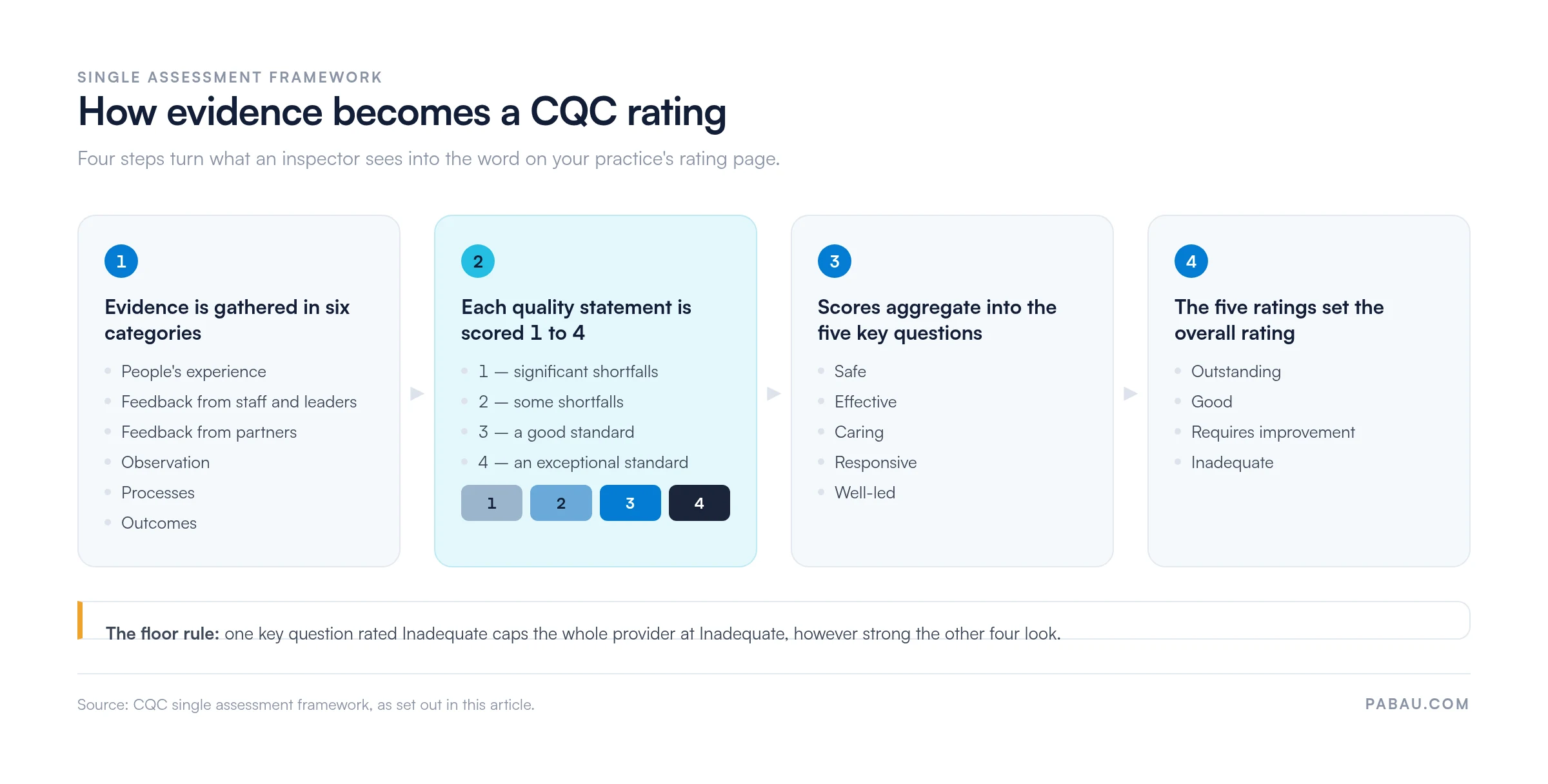
One caveat matters before you build a compliance plan around the numbers. CQC confirmed in March 2026 that it will drop scoring altogether and make a judgment directly at key-question level. A pilot runs through autumn 2026, with rollout planned for the end of the year. Scoring is the operative system today, so the table above still governs your next assessment.
The single assessment framework (SAF) replaced the older key lines of enquiry (KLOEs). CQC introduced it in November 2023 with an early-adopter phase, then rolled it out across England by March 2024.
Old approach (KLOEs): Inspectors followed open-ended lines of enquiry with no standardized scoring. Assessments could be subjective, and consistency varied between inspection teams.
New approach (SAF): CQC assesses providers against numbered quality statements. Each statement is scored 1 to 4 using six evidence categories: people’s experience, feedback from staff and leaders, feedback from partners, observation, processes, and outcomes. Standardizing the inputs this way makes judgments easier to compare between providers.
For private practices, that shift puts documentation at the center of the assessment. Digital consent forms, timestamped clinical records, and recorded staff training all become evidence items. Inspectors expect an audit trail that shows how you meet each quality statement.
Private aesthetic practices, cosmetic surgery centers, and independent diagnostic providers in England are regulated under the same standards as NHS trusts. Owners often assume the regulator only looks at the NHS or at large care homes. Any private provider delivering a regulated activity has to register and be rated, whether that activity is treatment, diagnostics, or surgery.
CQC registration has to be in place before you open, and it cannot be deferred. Preparing your evidence in advance, rather than after an inspection notice lands, is what protects the business.
If your practice has been rated Requires Improvement or Inadequate, CQC will set out what has to change and by when. Here is how to respond effectively.
The framework uses six evidence categories to assess each quality statement. Knowing them tells you which documentation to prepare before an assessment.
For each quality statement, inspectors look for evidence across these six categories. Strong evidence in most of them is what keeps a statement away from a score below 3.
Most practices assemble their CQC evidence after the notice arrives. Consent forms come out of a filing cabinet, training certificates out of an inbox, and complaints out of a spreadsheet somebody stopped updating in March. Reconstructing a year of documentation in a fortnight is where scores slip below 3.
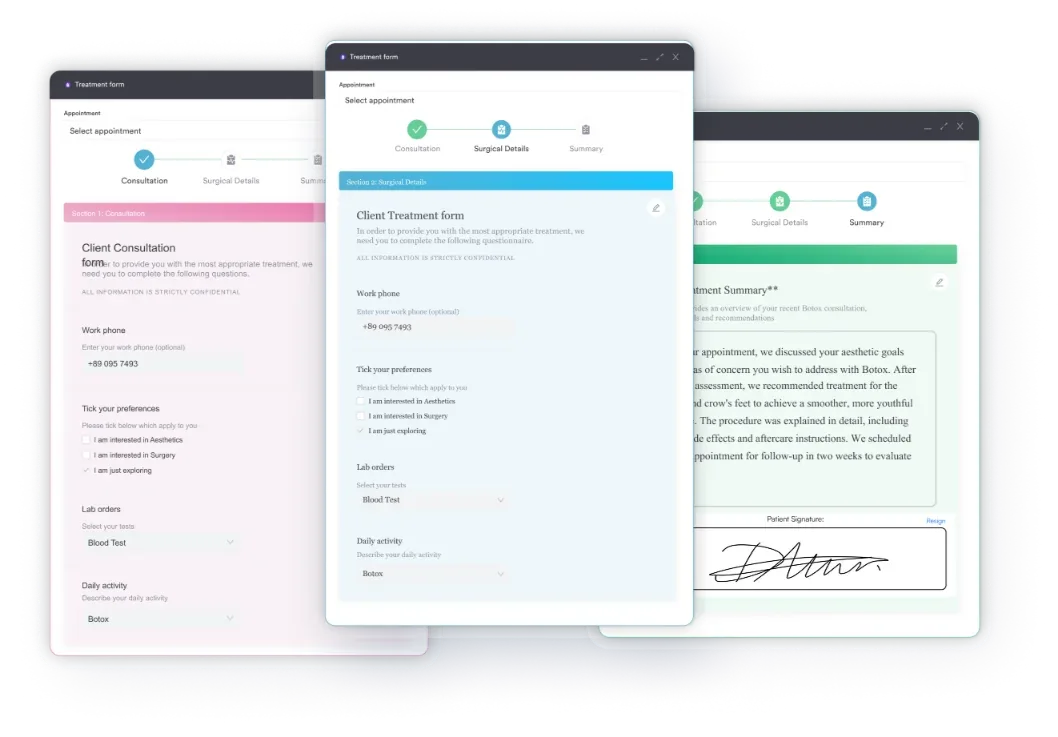
Practice management software like Pabau collects that evidence as part of the working day instead. Consent and intake forms are signed digitally and filed against the patient record with a timestamp. Every amendment to a record is logged with the user who made it. The audit trail for a quality statement is written by the time an inspector asks for it.
Patient feedback requests go out automatically after treatment, which feeds the people’s experience category. Staff training, policy acknowledgments, and incident reports sit in the same system as the clinical records they relate to. When your assessment comes, you are exporting what already exists rather than chasing it.

Pabau files consent forms, clinical records, staff training, and patient feedback against a timestamped audit trail as your team works. That turns assessment prep into an export rather than a scramble.

The rating your practice carries is decided long before an inspector walks in. It is decided by whether the consent form, the training record, and the complaint response can be produced against the quality statement they answer.
Scoring is due to change at the end of 2026, so treat the 1 to 4 numbers as the current mechanism rather than the point. The five key questions and the six evidence categories survive the change, and so does the demand for a documented audit trail. Build for those and the mechanism on top of them stops mattering.
Start with the downloadable reference sheet and work through it one key question at a time. Book a demo to see how Pabau keeps that evidence filed and dated as your practice works.

Want the full list of what CQC expects you to prove? CQC requirements guide breaks down what every provider must demonstrate to inspectors.
Budgeting for CQC registration before you open? CQC registration cost guide covers the fees involved in getting registered in the UK.
Handling patient data alongside your CQC evidence? GDPR checklist for UK practices sets out the records and consents you are expected to keep.
Outstanding means exceptional practice, and it is rare. Good means all standards are met consistently, and it is the most common rating. Requires Improvement means one or more standards were not met. Inadequate means serious breaches, with regulatory action likely.
CQC scores each quality statement 1 to 4 using six evidence categories. The scores within a key question are aggregated to produce a rating for that question. The overall provider rating is then derived from all five key questions.
Yes. Any private healthcare provider delivering regulated activities in England must register with CQC and receive a rating. That covers treatment, diagnostics, and surgery, and aesthetic practices are held to the same standards as NHS providers.
They are people’s experience, feedback from staff and leaders, feedback from partners, observation, processes, and outcomes. In practice that means patient feedback, staff and partner comments, what an inspector sees on site, your written procedures, and your measured results.
There is no fixed timetable. Under the single assessment framework, CQC assesses continuously and acts on risk. Frequency is no longer tied to a provider’s existing rating or to a set inspection cycle. New concerns, complaints, or data can trigger an assessment at any time.