Maja Popovska

Caregiver assessment
What is a caregiver assessment? A caregiver assessment is a structured evaluatio...

3
Last Updated: Oct 30, 2026
Free PDF 2 pages, print-ready Clinician-reviewed
A good character traits list is a structured record of the positive qualities a person shows, written as behavior you have observed. This free two-page template groups nine prompts under three categories: Communication skills, leadership qualities and adaptability. Each of the nine prompts has its own free-text box for your examples, and the sheet closes with Interpretation and How to use sections. Therapists, coaches and managers can use it to track strengths from one review to the next. If your practice already sends digital forms through Pabau, the practice management platform we build, you can collect the completed list the same way.
A two-page fill-in sheet with client details, an introduction and nine prompts across communication skills, leadership qualities and adaptability. Each of the nine prompts has its own notes box, followed by Interpretation and How to use sections for your summary and next steps.
Start from scratch, or upload this PDF or any form you already use, and Pabau's AI Form rebuilds it with tick boxes, text fields and a signature. Attach it to the treatment once, and every patient gets it on time.
AI Form rebuilds the consent, history and aftercare forms you already use. You review each one, then publish.
Patients complete forms on their phone before they arrive, so the front desk stops retyping paper.
Every signed form is versioned and attached to the treatment record, ready when you need it.
Set how long a consent stays valid. Returning patients skip forms they have already signed.
Supports HIPAA and GDPR compliance AES-256 encryption 4.8 on G2 4.7 on Capterra Trusted by 4,000+ practices worldwide

A good character traits list records positive qualities as specific behavior you have seen, rather than as labels.
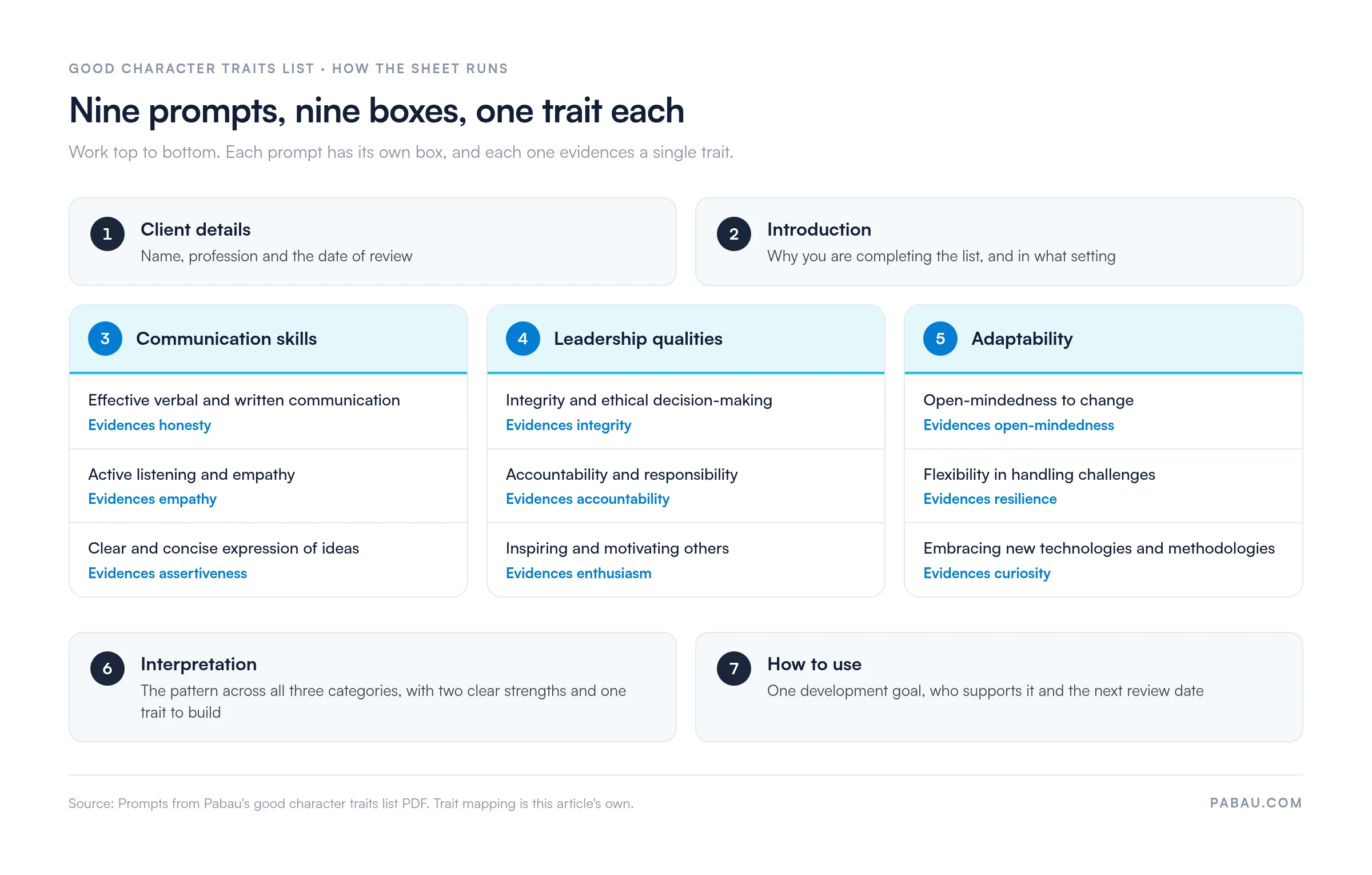
This template sets out nine prompts under communication skills, leadership qualities and adaptability, each with its own free-text box.
The PDF is a blank sheet with no definitions, so use the trait tables in this article as your reference.
Treat a completed list as a conversation starter, never as a clinical score or a diagnosis.
Practice software such as Pabau can send the list as a digital form and keep each completed copy in the patient record.
A good character traits list is a structured record of the positive qualities a person shows, such as honesty, empathy and accountability. Character traits are the consistent ways someone acts toward other people and toward their own work.
The most widely cited framework is the VIA Classification of Character Strengths. Psychologists Christopher Peterson and Martin Seligman published it in 2004, grouping 24 strengths under six virtues. For a wider clinical view of personality, the American Psychological Association is a reliable place to start.
The list supports observation and discussion. It does not measure a person or produce a score. Practitioners tend to use it in three ways:
The table below defines nine traits that appear across character education and coaching resources. Each one is matched to the template prompt where you would record it. The definitions are practical summaries, not clinical definitions.
The third column describes what each trait looks like when you see it. Recording that behavior keeps your notes full of evidence instead of adjectives.
If the nine traits above don’t fit your setting, the VIA Classification gives you a fuller list to choose from. Here are its 24 strengths, grouped under the six virtues, with a plain definition of each.
Many workplace and school lists add a handful of everyday traits that VIA folds into its broader strengths. These are worth recording too:
The template has no section for negative traits, and it doesn’t need one. If a concern comes up, record the behavior under the matching prompt and frame it as a development point.
These six patterns are the most useful to notice, because each one is the reverse of a strength on the list:
Write the behavior, never the label. “Interrupted the patient twice during the consultation” can be discussed and changed. “Rude” can only be argued with.
Character traits describe how someone chooses to act, and they are widely treated as qualities a person can develop. Personality traits describe broad, relatively stable tendencies in how someone thinks, feels and behaves.
Psychologists usually measure personality with standardized questionnaires, such as a Big Five personality test. The Big Five model covers openness, conscientiousness, extraversion, agreeableness and neuroticism. A character traits list works differently. It records observed behavior against chosen strengths, so it suits reflection and goal setting rather than measurement.
The PDF runs to two pages and moves in the order you would hold a review. Work through it like this:
Leave a prompt empty when you have no evidence for it. A blank box is more honest than a guess, and it shows you where to look next time.
The map below lays out the whole sheet in order, with the trait each prompt evidences from the definitions table.
Here is how one section of the sheet might read for a fictional practice manager. Note that every entry describes something that happened, with enough detail to discuss.
A written list turns vague impressions into specific notes. That consistency helps when more than one person reviews the same patient, student or team member.
Character also matters at work. The competency model published by the Society for Human Resource Management (SHRM) lists ethical practice among its core behavioral competencies. That overlap explains why several traits on this list also show up in workplace reviews.
Review the list alongside the person rather than filling it in alone. Ask them to choose two traits they already show and one they want to build. Record examples in their own words, and set a date to revisit the list. Repeat the review every few months so the notes show change across several sessions.
Therapists, counselors and coaches are the main audience. A strengths-based record balances notes that otherwise focus on problems. Practices that run mental health EMR software can keep the list close to the records they already maintain.
Solo coaches often pair the list with a coaching client management system to keep goals and notes together. Clinicians who already use a psychiatric evaluation template can add this list as a reflection tool alongside it.
The Profession field makes the sheet a good fit for managers and HR teams as well. Teachers can adapt it too, but should check that the language suits their policies and students. For wider character education material, start with Character.org.
On paper, a completed list ends up in a folder or a scanned PDF. By the next review, finding the last copy can take longer than the review itself.
Pabau, the therapy practice management software we build, lets you rebuild the template as a digital form. You can send it to a patient to complete before a session, or fill it in together on screen. Each completed copy saves to their record with the date attached.
At the next review, the previous lists sit in the same record, so you can compare entries side by side without searching. Pabau Scribe, our AI scribe, can also draft session notes, leaving you free to focus on the conversation.

Send the character traits list as a digital form and store each completed copy in the patient record. Compare reviews over time without digging through paper files.

A character traits list is only as useful as its evidence. Nine honest entries with dates will tell you more over a year than a page of glowing adjectives.
Start small. Pick the two or three prompts that matter for your setting, record what you see, and agree one trait to build. The value shows up at the second and third review, when you can point to change instead of describing a feeling.
Book a demo to see how Pabau sends, stores and compares completed trait lists for therapy and coaching practices.

Need a scored measure instead of free-text notes? Character strengths assessment gives you a free template with a scoring guide.
Looking for more strengths to choose from? Strengths list for therapists offers a ready list to draw on in sessions.
Want patients to name their own strengths? My strengths and qualities worksheet gives them a structured way to do it in therapy.
Connecting traits to what someone cares about? Personal values list helps you link observed behavior to personal values.
Comparing character with personality? Big Five personality test explains the model behind most personality questionnaires.
Good character traits are positive, consistent patterns of behavior, such as honesty, kindness, fairness and perseverance. The VIA Classification groups 24 of them under six virtues: Wisdom, courage, humanity, justice, temperance and transcendence.
Ten commonly listed examples are honesty, integrity, empathy, kindness, accountability, perseverance, fairness, gratitude, humility and self-control. No official ranking exists, so choose the traits that matter in your setting.
The VIA Classification, published by Christopher Peterson and Martin Seligman in 2004, lists 24 character strengths. They sit under six broad virtues that appear across cultures and traditions.
Character describes how someone chooses to act, and it is widely treated as something a person can develop. Personality describes broad, relatively stable tendencies, usually measured with questionnaires such as Big Five inventories.
No. The PDF is a blank fill-in sheet with client details, an introduction, nine prompts across three categories, and interpretation and how-to-use sections. Use the tables in this article for definitions.
Every three months suits most coaching and therapy relationships. Date each completed copy, so you can compare entries and show whether the chosen trait has developed.
Yes, character strengths are generally treated as capacities that grow with practice. Pick one trait, agree a small weekly behavior that shows it, and record examples at each review.