Journal prompts for mental health
Journal prompts for mental health are guided questions that help people process ...

2
Last Updated: Oct 13, 2026

An SLP goal bank is a collection of pre-written, measurable goals covering every major clinical domain.
SMART goals are the standard format for objectives that have to hold up at an IEP review or a payer audit.
Percent accuracy is not the right criterion for every domain, and swallowing goals are the clearest exception.
Customizing a goal from the bank takes 3 to 5 minutes, against 15 to 30 minutes writing one from scratch.
Practice management software like Pabau keeps goals in digital forms and treatment notes, beside session notes and progress data.
Measurable goal templates grouped by domain: articulation, language, fluency, voice, cognitive-communication, dysphagia, IEP objectives, and adult medical objectives. Each goal is written in SMART format, so you can adjust the target and the time frame for your client.
Download templateMost speech-language pathologists write goals from scratch for every client. Each one has to be measurable, functionally relevant, and defensible at an IEP review or a payer audit. A ready-made SLP goal bank removes most of that drafting time. You pick the closest template and adjust it for the client in front of you.
SLPs often move between pediatric, school-based, and medical caseloads in the same week. Each setting wants a different frame. IEP work needs SMART objectives, adults post-stroke need functional recovery targets, and dysphagia needs texture progression. One file covering all of them beats hunting through four separate resources.
This guide covers what the bank includes, how to adapt a template, and how to pick the measurable criterion for each domain. The criterion is what usually decides whether a goal survives review, and it changes from domain to domain.
An SLP goal bank is a structured collection of pre-written, measurable goals organized by clinical domain. Instead of drafting from zero for each client, you use it as a reference library. You select a goal, then adapt it to the client’s needs, functional limitations, and treatment setting.
The American Speech-Language-Hearing Association (ASHA) treats measurable goals as foundational to evidence-based practice. A goal bank keeps every goal tied to clinical best practice and functional communication outcomes. It also keeps them inside the rules you answer to.
Those are IDEA in schools, Medicare coverage rules in medical settings, and state licensing rules in private practice.
Most goal banks cover the same set of domains:
School-based SLPs lean on the bank for IEP-aligned objectives. Medical and adult SLPs use it for post-stroke aphasia, cognitive-communication after a traumatic brain injury, and dysphagia progression.
A goal bank does three jobs. It speeds up the writing, it keeps goals measurable and compliant, and it grounds them in evidence rather than instinct.
Download the template, then work through these five steps to make it part of your documentation routine.
A goal bank earns its keep once it lives inside your documentation system rather than sitting in a folder as a static PDF. Run it inside a therapy practice management platform and the goal, the session notes, and the progress data share one client record. Outcome reporting then becomes a filter, not a rebuild.
School-based SLPs. If you write IEP goals daily, templates that already meet IDEA measurability standards save hours each week. They also keep goals tied to classroom participation and academic performance, which is what an IEP team asks about.
Medical and adult speech therapists. Hospitals, skilled nursing facilities, outpatient rehab, and private practice all need assessment findings turned into measurable, medically necessary objectives. Adult goals use different criteria from pediatric ones. Diet texture advancement, intelligibility percentage, and word-retrieval accuracy have little in common, so a bank covering both populations matters.
Solo practitioners and small group practices. When you’re the only SLP in the practice, there’s no colleague to think a goal through with. The bank becomes your reference library, and it keeps goals consistent from client to client.
Clinicians carrying heavy caseloads. At 20 clients a week, 30 minutes of goal writing per new evaluation adds up fast. Selecting and adapting a template takes 3 to 5 minutes instead, which puts that time back into client care.
Measurability you can defend. Goals in a clinical bank are already written to meet ASHA practice standards and IDEA requirements for IEPs. That removes the vague, unmeasurable wording that draws insurance denials and audit findings.
Time back in your week. Customizing an existing goal takes 3 to 5 minutes. Writing one from scratch takes 15 to 30. Across a 20-client caseload, that difference is hours of documentation time.
Evidence over instinct. Goals drawn from a reputable bank rest on clinical literature and professional standards. That strengthens your reasoning when you report outcomes to referrers, payers, and families.
Consistency across the caseload. Standardized goals make outcomes comparable, so trends show up and treatment approaches can be refined. A solo SLP gets the same benefit as a group practice.
Faster onboarding for new clinicians. A new graduate or intern can read your bank and see how experienced SLPs frame a measurable objective. That shortens the learning curve for compliant documentation.
Audit your goal bank every six months. Pull 10 goals at random from closed cases. Check whether each was met as written, whether it was too easy or too hard, and whether the criterion matched the client’s performance. Feed what you find back into your customizations.
SMART is the standard format for SLP goal writing. Each component does a clinical job and a regulatory one, which is what makes a goal defensible to payers, families, and supervisors.
Here is a complete example, written for a child with autism and speech delay. “The child will produce 5 two-word utterances containing a verb, such as ‘dog run’ or ‘mommy sit’, during a 30-minute play session. The target is 75% accuracy by the end of 8 weeks, across 16 sessions.”
That goal names the child and the behavior, so it is specific. The 75% figure makes it measurable, and 16 sessions makes it attainable for a moderate language delay. Play-based turn-taking is functionally relevant, and the 8-week deadline makes it time-bound.
Most goals sent back for revision fail on the criterion, not the target behavior. Percent accuracy is the default clinicians reach for, and it fits articulation well. It describes swallowing safety and cue fading badly.
The criterion that holds up changes with the domain, as the breakdown below shows.
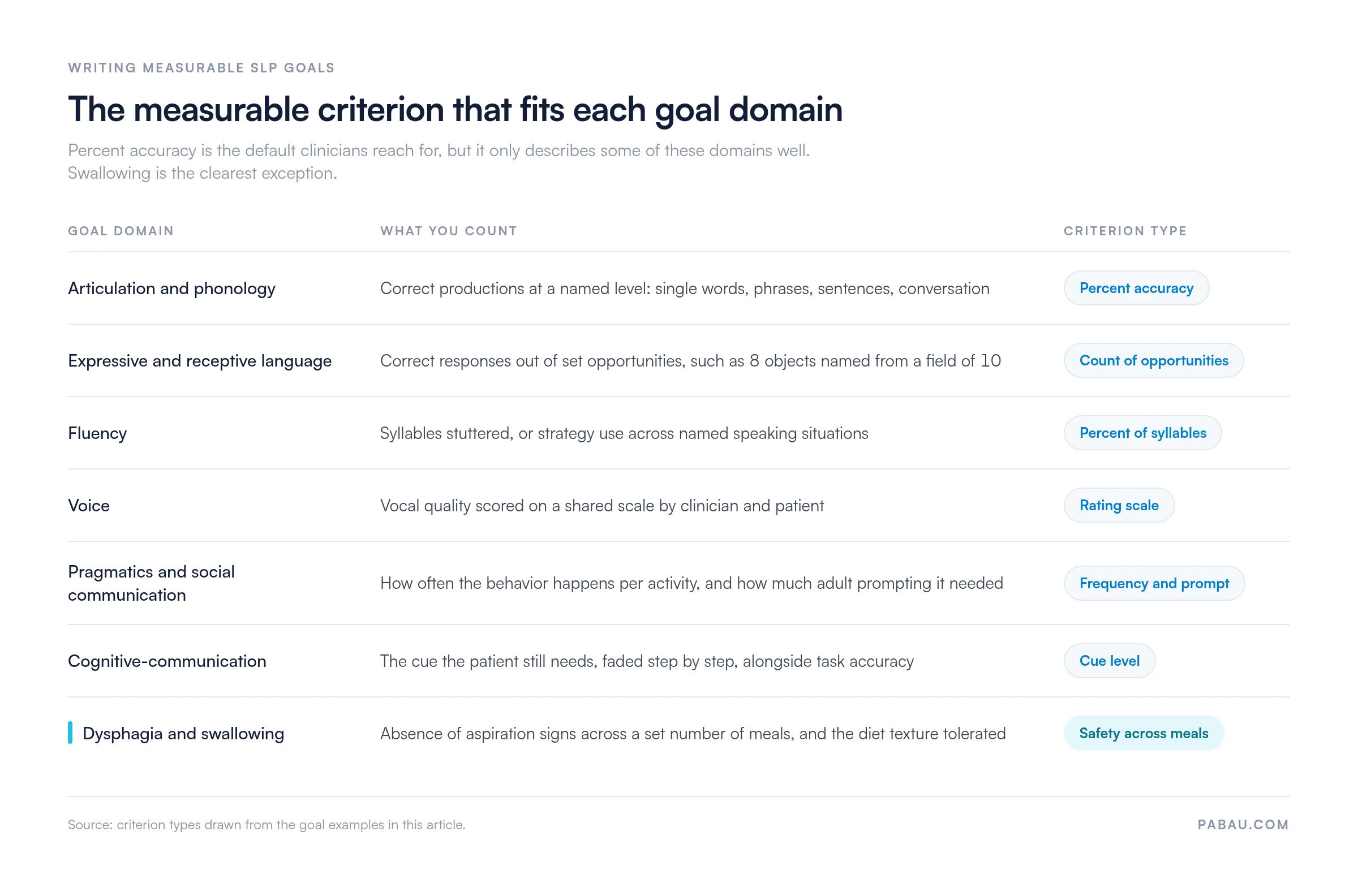
Two practical rules come out of that. In a swallowing goal, count meals and signs of aspiration rather than a percentage of correct trials. In a cognitive-communication goal, name the cue level, because fading the cue is the progress you are reporting.
School-based SLPs work under the Individuals with Disabilities Education Act (IDEA). IEP goals have to be measurable and tied to educational performance or access to the general curriculum. Annual measurable goals are required, and some states also ask for short-term benchmarks.
For school work, the templates that get used most cover:
One principle carries every IEP goal. Link it to an educational barrier. “Student will improve vocabulary” gives an IEP team no measure to work from. Compare it with this. “Student will increase expressive vocabulary from the 25th to the 40th percentile on the PPVT-4, raising contributions to grade-level literature discussions from 0 to 3.” That version names the barrier and the measure.
Medical SLPs in hospitals, stroke centers, rehab facilities, and skilled nursing homes work from a narrower set of domains.
Adult goals lead with functional recovery and safety. Two examples show the shape. “Patient will swallow thin liquids with no signs of aspiration, meaning no cough and no wet voice quality, across 3 consecutive meals.”
“Patient will retrieve the names of 8 common objects from a field of 10, moving from phonemic cuing to no cuing over 4 weeks.” Both point at an outcome the patient cares about, such as advancing a diet or getting home.
Medicare and other payers want goals tied to medical necessity and functional progress. CMS retired Medicare functional limitation reporting, the G-code and severity-modifier system, at the start of 2019.
What carries the case now is your clinical documentation. Record the patient’s functional status at baseline, the measurable change since, and why continued therapy is medically necessary.
A dysphagia care plan shows how that documentation fits together for one domain, from the swallowing goal to the diet texture on the chart. Recording progress in the session note as you go means you never reconstruct three months of therapy the week a payer asks.
Pragmatic language covers social communication, turn-taking, topic maintenance, and perspective-taking. Functional communication covers using language for everyday needs, such as requesting, refusing, problem-solving, and joining in. Both are now treated as core SLP treatment domains rather than extras.
A full goal bank includes templates for the situations these goals target:
These goals connect clinical progress to life outside the session. One example: “During community outings, the student will greet one peer without adult prompting and hold a two-turn conversation.” The goal then adds a functional request at 80% communicative success, such as asking for help or ordering a snack.
Most SLP practices keep goals in one place and progress data in another. The goal lives in a PDF, the session notes live in the record, and the progress spreadsheet sits on someone’s desktop. Reporting outcomes then means pulling three sources together by hand.
Pabau keeps them in the same place. You store the goal in a digital form or a treatment note against the client record. Session notes, measures, and attachments sit on that same record, so progress reads as one timeline.
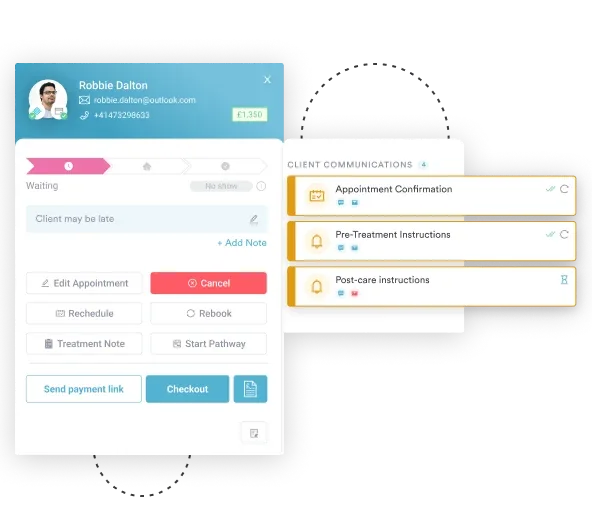
That changes two jobs. Reviewing a goal at 6 weeks means opening the client file instead of three documents. Answering a payer’s request for justification means exporting what is already recorded, not rebuilding it. Both become routine when your speech therapy software is built around the client record.

Pabau stores SLP goals in digital forms and treatment notes on the client record. Session notes and progress data sit beside them, so outcome reporting stops being a hunt through three documents.

A goal bank does not make clinical decisions for you. It removes the drafting time, so the decisions get your attention instead.
The part worth carrying away is the criterion. Pick the measure that fits the domain, tie it to what you assessed, and the goal will hold up at review. Pick a percentage because it looked familiar, and you will be rewriting it in six weeks.
Download the goal bank, then decide where the goals will live. Book a demo to see how Pabau keeps SLP goals, session notes, and progress data in one client record.

Want families pulling in the same direction on goals? Engaging families in speech therapy covers how to involve clients and families in choosing goals and tracking progress.
Writing goals for an adult with aphasia? Aphasia worksheet gives you the therapy tasks that sit underneath a word-retrieval goal.
Need the baseline before you set the target? Articulation test explains how to score speech sound production so your accuracy figure means something.
Working on /r/ with a school caseload? R worksheets for speech therapy supply the practice material for the goal you just wrote.
Comparing systems to hold all of this? Speech therapy practice management software walks through what to look for in scheduling, notes, and progress tracking.
An SLP goal bank is a collection of pre-written, measurable speech therapy goals organized by clinical domain. Those domains cover articulation, language, fluency, voice, swallowing, and cognitive-communication. You customize each goal for the individual client. It works as a reference library, so goals stay measurable and compliant across the caseload.
SMART stands for specific, measurable, attainable, relevant, and time-bound. In practice that means naming who does what and setting an accuracy or trial target. It also means keeping the timeline realistic and giving a deadline. Example: “Client will produce /r/ in initial-position words in structured conversation with 80% accuracy within 8 weeks.”
IEP goals are measurable annual objectives written by school-based SLPs under IDEA. IEP stands for Individualized Education Program. Each goal must address a barrier to educational performance or access to the general curriculum. It also needs a measurable criterion, such as an accuracy percentage, a frequency, or a rating scale. Unlike medical goals, IEP goals prioritize classroom and academic participation over functional recovery.
Yes, that is the point of a goal bank. Select the template that matches your client’s diagnosis or need. Then adapt the target to your assessment findings, session frequency, and functional priorities. That means the accuracy percentage, the context, and the behavior frequency. Customizing usually takes 3 to 5 minutes, because the bank supplies the structure and you supply the detail.
Review goal progress every 4 to 8 weeks. Session frequency and setting decide where you land in that range. School-based SLPs usually follow the IEP review schedule, while medical SLPs track more often in acute and inpatient settings. When a goal is met, archive it and write the next one. When progress flattens, revisit the goal against fresh assessment data.