OSHA respirator medical evaluation questionnaire
The OSHA respirator medical evaluation questionnaire is the mandatory health for...

3
Last Updated: Oct 15, 2026

The shoulder depression test screens for cervical nerve root compression and brachial plexus tension in patients with neck and arm symptoms.
You flex the neck away from the side you are testing, then press down on the shoulder on that tested side.
A positive result reproduces pain, tingling, or numbness in the arm on the side of the depressed shoulder.
No published study has measured this test’s sensitivity or specificity, so it never stands on its own as a diagnosis.
Practice management software like Pabau keeps the finding, the side tested, and the date together in one patient record.
A one-page assessment form with fields for patient details, the side tested, the direction of cervical flexion, and the patient’s response. It closes with space for your clinical impression and the tests you correlated it against.
Download templateThe shoulder depression test checks whether a cervical nerve root or the brachial plexus is under tension. You flex the patient’s neck away from the side you are testing. Then you press down on the shoulder on that side and watch that arm. Physical therapists, chiropractors, and sports medicine clinicians run it as one item in a cervical screen.
Two things about this test are easy to get wrong. The first is the laterality, because the neck and the hand move in opposite directions. The second is how much weight the result carries, and the honest answer is less than most sources imply.
This guide covers both, plus the contraindications and a template you can file in your physical therapy EMR.
The shoulder depression test is a provocative maneuver that puts the cervical nerve roots and the brachial plexus under stretch. If that reproduces the patient’s arm symptoms, the nerve is implicated.
It also appears in the literature as the brachial plexus depression test or the brachial plexus tension test. Combining lateral cervical flexion with depression of the opposite shoulder puts those neural structures under traction.
The question the test asks is whether the symptoms move with the nerve. Muscular and joint pain in the neck tends not to travel into the forearm and hand when you lengthen the plexus. Radicular pain does. That distinction is why the test earns a place in a cervical screen. On its own it cannot name the level or the cause.
Reach for it when the history points at the nerve rather than the joint or the cuff:
It pairs naturally with a compression test, because the two load the nerve root in opposite directions. The Spurling test narrows the intervertebral foramen, while this one lengthens the plexus. Agreement between them is worth more than either result alone.
Decide which side you are testing before you touch the patient. The rest of the sequence follows from that:
Five to 10 seconds under tension is enough. Pressure should be steady rather than forceful, and symptoms should settle once you release. If they do not, document that and stop testing. The four steps below show the laterality in one picture, because it is the part written instructions tend to muddle.
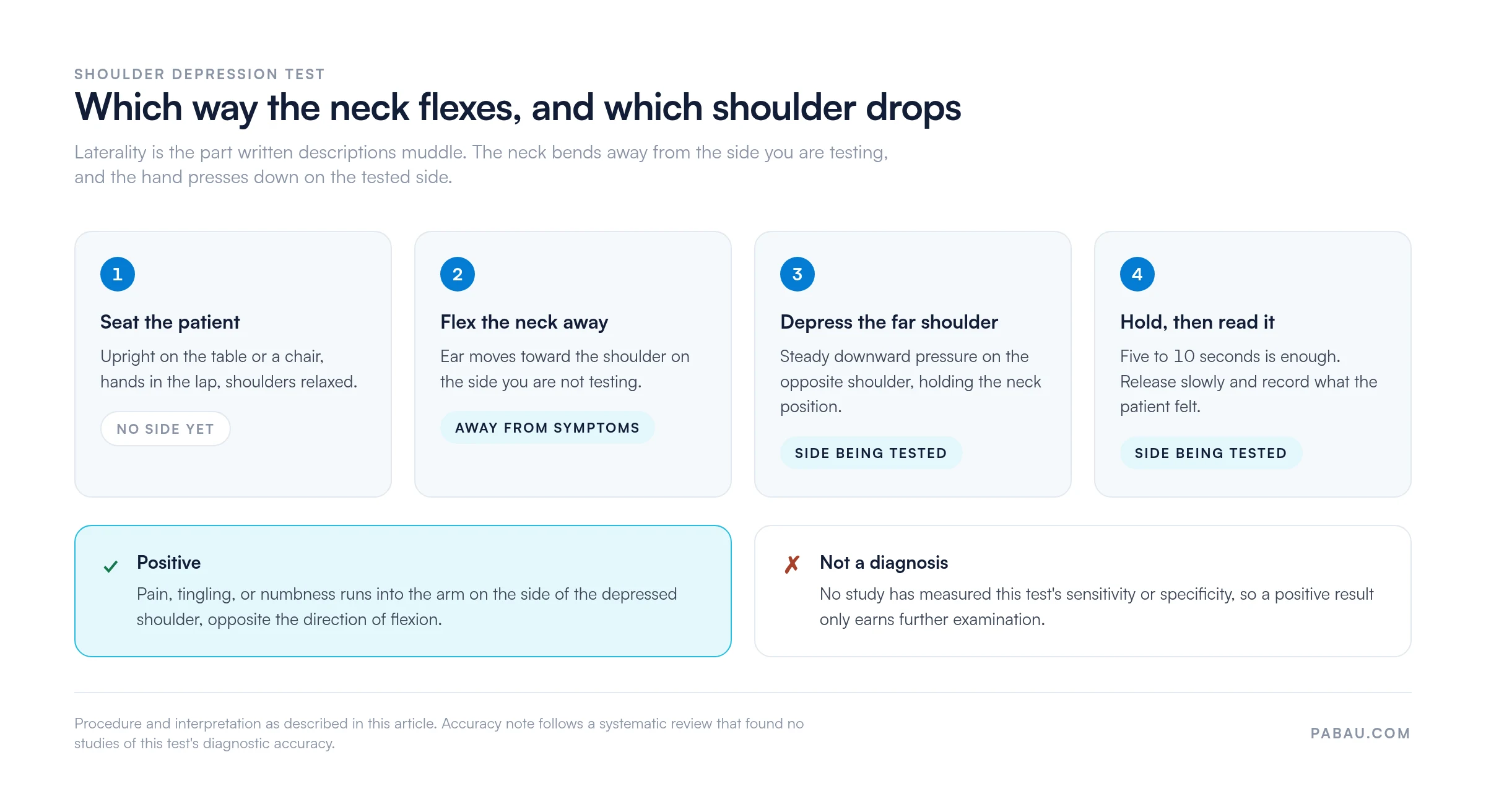
You are looking for the patient’s own symptoms, not for discomfort in general. A stretch that feels tight at the end of range is not a positive test.
A positive result points at nerve root compression or plexus tension. It does not confirm either one. Weigh it against palpation, range of motion, strength and reflex testing, and imaging where you have it.
No validated sensitivity or specificity data exists for this test. A published systematic review of provocative neck tests for cervical radiculopathy looked for studies measuring its diagnostic accuracy and found none. Any sensitivity, specificity, or likelihood ratio you see quoted for the shoulder depression test has no study behind it.
That is worth stating plainly, because it changes how you use the result. An unmeasured test cannot raise or lower the probability of a diagnosis by a known amount. Treat a positive finding as a reason to examine further, and treat a negative one as reassurance you have not confirmed.
Compression and distraction tests do have published accuracy figures, so build your reasoning around those and let this test add context. Documenting your finding either way still has value. It gives you a baseline to compare against at the next visit.
The maneuver lengthens several tissues at once. Nerve roots, the dural sleeve, the plexus, the scalenes, and the upper trapezius all take tension together. When something hurts, the test cannot tell you which of them produced it.
Patient factors shift the answer too. Fear of movement, an expectation of pain, and a history of being told what the test is for all change what gets reported. Asking an open question about location and quality gives you better information than asking whether it hurts.
Some presentations rule the test out, and some call for a lighter hand:
Explain the maneuver before you start, so the patient knows to speak up. Watch the face as much as the shoulder. Stop at once if symptoms worsen sharply or new neurological signs appear.
Laterality is the detail that gets lost first, and it is the one that makes the note re-readable six weeks later. Structured medical records management keeps these fields in the same place on every chart:
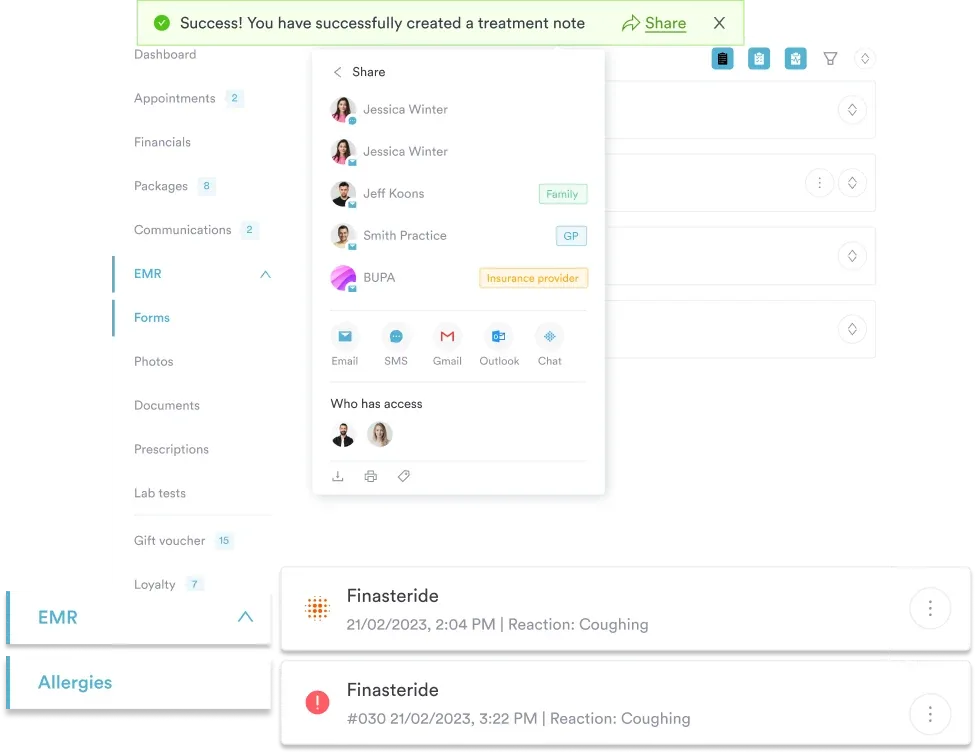
A template does the remembering for you. Every clinician in the practice records the same fields in the same order, which is what makes two sets of notes comparable.
No cervical screen rests on one maneuver. These are the tests this one usually sits beside:
If this test is positive, the upper limb tension tests are the usual next step. They narrow the finding to a specific nerve. Where the symptoms are positional or worse with the arm overhead, Adson’s test is worth adding to rule out thoracic outlet compression.
In most practices the assessment form and the chart live apart. A clinician fills in a paper sheet at the plinth. Later, someone retypes the useful parts into the record, or scans the sheet in as an unsearchable image. The side tested is exactly the detail that goes missing in that handover.
Practice management software like Pabau turns the same form into a digital one that writes straight into the patient record. You build the fields once, including the laterality and the response, and every clinician gets the same layout. The finding lands on the patient’s timeline next to the appointment it came from.
So the next visit starts from what you already know. You can see last month’s result, compare it to today’s, and show the patient the change without hunting through a folder. Charting takes minutes off each appointment, and the notes hold up when someone else in the practice picks up the case.


Build the shoulder depression test into a digital form and the result writes straight into the chart. The side tested and the response land on the patient’s timeline.

Get the laterality right and this test is quick, cheap, and genuinely informative. Flex away from the side you are testing, depress the shoulder on that side, and expect a positive result to show up in that arm. Anything else and you are reading the wrong limb.
Just do not ask the result to carry more than it can. Nobody has measured how often it is right, so it belongs in a cluster of findings rather than at the end of one. The trade-off is fair: a fast screen that helps you decide where to look next, as long as you write down what you actually did.
Download the template above and use it at the plinth. Book a demo to see how Pabau turns it into a digital form that files itself in the patient’s record.

Suspect first-rib or scalene involvement? The cervical rotation lateral flexion test checks first-rib mobility, which often sits behind stubborn cervicobrachial symptoms.
Screening cervical rotation as well? The cervical torsion test template separates neck-driven symptoms from vestibular ones, using the same documentation fields.
Working on the deep neck flexors? The cranio-cervical flexion test grades endurance, so you can track it across a course of treatment.
Positive result and planning treatment? These brachial neuritis exercises cover the progression clinicians reach for once the plexus is implicated.
It screens for cervical nerve root compression and brachial plexus tension. Lateral cervical flexion plus depression of the opposite shoulder puts those neural structures under traction and looks for reproduced arm symptoms.
Radicular symptoms appear in the arm on the side of the depressed shoulder, opposite the direction of flexion. That points at nerve root compression or plexus tension, and it calls for further examination rather than a diagnosis.
They load the nerve root in opposite directions. This test lengthens the plexus with flexion away from the tested side, while the Spurling test compresses the foramen with extension and flexion toward it.
Skip it with acute cervical fracture or instability, severe stenosis, recent cervical surgery, or progressive neurological signs. Also skip it where the patient cannot reliably describe what they feel.
No. A systematic review found no studies measuring this test’s sensitivity or specificity, so quoted figures are unsourced. Use it alongside history, imaging, and tests that do have published accuracy data.
Physical therapists, chiropractors, osteopaths, sports medicine physicians, and athletic trainers. It usually appears inside a wider cervical and upper limb examination rather than on its own.