Journal prompts for mental health
Journal prompts for mental health are guided questions that help people process ...

2
Last Updated: Oct 13, 2026

A self-sabotage worksheet takes a client from one recent episode to a written plan for changing it.
The free template runs three pages and eight sections, and the last one belongs to the clinician.
Section one pairs an open prompt with four behaviors: procrastination, negative self-talk, avoiding challenges, and perfectionism.
Sections four to seven are the action plan, covering goals, sources of support, and review dates.
Practice management software like Pabau sends the worksheet out and files the completed answers in the client record.
Three pages and eight sections, from one recent episode through to goals, support, and review dates. The last page is a signed observations and notes area for the clinician.
Download templateWhy do I keep doing this to myself? A self-sabotage worksheet gives a client somewhere to put that question they keep circling.
The free template above runs three pages and eight sections. It opens with one recent episode and closes with a plan the client committed to in writing.
Below is how each section works in practice.
The form turns a vague self-judgment into a specific, workable pattern. The client describes a recent action that worked against their own goal. Then they trace it backward to the cause and forward to a different response.
Self-sabotage is internal, which is what makes it hard to see. An external obstacle announces itself. A client might avoid applying for the job they want. Another picks a fight before intimacy deepens.
Either way the barrier is theirs, and writing it down is what makes it visible.
The behavior is rarely self-destructive on purpose. Usually it protects the client from failure, exposure, or the risk of wanting more than they believe they deserve. Meet it with curiosity rather than judgment, and the client keeps filling in the form honestly.
Where the sheet ends up matters as much as the conversation. Therapists who run a caseload through therapy practice management software keep each completed sheet with the session note.
The pattern then stays visible across appointments, not just in the one where it surfaced.
The worksheet opens with name, age, and date, then a one-line statement of purpose. After that it runs eight sections in a fixed order. Every one of them is open text, apart from the behavior checklist in section one.
Sections one to three are the diagnostic half. Four to seven are the plan. Section eight is yours.
There is no trigger log in this form and no thought record. It works at the level of the pattern rather than the individual thought. Pair it with a cognitive restructuring sheet when a client needs to test the evidence behind one specific belief.
Section one names procrastination, negative self-talk, avoiding challenges, and perfectionism. Those four cover most of what walks into a session. The fifth option is a blank marked “other”, and that blank is usually where the useful material sits.
Write the client’s own words in that blank rather than a clinical label. A client who reads back “I cancel things I was looking forward to” recognizes themselves. A label like “avoidant behavior” is much easier for them to argue with.
Section two asks three questions, and the order matters. Why did you do it, has this happened before, and what emotions or thoughts go with it. Most clients answer the third one most easily, so start there when the first stalls.
The section also asks whether the pattern has appeared before, and that question earns its place. A client who can date the pattern to a particular period usually stops treating it as a character flaw.
Keep their answers where the next appointment can reach them, so section two is not re-litigated from memory every month.
The form works best when the ground is already prepared. Run through these five before you print a copy.
Working through all eight sections takes about 45 minutes. Most therapists split it, covering sections one to three in the room and sending the client home with four to seven.
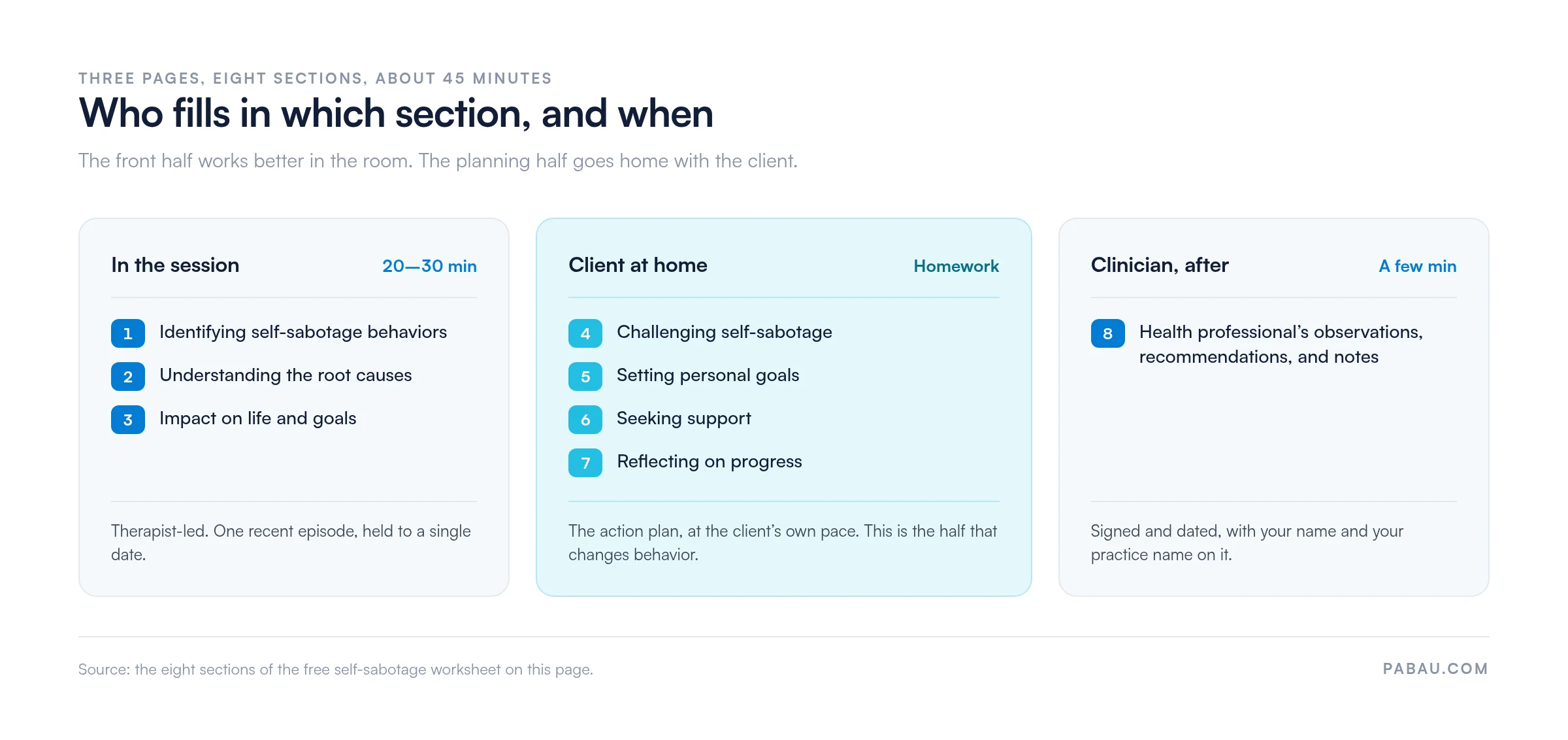
How you deliver the blank copies decides how many come back. An email attachment gets lost in a thread. Sending it through a client portal keeps it with the client’s record, and signals that it is part of their treatment.
Most self-sabotage handouts end once the root causes are on paper. This one keeps going for four more sections, and that is the part worth protecting when time is short.
Section four asks for specific ways to challenge the pattern, then for the positive behavior that replaces it. The second half is the one clients skip. Stopping a behavior leaves a space, and the old behavior returns unless a new one fills it.
Push for a replacement smaller than the one they want to write. A client who puts down “stop avoiding my inbox” has named an absence, not an action. “Open it at 9AM with coffee” is an action they can manage on a bad morning.
Section five wants clear, achievable goals with the steps for each one written out. Perfectionism will fight you here. A client who writes “stop procrastinating entirely” has set a goal they can only fail at. Break it down until the first step takes ten minutes.
Section six asks who can help, and then how the client will seek and use that help. The second question is the point. Naming a supportive friend costs nothing. Deciding to text that friend on the evenings when the goal slips is a plan.
Section seven asks the client to schedule dates for regular reflection, and to assess improvements and challenges at each one. A date on paper is the difference between a plan and an intention. Ask them to write the first date down before they leave the room.
The practice can also support those review dates between appointments. Automated reminder workflows prompt the client on the date they chose, so the review happens even when they forgot to write it down.
The last page belongs to you. It carries an observations, recommendations, and notes area, a signature line, and fields for your name and your practice name.
That is more than a formality. A signed, dated sheet with your recommendations sits in the client’s file. It records what was discussed and what was agreed. When the client returns and says it is happening again, you have the earlier pattern and your own note beside it.
Write it while the session is still fresh. A note reading “client identified perfectionism, first review set for March 12” is worth far more in six weeks than a general impression.
Four problems come up again and again, and all four are avoidable.
The form has no relationship-specific section, so you adapt the open prompts instead. Section one takes the episode, section two takes the attachment history, and section three takes the cost to the relationship.
Relationship sabotage tends to fire on closeness rather than on failure. A client starts an argument as things get good, or goes quiet when a partner moves nearer.
Under section two’s question about associated emotions, ask what happens in their body when the partner gets close. That answer is usually more specific than the reasons they can talk their way to.
Skip it when the client cannot yet name a goal. The whole form assumes a goal is being sabotaged. A client in crisis or without direction has nothing for sections three and five to work on.
It is also the wrong tool when the obstacle sits outside the client. Not every stalled goal is self-sabotage. A client blocked by money, caring duties, or discrimination can end up blaming themselves for a barrier they did not build.
And where trauma is driving the pattern, section two can open more than one session can hold. Read your client before you send those prompts home as homework.
Plenty of practices email this worksheet as an attachment and then wait. The completed copy comes back as a phone photo, or it does not come back at all. Section eight then gets typed into a separate notes field weeks later.
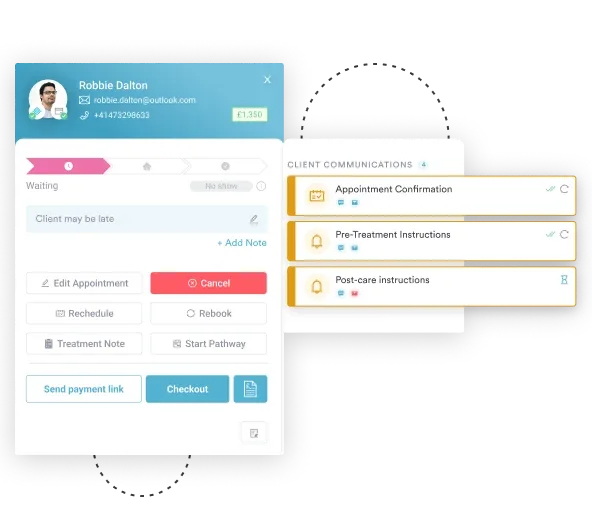
Practice management software like Pabau closes that loop. You attach the self-sabotage worksheet to the client’s next appointment as a digital form. Their answers land in the client’s record, so your section eight notes sit beside the session note.
The review dates from section seven get the same treatment. Pabau messages the client on the date they chose, without anyone in the practice having to remember it. If they do not respond, you can see that before the next appointment instead of during it.


Deliver the self-sabotage worksheet as a digital form and file the client’s answers in their record. Automated reminders then cover the review dates the client set in section seven.

Reach for this worksheet when a client keeps arriving at the same wall. The first three sections give you the pattern, sections four to seven are what make the client commit a plan to paper.
The trade-off is that the form asks a lot of a client at home. Four sections of planning, after a session that already went deep, is a lot to ask. Give them the back half when you think they will do it, and keep the front half for the room.
Then write section eight while it is fresh, and store the signed sheet where the next appointment can find it. Book a demo to see how Pabau delivers therapy worksheets and files the completed answers in the client record.

Is the sabotage mostly putting things off? Procrastination worksheets break the delay down into the trigger, the avoided task, and the first ten-minute step.
Need to get underneath the root causes in section two? Core beliefs inventory surfaces the belief that keeps producing the same behavior.
Are section five’s goals coming back too vague to use? SMART goals worksheet forces a measurable target and a date onto each one.
Looking for the replacement-behavior side of section four? Positive reframing worksheet gives clients a method for writing the alternative rather than guessing at it.
Building out the rest of your worksheet library? Therapeutic worksheets collects the printable forms therapists use most across intake, assessment, and homework.
Usually fear, low self-worth, unresolved trauma, or a loyalty conflict with family. The behavior protects the client from an outcome they are not ready to face. Section two of the worksheet asks them to name it.
No. It is a behavior pattern rather than a diagnostic category, so the DSM-5 does not list it. Self-sabotage shows up alongside anxiety, depression, ADHD, and trauma presentations.
Procrastination is one form of it. Self-sabotage covers any behavior working against the client’s own goal, so perfectionism, withdrawing from people, and turning down opportunity all count.
Sections four to seven work as homework. Sections one and two need a clinician to catch blind spots, and section eight requires one. Self-guided use sits alongside therapy, never in place of it.
Yes, with plainer wording. Ask why they think it happened instead of naming root causes, and keep section two short. Do not let a parent fill in section one for them.
Yes, for the goal-setting half. Sections four to seven fit coaching well. Section two can surface trauma, though, so refer out rather than work it yourself.