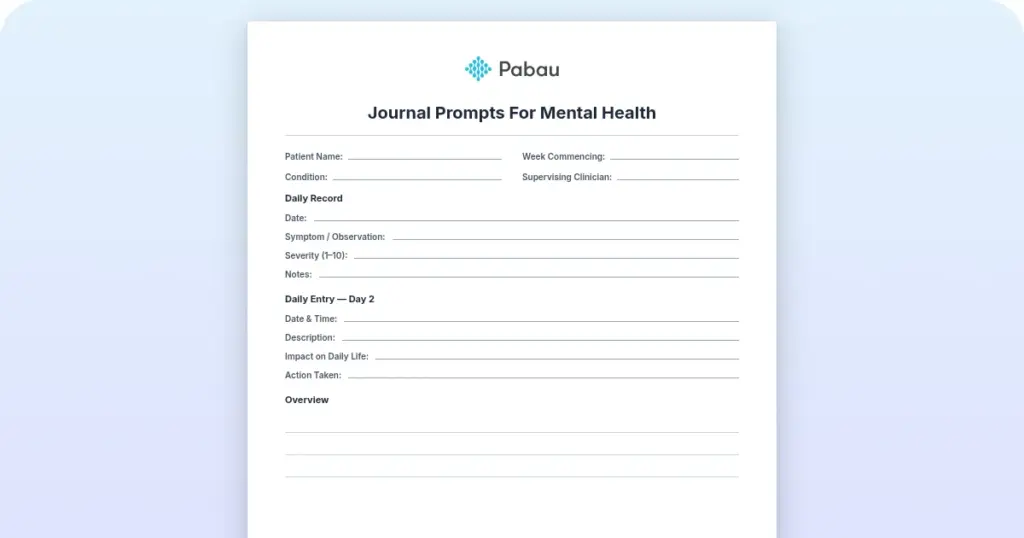
Journal prompts for mental health
Journal prompts for mental health are guided questions that help people process ...

2
Last Updated: Oct 13, 2026

Therapeutic worksheets are evidence-based clinical tools that reinforce treatment between sessions.
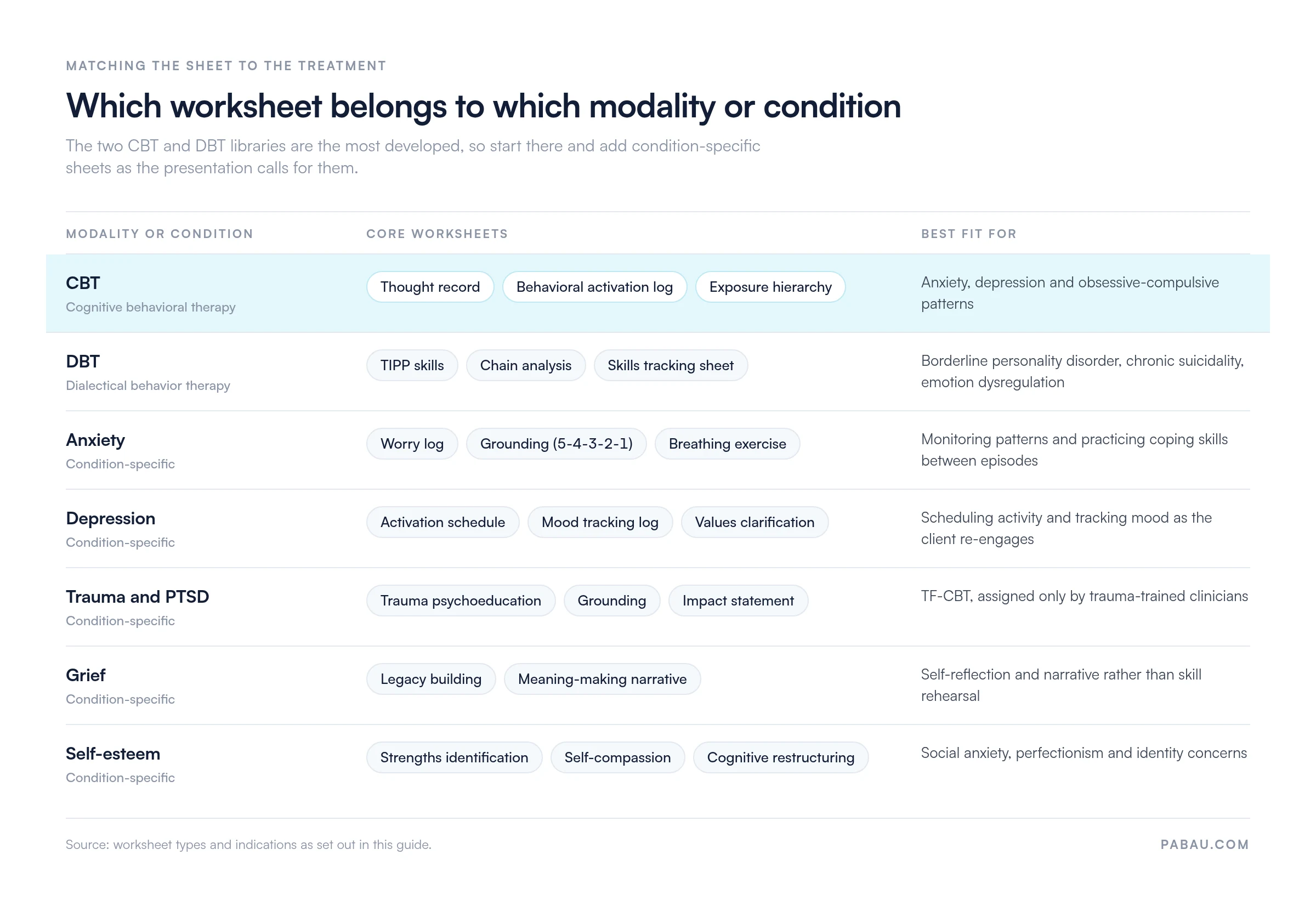
CBT and DBT have the deepest worksheet libraries, with condition-specific sets for anxiety, depression, trauma, grief, and self-esteem.
A worksheet only counts as clinical work once the completed sheet is filed in the client record.
Free libraries hand you the PDF, but they stop short of assigning, tracking, and documenting it.
Download the free pack below to skip building thought records and skills sheets from scratch.
Ready-to-print worksheets across CBT, DBT, mindfulness, anxiety, depression, trauma, grief, and self-esteem work. Customize any sheet, then assign it and file the completed copy in the client record.
Download templateTherapeutic worksheets turn what happens in session into something a client can practice at home. They are the standard vehicle for evidence-based homework, and homework compliance is one of the strongest predictors of a good outcome.
This guide covers the modalities with the deepest worksheet libraries, the conditions each one addresses, and where a sheet sits in your workflow. The free pack above gives you ready-to-print templates for CBT, DBT, mindfulness, anxiety, depression, trauma, grief, and self-esteem work.
Therapeutic worksheets are structured clinical tools that carry a session’s work into the days between appointments. They guide clients through self-reflection, behavioral exercises, thought patterns, skill practice, and coping strategy development. Unlike generic self-help material, they sit inside an evidence-based modality such as CBT, DBT, mindfulness-based intervention, or acceptance and commitment therapy (ACT).
The clinical purpose is specific. Worksheets give clients homework that reinforces therapeutic gains, extends your reach past the session boundary, and creates accountability for behavioral change. They also become a shared reference point, so you and the client can review completed sheets together and track progress.
The worksheets you assign are part of the treatment record. They must comply with HIPAA in the US and data protection standards such as GDPR in the UK.
Store them securely in the client record and retain them for the period your jurisdiction requires. Share them only with authorized staff, or with the client’s explicit consent.
The five stages below cover how a sheet moves from your library to the session note. Each stage also shows where the worksheet sits at that point.
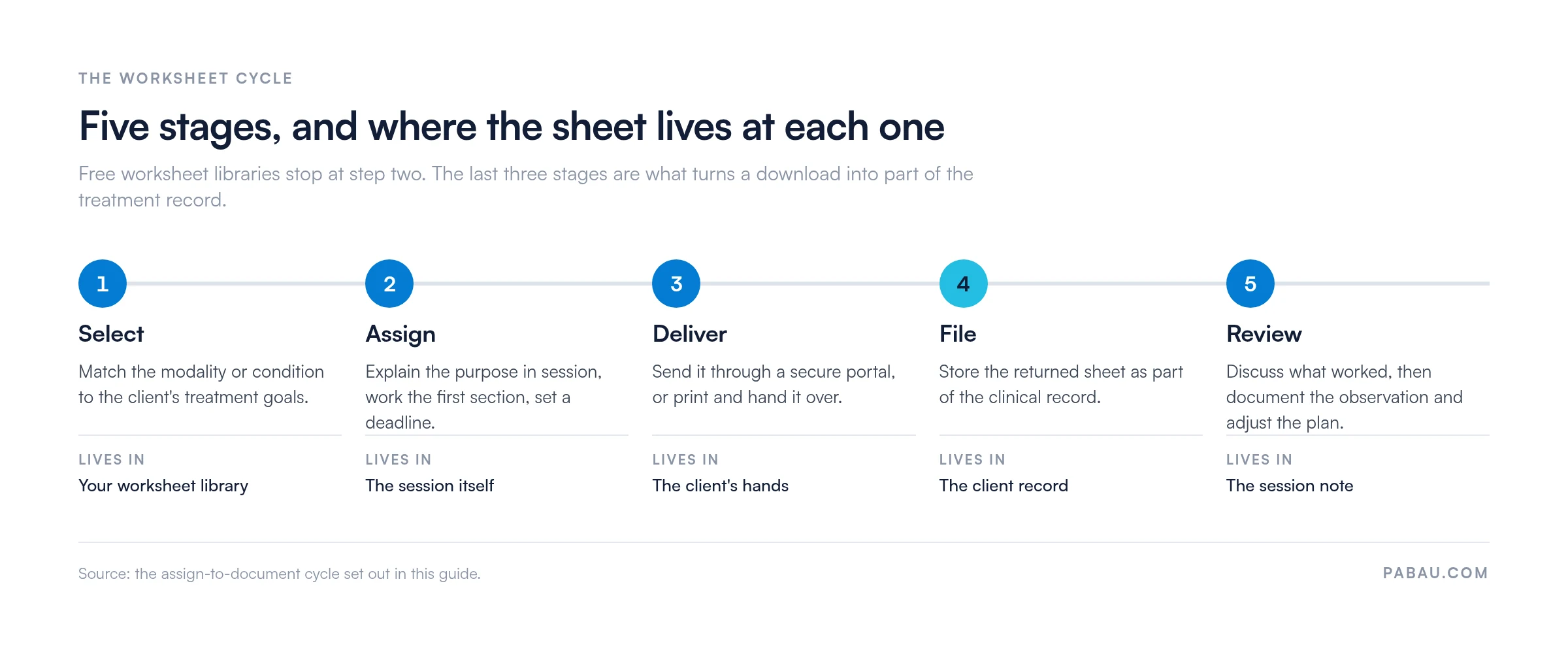
This cycle keeps worksheets inside your clinical work instead of treating them as optional extras. Homework compliance correlates with better outcomes in both CBT and DBT. A deliberate assign-and-review habit therefore pays off twice, in results and in engagement.
Individual therapy practices (psychology practices, counseling agencies, private therapists) build their between-session homework around worksheets. A solo practitioner or small group can keep a library, customize sheets to a client, and track completion without extra admin.
Group therapy and psychoeducation programs lean on worksheets heavily. Facilitators use them to structure discussion, assign the week’s skill practice, and give every participant something to take home. Group-oriented sheets include icebreakers, reflection prompts, and skill cards for modules such as DBT skills training.
Psychiatry and medication management practices use worksheets to support adherence, track mood and anxiety, and reinforce behavioral change alongside prescribing. Mood tracking sheets and side effect logs extend your oversight between quarterly medication reviews.
Pediatric and adolescent practices need age-appropriate sheets. A child therapist treating anxiety might use a simple worry log with child-friendly graphics. An adolescent therapist treating depression might assign a behavioral activation sheet built around teen routines.
Youth sheets often include a parent component, such as a homework checklist signed by parent and teen, or a family communication exercise.
They extend your clinical reach past the session. A 50-minute session is bounded. The week that follows is not. A worksheet assigned as homework means the client keeps practicing the skill or tracking the pattern for days. Research on CBT outcomes puts homework compliance among the strongest predictors of treatment success.
They make progress measurable. A sheet completed over a week produces objective data. Comparing sheets session to session shows concrete movement, such as fewer anxious thoughts, more coping attempts, and better mood ratings. That evidence builds client confidence and tells you what to adjust.
They cut your prep time. Instead of building a custom exercise for each client, you draw from a vetted template library. A standard thought record, emotion regulation sheet, or grief tracking form is already clinically sound and ready to adapt. That leaves more time for assessment, formulation, and the interpersonal work only you can do.
They strengthen your documentation. Completed sheets stored in the record show evidence-based intervention, informed consent, and ongoing monitoring. If a case is audited, reviewed by a supervisor, or challenged, that file speaks for itself.
They raise engagement and accountability. Assigning homework tells the client their own work matters. The frame is a partnership, where you guide and the client practices. That dynamic improves retention as well as outcomes.
Assigning, sending, chasing, and storing worksheets is easier when practice management software like Pabau keeps them inside the client record. Book a demo to see how worksheet admin stops eating into your clinical time.
Cognitive Behavioral Therapy (CBT) and Dialectical Behavior Therapy (DBT) have the two most developed worksheet libraries. Both depend on structured skill building between sessions, which is exactly what a worksheet delivers.
CBT worksheets work the cognitive triad of thoughts, feelings, and behaviors. Three sheets carry most of the load:
These fit anxiety, depression, and obsessive-compulsive patterns best. If you want one sheet to start with, the thought record worksheet does more clinical work than any other CBT form.
DBT worksheets center on skill building and emotional regulation. Each module has its own sheets, covering mindfulness, distress tolerance, emotion regulation, and interpersonal effectiveness. The TIPP sheet covers temperature, intense exercise, paced breathing, and progressive muscle relaxation. It hands the client immediate options during distress.
Chain analysis sheets help a client map the sequence of events and decisions that led to a problem behavior. Skills tracking sheets let them log weekly practice. A full set of DBT therapy worksheets is standard in treating borderline personality disorder, chronic suicidality, and emotion dysregulation.
Both modalities treat homework completion as a marker of engagement. Clients who finish CBT or DBT homework between sessions do better on symptom reduction, alliance, and relapse rates.
Beyond modality, worksheets are organized by presenting condition. Each condition has its own tailored interventions that a client practices between sessions.
Whichever sheet you pick, tell the client why. Someone with health anxiety gets more from a psychoeducation sheet on worry and physical sensation before any exposure assignment. A secure client portal makes it straightforward to send the sheet and see who has returned it.
Group programs use worksheets differently from individual therapy. A group sheet is usually a discussion device. It opens conversation, builds cohesion, and leaves every participant with something to practice that week.
Group therapy sheets include icebreakers, discussion prompts, and skill cards that participants fill in together. A DBT skills group might teach emotion regulation with a sheet in session, then send each member home with a weekly practice tracker.
Youth-focused sheets adapt language and design to developmental level. A 12-year-old with anxiety might use a colorful worry log with illustrations. A 17-year-old might use a fuller thought record built around social anxiety, academic pressure, and identity questions.
Adolescent sheets often carry a parent section, such as a shared communication exercise or family-based homework. Group and youth sheets also normalize the work, since every other member is doing it too. Filing them in the client record keeps them part of the official documentation.
Yes. The modalities behind them are extensively researched and endorsed by major clinical bodies. The American Psychological Association recognizes CBT and trauma-focused CBT as evidence-based for anxiety, depression, and PTSD.
The UK’s National Institute for Health and Care Excellence (NICE) recommends CBT and behavioral activation as first-line treatments for depression. Research on homework compliance points the same way.
Clients who complete worksheets between sessions see faster symptom reduction, a stronger therapeutic alliance, and lower relapse rates than clients who do not.
A worksheet is only as good as its implementation, though. A generic anxiety sheet handed over with no context and never reviewed contributes little. Effective use comes down to four steps:
The five-stage cycle earlier in this guide builds those steps into your routine.
Free worksheet libraries stop at the download. TherapistAid, Psychology Tools, and ChoosingTherapy all hand you the PDF, and none of them touch the practice workflow around it.
Organizing a library, assigning a sheet, and sending it securely are still yours to do. So is tracking who returned it and filing it in the record. The loop closes when therapy practice management software holds the worksheet inside the client’s care record.
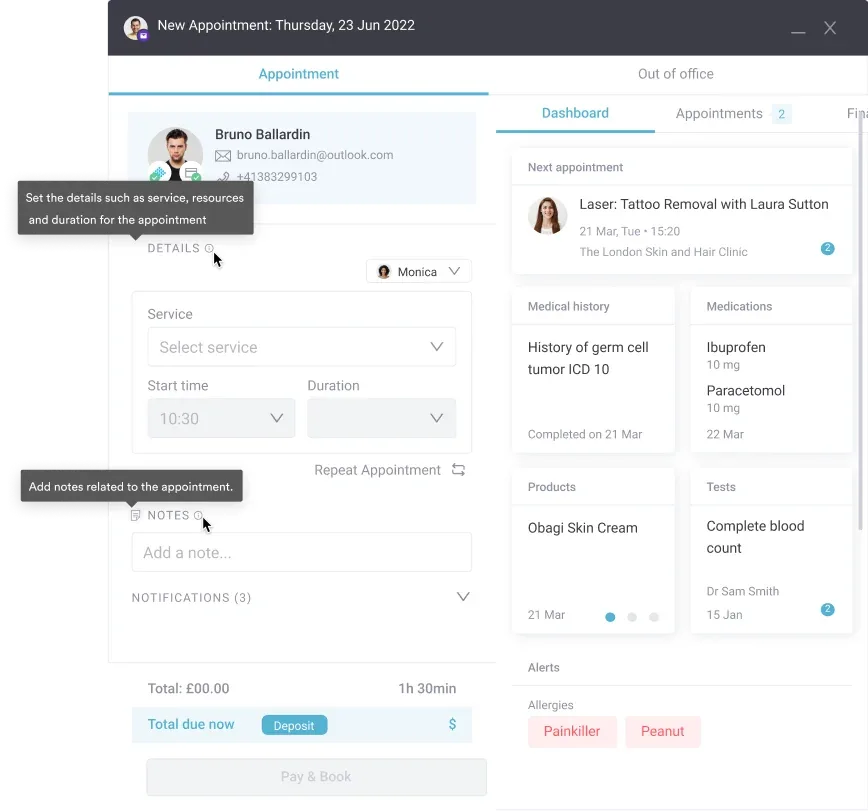
In Pabau’s mental health EMR, the sheet never leaves the client’s file. Instead of downloading a PDF and emailing it separately, you can:
That keeps you out of a second system. The worksheet stays in the clinical record from assignment through review, which supports both your documentation obligations and the treatment itself.

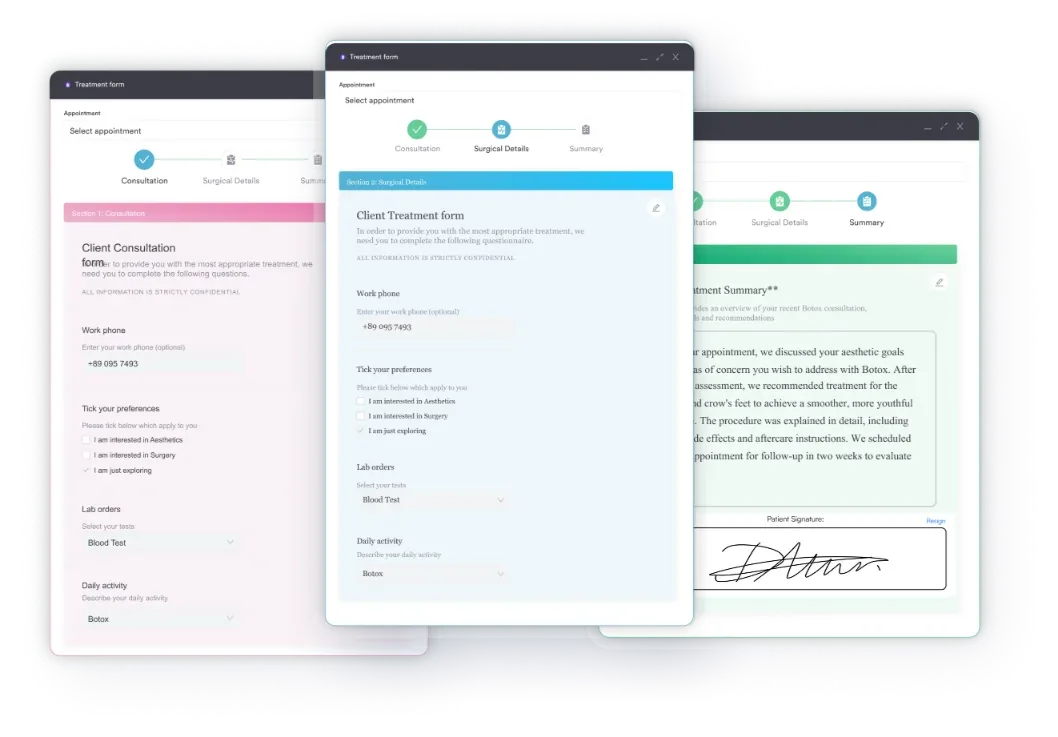
Pabau’s digital forms and client portal let you assign a worksheet and track who returned it. The completed sheet files itself in the client record, so there is no second system to check.

Worksheets are the cheapest clinical leverage available to you. Choosing the right one takes a minute, and it changes what a client does with the following week.
The trade-off worth remembering is that a sheet only counts once it comes back and gets read. Assign fewer worksheets and review every one, rather than handing out more than you will ever look at.
Download the free pack above, pick the two sheets your caseload needs most, and build the review step into your next session. Book a demo to see how Pabau keeps every assigned worksheet in the client record instead of your downloads folder.

Treating depression? Behavioral activation worksheet turns activity scheduling into a week the client can follow.
Need something for acute distress? Grounding techniques worksheet gives clients concrete options when the next session is days away.
Working with bereavement? Stages of grief worksheet supports narrative and meaning-making rather than skill rehearsal.
Documenting what the sheet revealed? Mental health note template gives you a structure for the session note that follows.
Comparing platforms to hold all of this? Top 7 mental health software ranks the options for US practices.
They are homework assignments that extend treatment between sessions. Clients use them to practice skills, track patterns, or work through a structured exercise tied to their modality and condition. They also give you objective data on progress and barriers.
The exercises are self-guided, but they work best when a therapist assigns and reviews them. A worksheet gives structure. The therapist interprets what comes back, adjusts the approach, and keeps the sheets serving one coherent treatment plan. Used alone from a free library, a worksheet may still help, but it lacks that clinical oversight.
Set a clear deadline, ask for the sheet back at the next session or through your portal, and record completion in your notes. If a sheet does not come back, find out why. The assignment may have felt irrelevant, been forgotten, or been too hard. Use what you learn to pace the next one.
CBT worksheets work the link between thoughts, feelings, and behaviors, using tools like thought records and behavioral activation. DBT worksheets build skills across four modules, covering mindfulness, distress tolerance, emotion regulation, and interpersonal effectiveness. CBT applies broadly. DBT is more intensive and usually reserved for emotion dysregulation or chronic suicidality.
Yes. Child and teen sheets differ in language, visual design, and content. A 10-year-old might use an illustrated worry log, while a 16-year-old gets a thought record pitched at teen social concerns. Adolescent sheets often add a parent component, such as a shared communication exercise.