CRM for chiropractors: how to manage patients, bookings and marketing
A CRM for chiropractors is a patient relationship management system built around...

Last Updated: Oct 13, 2026
The lateral scapular slide test measures how far each shoulder blade sits from the thoracic spine, then compares the two sides.
A side-to-side difference of 1.5 cm or more at any of the three arm positions counts as a positive result. That points to scapular dyskinesis, a movement impairment, rather than to a specific structural injury.
The test needs only a tape measure and a skin marker, so it works in the practice or pitch-side. Below are the three arm positions and the landmarks to mark. The guide then covers how to read the result against the 1.5 cm threshold, and what to do when it is positive.

The lateral scapular slide test measures bilateral scapular asymmetry at 0, 45, and 90 degrees of arm elevation.
A side-to-side difference of 1.5 cm or more is the most widely cited positive threshold, though not universally agreed upon.
Inter-rater reliability is moderate, with ICC values of 0.6 to 0.8, so combine the test with other special tests.
A positive result directs treatment toward serratus anterior activation and scapular retraction exercises to address scapular dyskinesis.
Practice management software like Pabau lets you store each LSST measurement in the patient record and compare sessions.
The lateral scapular slide test is a quantitative assessment that compares the resting position of each scapula. You measure from the medial scapular border to the nearest thoracic spinous process, on both sides. Altered scapular kinematics are reported in up to 68% of patients presenting with shoulder pain, rotator cuff pathology, or glenohumeral impingement.
The scapula acts as a dynamic platform for the rotator cuff. When it sits too far from the thoracic spine at rest, or fails to upwardly rotate during arm elevation, the subacromial space narrows. The serratus anterior and lower trapezius are then mechanically disadvantaged. The test quantifies how far the scapula has drifted from neutral, giving a reproducible number instead of a visual impression.
Three muscle groups govern scapular position, and each one changes how you read the result.
The key landmark is the medial scapular border. Take it level with the inferior angle, or the spine of the scapula, depending on the variant you use. The nearest ipsilateral thoracic spinous process is the fixed reference. Side-to-side asymmetry of that distance captures protraction, winging, and rotational deviation in one measurement.
The test requires minimal equipment, which makes it practical in the practice and pitch-side.
Ask the patient to remove their shirt or wear a sports top that exposes the full scapular region. The patient stands barefoot or in flat shoes, facing away from you. Correct posture is a neutral spine, feet shoulder-width apart, and weight evenly distributed.
Note any marked scoliosis or thoracic kyphosis in your findings. Spinal curvature introduces measurement variance, and it can make one side look more protracted than it is.
Mark the target landmarks on both sides before you start measuring. That keeps the numbers consistent if a colleague re-tests the patient, or if you repeat the measurement at a different arm position.
The test is performed at three standardized arm positions. Each position loads the scapular stabilizers progressively, so a deficit that appears only at 90 degrees means something different from one present at rest.
Write down the exact spinous process you used as the reference. Without it, a repeat measurement at the next visit can drift enough to look like progress.

A side-to-side difference of 1.5 cm or greater at any arm position is the most widely cited positive threshold. It comes from the original work of Kibler and colleagues, and it signals clinically meaningful asymmetry. A difference under 1.0 cm sits within normal variation. The cut-off is not universally agreed upon, and some studies report asymptomatic overhead athletes exceeding 1.5 cm without pathology.
Magnitude alone does not settle the reading. Where the difference shows up matters as much, and the chart below takes both into account.
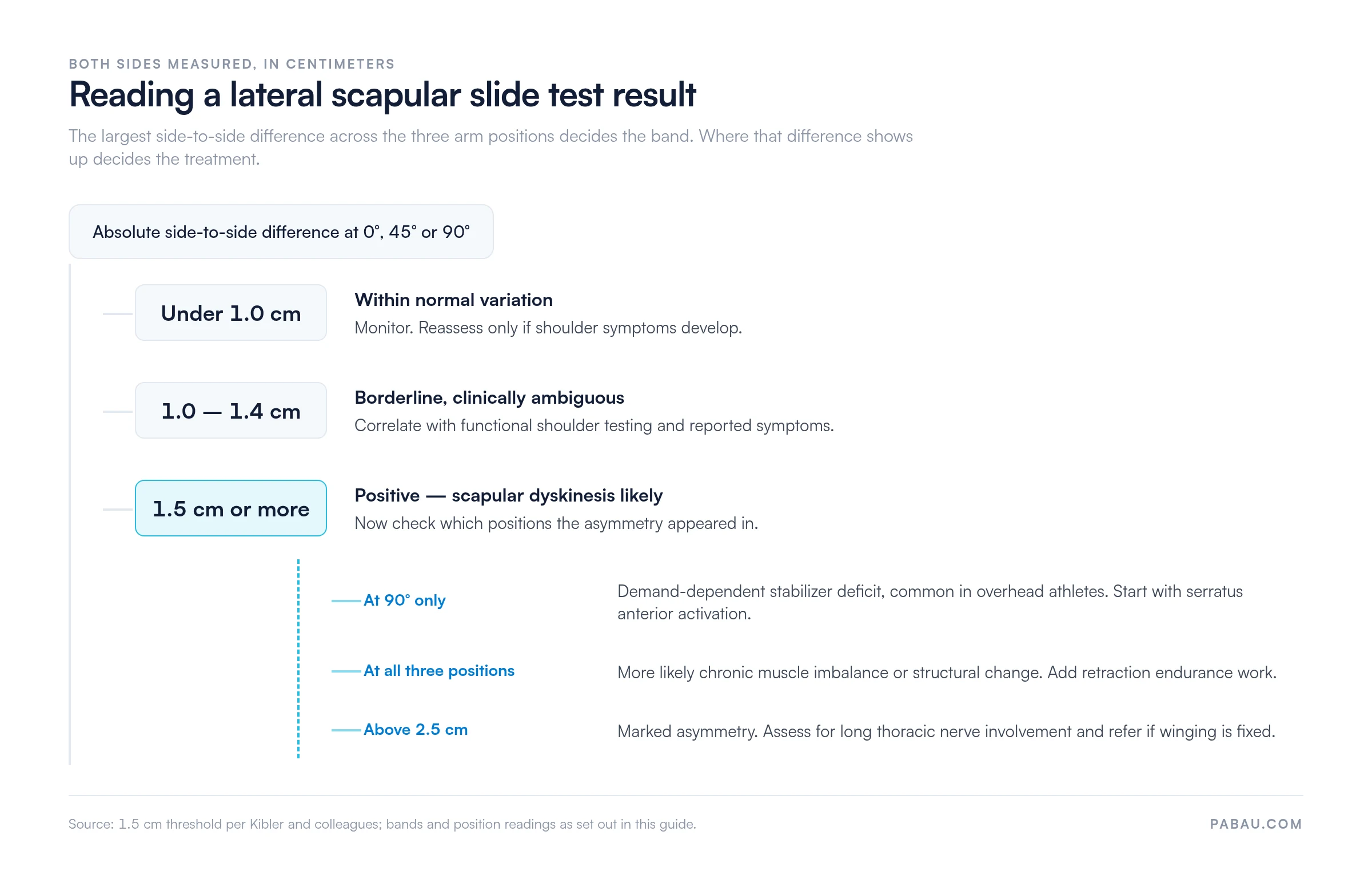
Asymmetry that appears only at 90 degrees suggests a demand-dependent stabilizer deficit. Overhead athletes with early scapular dyskinesis often present that way. Asymmetry at all three positions, rest included, more often reflects chronic muscle imbalance or structural change.
A difference above 2.5 cm counts as marked asymmetry. At that level, assess for long thoracic nerve involvement, and refer if the winging is fixed rather than positional.
Reliability data for the test is mixed, so treat it as a screen rather than a standalone diagnostic tool. Published inter-rater intraclass correlation coefficient (ICC) values usually fall between 0.6 and 0.8, which is the moderate range. Those figures come from research published in the British Journal of Sports Medicine. Intra-rater reliability is generally higher, at ICC 0.75 to 0.90, so results are more consistent when the same examiner takes both measurements.
Sensitivity and specificity for detecting a specific shoulder pathology, such as a rotator cuff tear, are limited when the test is used alone. A study indexed on PubMed (PMID 12839208) found limited specificity for shoulder dysfunction in asymptomatic athletes. The test screens for scapular asymmetry, a movement impairment, and cannot identify a damaged structure.
Always perform the LSST at least twice at each arm position and average the two measurements. Single-trial readings introduce meaningful variability, particularly at 90 degrees where patients tend to adjust their posture between attempts.
Four factors reduce LSST accuracy, and each one belongs in your findings.
Used as a screen and a progress-tracking measure, the test earns its place. It reports whether asymmetry is present and by how much. Identifying which structure is injured takes imaging, or a battery of other special tests.
No single scapular test covers every clinical scenario. The table below sets the LSST against three related assessments, so you know when to reach for which.
Combining the LSST with the Kibler dyskinesis test gives a stronger picture. The LSST quantifies the positional deficit at rest, while the Kibler test shows whether that deficit worsens dynamically. Add the wall push-up test when you suspect lateral scapular winging.
The LSST fits three clinical workflows. A physical therapy EMR lets you embed it as a structured field in the initial shoulder evaluation, so the numbers stay comparable across visits.
Whichever workflow you use it in, record the findings so a colleague can pick up the case without re-testing. If your current notes system cannot hold a structured measurement, our comparison of physiotherapy practice management software is the place to start.
A positive lateral scapular slide test points to the next stage of assessment and treatment. Management aims to restore normal scapular kinematics, beginning with low-load motor control work and progressing to functional strengthening.
For lower-limb work running alongside shoulder rehabilitation, our return to running protocol shows how progressive milestones and objective measures sit in one treatment record.
Re-test the LSST every four to six sessions to track asymmetry reduction. If the side-to-side difference has not improved after six weeks of targeted work, consider referral for imaging. That rules out structural contributions such as long thoracic nerve palsy, a subscapularis tear, or acromioclavicular joint pathology.
Most practices record an LSST result as free text inside a session note. Six numbers buried in a paragraph are hard to compare with the numbers from four sessions ago. They are harder still for a colleague covering the case.
Practice management software like Pabau lets you build the measurement into a structured form instead. Our patient intake software holds a custom LSST form that captures both sides at each of the three positions. It flags any difference at or above 1.5 cm. The result files against the patient record, not into a separate spreadsheet.
From there the numbers behave like any other tracked measure. You can see the trend across sessions and trigger a follow-up reminder when a re-test is due. The landmark you used travels with the record, so a colleague can repeat the measurement exactly.


Pabau gives physical therapy and sports medicine practices one place to record LSST measurements and track session-by-session progress. Automated reminders bring shoulder rehabilitation patients back for re-testing on schedule.

The value of the LSST sits in repetition. One measurement tells you whether asymmetry is present today. A series of measurements, taken the same way by the same examiner, tells you whether your rehabilitation is working.
That only holds if the method stays fixed. Use the same landmarks and positions every time, average two trials, and write down the reference spinous process. Get that right and a tape measure becomes an outcome measure.
Track those values from initial assessment through discharge and you build a clearer picture of progress than a visual impression can give. Book a demo to see how Pabau records shoulder assessments and schedules the re-tests that prove they worked.

Screening the rotator cuff in the same session? Infraspinatus test covers the technique and the findings that point to external rotation weakness.
Need to rule in subacromial impingement? Neer’s test sets out the passive elevation maneuver and how to read a painful arc.
Suspect a subscapularis problem behind the asymmetry? Belly press test explains the setup and what a positive result changes in the plan.
Assessing the upper back alongside the shoulder? Trapezius tear test walks through the strength testing that separates a tear from simple inhibition.
The lateral scapular slide test detects and quantifies bilateral scapular asymmetry. That asymmetry is a primary indicator of scapular dyskinesis and associated shoulder dysfunction. Clinicians use the test to screen athletes, post-surgical patients, and people with shoulder impingement. It also tracks changes in scapular alignment during rehabilitation.
A positive result is a side-to-side difference of 1.5 cm or greater, measured at any of the three standard arm positions. The distance runs from the medial scapular border to the nearest thoracic spinous process. That threshold is the most widely cited in the literature. Asymptomatic overhead athletes can exceed 1.5 cm without pathology, so read the number alongside symptoms.
Reliability is moderate. Inter-rater intraclass correlation coefficient values typically range from 0.6 to 0.8, so results can vary meaningfully between examiners. Intra-rater reliability is higher, at ICC 0.75 to 0.90. To improve consistency, standardize landmark identification, average two measurements at each position, and record the specific spinous process used.
The lateral scapular slide test quantifies scapular position across three arm elevations using tape-measure distances. The winged scapula test, usually the wall push-up test, assesses serratus anterior strength by provoking medial border winging under load. The LSST captures positional asymmetry at rest. The wall push-up test captures dynamic serratus failure under closed-chain loading. Use them together rather than interchangeably.
Treatment begins with serratus anterior activation in low-load positions, such as wall slides and supine protraction. It progresses to lower trapezius strengthening through prone Y-T-W drills and scapular retraction exercises. Closed-chain and sport-specific loading follow as the asymmetry reduces. Re-test the LSST every four to six sessions to track progress objectively.