Therapeutic interventions list
A therapeutic interventions list is a reference of evidence-based treatment tech...

Last Updated: Oct 13, 2026

A trigger worksheet turns a vague statement like “I get anxious” into a named situation, a named response, and a coping plan.
Internal triggers come from thoughts, memories and sensations, while external triggers come from people, places and events, and each needs a different strategy.
The clinical value shows up across four to eight weeks of entries, not in any single completed sheet.
Trauma work needs a grounding skill the client has already practiced before you hand over a trigger worksheet.
Storing completed worksheets in the client record, rather than a paper folder, keeps the pattern visible at the next review.
A ready-to-use clinical form with sections for internal and external triggers, emotional and physical responses, coping strategies, and post-session reflection. It works across mental health, trauma, and addiction recovery caseloads.
Download templateTrigger worksheets give a client language for the moment before a reaction, and that language is what makes the rest of therapy workable. The core idea is simple. A trigger has two halves, one internal and one external, and the form makes the client name both.
Grounding does little for a client whose trigger is a specific colleague, and avoidance planning does little for intrusive memories. Below you’ll find what the form contains and how to introduce it. You’ll also see how it adapts to trauma, addiction, and younger clients.
A trigger worksheet is a clinical form that helps a client pinpoint what sets off an emotional or behavioral reaction. That can be a person, a place, a thought, a memory, a physical sensation, or a situation.
The form breaks the identification into steps, so nobody has to introspect from a blank page.
The American Psychological Association defines a trigger as a stimulus that elicits a reaction, which is deliberately broad. The worksheet narrows it down to something you can work with. It moves a client from “I get anxious” to “when my partner raises their voice, my chest tightens and I want to leave the room.”
The template splits the work into six short sections. Each one asks for a different layer of the same event, which is why clients can complete it without a long explanation from you.
Sorting a trigger into internal or external decides which coping strategy has any chance of working. Get it right before you write the plan, because the two categories pull in opposite directions.
Most clients bring both. A client who dreads a Monday meeting is describing an external trigger. The thought that arrives with it is internal, and the two need separate responses.
Bring the worksheet in early, ideally while you are still building the formulation. That way it reads as part of a shared assessment rather than a verdict on how the client is coping.
Those five steps span more than one appointment, and the sequence below shows where each one falls in a treatment episode.
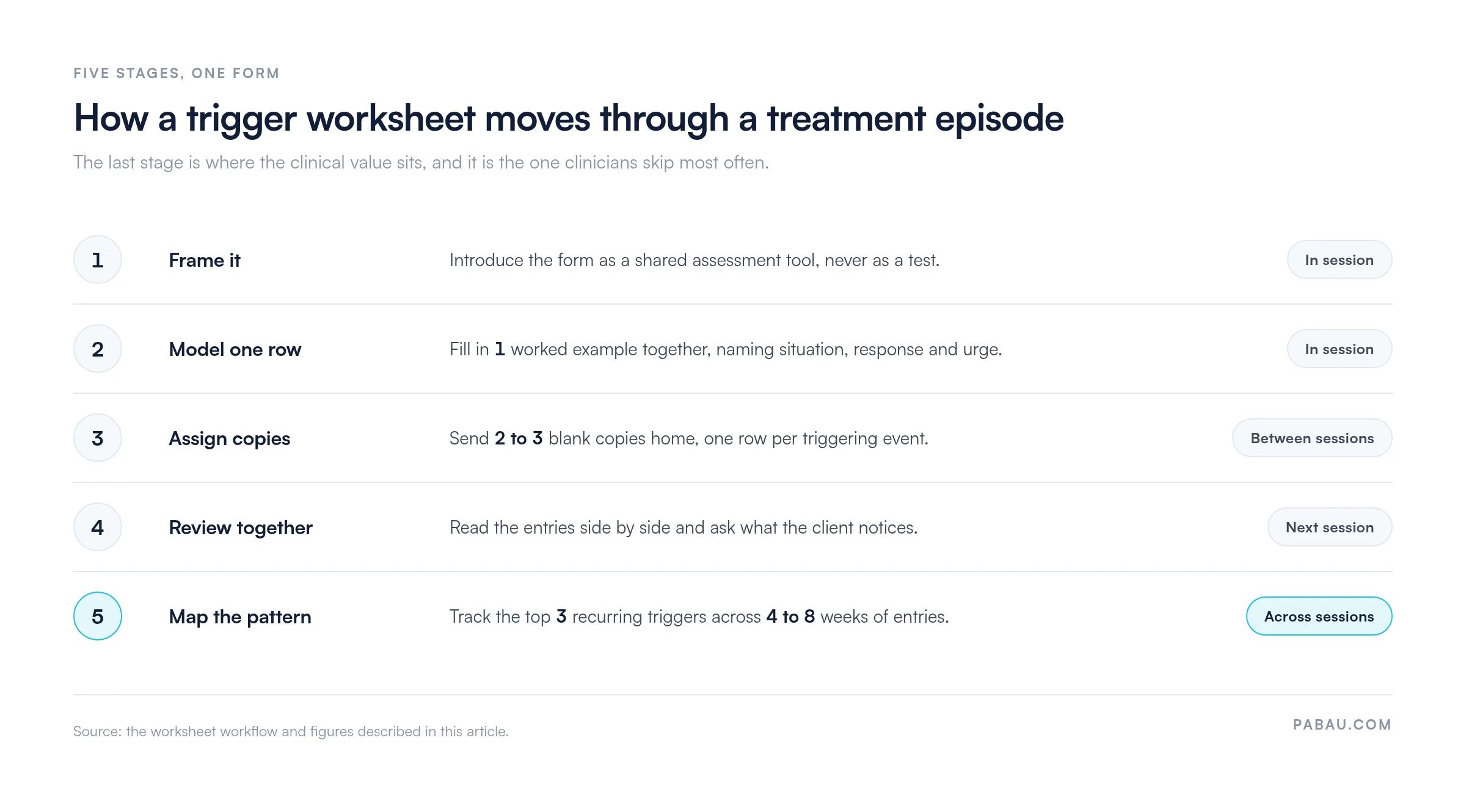
A single completed sheet describes one bad afternoon. Trigger mapping plots those sheets against each other, and that is where the pattern turns into something you can treat.
The method is deliberately low-tech. Keep a running chart with five columns: date, trigger, category, emotional response, and the coping strategy the client tried.
After four to eight weeks, three answers surface. You can see whether the same trigger keeps returning, whether the client’s coping is holding up, and whether a new trigger has appeared.
Longer-term work benefits most. Seasonal patterns, relationship cycles and stress clustering rarely show up in a single review. On a chart, you and the client usually spot them at the same moment.
Almost every failed rollout comes down to one of these. Each has a straightforward fix.
Clients living with anxiety, depression or emotion dysregulation often struggle to name what set a reaction off.
An emotion-focused version of the form scaffolds that by asking about mood, physical state and context before the feeling arrived.
Five fields do the work:
The rating is the field people skip, and it is the one that shows movement. “Anxious” looks the same in week one and week six, while an 8 that becomes a 4 does not.
Research suggests that clients who can name and track their emotions respond better to treatment for anxiety and mood disorders. Whether or not that holds for a given client, the tracking gives you something concrete to review.
Trauma triggers deserve a different sequence. Asking a client to catalog them before they can settle their own nervous system risks retraumatization. So the grounding skill comes first, and the worksheet second. Introduce it only once the client has used that skill successfully at least once.
A trauma version of the form carries four extra elements alongside the usual sections.
If you need a companion sheet for the skills half, a grounding techniques worksheet gives the client the practice material before the identification work starts.
In addiction and recovery work the same worksheet does a different job. It maps the high-risk situations, moods and social settings that have preceded use in the past. The client can then act on a plan while the urge is still manageable.
SAMHSA’s relapse prevention guidance treats early trigger identification as the point where intervention is still cheap.
The recovery version records five things. It captures the substance or behavior involved, the emotional state that came first, and the situational context. A coping plan and a short reflection close it out.
Once those patterns are on paper, they feed straight into a relapse prevention plan. That plan turns the client’s top triggers into named actions and named people.
Both frameworks use trigger identification, but they use it for different ends. The Beck Institute’s cognitive model runs from the situation to the automatic thought, then on to the emotional and behavioral response. Naming the situation is what lets you and the client examine the thought before the rest of the chain plays out.
DBT approaches it from the other side. Trigger awareness sits alongside emotion regulation and distress tolerance skills, and the worksheet becomes the raw material for a personal hierarchy of coping responses.
In CBT the trigger worksheet is often the step before a thought record. Once the situation is named, a 7-column thought record takes the client through the automatic thought, the evidence, and a balanced alternative.
Younger clients can use the same structure with plainer language and visual support.
For children aged 7 to 12, ask “what makes you feel really upset or worried?” Pair the sheet with drawings or emoji faces, and cap it at one or two triggers per session.
Teens can handle more detail, but keep the scaffolding. Many adolescents respond well to seeing the trigger, the emotion and the coping step laid out in order, because it makes something chaotic look manageable.
Plenty of practices still run worksheets on paper. The client takes a printed form home, brings it back or forgets it, and the sheet lands in a folder nobody opens between reviews. The pattern the worksheet was built to reveal never surfaces.
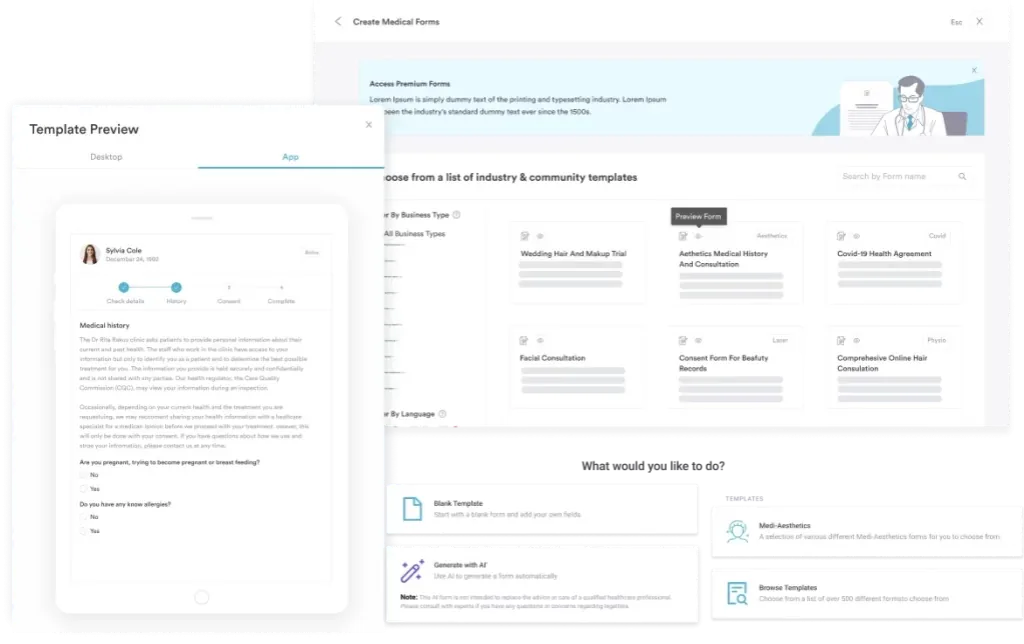
Practice management software like Pabau replaces that loop with a digital form. You build the trigger worksheet once in the template library, then send it to the client between sessions. Completed responses land in the client record, timestamped and sitting next to the session notes they belong with.
For a therapy caseload, that means the review step always has material. Pabau’s therapy practice management software keeps every completed sheet on one client timeline. You can scroll a month of entries during the session instead of shuffling paper.
The same mental health EMR holds the treatment plan, so linking a recurring trigger to an intervention is one note rather than a second system. Automated reminders can prompt the client to complete the week’s entry, which saves your front desk chasing it.
Complete the first example together in session, and say out loud that the client just did the work. A line like “that is exactly the kind of detail we need” costs ten seconds. Clients who experience the worksheet as collaborative rather than assigned are far more likely to keep using it.

Send trigger worksheets as digital forms, collect them between sessions, and review a month of entries from one client timeline instead of a paper folder.

The worksheet is easy to hand out and easy to waste. What separates the two is the review. A form you read with the client week after week becomes a record of what sets them off and what helps. One you collect and file is just homework.
So pick a cadence you can keep. Two or three entries a week, reviewed at the top of each session, will tell you more in a month. A single perfect worksheet never will.
If the filing is the part that keeps breaking, the fix belongs in your systems rather than your sessions. Book a demo to see how Pabau keeps completed worksheets, session notes and treatment plans on one client record.

Need the skills half of the plan? The coping skills worksheet turns each named trigger into a response the client has rehearsed.
Working with younger clients? Therapy worksheets for kids use the same structure with plainer language and visual prompts.
Want a baseline before you start tracking? The emotion regulation questionnaire measures how a client handles feelings before the worksheet work begins.
Need skills for the moment itself? DBT distress tolerance skills covers what a client can use when the trigger has already landed.
Treating anger or PTSD? The anger triggers diary narrows the same method down to one emotion and its escalation pattern.
One entry per triggering event works better than a fixed schedule. If events are rare, ask for a nightly review instead. Two to three entries a week is enough to show a pattern by the next session.
A trigger worksheet stops at the antecedent and the response. A thought record carries on, capturing the automatic thought, the evidence for and against it, and a balanced alternative. Many clinicians use both, in that order.
Work backwards from the body. Ask where the client felt the change first, then what happened in the ten minutes before it. Clients often recall a physical shift more easily than the situation around it.
Yes, if the worksheet informs your formulation or treatment plan, it is clinical documentation. Store it in the client record with a dated note on what you discussed, rather than in a separate folder.
Yes. A digital form sent between sessions tends to get completed closer to the event, which improves recall. Keep the mobile version short, because a long form on a small screen gets abandoned.