Anemia nursing care plan
An anemia nursing care plan is a structured document that guides a nurse from as...

1
Last Updated: Oct 9, 2026
Holotropic breathwork is a facilitated breathing practice that uses faster, deeper breathing, evocative music and a trained sitter to reach a non-ordinary state of consciousness. Holotropic breathing was developed by Stanislav and Christina Grof at California’s Esalen Institute in the 1970s, and a session runs two to three hours.
Participants work in pairs, swapping roles as breather and sitter. The fast breathing lowers carbon dioxide in the blood, which causes tingling and cramping and can bring up strong emotions. Heart disease, aneurysm, pregnancy, seizure disorders and psychiatric history all need screening first.
This holotropic breathwork guide is written for the practitioners who run sessions. It covers what the breathing does to the body, what the research shows and the three-gate breathwork screen. That’s a framework we built to turn contraindication lists into recorded booking decisions.

Holotropic breathwork pairs faster, deeper breathing with evocative music, release work and mandala drawing, usually in groups of breather and sitter pairs.
A breathing session typically runs two to three hours, and a weekend workshop gives each participant one turn as breather and one as sitter.
Fast breathing lowers carbon dioxide and narrows brain blood vessels, which is why stroke, aneurysm and seizure history top the screening tiers.
The evidence is promising but thin, with small studies and clinical reports and no large randomized controlled trial of holotropic breathwork itself.
The three-gate breathwork screen turns contraindications into three recorded decisions: intake screening, informed consent with a session plan, and a follow-up check-in.
Holotropic breathwork is a practice developed by Stanislav and Christina Grof that uses faster, deeper breathing and music to reach a non-ordinary state of consciousness.
The Institute for Holotropics describes holotropic breathwork as an experiential method of self-exploration that combines accelerated breathing, music and bodywork. The method draws on psychedelic research, depth psychology, transpersonal psychology and Eastern spiritual practice.
Stan Grof’s breathwork grew out of LSD research. Grof spent years on psychedelic therapy studies, including at the Maryland Psychiatric Research Center. After legal LSD use was suppressed in the late 1960s, the Grofs looked for a drug-free route to similar states. Grof’s own account dates the result to Esalen in the mid-1970s, which is why the method is sometimes marketed as psychedelic breathwork.
The holotropic definition comes from the Greek holos, meaning “whole,” and trepein, meaning “moving in the direction of something.” Put together, holotropic means “moving toward wholeness.”
Some sources call the practice holotropic therapy or breathwork therapy. The Institute’s own training page says its program is not a psychotherapy or counseling training. Cleveland Clinic recommends using holotropic breathwork alongside ongoing therapy, so emotions that surface have somewhere to go.
Holotropic Breathwork® is a registered trademark in many countries. Only practitioners certified through Grof Transpersonal Training (GTT), which also operates as the Institute for Holotropics, may use the name. The Institute publishes a guide to imitation formats that borrow the name without the structure.
A holotropic breathwork session runs two to three hours of accelerated breathing to music, then closes with release work, mandala drawing and group sharing.
Most sessions take place at a weekend workshop, where participants pair up and swap roles between the morning and afternoon. The breather lies on a mat with eyes closed. The sitter stays beside them, fetches water or tissues, and doesn’t breathe along or interpret what happens.
On a November 2026 Institute for Holotropics weekend in Minneapolis–St. Paul, Saturday holds two breathing sessions. They run from 8:30 AM to 12:30 PM and from 1:30 to 5 PM. The table shows how a holotropic breathing session breaks down, who leads each phase and the record each phase creates for your practice.
The holotropic breathing technique asks only that you breathe faster and deeper than usual, with no set rate, count or pattern to follow.
The Grofs’ principles deliberately give no further breathing instructions, which separates the holotropic breathing method from counted styles. Here’s how to do holotropic breathing as a breather, in order:
Holotropic breathwork music follows a planned arc, from activating rhythmic pieces through a dramatic breakthrough to quiet, meditative music as the session ends.
Grof describes five phases in a 2014 paper in the Journal of Transpersonal Research:
Grof advises against pieces with strong associations, such as famous wedding marches, because they steer what the breather experiences. Facilitators either build their own sequences or play a prerecorded program. A prerecorded set frees the facilitator for the group, but it can’t follow the energy of the room.
Cleveland Clinic says the most common experience is emotional release, which can range from sadness, anger or fear to heavy sobbing. Physically, breathers often notice tingling, cramping in the hands and lightheadedness. Grof reports that some people feel progressive relaxation or even mystical experiences instead.
We hear the same question from practitioners new to running groups: is the cramping a sign something is wrong? Grof’s answer is that tensions usually peak and then release, so sitters are trained to support them rather than stop the session.
Holotropic breathing lowers blood carbon dioxide, which makes the blood more alkaline, narrows brain blood vessels and causes tingling, cramping and lightheadedness until breathing slows.
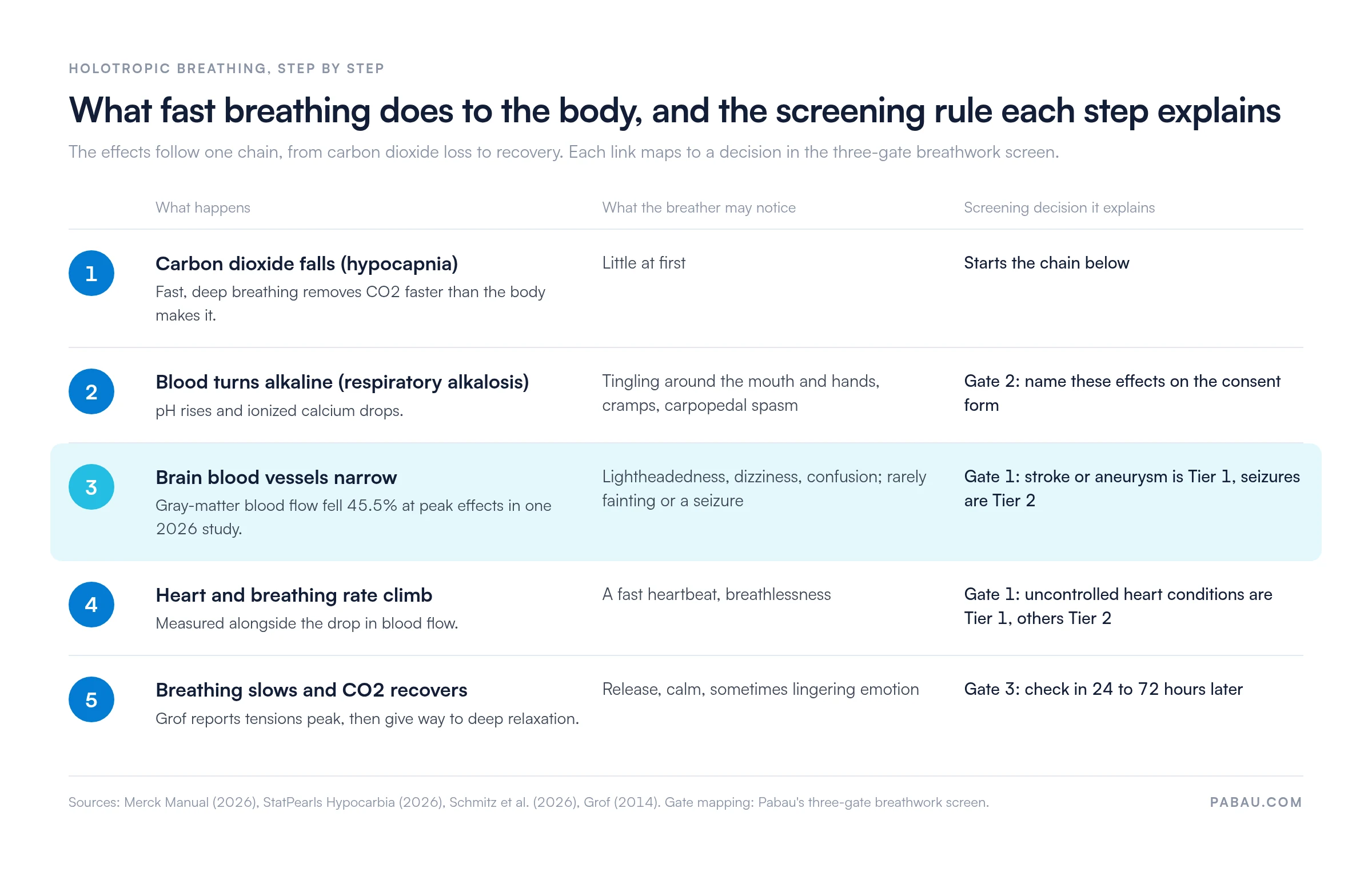
Researchers group holotropic breathwork with other fast-breathing styles under the label high ventilation breathwork. The physiology runs in a predictable sequence:
A 2025 study by Havenith and colleagues in Communications Psychology found that falling exhaled carbon dioxide correlated with the onset of altered states (r = −0.46). That correlation suggests the carbon dioxide drop helps produce the altered state the method is designed to reach.
Grof disputes the textbook reading of the cramping. In his 2014 paper he reported that, across more than 35,000 sessions, many breathers never developed classic carpopedal spasms. In those who did, he found the tension self-limiting, ending in deep relaxation.
This chain explains why Gate 1 of the three-gate breathwork screen is tiered the way it is. Narrowed brain vessels make stroke and aneurysm history a do-not-book answer. Seizure risk explains why epilepsy needs clearance, and cramping is why Gate 2’s consent form names the physical effects up front. The diagram maps each step to the decision it explains.
No published study has shown that holotropic breathwork causes brain damage, but the fast breathing does temporarily cut blood flow to the brain.
A 2026 study by Schmitz and colleagues scanned 30 experienced high ventilation breathwork practitioners. Gray-matter blood flow fell 45.5% at the point of strongest effects, alongside a faster heart and breathing rate. The study measured the drop during breathing and was not designed to test for lasting harm.
None of the studies in the evidence table below reported brain injury. Eyerman’s program logged no adverse reactions across about 11,000 psychiatric inpatients, though its sessions were shorter, at 90 minutes.
So concerns about holotropic breathwork and brain damage rest on a documented mechanism. No study has yet documented an injury. The risk sits with people whose brain blood supply is already compromised. That’s why stroke and aneurysm history are Tier 1 and seizure disorders need physician clearance.
Holotropic breathwork shows promise for self-awareness, death anxiety and well-being, but the evidence comes from small studies, not large randomized trials.
A PubMed search for the term returns only eight records (September 2026), and none is a large randomized controlled trial. A 2007 paper by Rhinewine and Williams described the method as a “prolonged, voluntary hyperventilation procedure.” The authors concluded that more rigorous research was needed to confirm or refute its benefits.
Read the Miller and Nielsen result closely before you quote it to participants. Paranoid ideation scores rose after the sessions, although they stayed within the normal range, and the authors called this a “wary phase.” That belongs in your consent conversation.
The Eyerman program also adapted the format. Inpatients breathed for 90 minutes inside a two-hour slot, well short of a workshop session. Its safety record doesn’t transfer directly to a three-hour group.
Holotropic breathwork contraindications include cardiovascular disease, high blood pressure, aneurysm, glaucoma, recent surgery, osteoporosis, seizure disorders, pregnancy and a history of psychosis.
Two first-party sources publish the official contraindications. GTT’s written principles require that physical and emotional contraindications be discussed before the first session, with expert assessment when there are concerns. Stanislav Grof’s screening guidance calls a medical examination a prerequisite and names the conditions that pose a serious risk.
Cleveland Clinic adds panic attacks, any condition that needs regular medication, and pregnancy or breastfeeding. Healthline adds glaucoma, retinal detachment and a family history of aneurysm.
The table below sorts each condition into one of three screening tiers. Tier 1 means do not book, Tier 2 means book only with written physician clearance, and Tier 3 means book with recorded bodywork limits. Treat the table as a practice screening aid, not medical advice.
Holotropic breathwork dangers are mostly short-lived hyperventilation effects, plus the risk of emotional material surfacing faster than someone can process it. Cleveland Clinic lists these typical hyperventilation symptoms:
The psychological risks are harder to spot. The Institute for Holotropics warns that without proper training, screening, preparation and integration, sessions can lead to panic, retraumatization or serious psychological consequences.
So is holotropic breathing dangerous? For a screened adult in a facilitated group, the documented effects are short-lived. For someone with an unscreened Tier 1 condition, the same breathing carries serious risk.
Holotropic breathwork at home, alone, isn’t the official method, because the Grof format requires a trained facilitator, a dedicated sitter, screening and integration.
The Institute for Holotropics says fast breathing alone at home, online, at a festival or with substances is not Holotropic Breathwork®. Solo practice also removes the person who would respond to the effects in the chain above:
If participants want a home practice between workshops, point them to slow methods that don’t aim to lower carbon dioxide, such as box breathing. Even the faster Wim Hof Method warns that intense rounds can, rarely, cause loss of consciousness. Tier 1 participants should agree any practice with their physician first.
The three-gate breathwork screen runs participants through intake screening, informed consent with a session plan, and a follow-up check-in, recording a decision at each gate.
A contraindication list tells you what to ask. Holotropic breathwork practitioners also need a rule for what happens after each answer, and proof that the rule was followed.
When we set up intake forms for wellness practices, the weak point is usually a single “any medical conditions?” box. A yes there can’t tell glaucoma from pregnancy, so the facilitator ends up reading every form by hand at the door.
The diagram below shows each gate and the decisions it can produce.
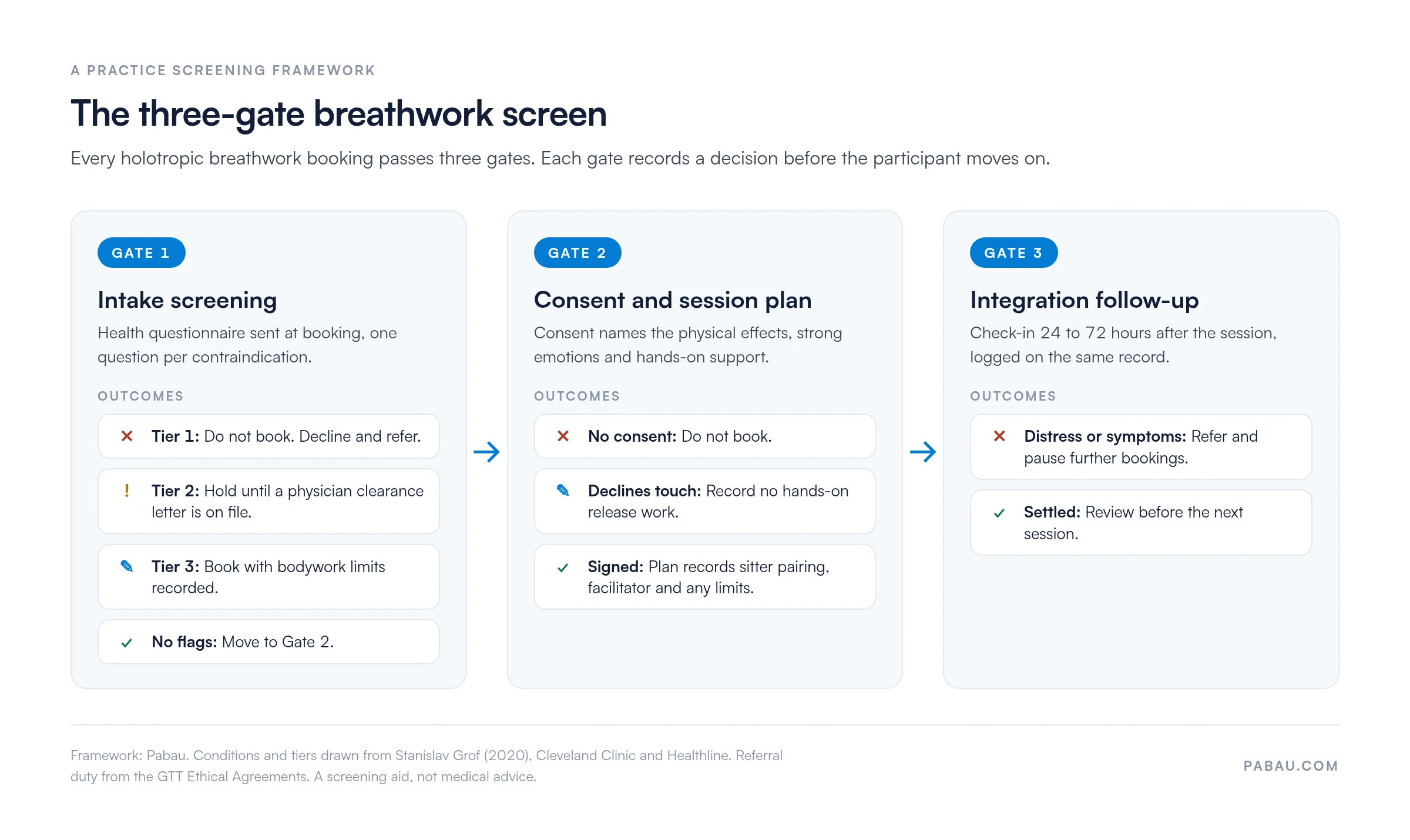
Every gate leaves a record. If a participant later reports a problem, you can show what they disclosed, what they agreed to and when someone checked on them. In Pabau’s practice management software, all three records sit on one patient file instead of three folders.
Pair Gate 3 with a wellness journal template, so participants can note emotions, dreams and insights between the session and the check-in.
Holotropic breathwork differs from other methods in session length and setting: two to three hours of breathing in a group, against minutes for box breathing.
Researchers group the fast-breathing styles under high ventilation breathwork. A 2023 review by Fincham and colleagues uses it as the umbrella term for deliberate fast, deep breathing. Rebirthing breathwork, founded by Leonard Orr in the 1970s, uses a continuous connected breath. Transformational breathwork, taught as Transformational Breath® by Judith Kravitz’s foundation, centers on full diaphragmatic breathing.
The Wim Hof breathing method alternates rounds of 30 deep breaths with a breath hold, usually as a short solo routine. Psychedelic breathwork names no method of its own. It is a marketing label for fast-breathing sessions sold on the promise of an altered state.
Havenith and colleagues compared holotropic and conscious-connected sessions directly in 2025. Both lowered carbon dioxide and produced highly similar outcomes, even though holotropic sessions ran about twice as long. For participants who land in Tier 1, a slow method like box breathing is the usual alternative to suggest, with their physician’s agreement.
Holotropic breathwork training for certification takes seven five-and-a-half-day modules, a two-week closing intensive, consultation hours and supervised workshops through the Institute for Holotropics.
The Institute says it is the only organization that can certify Holotropic Breathwork® facilitators worldwide. Stanislav and Christina Grof founded it in 1989, and Tav and Cary Sparks have owned and run it since 1998. Its certification process requires:
Certification also needs upkeep. To stay on the active list, facilitators attend a module at least once every three years. They also breathe as a breather at least twice a year.
Grof holotropic breathwork training now comes in more than one lineage. Grof Legacy Training teaches the method as Grof® Breathwork, a name Grof explained in 2020 as a trademark workaround. In the European Union, the Institute says the GTT name is held by an organization it has no affiliation with.
For theory, the standard text is Holotropic Breathwork: A New Approach to Self-Exploration and Therapy by Stanislav and Christina Grof (SUNY Press, 2010).
An official Institute for Holotropics weekend workshop costs $440 in Minneapolis–St. Paul for November 13–15, 2026, including Saturday lunch but not lodging. Prices vary by facilitator, location and format, so compare what each fee includes.
Start with the Institute’s certified facilitator list, which shows each person’s certification date and professional development status. Then run through these checks:
Many breathwork programs still run on a paper health form signed at the door and a consent sheet in a folder. The follow-up depends on someone remembering. That setup can’t show who cleared Gate 1 before they lay down to breathe.
When a participant books through Pabau’s online booking, digital intake forms go out automatically before the appointment. Every completed form feeds into the patient record. Build your contraindication questions into that questionnaire, so a Tier 1 answer is on file before the facilitator’s preparation talk.

Pabau also sends the consent form and pre-care instructions matched to whatever the patient books. With Pabau’s pre- and post-care software, you tick a box at booking and post-session messages queue automatically. That gives you a Gate 3 check-in without anyone setting a reminder, and every message is logged in the patient’s profile.
Treatment notes sit on the same record, so every facilitator on your team sees the intake answers, signed consent and session note together. Wellness centers and day spas can run breathwork beside their other services with Pabau’s spa software. Still comparing systems? Our roundup of the best wellness clinic software covers the alternatives.

Pabau sends your breathwork health questionnaire and consent form at booking, queues the post-session check-in, and keeps every answer on one patient record.

Holotropic breathwork earns its reputation as a powerful method, and that power is the reason it belongs in a screened, facilitated setting. The physiology is well understood: carbon dioxide falls, brain vessels narrow, and the body recovers when breathing slows. The risk sits in who you let onto the mat.
If you offer it, adopt the three-gate breathwork screen before your next workshop. If you don’t have a certified facilitator on staff, send participants to one on the Institute’s list. Record each decision, because a contraindication you asked about but never wrote down protects no one.
Book a demo to see how Pabau keeps your breathwork screening forms, consent and follow-up on one patient record.

Planning goals after a session? Personal wellness plan maps a participant’s goals across seven dimensions of wellness.
Tracking progress between workshops? Wellness journey template gives your practice a free template for following a patient’s progress over time.
Building your intake paperwork? Spa intake form template is a free intake form you can adapt for breathwork screening.
Helping participants keep routines between sessions? Health and wellness planner template is a free printable planner for daily habits.
Holotropic breathing is low-risk for screened, healthy adults in a facilitated group, but the dangers of holotropic breathwork are serious for some people. Hyperventilation can cause tingling, dizziness and hand or foot spasms, and strong emotions can surface. Heart disease, aneurysm, pregnancy, seizure disorders and psychiatric history all need screening first.
Not in the official format. The Institute for Holotropics says fast breathing on your own isn’t Holotropic Breathwork®, because the method depends on a sitter, trained facilitators, screening and integration. Practicing holotropic breathwork at home also removes the person who would respond to fainting, cramping or distress.
An official Institute for Holotropics weekend workshop in Minneapolis–St. Paul costs $440 for November 2026, including Saturday lunch but not lodging. Prices vary by facilitator, location and length. Check whether meals and accommodation are included before you compare two workshops.
The evidence is promising but limited. One small study linked the method to lower death anxiety, and a 2025 study tied deeper altered states to fewer depressive symptoms. No large randomized trial has tested it for anxiety or trauma. The Institute also warns that poorly run sessions can retraumatize, so use breathwork alongside therapy rather than instead of it.
Skip it if you have cardiovascular disease, uncontrolled high blood pressure, or a history of heart attack, stroke or aneurysm. The same applies during pregnancy or breastfeeding. Glaucoma, seizure disorders, recent surgery, panic attacks and psychiatric history need physician clearance first.