A BHRT consent form records what a patient was told before bioidentical hormone therapy, covering approval status, label risks, monitoring, alternatives and withdrawal rights. This free template is dated to FDA labels checked November 12, 2026, and the patient signs it after the prescriber reviews their intake answers.
The page also carries a full hormone therapy intake form for menopause and testosterone therapy patients, covering history, current hormones, symptoms, vitals and blood tests. Every risk line on the consent names its source and the date it was checked. Review both forms with your medical director and legal counsel before use.
Template details
Template type
Consent form
Format
Printable PDF, 3 pages
Sections
2 sections
Fields to complete
12 fields
Best for
Hormone Replacement Therapy (HRT)
PabauCLINICAL FORM TEMPLATE
BIO IDENTICAL HRT
IMAGE AND VIDEO CONSENT FORM
PabauCLINICAL FORM TEMPLATE
BHRT consent form
BIO IDENTICAL HRT
IMAGE AND VIDEO CONSENT FORM
PDF
Free download
Download your free BHRT consent form
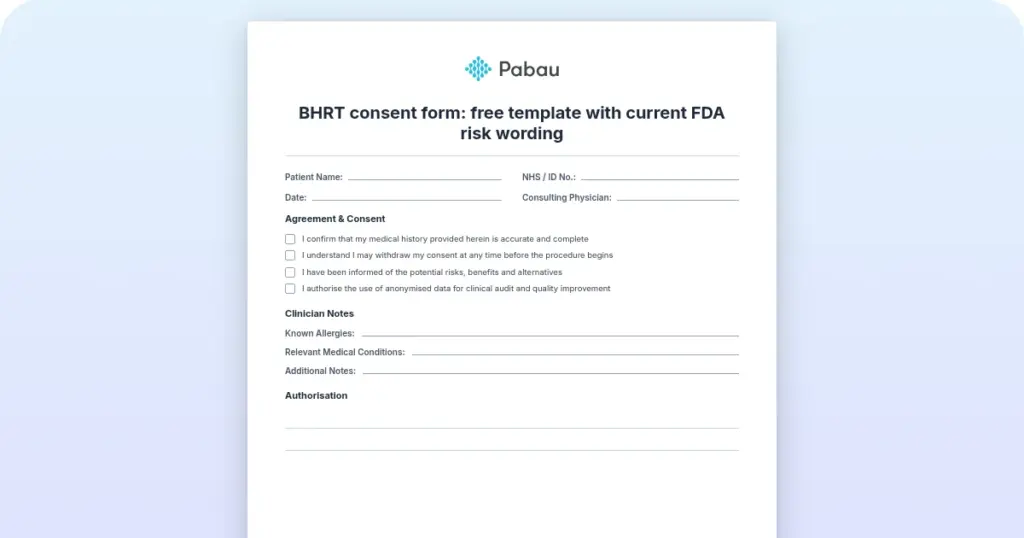
A three-page, print-ready consent form covering the hormones prescribed, a compounding disclosure and a six-row risk table with dated sources. It closes with contraindication tick-boxes, monitoring, withdrawal and payment lines, and patient, prescriber and witness signatures.
What’s inside
Patient, prescriber, practice and supervising physician details, with patient ID and date
Estradiol and progesterone by route, product type, dose and schedule
Compounding disclosure, the “bioidentical” statement and the reason for compounding
Six-row risk table with who each risk applies to and dated sources
Contraindication tick-boxes, monitoring commitments, alternatives and the right to withdraw
Patient, prescriber and witness signatures, with form version and review date
PDF · 3 pages · 79 KB•No sign-up needed•Updated September 2026
Generate it. Send it. File it automatically.
Turn this template into a Smart Form
Start from scratch, or upload this PDF or any form you already use, and Pabau's AI Form rebuilds it with tick boxes, text fields and a signature. Attach it to the treatment once, and every patient gets it on time.
Generate with AI from a PDF, Word file or photo
Precare before the visit, aftercare after checkout
Patient, prescriber, practice and supervising physician details, with patient ID and date
Estradiol and progesterone by route, product type, dose and schedule
Compounding disclosure, the “bioidentical” statement and the reason for compounding
Patient confirmation
I have read and understood this form
Patient signature
Smart Form ready
AI
Built from your PDF
2Sections
12Fields
Attached to service
Sends before the visit
This patient
Checked out
Sent
Signed
On record
Why practices run their forms on Pabau
Bring your forms across fast
AI Form rebuilds the consent, history and aftercare forms you already use. You review each one, then publish.
Save hours every week
Patients complete forms on their phone before they arrive, so the front desk stops retyping paper.
Stay audit-ready
Every signed form is versioned and attached to the treatment record, ready when you need it.
Ask patients once
Set how long a consent stays valid. Returning patients skip forms they have already signed.
Supports HIPAA and GDPR compliance•AES-256 encryption•4.8 on G2•4.7 on Capterra•Trusted by 4,000+ practices worldwide
Key takeaways
The free download is a three-page BHRT consent form, and the intake form that comes before it is written out in full on this page.
Compounded hormone preparations, pellets and creams included, are not FDA-approved, and the consent form says so in writing.
Since the FDA’s November 10, 2025 request, labels change product by product, and estrogen-alone products keep the endometrial cancer boxed warning.
Intake answers that match a label contraindication, such as past breast cancer or a blood clot, go to the prescriber before the patient signs consent.
Pabau, the practice management platform we build, sends both forms before the visit and saves the signed copies to the patient record.
Found our content helpful?
What the BHRT consent form covers
A BHRT consent form shows that the patient understood the treatment, its approval status and its risks before the first prescription. The National Academies’ 2020 recommendations ask prescribers to explain the limited evidence and say compounded preparations are not FDA-approved.
Our free download covers the consent part of that paperwork. It runs to three print-ready pages in eight sections, and every risk line names its source and the date it was checked.
We reviewed the BHRT consent forms that rank for this search, and none dated its sources or carried a prescriber signature. Several still describe compounded hormones as natural or FDA-monitored. The form holds these sections:
Patient and prescriber details: Names, date of birth, patient ID, credentials and the supervising physician or medical director
Hormones and routes: Estradiol and micronized progesterone by route, plus an FDA-approved, compounded or pellet tick-box for product type
FDA approval status: The compounding disclosure, what “bioidentical” does and doesn’t mean, and the prescriber’s medical reason for compounding
Risks: Six label risks, each with who it applies to and a dated source line
Contraindications: The current label’s list as patient tick-boxes, plus the pregnancy line
Monitoring: Yearly exams and mammograms, bleeding reports, progestogen use and the saliva-testing statement
Alternatives and withdrawal: Options discussed, questions answered, the right to withdraw and a neutral payment line
Signatures: Patient, prescriber and optional witness, with a form version and last-reviewed date
The consent covers estradiol and progesterone for menopause. A patient starting testosterone therapy needs a consent written to that product’s labeling. The intake history lives on this page too, in the hormone therapy intake form further down.
The pellet insertion consent and the prescribing record stay in your own systems. The consent form also carries one practice-policy line on paused refills, which you edit or delete before use.
A medical director usually checks two parts first. The compounding disclosure and the risk table are where older forms contradict current ACOG guidance on compounded hormones and the FDA’s 2025 labeling change.
Risks and contraindications to review before prescribing
Screening is finished before the patient signs the form. The prescriber reviews the intake answers, walks through the risk table with the patient, then checks every contraindication the patient ticked.
The risk table on the consent form
The risk section follows current FDA labeling, with six risk areas, who each applies to and the label it comes from. We used the Vivelle-Dot label (revised October 2026) and the Bijuva label (revised February 2026).
Risk
What the label says
Applies to
Source and date checked
Endometrial cancer
Estrogen without a progestogen raises endometrial cancer risk in a woman with a uterus. Adding a progestogen lowers the risk of endometrial hyperplasia.
Systemic estrogen alone, with a uterus. The boxed warning stays.
The table makes no efficacy claims. Benefits belong in the prescriber’s conversation, and the consent form records the risks.
Answers the prescriber reviews before treatment
Flag every intake or consent answer that matches a contraindication or warning in the product’s FDA-approved labeling. The prescriber reviews each flag before treatment. Staff do not interpret the answer. They make sure the prescriber sees it.
Section 5 of the consent form lists the estradiol label’s contraindications as patient tick-boxes, so the intake answers get a second check at signing. Labeling is product-specific, and the table uses two current labels checked November 12, 2026.
Estradiol contraindication: active DVT or PE, or a history of either.
Flag for prescriber review
Stroke or heart attack, now or in the past
Estradiol contraindication: active arterial thromboembolic disease, or a history of it.
Flag for prescriber review
Liver disease
Estradiol contraindication: hepatic impairment or disease.
Flag for prescriber review
Protein C, protein S or antithrombin deficiency, or another clotting disorder
Estradiol contraindication: known thrombophilic disorders.
Flag for prescriber review
Gallbladder disease
Estradiol warning: estrogens increase the risk of gallbladder disease.
Flag for prescriber review
High triglycerides
Estradiol warning: estrogen may raise triglycerides and lead to pancreatitis.
Flag for prescriber review
Thyroid medication
Estradiol warning: monitor thyroid function in women on thyroid replacement.
Flag for prescriber review
Known or suspected prostate cancer
Testosterone contraindication.
Flag for prescriber review
Enlarged prostate or urinary symptoms
Testosterone warning: BPH symptoms may worsen. Evaluate for prostate cancer before starting.
Flag for prescriber review
High blood pressure that is not controlled
Testosterone labeling: not recommended with uncontrolled hypertension.
Flag for prescriber review
Sleep apnea, or risk factors such as obesity or chronic lung disease
Testosterone warning: treatment may worsen sleep apnea.
Flag for prescriber review
Plans to father a child
Testosterone warning: large doses may suppress sperm production.
Flag for prescriber review
Hematocrit above the reference range
Testosterone warning: a rise may require lowering or stopping treatment.
Flag for prescriber review
Allergy to the product or its ingredients
Estradiol contraindication: known anaphylaxis, angioedema or hypersensitivity to the product.
Flag for prescriber review
Migraine with aura, diabetes and smoking stay on the intake form because prescribers weigh them. Neither label lists any of the three as a contraindication, so the form records them without a flag.
Pregnancy is worded differently on updated labels. The Vivelle-Dot label says hormone therapy for menopause is not indicated for use in pregnancy, so the form uses that wording.
Age and timing go on the record as well. The Menopause Society’s 2022 position statement calls the benefit-risk ratio favorable for women under 60, or within 10 years of menopause onset, without contraindications.
Monitoring instructions to give the patient
Section 6 of the form turns monitoring into commitments the patient signs. Repeat them on a plain-language sheet, so the patient keeps a copy after the visit:
Have a breast exam, a pelvic exam and a mammogram every year, unless your prescriber advises otherwise
Report any vaginal bleeding to the practice right away, because bleeding after menopause needs evaluation
Take a progestogen as prescribed if you have a uterus and use systemic estrogen
Keep the follow-up visits and blood tests on your prescriber’s plan
Call the practice straight away about loss of vision, severe high calcium, pancreatitis linked to high triglycerides, or jaundice that returns. The label says estrogen is stopped then
The form also rules out saliva and urine hormone tests for setting the dose. The Menopause Society calls them unreliable and does not recommend them.
Reminders keep that schedule on track. Pabau runs recall Workflows by SMS, email or WhatsApp. The workflows skip patients who already have a booking, so nobody gets chased for a visit they have already made.
Treatment records and prescribing details
A prescribing record shows what was prescribed, why, and which consent version covered it. It’s the first document you check when a patient reports a side effect or a compounded product becomes unavailable.
Record field
What to note
Why it matters
Hormone and product
Product name, or the compounding pharmacy
Shows which prescribing information applies to the patient
Product type
FDA-approved, compounded or pellet
Decides whether the compounding disclosure and pellet consent apply
Dose, route and schedule
Each hormone, with its route
A route change calls for a new signature
Reason for compounding
The medical reason, such as an ingredient allergy or a dose no approved product offers
The Menopause Society limits compounding to reasons like these, and the National Academies say patient preference alone should not decide it
Monitoring dates
Breast and pelvic exams, mammogram and follow-up bloods
Shows the yearly checks on the form took place
Form version signed
Version number and signing date
Proves which wording the patient agreed to
Record the form version with every signature, not only the filed PDF. A patient who signed last spring may hold wording that no longer matches their product’s label.
Pro Tip
Add the form version and last-reviewed date to your prescribing template, so they’re filled at every visit. When a label changes, a search by version shows which patients need to re-sign.
Pabau stores these entries on the patient record, next to the intake answers, medications and test results. The prescriber sees the last dose and the signed consent before the next appointment.
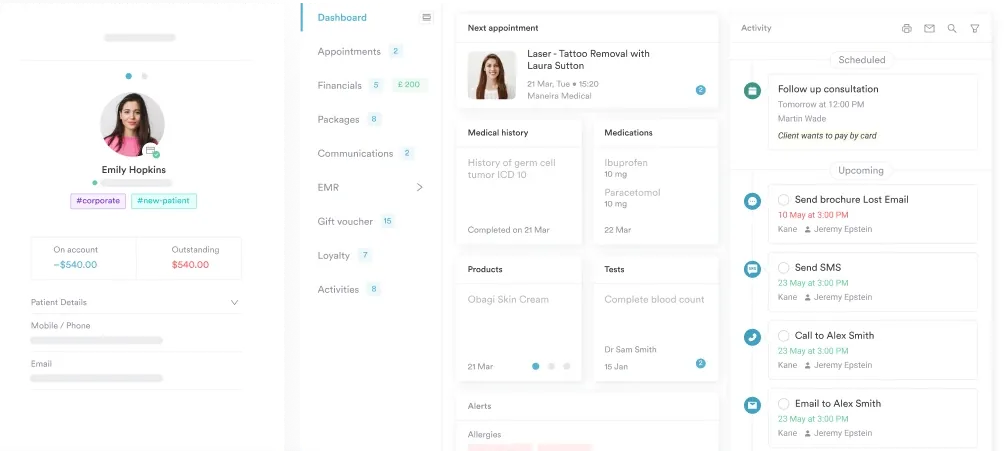
Pabau’s patient record shows medical history, medications and test results together, so the prescriber can check doses and blood work before a refill.
How to put the form to work in your practice
The download is a single consent form with tick-boxes, blanks and signature lines. Read it against your own prescribing protocol, then roll out one version to every prescriber.
Review the form with your medical director and legal counsel, then fill in the version box and last-reviewed date
Edit or delete the practice-policy line on paused refills
Have the prescriber complete section 2, the hormones, routes and product type, before the patient signs
Send the consent form before the visit with the intake form, so the patient reads the risk table at home
Review every ticked contraindication, then collect the patient and prescriber signatures
Store the signed copy with the prescribing record, plus a separate insertion consent for pellets
Patients re-sign when what they were told changes. Each of these triggers sends the form back out:
When the hormone changes, such as adding a progestogen
When the product type changes, such as moving from an FDA-approved product to a compounded preparation
When the route changes, including a move to pellets, which also needs its own insertion consent
At the practice’s annual review, alongside the yearly exams the form lists
When the practice issues a new form version after a label change
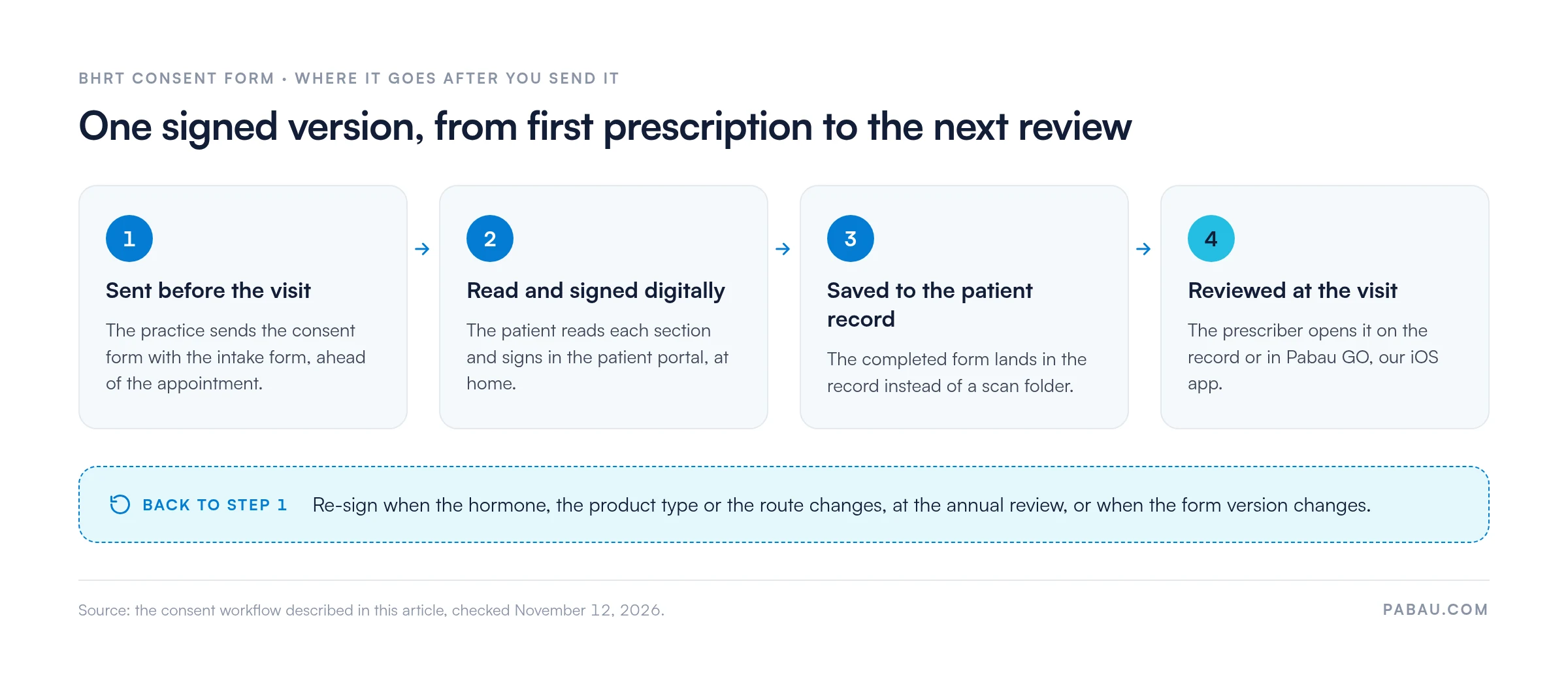
The re-sign loop is easiest to see as a cycle, where each trigger sends the patient back to the first step.
Sending, signing and saving the form in one record means the version a patient signed is the one the prescriber opens. Source: the workflow described in this article.
For a patient moving to pellets, our guide to hormone pellet insertion covers the procedure side.
Regulation, compounding and FDA labeling
Compounded hormone preparations are not FDA-approved, so the FDA has not reviewed their safety, effectiveness or quality before marketing. FDA-approved estradiol and progesterone products do exist. That is why the form asks for the medical reason whenever a compounded one is used.
Pellets need one extra line. In 2019, the FDA said a 2018 inspection of a pellet company found 4,202 unreported adverse events. The agency could attribute only 61, such as pellet extrusion and cellulitis, to compounded testosterone pellets.
On November 10, 2025, the FDA asked manufacturers to drop cardiovascular, breast cancer and probable dementia language from hormone therapy boxed warnings. The endometrial cancer warning stays on systemic estrogen-alone products.
The FDA’s updated-labels list named nine products as of October 30, 2026. Prometrium, Divigel, Cenestin, Enjuvia, Minivelle, Vivelle, Vivelle-Dot, Estring and Bijuva are on it. The Climara label still carried the old four-part boxed warning when we checked. A form that quotes one boxed warning for every product is wrong either way.
We call the fix The 2026 label check. It sets common consent-form wording against what the primary sources say now, with replacement wording for each line. Run it against your current form before you swap in this one.
Old form wording
What current primary sources say (checked November 12, 2026)
Replacement wording
“Bioidentical hormones are natural and safer.”
The FDA has no evidence compounded bioidenticals are safe and effective, or safer. FDA, December 14, 2023.
“Bioidentical” describes a hormone’s chemical structure.
Hormone therapy for menopause is not indicated for use in pregnancy.
The Menopause Society’s November 2025 response noted that systemic estrogen still carries risks to review in detail. That is the case for keeping the full risk table on the form even as boxed warnings shrink.
What this bioidentical HRT template covers before consent
Before consent, this bioidentical HRT template gives the prescriber a hormone therapy intake form that records history, current hormones, symptoms, vitals and recent blood tests. Intake records the patient’s health and treatment as they stand today. Consent records what the prescriber explained and what the patient agreed to.
What goes on a BHRT intake form?
A BHRT intake form records medical history, medication and hormone use, symptoms and recent blood tests for the prescriber to review before the first visit. The Menopause Society’s 2022 position statement says treatment should be individualized. The statement ties a favorable benefit-risk ratio to age, time since menopause and the absence of contraindications.
A BHRT intake form is an HRT form with one extra question. It asks whether the hormones a patient already uses are compounded or FDA-approved products. The disclosure about compounding then goes on the consent form, and the rest of the intake covers the same ground:
Patient details: Contact details, emergency contact, primary care provider, preferred pharmacy and insurance.
Medical and family history: Cardiovascular disease, stroke, blood clots, liver and gallbladder disease, hormone-sensitive cancers and family history.
Medication and hormone use: Every medicine, supplement and allergy, plus each hormone product’s dose, route and prescriber.
Group sections: Menopause and reproductive history for one group, and testosterone therapy history for the other.
Symptoms, vitals and labs: A severity checklist, blood pressure, weight and BMI, and recent blood test results.
Declaration: The patient’s signature confirming the answers are accurate.
One form for menopause and testosterone patients, or two?
One form serves both groups when it shares a core and adds a short section for each. About two-thirds of the questions apply to every hormone therapy patient: history, medication, vitals, labs and the declaration.
We built this template that way so a practice keeps one form to maintain and one set of answers to review. A patient skips the section that doesn’t apply. Two separate forms tend to drift apart, and a change to the shared questions then has to be made twice.
The hormone therapy intake form, section by section
This HRT intake form has 11 sections, written so you can copy them into your own form as they stand. The form feeds the evidence-based hormone therapy protocol templates your prescribers already follow. It records facts and leaves every treatment decision to the prescriber.
1. Patient details
Full legal name, preferred name and date of birth
Sex recorded at birth, asked only where the prescriber needs it for the medicines being considered
Phone, email and home address
Emergency contact: name, relationship and phone number
Primary care provider: name, practice and phone number
Preferred pharmacy: name, address and phone number
Insurance carrier, member ID and policyholder name, where the practice bills insurance
2. Reason for visit and goals
What brings you in today?
Which three symptoms bother you most?
What would you like to discuss with the prescriber at your first visit?
3. Medical and family history
Each condition takes a Yes, No or Not sure answer, with space for the year of diagnosis and current treatment.
Heart disease or heart attack
Stroke or mini-stroke (TIA)
Blood clot in a leg or lung (DVT or PE)
A clotting disorder, such as protein C, protein S or antithrombin deficiency
High blood pressure
Diabetes
Liver disease
Gallbladder disease
High triglycerides
Thyroid disease, and any thyroid medication
Migraine with aura
Breast cancer
Endometrial, ovarian or another hormone-sensitive cancer
Prostate cancer
Any other cancer, with the type and year
Smoking: current, former or never, with the amount
Alcohol: drinks per week
Family history: breast or ovarian cancer, prostate cancer, blood clots, heart disease or stroke, with the relative and their age at diagnosis
4. Medication, supplements, allergies and hormone use
Every prescription medicine: name, dose and how often
Over-the-counter medicines, vitamins and herbal supplements
Allergies to medicines, adhesives or other substances, and the reaction
Current or past hormone use: product name, dose, start and stop dates
Route: tablet, patch, gel or cream, injection, pellet or vaginal product
Who prescribed it, and the pharmacy that fills it
Is the product compounded or FDA-approved? Compounded / FDA-approved / Not sure
5. Menopause and reproductive history
For patients assessed for menopause hormone therapy.
Menopausal status: regular periods, periods changing, no period for 12 months or more, or not sure
First day of your last menstrual period
Hysterectomy: Yes or No, and the year
Ovaries removed: one, both or neither, and the year
Could you be pregnant? Yes / No / Not sure
Current contraception, if any
Any vaginal bleeding a doctor has not yet explained? Yes / No
Last mammogram: date and whether follow-up was needed
Last cervical screening: date and result
Last bone density scan: date and result, if you have had one
6. Testosterone therapy history
For patients assessed for testosterone therapy.
Current or past testosterone use: product, dose and dates
Do you plan to father a child in the next two years? Yes / No / Not sure
Diagnosed sleep apnea, loud snoring or daytime sleepiness
Urinary symptoms, such as a weak stream or getting up at night to urinate
Diagnosed enlarged prostate (BPH)
Last PSA test: date and result, if known
Last hematocrit: date and result, if known
7. Symptom assessment
The patient rates each symptom from none to severe. The checklist gives a baseline and is not a validated scale. If your prescribers want a scored, published scale, add it under its own terms rather than adapting these items.
Symptom
None
Mild
Moderate
Severe
Hot flashes
☐
☐
☐
☐
Night sweats
☐
☐
☐
☐
Trouble sleeping
☐
☐
☐
☐
Low mood or irritability
☐
☐
☐
☐
Anxiety
☐
☐
☐
☐
Brain fog or poor memory
☐
☐
☐
☐
Fatigue
☐
☐
☐
☐
Low sex drive
☐
☐
☐
☐
Vaginal dryness or painful sex
☐
☐
☐
☐
Erection difficulties
☐
☐
☐
☐
Joint or muscle aches
☐
☐
☐
☐
Loss of strength or stamina
☐
☐
☐
☐
8. Vitals at intake
Blood pressure: two seated readings, with the time taken
Weight
Height
BMI, calculated from weight and height
9. Blood test results
Record the date drawn, the lab, whether the patient was fasting and the time of day. Then add a row per marker with the result, units and the lab’s reference range. Which markers to order is the prescriber’s call, and our menopause hormone levels template gives a separate log for tracking them.
For testosterone therapy, the product labeling names baseline checks that belong on this section. The rows below come from the AndroGel 1.62% prescribing information, revised July 2025 and checked November 12, 2026.
Marker
What the labeling says
Fields on the form
Serum testosterone
Confirm low testosterone with morning levels measured on at least two separate days, below the normal range.
Two results, each with its date and draw time
Hematocrit
Check hematocrit before starting treatment.
Result, reference range and date
Prostate evaluation, including PSA
Evaluate patients for prostate cancer before starting androgens.
PSA result and date, plus the date of any prostate exam
Other markers
As ordered by the prescriber.
Blank rows for marker, result, units, range and date
10. Patient declaration and signature
“I confirm the information on this form is accurate and complete to the best of my knowledge. I will tell the practice if my health or medicines change before treatment starts.”
Patient signature
Printed name
Date
Consent to treatment is not part of this declaration. The patient signs the BHRT consent form in this template’s download after the prescriber has discussed risks and alternatives.
11. Practice line
Print this line at the foot of the form: “Review this form with your medical director and legal counsel before use.” State rules on hormone therapy, supervision and record keeping vary, so the review settles which questions your practice must add.
How does the Intake-to-chart map work?
The Intake-to-chart map pairs each form section with why the practice asks it and where the answer lives in the patient record. It shows the prescriber where to look before the consult. It also shows the practice manager why each question earns its place.
The third column describes Pabau, the practice management platform we build. Where a section’s reason is clinical, the source is named in the row.
Form section
Why the practice asks
Where the answer lives in Pabau
Patient details
Identifies the patient and who to call, refer to or bill.
The patient record, with the completed form saved on it
Reason for visit and goals
Frames the first consult around the patient’s priorities.
The completed form on the patient record
Medical and family history
Estradiol labeling lists breast cancer, blood clots, stroke and liver disease as contraindications (Vivelle-Dot prescribing information).
Medical history on the patient record, from the completed form
Medication, allergies and hormone use
Shows current doses and routes, and whether a product is compounded.
Medications and allergies on the patient record, from the completed form
Menopause and reproductive history
The Menopause Society ties the benefit-risk ratio to age and time since menopause (2022 position statement).
The completed form on the patient record
Testosterone therapy history
Testosterone labeling covers prostate cancer, sleep apnea risk and effects on sperm production (AndroGel 1.62% prescribing information).
The completed form on the patient record
Symptom assessment
Sets a baseline to compare against at follow-up visits.
The Measures tab, which charts vitals and weight over time
Blood test results
Testosterone labeling asks for confirmed low levels and a hematocrit before starting.
The lab results area, with a biomarker trend chart where Labs is switched on
Results the patient already holds
Avoids repeating recent tests.
Documents the patient uploads through the patient portal
Declaration and signature
Confirms the patient vouches for the answers.
The signed form, stored on the patient record
BHRT consent form
Records what the prescriber explained and the patient agreed to, including compounded status (National Academies, 2020).
The signed consent, stored on the patient record with its form version
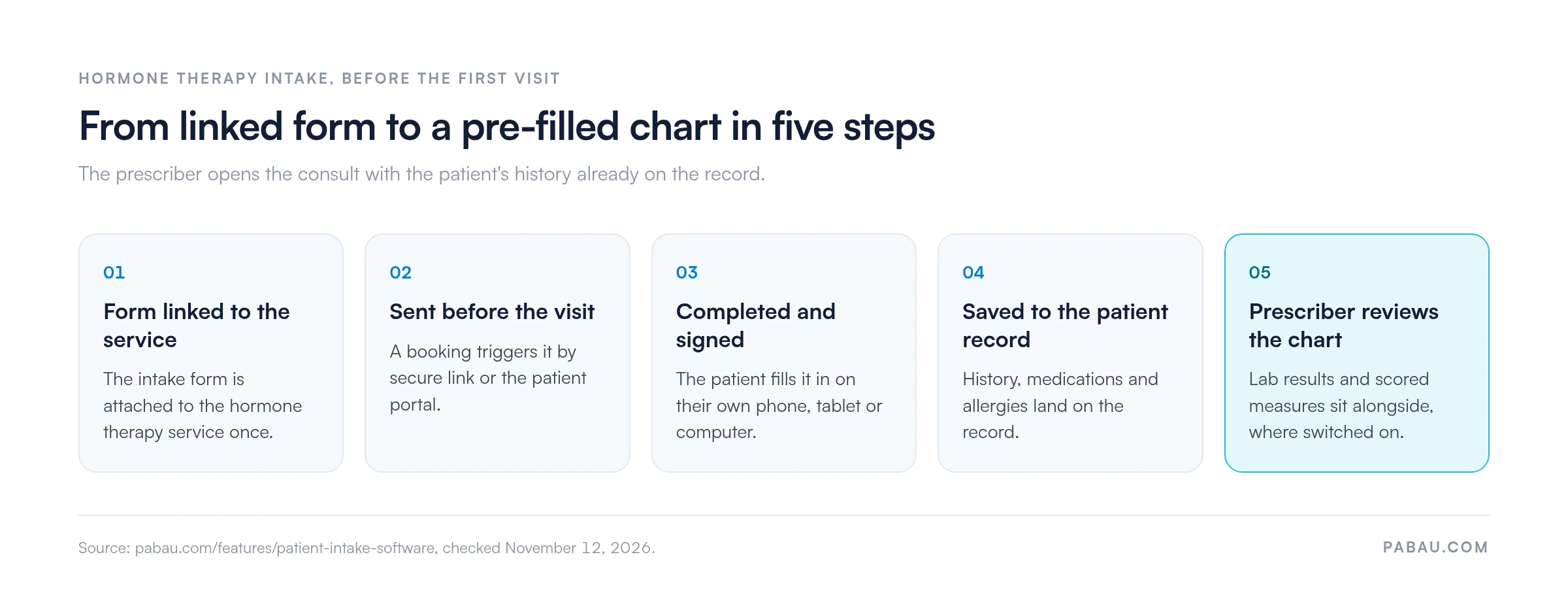
Read down the third column and the pattern is plain. Once the form is digital, the prescriber’s prep happens in one record instead of a folder, a lab portal and an inbox. The flow below shows how the form gets there.
Pabau’s intake forms reach the patient record before the consult, so your prescriber screens a hormone therapy patient from one chart. Source: Pabau’s patient intake software page.
How Pabau keeps BHRT intake, consent and prescribing records together
Paper forms tend to sit in one folder, monitoring dates in a diary and lab results in a separate portal. When a patient calls about bleeding, someone has to pull all three together by hand.
With Pabau’s patient intake software, the intake form and the BHRT consent go out before every booking for your hormone therapy service. Patients complete and sign both on their own device, by secure link or through the patient portal.
The answers and the signed consent land in the patient record, so the chart is filled in before the consult. Nobody retypes a medication list from a scanned page. Pabau GO, our iOS app for practitioners, shows the same forms and consents as a checklist on the patient’s care pathway.
Already have an intake PDF you trust? Upload it, and Pabau’s AI rebuilds it as a smart form with its fields and signatures.
Practices building a full hormone service around these forms can see how HRT clinic software handles booking, charting and follow-up in one system. Where testosterone therapy is the main service, Pabau’s men’s health clinic software keeps the same intake, consent and lab records.
What can’t a paper or PDF form do?
A paper or PDF form can’t send itself, file itself or chart a result over time. Each row below pairs a limit of the paper version with the Pabau feature that removes it.
Paper or PDF limit
What Pabau does instead
Someone retypes the answers into the chart
Completed answers land in the patient record.
Staff chase forms that never came back
The form linked to the service goes out ahead of every booking.
Lab results sit in a portal or an emailed PDF
US practices can switch on Labs. Quest tests are ordered from the record with the practice’s own Quest login, and results import automatically.
Labcorp results get attached by hand
Orders placed in Labcorp Link sync results back to the record.
Hormone levels never show a trend
A biomarker-over-time chart sits on the patient record.
Scores stay on paper
The Measures tab charts scored measures such as PHQ-9 and GAD-7 over time, per patient.
Patients bring results on paper
Patients upload documents through the patient portal.
Follow-up visits slip
Recall Workflows on 90-day and 6-month templates send SMS, email or WhatsApp and skip patients who already have a booking.
Signed consent lives in a filing cabinet
The signed consent form is stored on the patient record.
Every Pabau plan includes the core features, and add-ons enhance the experience. Text messages use usage-based SMS credits. Structured onboarding sets your forms and services up with you before the first patient receives them.
Send, sign and store intake and consent
Pabau sends your hormone therapy intake form and BHRT consent form before the first visit and saves the signed copies to the patient record. Your prescriber starts the consult with the history and the signed consent on screen.
A BHRT consent form is only as defensible as its sources and the date on them. A form that quotes one boxed warning for every product, or calls compounded hormones safer, invites the questions it was written to settle.
Pair the consent with an intake form the prescriber reads before the visit, so the risk conversation starts from a complete history. Re-check the FDA’s updated-labels list at each annual review, before a new form version reaches patients.
Book a demo to see Pabau send your intake and consent forms before the first visit and file the signed copies on the patient record.
Continue your research
Tracking hormone levels between visits?Menopause hormone levels template gives prescribers a log for the results recorded at intake.
Moving a patient to pellets?Hormone pellet insertion walks through the procedure that needs its own insertion consent.
Adding testosterone therapy from scratch?How to start a TRT clinic covers licensing, protocols and membership billing for a new testosterone service.
Is a BHRT consent form the same as a menopause hormone therapy consent form?
Mostly, yes. A BHRT informed consent covers the same label risks, contraindications and monitoring as any menopause hormone consent. It adds the compounding disclosure, recording whether each product is FDA-approved or compounded and why.
Are bioidentical hormones FDA-approved?
Some are. The FDA has approved estradiol and progesterone products identical to the hormones women make. Compounded bioidentical preparations are not FDA-approved, and no approved drug contains estriol.
Did the FDA remove the boxed warning on hormone therapy?
Partly. In November 2025 the FDA asked for cardiovascular, breast cancer and probable dementia language to come out of boxed warnings. The endometrial cancer boxed warning stays on systemic estrogen-alone products, and only nine labels were updated by October 30, 2026.
Is consent part of a hormone therapy intake form?
No. The intake form records the patient’s history and current treatment, and the patient signs only a declaration that the answers are accurate. Consent to treatment is signed on a separate BHRT consent form after the prescriber discusses risks and alternatives.
What is the difference between an HRT and a BHRT intake form?
A BHRT intake form adds one question to an HRT intake form, asking whether the patient’s current hormones are compounded or FDA-approved. The history, medication, symptom and lab fields stay the same. The compounding disclosure itself belongs on the BHRT consent form.
Which blood tests are recorded on the intake form?
The intake form records the results the prescriber orders, with the date drawn, the lab and the reference range. For testosterone therapy, AndroGel 1.62% labeling asks for morning testosterone measured on two separate days and a hematocrit before starting. It also calls for a prostate cancer evaluation.
Do compounded hormone pellets need their own consent?
Yes. Pellet insertion is a procedure, so it gets a separate procedure consent alongside the medication consent. The medication consent still records that pellets are compounded and not FDA-approved.


 Mark Brave