Physician credentialing checklist
A physician credentialing checklist lists every license, certificate, verificati...

Last Updated: Oct 23, 2026

The FLACC pain scale scores pain in non-verbal children aged 2 months to 7 years. Face, Legs, Activity, Cry, and Consolability are each rated 0 to 2.
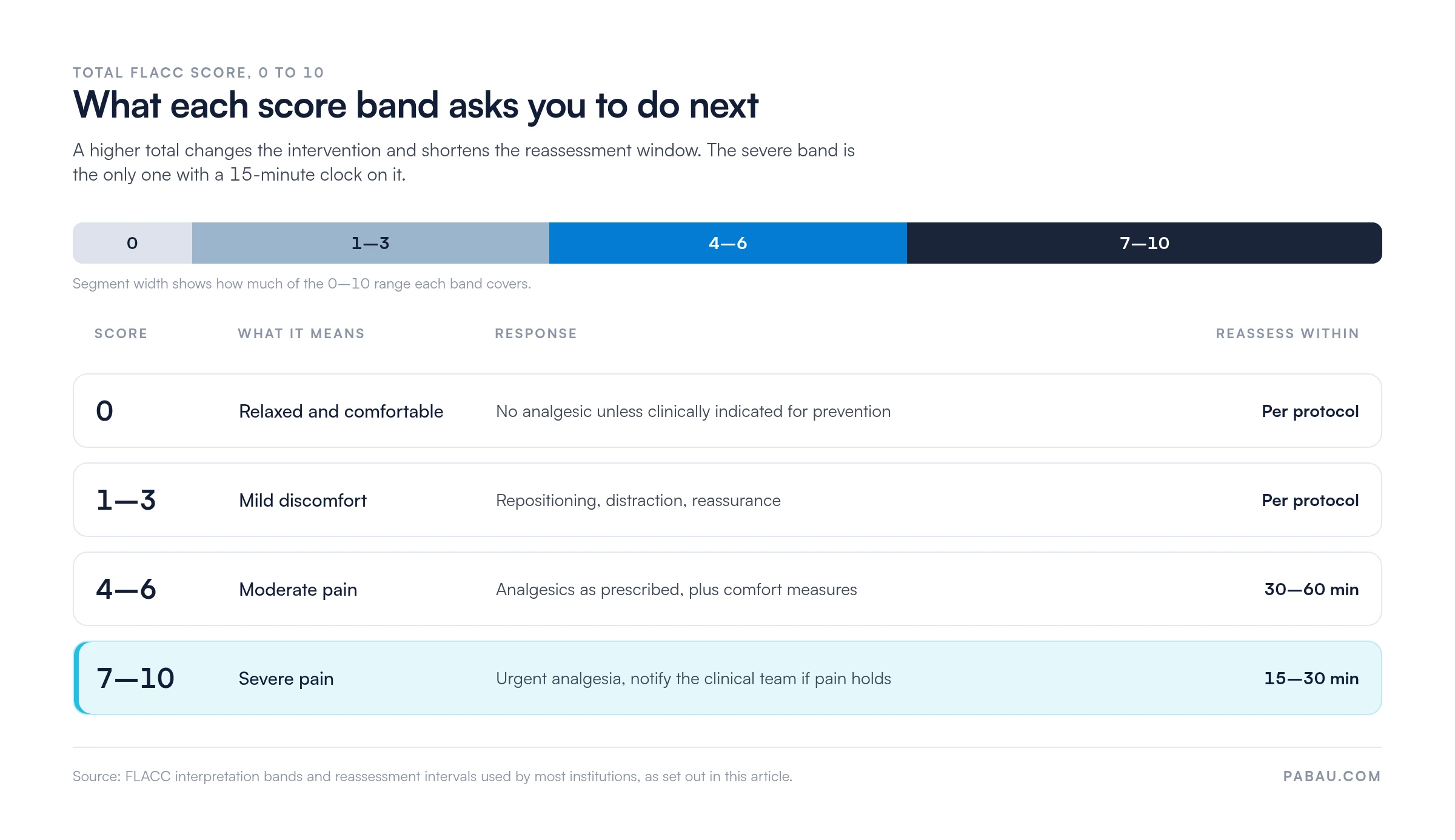
Totals run from 0 to 10. A score of 0 means relaxed and comfortable, 1 to 3 mild discomfort, 4 to 6 moderate pain, and 7 to 10 severe pain.
A total of 4 or more calls for intervention. Reassess within 30 to 60 minutes for moderate pain, and within 15 to 30 minutes for severe pain.
The scale has strong inter-rater reliability and concurrent validity in pediatric populations. That is why it is one of the most widely used behavioral pain tools.
The revised version, FLACC-R, lets you swap in behavioral descriptors written for a child with cognitive impairment or a developmental disability.
A one-page scoring chart covering Face, Legs, Activity, Cry, and Consolability. It carries the 0 to 10 interpretation bands, plus space to log the score, the intervention, and the reassessment time.
Download templateThe FLACC pain scale is a validated behavioral pain assessment tool. Sandra Merkel, Patricia Voepel-Lewis, and colleagues at the University of Michigan Health System developed it in 1997. The acronym stands for Face, Legs, Activity, Cry, and Consolability. Those are the five observable behaviors clinicians score when a patient cannot report pain themselves.
It answers a hard question in pediatric and specialty care: How do you measure pain in someone who cannot describe it? Non-verbal children, infants, and patients with cognitive impairments all need an assessment that does not depend on words. The scale gives clinicians a standardized, evidence-based method to quantify pain and guide treatment.
The tool matters most where self-report is not an option. The Wong-Baker FACES scale, for example, needs a child of roughly 3 years or older. Pediatric wards, intensive care units, and post-operative recovery units all rely on the FLACC to ensure pain does not go undetected and undertreated. Practices serving children with developmental disabilities use it for the same reason.
The FLACC pain scale evaluates five behavioral categories, each scored 0, 1, or 2. Add them up and you get a total between 0 and 10.
Each category reflects what you observe during a 2-to-5 minute window, not what the patient says. Score the child at rest where you can, and record the time alongside the total.
Score interpretation drives the pain management decision and the documentation that follows. The bands below set both the response and the reassessment clock.
Documentation records the total score, the time of the observation, any intervention, and how the patient responded. Many practices build the FLACC straight into the electronic health record (EHR), so reassessment prompts fire at set intervals.
Practices that score on paper end up with the assessment in one place and the medication record in another. Practice management software built for primary care keeps both in the same patient record. The next nurse on shift can then read the pain trend without hunting for it.

The FLACC pain scale has been validated primarily in children aged 2 months to 7 years. Within that range it holds up across post-operative children, critically ill infants, and children in palliative care.
Reach for it when the child cannot self-report, whether they are preverbal, non-verbal, or cognitively impaired. It also suits patients whose behavior tells you more than their words do, such as critically ill or sedated children.
For younger infants (neonates to 6 months): The CRIES pain scale is usually preferred. It adds physiologic markers, such as oxygen requirement and changes in vital signs, to the behavioral ones. Our CRIES pain scale template sets out the scoring in full.
For older children (8 years and up) with intact communication: Move to a self-report scale, such as Wong-Baker FACES or a numeric rating scale.
Not formally. The scale was validated in children, and no equivalent adult validation exists. Clinicians do use it off-label for non-verbal adults in intensive care, post-operative recovery, or profound cognitive impairment. That usually happens when a more adult-specific tool is unavailable.
The CPOT, or Critical Care Pain Observation Tool, is the adult standard in the ICU. For older adults with dementia, the Abbey pain scale is the more common choice.
If you do use the FLACC with an adult, say so in the note. Record that the assessment was behavioral, and flag any factor that could mask pain behavior, such as sedation or neuromuscular blockade. Follow your institution’s protocol and the guidance for your patient population.
The FLACC-R adapts the original for children with cognitive impairments or developmental disabilities. Standard descriptors do not always match how these children show pain. A child with autism or cerebral palsy may not cry when hurting, or may make repetitive movements unrelated to pain.
The FLACC-R lets caregivers and clinicians write their own behavioral descriptors for each child. Instead of the generic five categories, it carries the pain indicators a caregiver interview surfaced for that particular child. The tool then reflects how that child shows pain, rather than a standard framework that might miss the signal.
Several behavioral and self-report scales cover pediatric and non-verbal patients. Knowing which one fits which patient keeps assessment consistent across age groups and settings.
The FLACC remains the default for behavioral pain assessment in children aged 2 months to 7 years who cannot self-report. It picks up more pain behavior than a simple global impression, and its fixed descriptors keep observer bias down.
The FLACC has strong psychometric evidence behind it. A systematic review published in PubMed Central examined its measurement properties across multiple studies. It confirmed robust inter-rater reliability, meaning different clinicians score the same patient consistently, and concurrent validity against other pain measures.
Merkel and colleagues ran the original validation in post-operative pediatric patients in 1997. Later research extended it to emergency departments, intensive care units, and palliative care. Major pediatric nursing and pain management organizations endorse the scale.
Observer variability: The FLACC rests on your reading of behavioral cues. Two clinicians watching the same child can land on different scores, especially in the middle bands. Training and a fixed observation window narrow the spread.
Cultural and individual pain expression: Culture, temperament, and learned coping shape how a child shows pain. A stoic child may barely change expression despite significant pain, while an anxious one may look worse than they feel. Caregiver input and repeated observation improve accuracy.
Developmental and cognitive conditions: Children with autism, cerebral palsy, or similar conditions often express pain atypically. The FLACC-R exists for that reason, but the standard descriptors still will not fit every patient.
Sedation and medication: Sedatives, paralytics, and opioids all suppress the behaviors the scale counts. In a heavily sedated or neuromuscularly blocked patient, the score understates the pain. Note that in the record, alongside the condition and the pain you would expect from it.
Step 1: Observe the patient for 2 to 5 minutes in a calm state, or immediately before or after a painful procedure. Do not score during distress that has another cause, such as frustration or separation anxiety.
Step 2: Give each category a 0, 1, or 2, using the descriptors in the tool. Work through Face, Legs, Activity, Cry, and Consolability in that order.
Step 3: Add the five scores for a total between 0 and 10.
Step 4: Record the total, the time of assessment, and any intervention. Then reassess on the schedule your protocol sets, typically 30 to 60 minutes after an intervention, or hourly in acute care.
Put the FLACC into the electronic health record or the paper chart alongside vital signs and clinical notes. Use the same observation window and timing across the whole team, so scores stay comparable. Short training sessions are the cheapest way to lift inter-rater reliability.
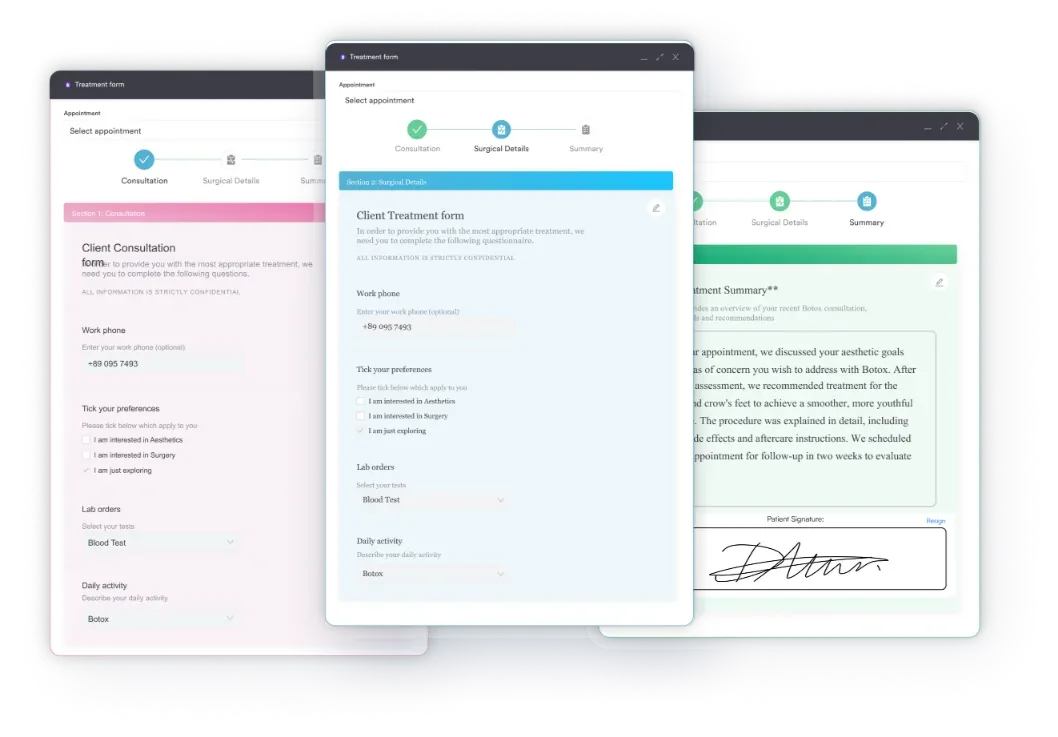
Most pediatric teams score the FLACC on a printed chart, then copy the total into the record later. That copying step is where times drift and interventions go unrecorded. It is also the part an auditor asks about first.
Practice management software like Pabau replaces the step with a custom form. Build the five FLACC categories as a scored section of your treatment note. The total then lands in the patient record the moment you save it.
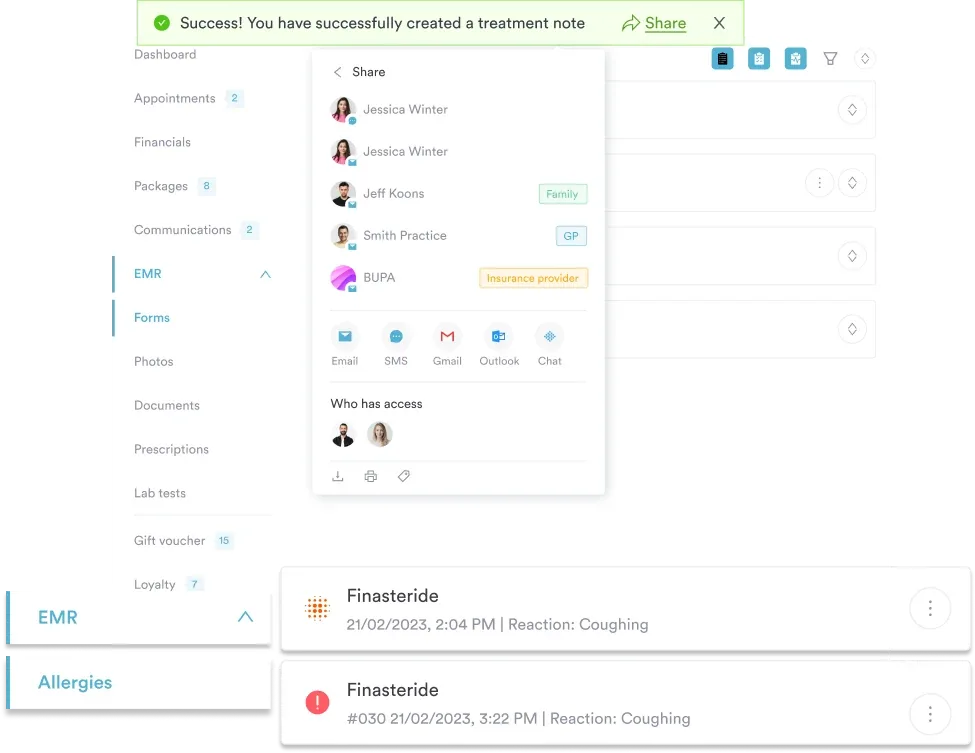
Reassessment prompts can fire automatically at 30 or 60 minutes, so the follow-up score does not depend on someone remembering. Because the score sits next to allergies, prescriptions, and the rest of the chart, the nurse taking over reads the pain trend in seconds.

Pabau’s custom forms hold the FLACC score, the intervention, and the patient’s response in one clinical record. Reassessments are prompted on time, and your documentation stands up to audit.

Pain that no one can describe still needs a number, and the FLACC gives you one you can defend. The discipline around the scale is what makes it work. Use the same observation window, the same descriptors, and a reassessment that lands on time.
Download the template, print it for the ward, and decide as a team where the score gets recorded. If that place is a sheet of paper, the trend will be hard to see by the third shift.
Book a demo to see how Pabau turns the FLACC into a scored form that writes straight into the patient record.

Assessing pain in a newborn? CRIES pain scale template covers neonates to 6 months, the age band where the FLACC has not been validated.
Working with non-verbal older adults? Abbey pain scale is the behavioral tool built for dementia patients rather than children.
Need the wider pediatric workup? Pediatric assessment frameworks and tools shows where a pain score sits in the full clinical picture.
Documenting the care that follows a high score? Acute pain nursing care plan turns the number into a written plan with goals and evaluation.
FLACC stands for Face, Legs, Activity, Cry, and Consolability. Those are the five behavioral categories you score, each from 0 to 2.
The FLACC pain scale is validated for children aged 2 months to 7 years. It is used off-label in older children and non-verbal adults. For children with cognitive impairments, the FLACC-R is the better fit.
Not formally. The CPOT, or Critical Care Pain Observation Tool, is the standard for non-verbal adult ICU patients. Some practices still use the FLACC off-label with non-communicative adults, and document the limitation in the note.
FLACC-R is the revised version for children with cognitive impairments or developmental disabilities. It lets you write behavioral descriptors from a caregiver interview, where the standard FLACC uses the same descriptors for every child.
Reassess 30 to 60 minutes after an intervention, and hourly in acute or ICU care. Otherwise follow your institution’s schedule. Record every score and every intervention in the patient’s record.
Yes. Systematic reviews confirm strong inter-rater reliability and concurrent validity in pediatric populations. Major nursing and pain management organizations endorse it.