High protein grocery list: Free PDF with protein per serving
A high protein grocery list is a shopping guide that groups protein-rich foods b...

2
Last Updated: Oct 8, 2026
A no call no show policy is a written rule covering what counts as a missed shift with no notice, and what happens next. In a practice it sets the call-in window, the discipline ladder, and the point where repeated absence becomes job abandonment.
Healthcare changes the arithmetic. A front-desk shift can usually be absorbed by whoever is already in. A prescriber’s list cannot, because scope and supervision rules limit who may take it over. So the first hour after a no-show goes on patient coverage, and discipline waits until the facts are in.
The template below is the policy in full, ready to adapt. This guide explains the decisions behind each clause, from the length of the call-in window to the offense count that ends in termination.
A ready-to-use policy covering the call-in window, the accepted notification methods, and a four-step discipline ladder. It also carries job abandonment criteria, FMLA and ADA exception wording, an incident documentation checklist, and a return-to-work interview outline.
Download template
A no call no show policy defines an unexcused missed shift and sets the discipline that follows it.
In a practice the first response is clinical rather than disciplinary, because the missed shift has patients attached to it.
Job abandonment usually means three or more consecutive missed shifts with no contact, and your own policy sets that number.
FMLA and ADA can protect an absence, so check both before you apply any step of the ladder.
Consistent documentation at every step is what makes a later termination defensible.
A no call no show policy is the written rule that turns a missed shift into a documented, disciplinable event. It names who staff must contact, how long before the shift they must do it, and what follows at each offense.
Without the written version, every absence gets handled by whoever happens to be on duty. That is where discrimination claims begin, because two employees with the same record end up with different outcomes.
A missed shift in a practice costs more than the hours. The appointments attached to it belong to patients who planned their week around them.
Coverage is what separates healthcare from most employers. Front-desk and admin shifts can usually be absorbed by whoever is already in. A prescriber’s list cannot, since scope and supervision rules limit who may take it over. One licensed absence can therefore close a room for the day.
A written policy makes attendance a stated condition of the job rather than a judgment call. It also gives you the paper trail that shows a regulator, or a court, that everyone was treated the same way.
A complete policy covers seven elements. The template above already contains all of them, so the work left to you is setting the numbers that suit your practice.
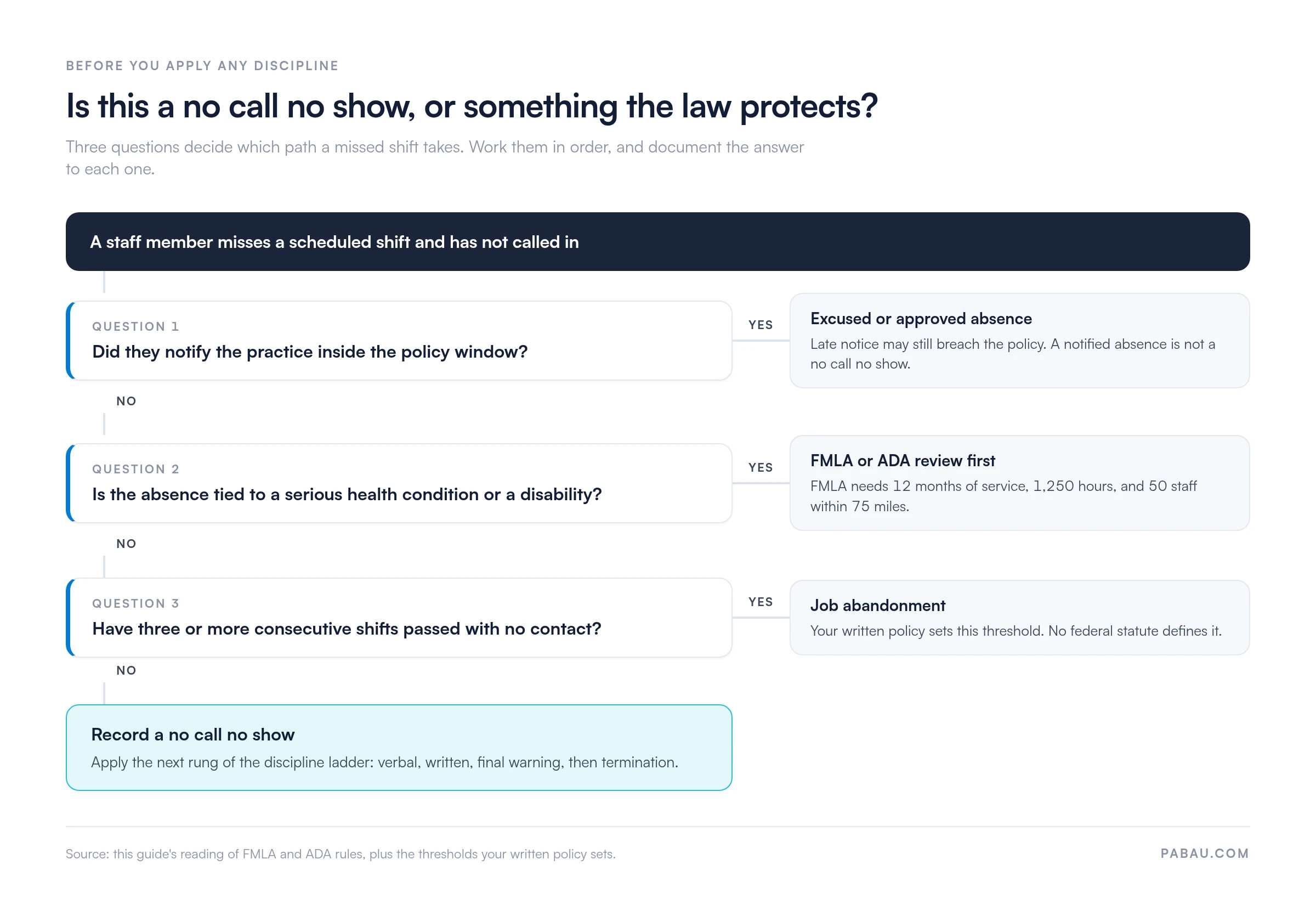
One missed shift with no notice is a policy violation. Three or more consecutive missed shifts with no contact is job abandonment, which is handled as a resignation rather than a discipline case.
Consecutive shifts without contact is the threshold that matters, and no federal statute sets it. Three days is the number most employers write into their policies, but state rules on final pay and unemployment differ. Your own policy has to state the figure you will use, and then you have to use it.
Progressive discipline works by making each step predictable and recorded. If a termination is challenged later, the file shows a sequence rather than a decision made on one bad morning.
Write the conversation down at every rung, not only the last one. An employee counseling form keeps the date, what was said, and the agreed next step in one place. That record is what a wrongful termination defense rests on.
Some practices escalate faster for clinical roles, since a medical director’s absence closes more of the schedule than a receptionist’s. Adjust the ladder if you want to, then apply it the same way every time. Terminating one person at the second offense while warning another at the third hands a discrimination claim its evidence.
Work these seven steps in order. The first three protect patients, and the rest protect the practice.
Check for a protected reason before you apply any discipline. Terminating a staff member whose absence was caused by a qualifying medical condition turns a routine attendance case into a wrongful termination claim.
Those rules combine into three questions, and a manager has to answer them in order before the ladder applies.
Prevention costs less than discipline, and most of it is scheduling hygiene rather than management.
Most of these controls only hold up when the rota, the call-in log and the warning history sit in one system. That is the job of software built for practices. It keeps attendance history somewhere a manager can find it at 8am, rather than in a spreadsheet nobody has opened since March.
Download the template, then read it through with your HR lead or employment counsel. The at-will statement and any state-specific wording are the two clauses worth a second opinion.
Set your own numbers next: the notice window, the named contact, and the offense count that ends in termination. Have every member of staff sign a copy, at onboarding for new hires and at the next team meeting for everyone else.
File the signed copies in each personnel record. Then review the policy once a year, and again whenever your staffing model, opening hours or state rules change. Your safety paperwork runs on the same routine, since an OSHA handbook for practices also needs a signed acknowledgment and a scheduled review.
A policy only works if staff can see their shifts and reach someone quickly when they cannot make one. That is where practice management software like Pabau helps, because it holds the rota, the reminders and the attendance record in one place.
Pabau sends staff their shifts as push or SMS reminders, 24 hours and two hours ahead, through automated appointment and shift reminders. Team management and scheduling keeps rotas, availability and cover arrangements in one view. When someone does not arrive, a manager can see who is free without calling round.
Staff mark unavailability in the app or call the practice line, and both leave a timestamped record. So when a manager later decides which rung of the ladder applies, the contact history is already sitting there rather than being reconstructed from memory.
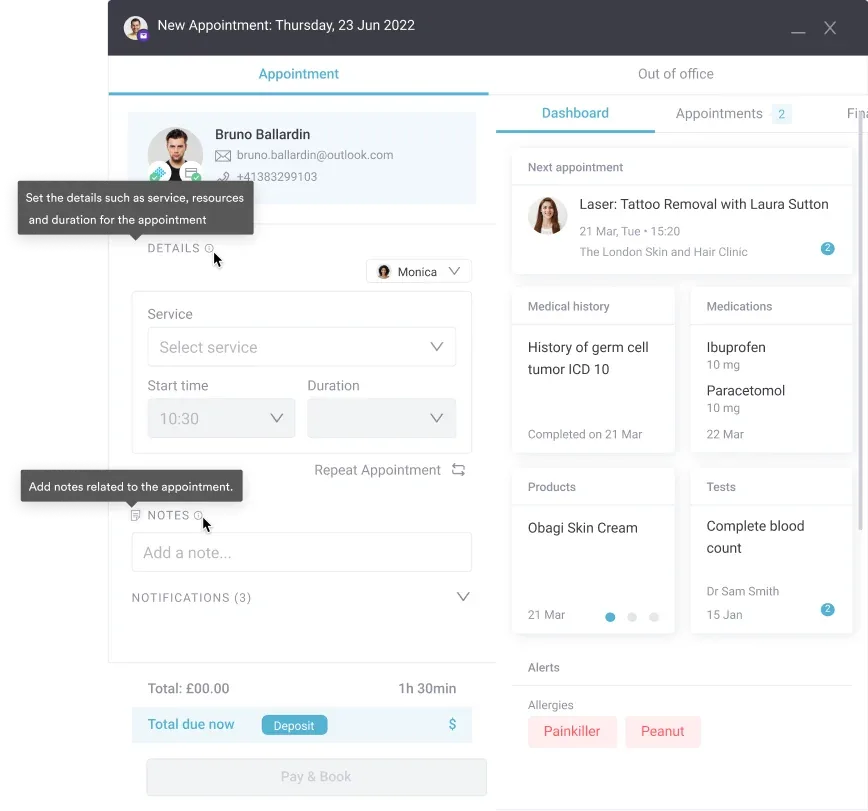

Pabau sends staff their shifts, logs every call-in with a timestamp, and keeps warning history beside the rota. Managers apply the discipline ladder from one record instead of a spreadsheet.

Writing the policy is the easy part. What decides whether it survives a challenge is whether the third person to break it gets the same treatment as the first.
So set numbers you can defend, write them down once, and then hold the line. A window you never enforce is worse than a longer one you do. Staff work out quickly which rules carry consequences and which do not.
Pair the policy with reminders and a call-in route that works at 6am, and most absences will arrive as a message rather than as silence. Book a demo to see how Pabau keeps shift reminders, call-in records and warning history in one place.

Need the wider operating picture? What is practice management software explains how one system replaces the separate tools attendance tracking usually sprawls across.
Attendance problem that warnings have not fixed? Performance improvement plan template gives you a structured way to set expectations and a review date.
Wondering why absences keep repeating? Burnout in healthcare covers the workload patterns that turn into unplanned absence.
Want attendance to feed into performance reviews? Annual review template gives you a format that records attendance alongside clinical performance.
Drafting other employment terms? Physician non-compete agreements walks through what is enforceable and what your state may strike out.
Most practices use four steps: verbal warning, written warning, final written warning, then termination. The count is yours to set, as long as the policy states it and you apply it the same way to everyone. Job abandonment is separate, and three or more consecutive missed shifts with no contact can end employment straight away.
In an at-will state, yes. Doing it with no written policy and no prior warning invites a discrimination claim, especially where other staff were given the ladder. The safer route is to apply progressive discipline consistently, even where the policy permits immediate termination.
A hospitalization or an accident is an exception. The employee or a family member still has to make contact as soon as they reasonably can. Record when contact finally came and what was said. If the absence is FMLA-eligible, it stays protected regardless of the notice given.
Record the employee’s name, the shift date and time, and when you noticed the absence. Log every contact attempt with its time, method and result, then the explanation given, the offense count, the action taken, and the employee’s acknowledgment. File it in the personnel record, because consistency is only provable on paper.
A no call no show is one or two missed shifts without notice, handled through the discipline ladder. Job abandonment is three or more consecutive missed shifts with no contact and no stated intent to return. It is treated as the employee ending the job, so the ladder no longer applies.
No. If the absence qualifies under FMLA, it is protected even where the employee did not request leave in advance. Disciplining it can be read as retaliation. Investigate the reason for every absence, and take advice before acting where a medical cause is possible.
Yes. The written version is what shows a regulator, or a court, that every employee was treated the same way. It also settles expectations before the first incident rather than during it. Without one, any discipline you apply looks arbitrary.