Anja Dodevska

Stylage filler: Grades, consent form and aftercare
Download your free Stylage consent form A ready-to-use patient consent form for ...

4
Last Updated: Oct 28, 2026
Free PDF 2 pages, print-ready Clinician-reviewed
A teenage blood pressure chart classifies a reading for patients aged 13 to 17 against the AAP 2017 thresholds. Normal is below 120/80 mmHg. Elevated is a systolic of 120 to 129 with a diastolic below 80. Stage 1 hypertension is 130 to 139 systolic or 80 to 89 diastolic, and stage 2 starts at 140/90 mmHg. From age 13 these cutoffs are fixed values for boys and girls alike. The chart therefore reads like an adult chart, not a pediatric percentile table.
A two-page printable form with reference thresholds for normal, stage 1 and stage 2 readings. It also has fields for patient details, risk factors, dated readings, an assessment and physician's notes.
Start from scratch, or upload this PDF or any form you already use, and Pabau's AI Form rebuilds it with tick boxes, text fields and a signature. Attach it to the treatment once, and every patient gets it on time.
AI Form rebuilds the consent, history and aftercare forms you already use. You review each one, then publish.
Patients complete forms on their phone before they arrive, so the front desk stops retyping paper.
Every signed form is versioned and attached to the treatment record, ready when you need it.
Set how long a consent stays valid. Returning patients skip forms they have already signed.
Supports HIPAA and GDPR compliance AES-256 encryption 4.8 on G2 4.7 on Capterra Trusted by 4,000+ practices worldwide

Teens aged 13 and over are classified with fixed mmHg thresholds under AAP 2017.
Under 13, hypertension is defined by the 95th percentile for age, sex and height.
Normal for adolescents 13+ is below 120/80 mmHg, and stage 2 starts at 140/90 mmHg.
When systolic and diastolic fall in different categories, the higher category applies.
Practice software such as Pabau can store each reading and the patient’s history in one record.
For adolescents aged 13 and over, a normal reading is below 120/80 mmHg. This applies to both boys and girls under AAP 2017 criteria, so the chart does not split categories by sex at this age.
The downloadable PDF lists the normal, stage 1 and stage 2 thresholds but has no separate elevated row. Record a systolic of 120 to 129 with a diastolic below 80 as elevated, using the table above.
Place the systolic and the diastolic value in their own rows, then take the higher of the two categories. The grid below shows how the two values combine.
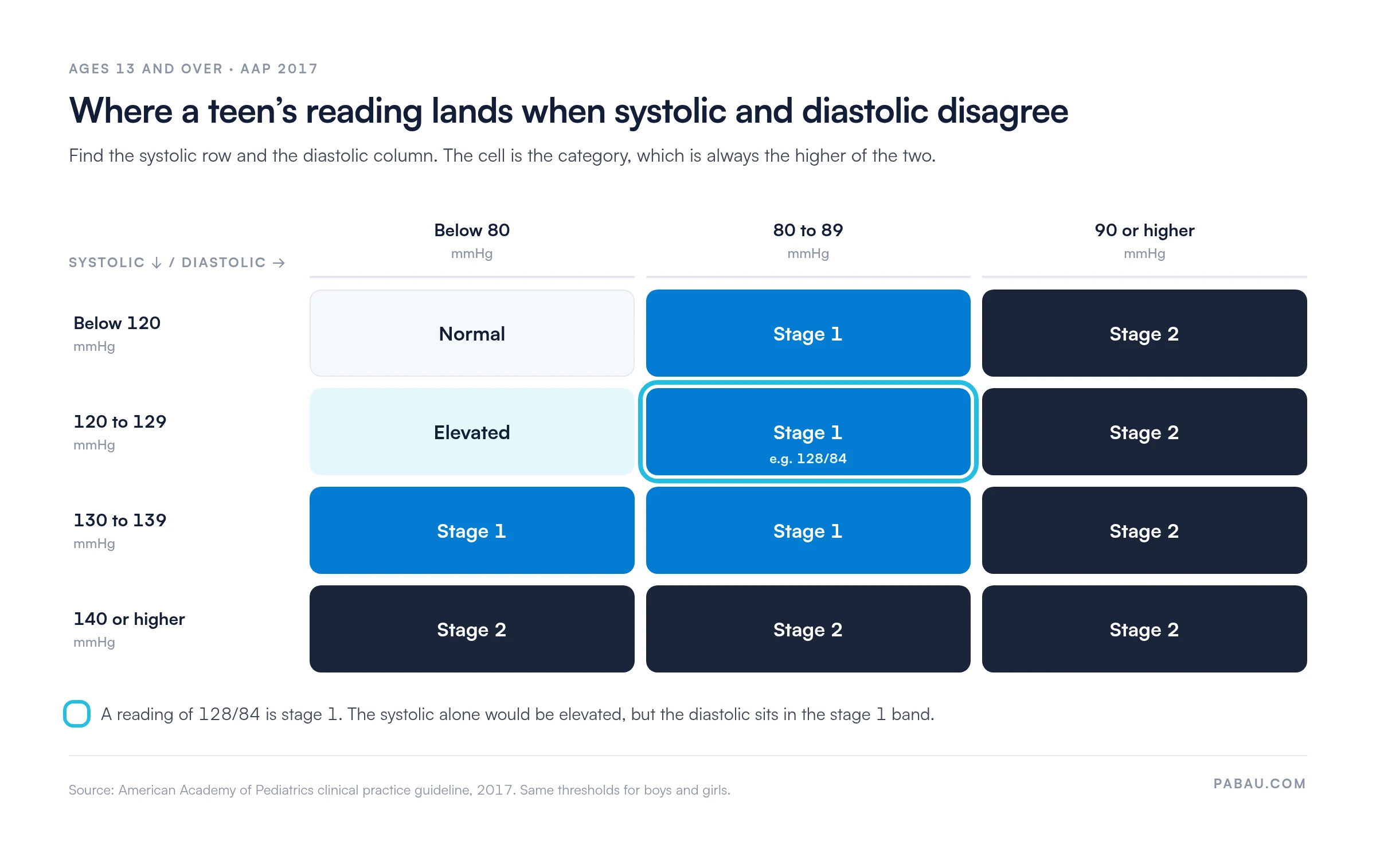
From age 13, stage 1 starts at 130/80 mmHg and stage 2 starts at 140/90 mmHg, according to the AAP 2017 guideline. These fixed thresholds match the adult categories on a normal blood pressure chart, so a teen moves into adult care without a change of scale.
A blood pressure range describes the category a reading falls into. It is not a diagnosis on its own, and a single high reading needs confirmation before any label is applied.
Under 13, a reading is placed against percentile bands for age, sex and height instead. Our pediatric blood pressure chart covers those bands for younger children.
Ambulatory blood pressure monitoring (ABPM) is the usual way to confirm suspected hypertension. The teen wears a portable cuff that records readings over 24 hours, usually arranged through a specialist service.
Most adolescent hypertension is primary, meaning no single cause is found. Obesity is the most common risk factor for primary hypertension in this age group. That is the finding of an American Family Physician review of high blood pressure in children and adolescents.
In teens, obesity means a BMI at or above the 95th percentile for age and sex. Judge the BMI item on any risk factor checklist against that percentile rather than an adult cutoff.
Secondary hypertension is less common in this age group. Renal disease and endocrine disorders are the usual causes, and a suspected secondary cause calls for a fuller workup.
Auscultatory (manual) measurement is the reference standard for pediatric blood pressure. Cuff size has the biggest effect on accuracy. The AAP 2017 guideline says the bladder should encircle at least 80% of the arm circumference.
The white coat effect can raise office readings, so one high reading at the practice should not settle the category. Refer for confirmation when readings stay high across visits.
The chart values come straight from the guideline. Treatment decisions sit with the treating clinician and fall outside this article’s scope.
A poor technique produces a reading that lands in the wrong row, so the method matters as much as the chart. For a step-by-step walkthrough, see our guide to the blood pressure test.
Put the chart in the consultation room and make it part of the triage routine. Staff record the age and readings, and the clinician confirms the category before any follow-up is booked.
Document the category, the repeat readings and the planned confirmation step. A clear note stops the next clinician from reclassifying the teen on a single reading.
Audit your intake forms before printing the chart. Capture age, sex and cuff size on the same form. The team can then classify a reading without searching through the patient’s notes.
On paper, each reading lives on a separate sheet, and the next clinician has to find the last one before judging a trend. That search is where a teen gets reclassified on a single high reading.
Pabau runs scheduling, records and forms for private GP practices, and it turns the chart’s fields into a digital form. Its patient intake software captures age, readings and risk factors before the visit.
Each completed form lands in the patient’s Client record, next to earlier readings and consent. Clinicians see the trend at a glance, so a confirmation step gets booked rather than forgotten.

Pabau’s digital forms and Client records keep blood pressure readings, history and consent together, so the team can find them at the next visit.

The thresholds for teens are simple, and they are the same for boys and girls from age 13. Misclassification comes from the process around them: the wrong cuff, one reading taken as final, or a note nobody can find at the next visit.
Fix those three points and the chart does its job. Pair it with the PDF at intake, and keep percentile charts for the under-13s.
Book a demo to see how Pabau keeps every teen’s readings and follow-ups in one patient record.

Recording other vital signs too? Pediatric vital signs chart lists normal vital sign ranges by age.
Seeing older patients as well? Senior blood pressure chart covers readings in older adults.
A teenage blood pressure chart is a clinical reference that places a reading in the normal, elevated, stage 1 or stage 2 category. From age 13, it uses fixed mmHg thresholds that are the same for boys and girls.
A normal reading for adolescents aged 13 and over is below 120/80 mmHg under AAP 2017 criteria.
Stage 1 hypertension starts at 130/80 mmHg and stage 2 at 140/90 mmHg for teens aged 13 and over.
From age 13, the AAP 2017 guideline uses fixed mmHg thresholds that align closely with adult cutoffs.