Antipsychotic medication list
An antipsychotic medication list is a structured reference that organizes psychi...

2
Last Updated: Oct 13, 2026
A mental abuse checklist is a structured assessment tool that helps clinicians, therapists, and social workers identify patterns of psychological abuse in a patient’s relationships. It covers verbal attacks, gaslighting, isolation, controlling behavior, and threats. Psychological abuse leaves no visible marks, which makes it harder to recognize than physical harm. A checklist turns the warning signs into named questions, so your assessment stays systematic and your documentation stays complete.
This guide covers what the checklist screens for, how to use it in session, and what to do when a patient discloses abuse. The downloadable template below is ready to adapt to your setting and patient population.
A ready-to-use assessment tool for identifying patterns of psychological abuse. It covers verbal abuse, gaslighting, controlling behavior, isolation tactics, threats, and emotional manipulation across relationship types.
Download template
A mental abuse checklist is a screening tool rather than a diagnostic instrument, and it names the patterns psychological abuse follows.
Psychological abuse causes measurable harm, including anxiety, depression, PTSD, and diminished self-worth.
It often runs for years with no physical abuse alongside it, which is why routine screening catches cases an open conversation misses.
Clinicians in most jurisdictions carry mandatory reporting duties once a patient discloses abuse.
Pabau’s digital forms and secure patient records let you log a disclosure privately and trigger safeguarding follow-up.
A mental abuse checklist identifies the behaviors and patterns that make up psychological abuse in relationships. Psychological abuse, also called emotional or mental abuse, is a pattern of non-physical behavior intended to control, isolate, humiliate, or frighten another person. It sits apart from physical abuse but does comparable damage to mental health.
The checklist provides structured questions that help you recognize signs patients may not label as abuse themselves. Many people minimize what is happening to them (“at least he doesn’t hit me”) or treat it as ordinary (“that’s just how relationships are”). Naming each behavior turns the pattern into something a patient can see and act on.
Key regulatory context: In most clinical settings, a patient’s disclosure of abuse triggers mandatory reporting duties. The CDC documents intimate partner violence as a public health priority. UK clinicians work to the Care Act 2014 safeguarding framework. US practitioners follow state mandatory reporting laws and HIPAA confidentiality rules. A structured checklist keeps your documentation in line with those requirements.
The checklist works best as a conversation framework. Read it out as an interrogation script and most patients will close down. Five operational steps:
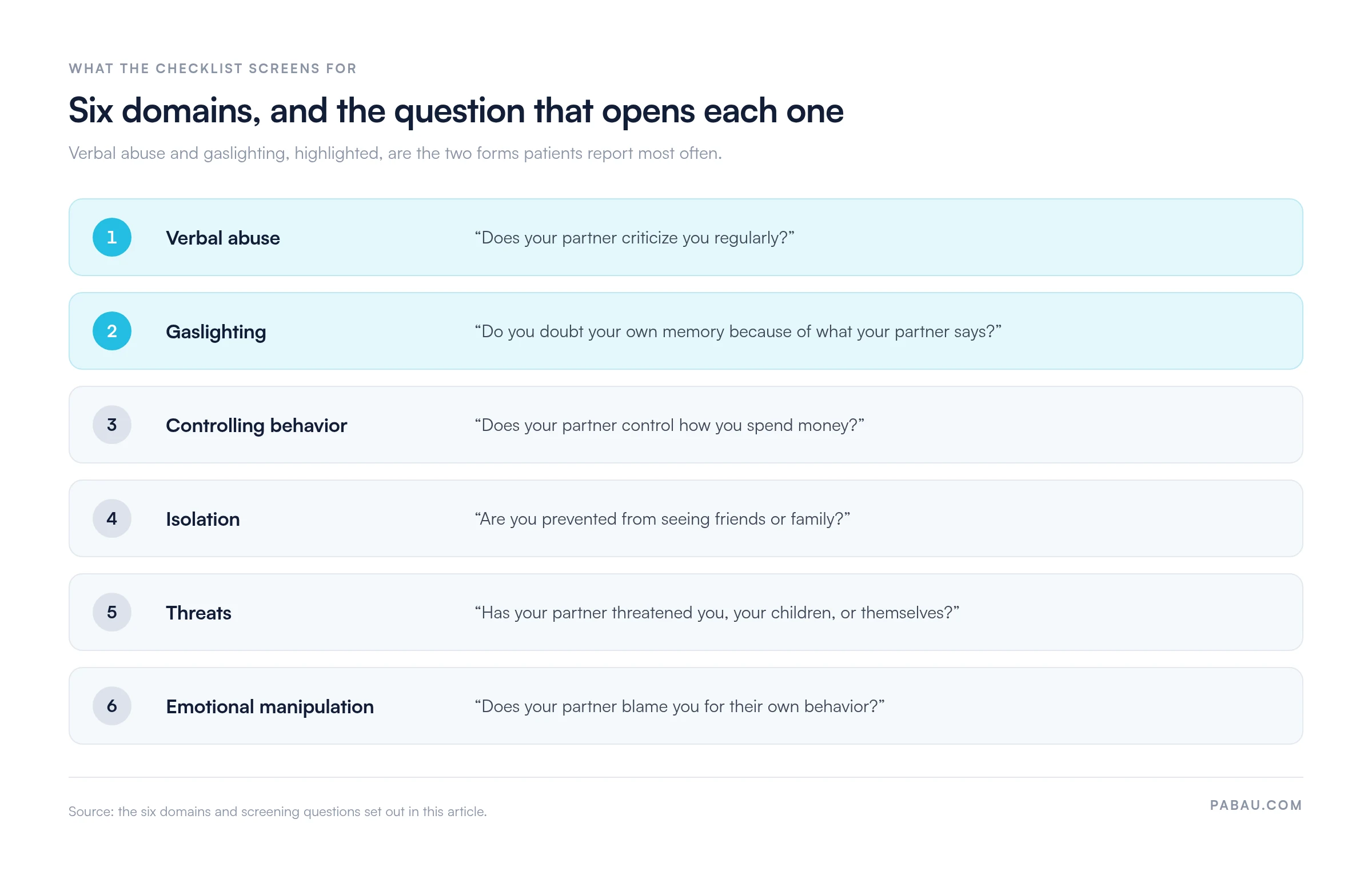
The checklist groups the behaviors into six domains, and each domain has a question you can ask out loud.
Mental health clinicians use it during intake, during ongoing assessment, and whenever a patient presents with trauma symptoms. That includes therapists, counselors, psychologists, and psychiatric nurses. Social workers and family support workers use it to assess abuse inside family relationships, including elder abuse and child emotional abuse.
Primary care practitioners screen for intimate partner violence as part of routine health assessment. Domestic violence advocates and legal aid workers use the same framework to help people recognize patterns and build safety plans.
Any setting where people disclose relationship concerns benefits from having a structured checklist on hand. That includes employee assistance programs, occupational health, and rehabilitation practices.
Systematic assessment: A checklist means you ask consistent questions across every patient, which reduces unconscious bias. A fixed set of questions also surfaces disclosures that an open-ended conversation leaves unasked.
Patient validation: People often minimize abuse or blame themselves for it. A checklist with named behaviors validates what they are describing. You can say: “The constant criticism and the isolation from friends are recognized forms of psychological abuse, and they are not your fault.”
Compliance and documentation: Structured checklists create clear, defensible records for safeguarding reviews, case conferences, and legal proceedings. HIPAA requires secure documentation of any disclosure. Software built to manage a therapy practice keeps that record encrypted, access-logged, and audit-trailed.
Safety planning: Once abuse is identified, the checklist gives you a framework for the next conversation. It covers trusted contacts, secure ways to communicate, and copies of documents the patient may need for legal action.
When a patient discloses abuse, your first response shapes whether they come back. Avoid “Why didn’t you leave?” and “Have you thought about leaving?” Try “I’m glad you’re telling me this. Your safety matters. Here’s what we can do.” Then document their words rather than your interpretation.
Verbal abuse and gaslighting are the two forms patients report most often, and they are usually the entry point for a disclosure. Verbal abuse includes constant criticism, insults, threats, name-calling, and yelling. A partner might say “You’re stupid,” “No one would want you,” or “If you leave, I’ll hurt myself.”
Gaslighting is a recognized tactic within psychological abuse. It works by manipulating someone into questioning their own reality. Typical lines are “That never happened” and “You’re crazy for thinking that.” The person gradually loses confidence in their own memory.
Both are documented in clinical literature and in WomensLaw.org’s framework on emotional and psychological abuse. The checklist flags them with two questions. Ask “Does your partner criticize you regularly?” and “Do you doubt your own memory because of what your partner says?”
Controlling behavior isolates the person and deepens their dependence on the abuser. It takes several forms:
Three questions open this domain:
Isolation is a hallmark of abuse. Once someone loses their support network, leaving gets harder and psychological dependence deepens. The Duluth Power and Control Wheel is the evidence-based framework used by abuse intervention programs worldwide. It names isolation as a primary tactic, alongside threats, economic control, and emotional abuse.
A threat does not have to name violence to work. “If you leave, I’ll hurt myself” transfers responsibility for the abuser’s safety onto the person being abused. “I know where your mother lives” makes the threat specific without stating it. Ask directly: “Has your partner threatened you, your children, or themselves?”
Emotional manipulation runs alongside both. Blame-shifting is the most common form, and patients often arrive convinced the abuse was a reaction to something they did. Ask “Does your partner blame you for their own behavior?” A yes usually opens up material the earlier questions missed.
Psychological abuse causes measurable harm. People develop anxiety, depression, post-traumatic stress disorder (PTSD), and diminished self-worth. Some experience complex trauma (C-PTSD) where the abuse has run for years. Include the checklist in your assessment whenever you screen for those conditions and the trauma history is unclear.
The effects persist after the abuse ends. Survivors commonly report ongoing hypervigilance, intrusive thoughts, and difficulty trusting other people. Early identification and referral to domestic abuse services, paired with trauma-informed therapy, improves outcomes significantly.
Lenore Walker’s Cycle of Violence model describes four phases: Tension building, incident, reconciliation, and calm. Understanding the cycle helps explain why patients stay (“he’s always sorry afterward”) and why abuse tends to escalate. Run the checklist across several appointments and you can see whether the pattern is worsening.
Watch for three escalation signals. Abuse becomes more frequent, threats turn specific, or isolation intensifies. Once you detect escalation, safety planning becomes urgent.
The three terms are used interchangeably in most clinical settings, though subtle distinctions exist. “Emotional abuse” emphasizes harm to feelings and self-esteem. “Psychological abuse” covers all non-physical harm, including manipulation and coercion. The two are used interchangeably, including by the APA. “Mental abuse” is lay language for the same concept.
For checklist purposes, treat them as synonymous. Your template can use whichever term fits your jurisdiction and patient population.
When a patient discloses abuse, give them crisis contact information straight away. US: National Domestic Violence Hotline 1-800-799-7233. UK: Women’s Aid 0808 2000 247. Both offer free, confidential support 24/7.
A safety plan covers four things:
Document the plan in the patient record. Our domestic violence worksheet walks through the same planning steps in a format you can complete with the patient. If children are at risk, child protective services or social care may need notification, depending on your jurisdiction.
One clinical note matters more than the rest. Never suggest leaving in a single appointment, because leaving is the most dangerous point for someone being abused. Work with domestic abuse specialists and legal advocates instead. Your job is to hold a safe space for the disclosure, validate what the patient describes, and connect them to expert help.
This checklist is a screening and awareness tool, not a diagnostic instrument. A single flagged item does not prove abuse. Clinical judgment, ongoing assessment, and conversation are still essential. Abuse also sits on a spectrum, and occasional controlling behavior differs from systematic, escalating psychological abuse.
If you are reading this and recognizing abuse in your own relationship, the checklist is for you too. Abuse is not your fault. Reaching out to a domestic abuse organization, a therapist, or someone you trust is the first step. You do not need to leave immediately to seek help, and advisors can support you in safety planning at your own pace.
A disclosure of abuse has to be documented securely. GDPR in the UK and EU, and HIPAA in the US, both require encrypted records with access logs. A mental health EMR with role-based permissions keeps the note visible to the clinical team and to nobody else.
Never print a disclosure, and never leave one in an unlocked file. If the perpetrator has access to the patient’s mail or devices, the record of the disclosure becomes a risk in itself. Compliance management software is what makes these rules workable day to day. It flags the disclosure for safeguarding review, restricts who can open it, and logs every access.
In a lot of practices the disclosure lands in a free-text note, or on a paper form that sits in a drawer. That holds up until someone has to prove who read the note. It also fails when a letter quoting the disclosure reaches a household the patient shares with the abuser.
Practice management software like Pabau stores the disclosure as a structured form against the patient record. Access is role-based and every view is logged. The form can be flagged so a safeguarding lead picks it up the same day. No paper copy leaves the building, and no correspondence goes to a shared address by accident.
You also get the record a safeguarding review asks for. Pabau keeps the checklist responses, the date, the clinician, and the referral together. You can show your working months later without reconstructing it from memory.
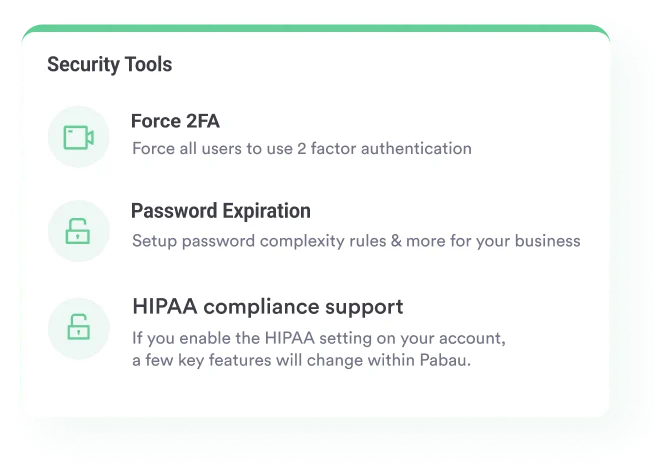

Pabau’s encrypted digital forms and access-logged patient records help you document abuse disclosures safely and meet HIPAA and GDPR requirements.

Screening for psychological abuse works as a habit, not as a one-off. Ask the six questions of every patient you assess for relationship concerns, and you will hear disclosures an open-ended conversation never reaches.
One trade-off is worth remembering. A checklist gives you structure, and structure can feel clinical at the moment a patient finally speaks. Lead with the conversation, use the form to make sure nothing is left unasked, and write the note afterward in the patient’s own words.
Book a demo to see how Pabau keeps abuse disclosures encrypted, access-controlled, and ready for a safeguarding review.

Need a trauma history alongside the abuse screen? Trauma questionnaire template gives you a structured way to record events, symptoms, and severity.
Want a plan for the appointment where risk is immediate? Crisis intervention strategies for clinicians sets out what to do in the room and who to call next.
Need a safety plan you can complete together? Suicide safety plan covers warning signs, coping steps, and the contacts a patient can reach at short notice.
Looking for trauma-informed practice guidance? Mental health EMR software includes safeguarding workflows and crisis contact fields.
Mental abuse and emotional abuse are used interchangeably in clinical practice. “Emotional abuse” emphasizes damage to feelings and self-esteem. “Mental abuse” is lay language for the same concept. “Psychological abuse” covers all non-physical harm, and the terms are used interchangeably, including by the APA. All three describe non-physical patterns of control, manipulation, or harm, and one checklist covers them together.
No. A mental abuse checklist is a screening and awareness tool that systematizes identification of abuse patterns. Clinical judgment, ongoing conversation, and comprehensive assessment are required for a diagnosis. A high checklist score indicates risk and warrants further exploration and referral, not a diagnosis of abuse.
The Duluth Power and Control Wheel is an evidence-based framework used worldwide by domestic abuse intervention programs. It maps eight tactics of abuse: intimidation, emotional abuse, isolation, denying and blaming, using children, economic abuse, coercion and threats, and male privilege. The wheel shows how those tactics overlap and reinforce each other, and most mental abuse checklists align with its categories.
Mandatory reporting laws vary by jurisdiction. In the US, most states require reporting of child abuse and neglect, while intimate partner abuse reporting varies by state. In the UK, clinicians follow the Care Act 2014 safeguarding framework and must report where vulnerable adults are at risk. Always check your local laws and your employer’s safeguarding policy. When in doubt, consult your professional body or a safeguarding lead.
Validate what they describe, give them crisis contact information, and work with domestic abuse specialists on safety planning at the patient’s own pace. Leaving is the most dangerous point for someone being abused. Your job is to hold a safe space for the disclosure and make the expert referral, not to decide when or whether the patient leaves.