Antipsychotic medication list
An antipsychotic medication list is a structured reference that organizes psychi...

2
Last Updated: Oct 13, 2026
A cycle of abuse wheel is a visual framework that maps the four repeating phases of intimate partner violence: tension building, incident, reconciliation, and calm. Therapists, counselors, and social workers use it to show a survivor where they sit in the pattern. That is where safety planning starts.
Psychologist Lenore Walker described the pattern in 1979, and it remains a standard assessment and psychoeducation tool in mental health practice. The Power and Control Wheel, from the Duluth Model, sits alongside it and maps the tactics an abuser uses rather than the timing of incidents.
A one-page printable sheet with a short disclaimer and an open notes area, for recording what a survivor describes in an intake or psychoeducation session. The file carries no phase diagram, so use it beside the four-phase breakdown on this page.
Download template
The cycle of abuse wheel maps four repeating phases that shape intimate partner violence: tension building, incident, reconciliation, and calm.
Tension builds through controlling behavior and coercion, and the incident phase brings acute physical, emotional, sexual, or financial abuse.
Reconciliation brings apologies and promises, and the calm that follows is a false normalcy before the pattern restarts.
Trauma bonding across the reconciliation and calm phases explains why survivors stay, which keeps clinical blame out of the room.
Pabau, practice management software with clinical documentation tools, holds secure patient records, treatment notes, and digital intake and consent forms.
The cycle of abuse wheel is a visual model showing how intimate partner violence unfolds in repeating phases rather than as random acts. Psychologist Lenore Walker described the pattern in 1979 after interviewing battered women about their relationships. Abusive relationships follow a predictable rhythm: tension builds, an acute incident occurs, the abuser apologizes and reconciles, calm follows, and tension starts rising again.
This model is distinct from the Power and Control Wheel, developed by the Duluth Model. That wheel maps the tactics an abuser uses to hold power, including isolation, economic control, threats, and coercion.
The wheel stays in wide use across mental health assessment, psychoeducation, and clinical records because it normalizes what survivors describe. It explains why leaving is hard, and it gives safety planning a place to start.
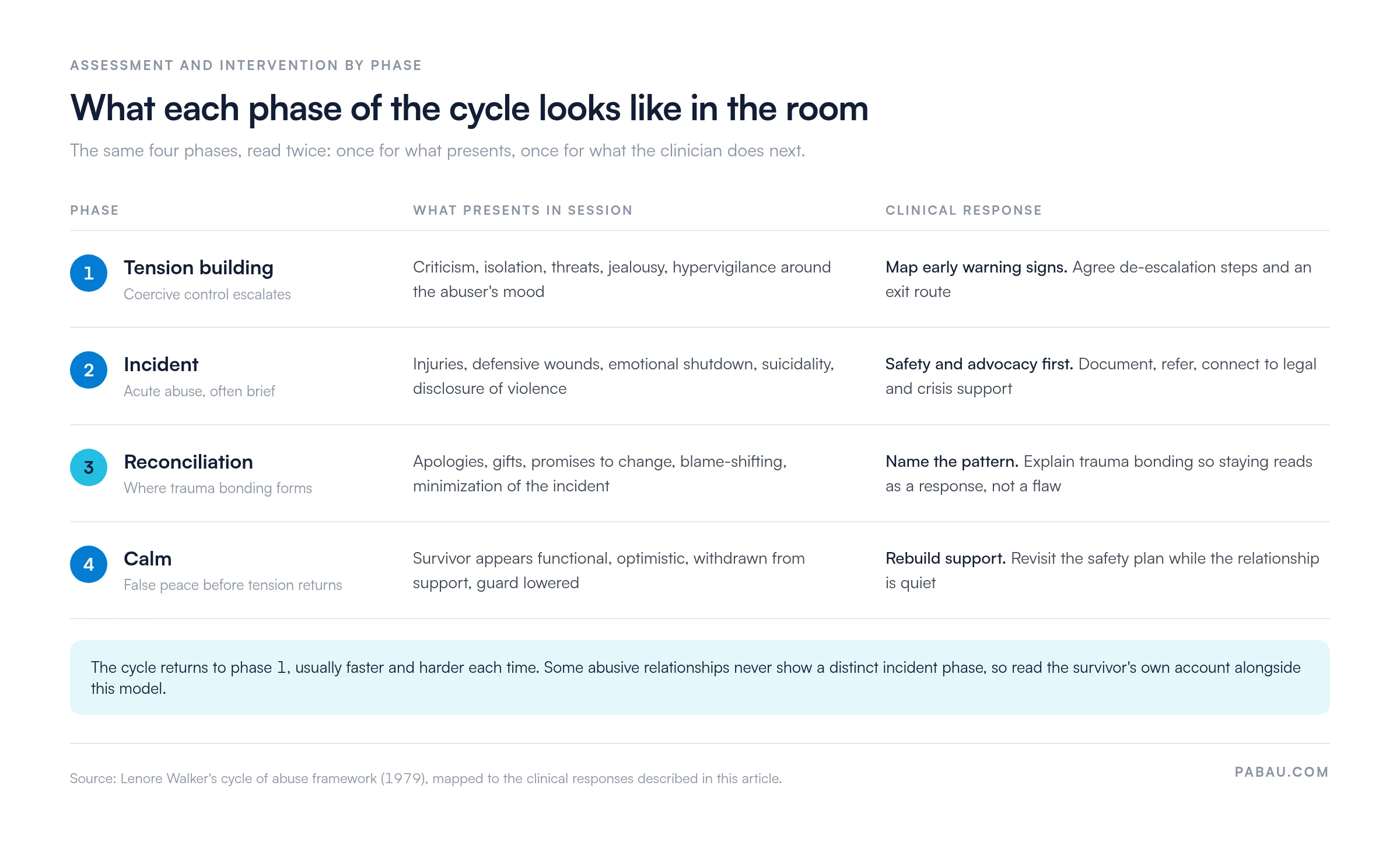
During tension building, the abuser’s controlling behavior escalates. The survivor may notice increased jealousy, criticism, isolating behavior, or financial restrictions.
The acute abuse incident occurs here: physical violence, severe emotional abuse, sexual assault, or financial exploitation. This phase is often brief but intense.
After the incident, the abuser often apologizes, promises change, or minimizes what happened. The survivor may feel relief that the violence has stopped, which creates the conditions for trauma bonding.
A period of relative normalcy follows. The abuser may be attentive, or the relationship may feel temporarily stable. This false peace reinforces hope that the abuse is over, which makes leaving harder.
Both tools are valuable in clinical practice, but they answer different questions.
Many clinicians use both. The wheel carries the assessment and psychoeducation work. The Power and Control Wheel then opens up the specific mechanisms of control a survivor has lived with. A structured psychiatric evaluation template gives both frameworks somewhere to land in the record.
The wheel does its best work when it is introduced as a normalizing, non-blaming tool. Survivors often carry shame about staying, and the model reframes their responses as survival strategies inside a predictable system.
Naming the four phases is the straightforward part. Sequencing the conversation so the survivor stays regulated takes a protocol, and this one runs in five steps.
Close by asking which phase the survivor is in now, and what safety would look like from there. A domestic violence worksheet is a useful place to hold what they name, so the mapping survives past the session.
Trauma bonding is the mechanism that keeps survivors in the cycle. During tension and incident phases, the abuser is the source of fear. During reconciliation and calm, the abuser becomes the source of relief. That alternation between fear and relief builds an intense attachment that can feel like love.
Clinically, naming it reframes staying as a trauma response rather than a choice or a character flaw. Record that framing in the intake assessment and the safety plan, so the next clinician does not repeat the blame the survivor has already heard.
The narcissistic abuse cycle differs in structure but serves the same function: maintaining abuser control and survivor entrapment. The usual pattern runs idealize, devalue, discard, then hoover, which is the re-contact.
Walker’s cycle describes phases inside one continuous relationship, while the narcissistic pattern often cycles the relationship itself on and off. Both run on trauma bonding, and both call for trauma-informed treatment rather than incident-by-incident crisis work.
Clinicians can use this phase-by-phase guide to help survivors identify where they are, and what safety planning is needed next.
The phase a survivor is in changes what the session is for. The map below pairs what presents in the room with the intervention that fits it.
Three interventions follow from that reading.
One caveat matters more than the rest. Not every abusive relationship follows the Walker cycle: some show chronic low-level abuse with no explosive incident, and others cycle on and off. Treat the wheel as a teaching framework, and read it alongside the survivor’s own account.
Notes from a domestic violence case tend to scatter. Part sits in a paper file, part in a scheduling tool, and part in someone’s inbox. The next clinician to see that patient then reconstructs the survivor’s position in the cycle from memory.
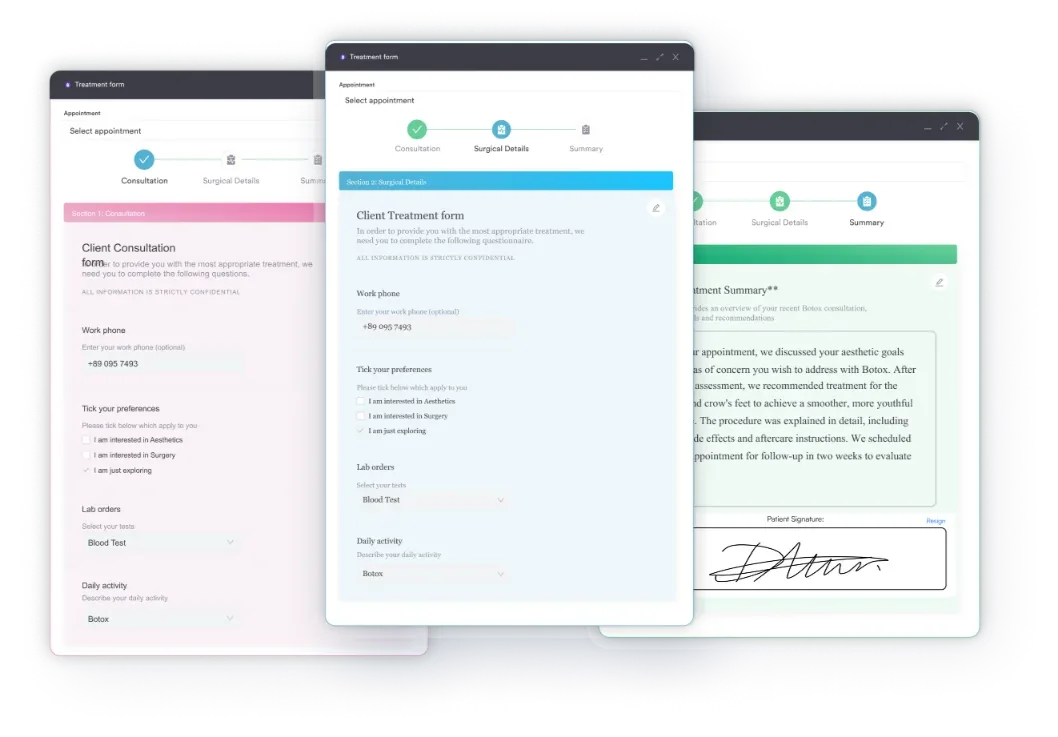
Pabau, practice management software for therapy and mental health practices, keeps that record in one place. Intake and consent forms are completed digitally, treatment notes attach to the patient’s own record, and access stays limited to the staff who need it.
Running a trauma caseload in software for therapy practices means the phase language from the wheel stays in the chart. The next session starts where the last one ended, and a safeguarding referral draws on a record that is already complete.

Pabau’s digital intake forms, consent records, and treatment notes sit inside the patient’s own file. Your team documents a sensitive case once, then finds it again without searching three systems.

The wheel earns its place in a session because it moves the conversation away from why the survivor stayed. It gives the pattern a shape they can point at, and a shape is easier to argue with than shame.
Use it as an opening frame, then let the survivor correct it. Some relationships never show a clean incident phase, and forcing an account into four tidy boxes costs you the detail safety planning depends on.
Whichever frame you use, the record has to hold it. Book a demo to see how Pabau keeps intake forms, consent, and session notes for a sensitive case in one patient file.

Need a structured intake for trauma work? Psychiatric evaluation template gives you a full mental health assessment framework to record what the survivor describes.
Working through the pattern with a survivor? Domestic violence worksheet walks through the same material in a form the survivor completes with you.
Ready to write the safety plan? Mental health safety plan covers warning signs, coping steps, and the contacts to reach in a crisis.
Looking for a coping tool between sessions? Coping wheel gives survivors a set of regulation strategies to reach for when tension rises.
Running this work in a group? Group therapy informed consent sets out the confidentiality and safety protocols to agree before the first session.
The cycle of abuse wheel is a visual model of how intimate partner violence unfolds in four repeating phases. Psychologist Lenore Walker described it in 1979: tension building, incident or explosion, reconciliation, and calm. Clinicians use it to help survivors recognize the pattern and read their own responses as survival strategies.
The cycle of abuse wheel maps the temporal flow of violence over time, meaning when incidents happen and how survivors respond. The Power and Control Wheel comes from the Duluth Model. It maps the tactics abusers use to maintain control, including isolation, economic abuse, and coercion. Many clinicians use both frameworks together in assessment and treatment.
During reconciliation, the abuser apologizes, promises change, and may show affection, creating relief and hope after the violence. This alternation between fear and relief creates trauma bonding, an intense psychological bond that can feel like love. Survivors often read the reconciliation as proof the relationship can improve, which makes leaving feel impossible.
The National Domestic Violence Hotline (1-800-799-7233) provides 24/7 crisis support, safety planning, and local advocacy referrals. Futures Without Violence offers evidence-based training and resources. Maintain local referral relationships with DV shelters, legal advocates, and law enforcement liaisons to provide warm handoffs and continuity of care.