List of vitamins: All 13 with RDAs and deficiency signs
A list of vitamins names the 13 essential vitamins the body needs from food or s...

13
Last Updated: Oct 8, 2026

A medication deferral list records which drugs stop a donor from giving blood, plasma, or platelets, and for how long.
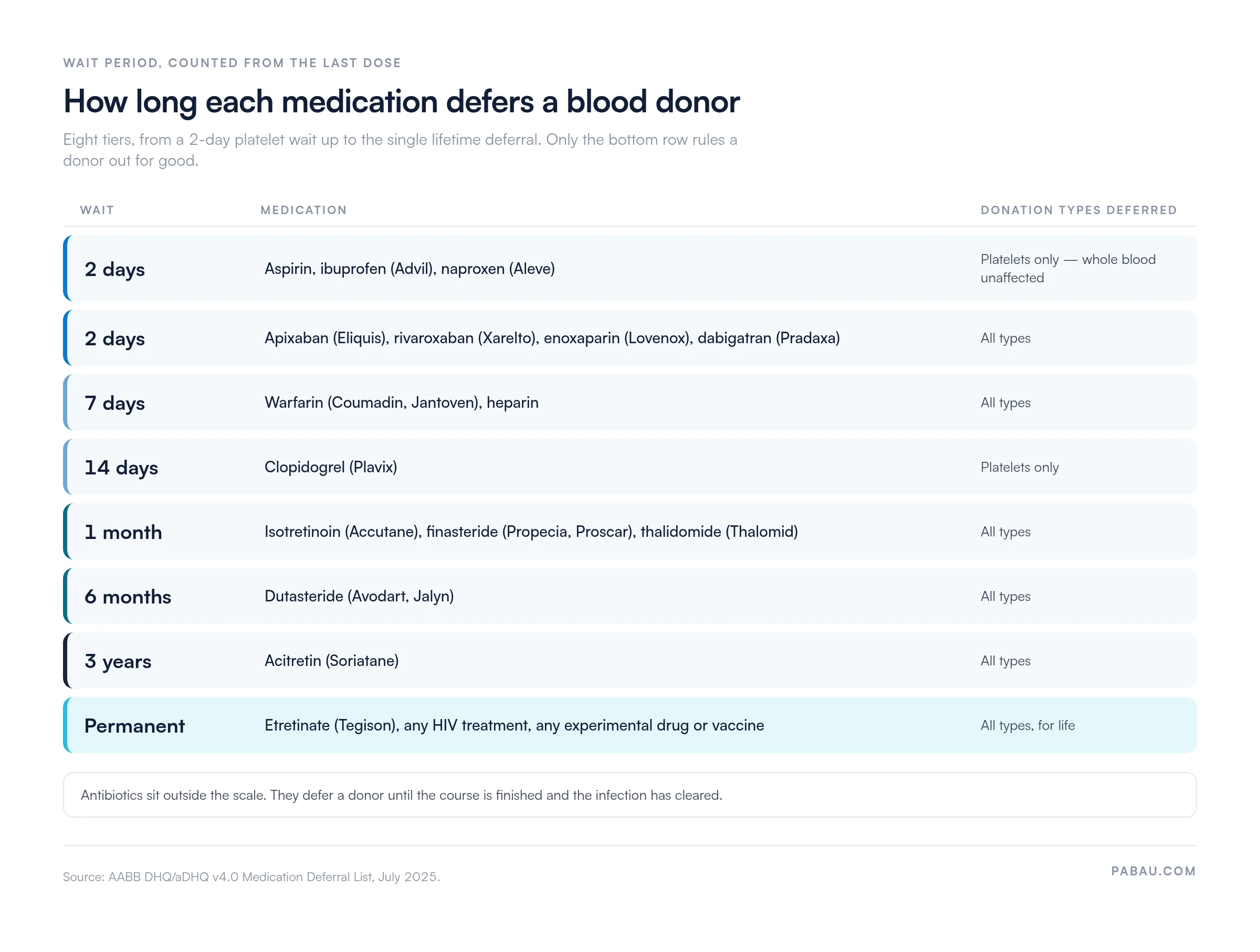
Etretinate (Tegison) is the one retinoid that defers a donor permanently. Isotretinoin (Accutane), finasteride (Propecia, Proscar), and thalidomide (Thalomid) each carry a 1-month wait instead.
Temporary deferrals run from 2 days to 3 years. Aspirin defers platelet donors for 2 days, dutasteride (Avodart) for 6 months, and acitretin (Soriatane) for 3 years.
A deferral often comes from the condition rather than the drug, so an antibiotic or an anticoagulant needs both questions asked at intake.
Practice management software like Pabau captures medication history at intake, then flags each donor when a temporary deferral expires.
A two-page reference covering the permanent deferrals and every temporary wait period, from 2 days to 3 years. It also lists the medications that cause no deferral at all, and includes a blank donor screening log. Figures come from the AABB DHQ/aDHQ v4.0 Medication Deferral List, updated July 2025.
Download templateA medication deferral list for donating blood is the reference staff check when they screen a donor at intake.
Blood centers, plasma collection sites, and practice coordinators all work from one. This guide covers what belongs on the list and which deferrals are genuinely permanent. It also gives every temporary wait period and shows how to build the check into intake.
A medication deferral list is a reference table showing which medications disqualify a donor from giving blood, plasma, or platelets, and for how long. It splits into two categories. Permanent deferrals rule the donor out for life, and temporary deferrals set a wait period that starts at the last dose.
The split matters more than it looks. Only a handful of drugs sit in the permanent column. Treating a temporary deferral as a lifetime ban costs the center a donor who was eligible weeks later. The Red Cross and other blood centers publish eligibility criteria alphabetically. Those lists are revised as FDA and AABB (American Association of Blood Banks) guidance changes.
The list applies differently across the three donation types: whole blood, plasma, and platelets. A medication that defers a platelet donor may leave whole blood donation untouched. Aspirin is the clearest example, and it is the deferral screening staff field most often.
The downloadable template uses a structured table so staff and coordinators can check donor eligibility in seconds. Follow these five steps to use it well:
Only a handful of medications defer a donor permanently. In the retinoid family, that list is one drug long. Etretinate, sold as Tegison, carries a lifetime deferral because it stays detectable in blood for years after the last dose. Permanent deferral also applies to any medication taken to treat HIV, and to experimental products the medical director has not cleared.
Isotretinoin, finasteride, thalidomide, dutasteride, and acitretin still appear as permanent deferrals on older reference sheets and on plenty of donor-facing pages. They are not permanent. Each one carries a defined wait period, and all five sit in the temporary table below.
Temporary deferral medications let a donor return once a set wait period has passed. Those waits range from 2 days to 3 years, depending on how long the drug takes to clear the body. Some drugs defer platelet donors only, because platelet recipients need working platelets straight away.
Two of these rows deserve a second look at intake. Dutasteride runs six times longer than finasteride, even though the two drugs work the same way. A donor who has taken both needs the later of the two dates. Acitretin runs for 3 years. A donor who drinks alcohol while taking it can convert the drug back into etretinate, the permanent deferral above.
Laid out on a single scale, the two tables above collapse into eight tiers. The tier a drug falls into is what decides the donor’s return date, so it is the figure worth committing to memory.
Most medications cause no deferral at all, and donors worry about far more prescriptions than the list covers. If a drug does not appear on the deferral table, it usually has no bearing on eligibility.
Omeprazole is the only gastrointestinal drug named above. A fuller GI medication list maps the other acid-suppressing and digestive classes donors report at intake.
Platelet donors face tighter medication rules than whole blood donors. Platelets go to patients who are bleeding or severely thrombocytopenic, and those patients need the transfused platelets to clump on arrival. Any drug that blunts platelet aggregation therefore defers a platelet donor, even when whole blood donation stays open.
Aspirin, ibuprofen, and naproxen each carry a 2-day platelet deferral and no whole blood deferral. The antiplatelet drugs run longer, up to 14 days for clopidogrel (Plavix). Build both questions into the intake script, because a donor who takes an over-the-counter painkiller rarely thinks to mention it. Automated workflows can flag the question before the donor reaches the chair.
Plasma is used to make clotting factors, albumin, and immunoglobulin for critically ill patients, so plasma centers screen medication history closely. In practice, a drug that defers whole blood donation defers plasma donation for the same length of time. The deferral list is shared across donation types, and the wait period does not shorten because the donor is giving plasma instead.
That means isotretinoin (Accutane) defers plasma donation for 1 month, not permanently, and etretinate (Tegison) rules a donor out of every donation type for life. Anticoagulant donors may still be accepted once the wait period has passed and the underlying condition is stable. The wait period depends on the drug, so staff can check anticoagulants grouped by class before clearing a donor. Always check your plasma collection center’s own medication list, since individual facilities can apply stricter criteria than the shared standard.
Blood bank staff at hospitals, regional blood centers, and independent donation facilities use the list as a daily screening reference. Plasma collection coordinators rely on it to keep eligibility decisions consistent with FDA and AABB standards across shifts.
Practice administrators and coordinators at IV therapy practices, functional medicine practices, and wellness centers use it for a different reason. They need to answer donor eligibility questions accurately and flag contraindications before treatment. These practices often ask about a recent blood or plasma donation, particularly where a protocol depends on current labs.
Protects donors and recipients: systematic screening catches a contraindicated donation before collection, rather than after the unit has entered the supply.
Keeps eligible donors: writing down the wait period turns a temporary deferral into a scheduled return visit instead of a donor who never comes back.
Reduces liability: a documented screening decision creates an audit trail if a question is raised about donor eligibility later.
Supports multi-location consistency: facilities running several sites can work from one reference, so the same donor gets the same answer at every location.
Record the wait period, not just the deferral. Donors on isotretinoin, finasteride, or thalidomide are often told they can never donate again, when the wait is 1 month. Storing the date each deferral expires turns a lost donor into a scheduled return visit.
Strong donation centers treat medication screening as a step in intake, not a question someone remembers to ask. Capture the drug name, the last dose, and the resulting deferral in one structured digital form. That removes the transcription errors that come with re-keying a paper answer. A running medication log then keeps the same detail to hand at the donor’s next visit.

Train staff on the difference between the two deferral types, and be explicit that a temporary deferral is an invitation to return. Many centers send an automated message when a deferral expires, which lifts return-donor rates without adding a call to anyone’s list. Keep the reference inside the donor record system so nobody has to switch windows mid-screening.
Medication history is protected health information even when the donor is not a patient at your facility. Store it in encrypted, access-restricted records backed by compliance management software. HIPAA requires appropriate technical and administrative safeguards, and a donor screening log kept on a shared spreadsheet rarely meets that bar.
In most practices the deferral check lives in someone’s head or on a printed sheet by the desk. Two coordinators reading the same list can reach different answers about the same drug. A temporary deferral written as “come back later” gives the donor nothing to act on.
Practice management software like Pabau moves that check into the intake form itself. Medication history is captured once, stored against the donor’s record, and visible to every member of staff who opens it. Automated workflows can trigger a reminder on the date a deferral expires, so the donor hears from you rather than being left to guess.
The result is a screening decision that reads the same at every location and a deferred donor who comes back. The check no longer rests on someone remembering a printed sheet, and the audit trail builds itself as staff work.

Pabau captures medication history at intake and stores the date each deferral expires. Automated reminders bring the donor back on the right day, without anyone tracking wait periods by hand.

At intake, the question worth answering is how long a drug defers the donor. Etretinate (Tegison), HIV treatment, and unapproved experimental products are the permanent answers. Every other drug on the list has a date attached, and that date is the part worth writing down.
Treating a 1-month isotretinoin wait as a lifetime ban is the expensive version of this mistake. It sends away a donor who was eligible four weeks later, and it spreads through your team as soon as one person repeats it. Download the template above, check it against your own center’s current policy, and put the wait period in the record rather than in a conversation.
Book a demo to see how Pabau captures medication history at intake and brings deferred donors back when their wait period ends.

Building the medication question into your forms? Medical forms at your healthcare practice covers how to capture medication history in a form that supports clinical decisions and stands up to an audit.
Setting up donor screening from scratch? New patient questionnaire template gives you the baseline questions to build your medication and eligibility section around.
Need to document a reaction after a dose or a donation? Adverse reaction form sets out the fields an incident record needs so the event stays traceable later.
Permanent deferral rules a donor out for life. Only a few medications do this, including etretinate (Tegison) and any drug taken to treat HIV. Temporary deferral sets a wait period after the last dose, and the current list runs from 2 days to 3 years. Aspirin defers platelet donors for 2 days but does not defer whole blood donors at all.
Yes, after a 1-month wait from the last dose. Isotretinoin, sold as Accutane, Absorica, Claravis, Myorisan, and Zenatane, is a temporary deferral rather than a permanent one. The wait exists because isotretinoin causes severe birth defects if it reaches a pregnant transfusion recipient. Screening staff should record the last-dose date so the donor can be invited back once the month has passed.
Etretinate (Tegison), a psoriasis retinoid, defers a donor permanently because it stays detectable in blood for years. Any medication taken to treat HIV also carries a permanent deferral, since it reflects an HIV diagnosis. Experimental or unapproved products are deferred at the medical director’s discretion. Most other drugs on the deferral list have a finite wait period.
Finasteride (Propecia, Proscar) carries a 1-month wait after the last dose. Dutasteride (Avodart, Jalyn) carries 6 months, because it clears the body far more slowly. Acitretin (Soriatane) carries 3 years. All three are temporary deferrals, so a donor who has passed the wait period is eligible again.
Warfarin and heparin carry a 7-day wait after the last dose. Apixaban (Eliquis), rivaroxaban (Xarelto), enoxaparin (Lovenox), and dabigatran (Pradaxa) carry 2 days. The condition behind the prescription matters too, so an active clot defers the donor on its own. Confirm both the drug and the diagnosis with your local blood center.
Aspirin defers platelet donors for 2 days because it stops platelets from clumping properly. Ibuprofen (Advil) and naproxen (Aleve) carry the same 2-day platelet deferral. Neither affects whole blood donation. A donor can give whole blood the same day they take aspirin, but must wait 2 days to give platelets.
Donors on antibiotics are deferred until the course is finished and the infection has cleared. The deferral protects recipients from an active infection reaching the blood supply. Most donors become eligible 24 to 48 hours after the last dose. The exact wait depends on the infection and on local center policy.
Most ADHD medications, including Adderall and methylphenidate, cause no deferral from blood or plasma donation. The donor’s underlying condition can still matter, and center policies vary. Tell the donation center about the diagnosis and the medication, and staff will confirm eligibility against their current criteria.
GLP-1 agonists such as semaglutide (Ozempic) and tirzepatide (Mounjaro) do not appear on the current medication deferral list. This is a newer drug class, so individual centers may still be setting their own policy. Donors taking one should call their local blood center to confirm before booking a donation.