CRM for chiropractors: how to manage patients, bookings and marketing
A CRM for chiropractors is a patient relationship management system built around...

Last Updated: Oct 13, 2026
A blood type donation chart shows which blood types can safely give to and receive from each other. O negative red cells go to any patient. AB positive can receive from every donor. AB plasma, positive or negative, suits all four ABO groups.
Those three rules settle most transfusions. Plasma and platelets follow a different pattern, which the sections below set out in full. You will also find US frequency figures, the criteria donors have to clear, and a printable donor intake form.
A printable donor intake form with donor details, emergency contact fields, and the eligibility criteria donors must meet. It adds a practitioner sign-off checklist and a blank section for recording each donor’s type and suitable donations.
Download template
O negative is the universal red cell donor because it carries no A, B, or Rh antigens.
AB positive receives red cells from every donor, and AB plasma of either Rh type suits all recipients.
O positive is the most common type at roughly 37%, and its red cells go to any Rh-positive patient.
Plasma and platelet rules run opposite to whole blood, which matters most for apheresis programs.
Blood type belongs on the patient record at intake, not at the moment a transfusion is needed.
The ABO blood group system sorts blood by two antigens on the surface of red blood cells. Those antigens are called A and B, and your type depends on which ones you inherit.
Type A carries A antigens, type B carries B, type AB carries both, and type O carries neither. The Rh factor adds a second layer, based on whether the Rh antigen is present.
Your body makes antibodies against the antigens you don’t have. An A-positive person carries A and Rh antigens, so they produce anti-B antibodies.
Incompatible blood triggers a hemolytic reaction, where the recipient’s antibodies attack the donor’s red cells. That reaction can be fatal. Structured patient intake forms record blood type long before anyone reaches for a unit.
Six facts do most of the work here:

The eight types come from combining ABO with Rh status. Frequency varies by ethnicity and geography, but the US averages are well documented.
O positive leads at roughly 37%, which makes it the workhorse of routine transfusion. O negative sits near 7%, and its value comes from being safe to give before a patient’s type is known.
According to the American Red Cross, O negative is only 6-7% of the US population, yet demand never lets up. It can go to trauma patients and to newborns who arrive with no known type.
AB negative is the rarest of the eight at 0.6-1%. AB donors matter most for plasma, because AB plasma of either Rh type suits every recipient.
The compatibility matrix is the part of the chart that gets used at the chairside. Use it to match donor and recipient for whole blood and red cells. A safe match means the donor’s red cells carry no antigen the recipient’s antibodies will attack.
Read the table the other way and the donor’s view appears. O negative shows up in all eight rows. AB positive shows up in one.
O negative is the universal red cell donor because it carries neither A nor B antigens, and no Rh antigen either. Without those surface markers, O-negative red cells give a recipient’s antibodies nothing to attack. That makes it the only type safe to transfuse before a patient’s blood type is known.
Blood banks recruit O-negative donors hardest and hold the largest reserves of them. Only about 7% of the US population qualifies, so supply tightens in winter and after mass casualty events. Practices running donor programs feel that squeeze first, because their recall lists are what refill the shelf.
Compatibility changes with the component. Whole blood, platelets, and plasma each carry different antigens and antibodies, so one matrix cannot cover all three. The reversal between red cells and plasma is the quickest way to see it.
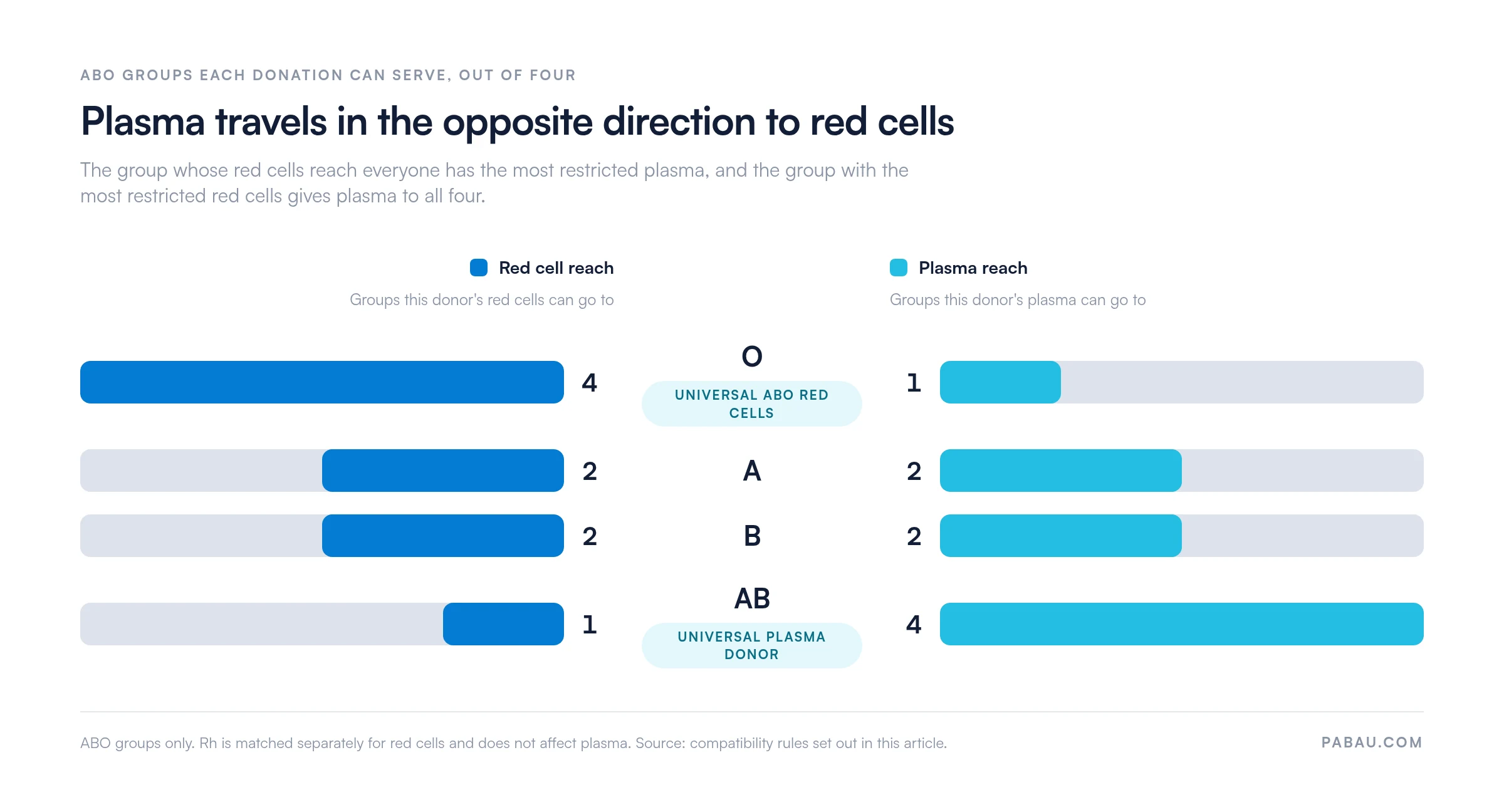
Whole blood is the traditional donation, with red cells, white cells, platelets, and plasma collected together. It follows the ABO and Rh rules above, so O negative gives and AB positive receives.
Platelet donations are collected by apheresis. They need ABO compatibility but not Rh matching, because platelets carry very little Rh antigen. AB positive platelets suit almost every recipient, which is why cancer and surgical patients rely on them.
Plasma donations run the other way. AB plasma, from AB positive and AB negative alike, is the universal plasma donor, because it carries no anti-A or anti-B antibodies. O plasma is the most restricted and suits only O recipients.
Recording the component, not just the date, keeps a transfusion history usable. A medical records management system holds that detail against the patient, where the next clinician will look for it.

Blood type is only half the screen. Donors also have to clear age, weight, health, and travel criteria set by the FDA and the collecting blood center.
Most US centers ask for donors aged 17 or over, weighing at least 110 pounds, and free of active infection. Hemoglobin is tested on the day to confirm the donor can spare a unit.
Deferral criteria move as disease surveillance changes, and they differ between countries. The form on this page lists metric-first thresholds and a 16 to 71 first-time age range. Those follow UK donor service rules, so check your own blood center’s criteria and edit the checklist before printing.
Repeat donors are the easiest volume to protect. Whole blood donors become eligible again after 56 days, and automated reminder workflows can contact them the day they qualify.

A chart on the wall only helps if the record underneath it is right. Five habits keep the two in step.
Consent belongs in the same place as the result. A signed blood test consent form filed against the patient record settles any later question about what was agreed.
Well-built software for primary care keeps the consent, the type, and the draw date in one file rather than three.
Sometimes, and only within limits. Each parent passes on one ABO allele. Both A and B are dominant over the O allele. A child who inherits A from one parent and O from the other has type A blood. Rh works the same way, with positive dominant over negative.
Two type-O parents can only have type-O children, because neither can pass on anything else. Two AB parents can have A, B, or AB children, and never an O child. Each of them hands over either an A allele or a B allele. Two type-A parents can still produce a type-O child if both carry a hidden O allele.
Rh status is the part worth flagging early. An Rh-negative mother carrying an Rh-positive baby needs anti-D prophylaxis, and that decision starts with a confirmed type on file.
Most practices still hold blood type in two places. It sits on a paper intake form in a drawer, and in the memory of whoever took the call. Neither survives a staff change or a busy Monday.
Practice management software like Pabau stores blood type as a structured field on the patient record. It is not a note somebody typed into free text. Intake forms feed the field directly, so the value is there before the appointment starts. Consent forms and lab results file against the same record.
That pays off when a donor comes back. Their eligibility date, last component, and confirmed type sit together, so your team books the next slot without a search. Every Pabau subscription includes the forms, records, and automation features involved.

Pabau’s intake forms and patient records store blood type, consent, and donation history in one file. Your team finds it in seconds, without opening a filing cabinet.

Keep the compatibility tables where the work happens and the chart earns its place. The reversal between red cells and plasma is the rule worth re-reading before an apheresis shift. O negative and AB plasma sit at opposite ends of the same logic.
The chart is only as good as the record beside it. Get blood type onto the patient file at intake, and the chairside question never comes up. Book a demo to see how Pabau keeps blood type, consent, and donation history on one patient record.

Drawing blood at your practice? The blood test consent form sets out what the patient is agreeing to before the needle goes in.
Building a new patient file? The general practice intake form lists the fields worth capturing, blood type included.
Reading blood gas results? The ABG chart gives the normal ranges and explains what a shift in each value means.
Storing donor records securely? The HIPAA compliance checklist for primary care walks through what has to be locked down.
Rh-null, often called golden blood, is the rarest of all. Fewer than 50 people worldwide have ever been identified with it, because their red cells carry no Rh antigens. Among the eight main types, AB negative is rarest at roughly 0.6 to 1% of the US population.
Whole blood donors can give every 56 days, up to six times a year. Platelet donors can return every seven days, up to 24 times a year. Plasma donors can give every 28 days, and a Power Red donation carries a 112-day wait.
No. ABO group and Rh status are inherited and fixed for life. The one exception is an allogeneic bone marrow or stem cell transplant, where the recipient gradually takes on the donor’s blood type.
Usually yes. In the US, a tattoo applied at a state-regulated shop with sterile needles and single-use ink carries no waiting period once it has healed. Where the state does not regulate tattoo facilities, donors wait three months. The rule guards against hepatitis transmission.
Yes. Every unit is typed and crossmatched against the recipient’s own sample first, whatever the chart or the record says. O negative is released uncrossmatched only in emergencies, when waiting for results costs more than the risk.