Despina Petrushevska

List of vitamins: All 13 with RDAs and deficiency signs
A list of vitamins names the 13 essential vitamins the body needs from food or s...

14
Last Updated: Oct 8, 2026
Free PDF 2 pages, print-ready Clinician-reviewed
The AIP autoimmune protocol diet is an elimination diet that removes common food triggers for a set period, then reintroduces them one at a time. Elimination cuts grains, legumes, dairy, eggs, nuts, seeds, nightshades, alcohol and NSAIDs, and usually lasts 30 to 90 days.
For dietitians and functional medicine practitioners, the hard part is often the record-keeping. Each patient needs a clear log of what they ate, what was removed, and how they responded to each food.
This template gives your practice a written AIP protocol, covering scope, responsibilities, the procedure to follow and what must be recorded. Pabau, the practice software we build, can then collect each patient's details through a digital intake form before the first consultation.
Use it as supportive dietary management alongside medical care, not as a treatment for autoimmune disease.
A two-page protocol document with sections for purpose, scope, definitions, responsibilities, procedure, records, training and monitoring. It closes with an approval and review block, so you can adapt it to your practice and sign it off.
Start from scratch, or upload this PDF or any form you already use, and Pabau's AI Form rebuilds it with tick boxes, text fields and a signature. Attach it to the treatment once, and every patient gets it on time.
AI Form rebuilds the consent, history and aftercare forms you already use. You review each one, then publish.
Patients complete forms on their phone before they arrive, so the front desk stops retyping paper.
Every signed form is versioned and attached to the treatment record, ready when you need it.
Set how long a consent stays valid. Returning patients skip forms they have already signed.
Supports HIPAA and GDPR compliance AES-256 encryption 4.8 on G2 4.7 on Capterra Trusted by 4,000+ practices worldwide

AIP is dietary management and sits alongside, not in place of, prescribed medical care.
Elimination removes grains, legumes, dairy, eggs, nuts, seeds, nightshades, alcohol and NSAIDs.
Reintroduction should be supervised by a registered dietitian or qualified clinician.
Pabau’s digital forms can capture intake details online, keeping records consistent.
An AIP autoimmune protocol diet template is a printable protocol document that sets out how your practice runs AIP. It names who the protocol applies to, who is responsible, the steps to follow and what gets recorded.
A consistent record supports professional standards. The Academy of Nutrition and Dietetics sets standards for nutrition care, and clear records help you meet them.
Two phases shape the record:
The procedure section is where you write out both phases, and the records section says what gets logged at each step. The flow below shows what the patient record should hold from baseline to review.
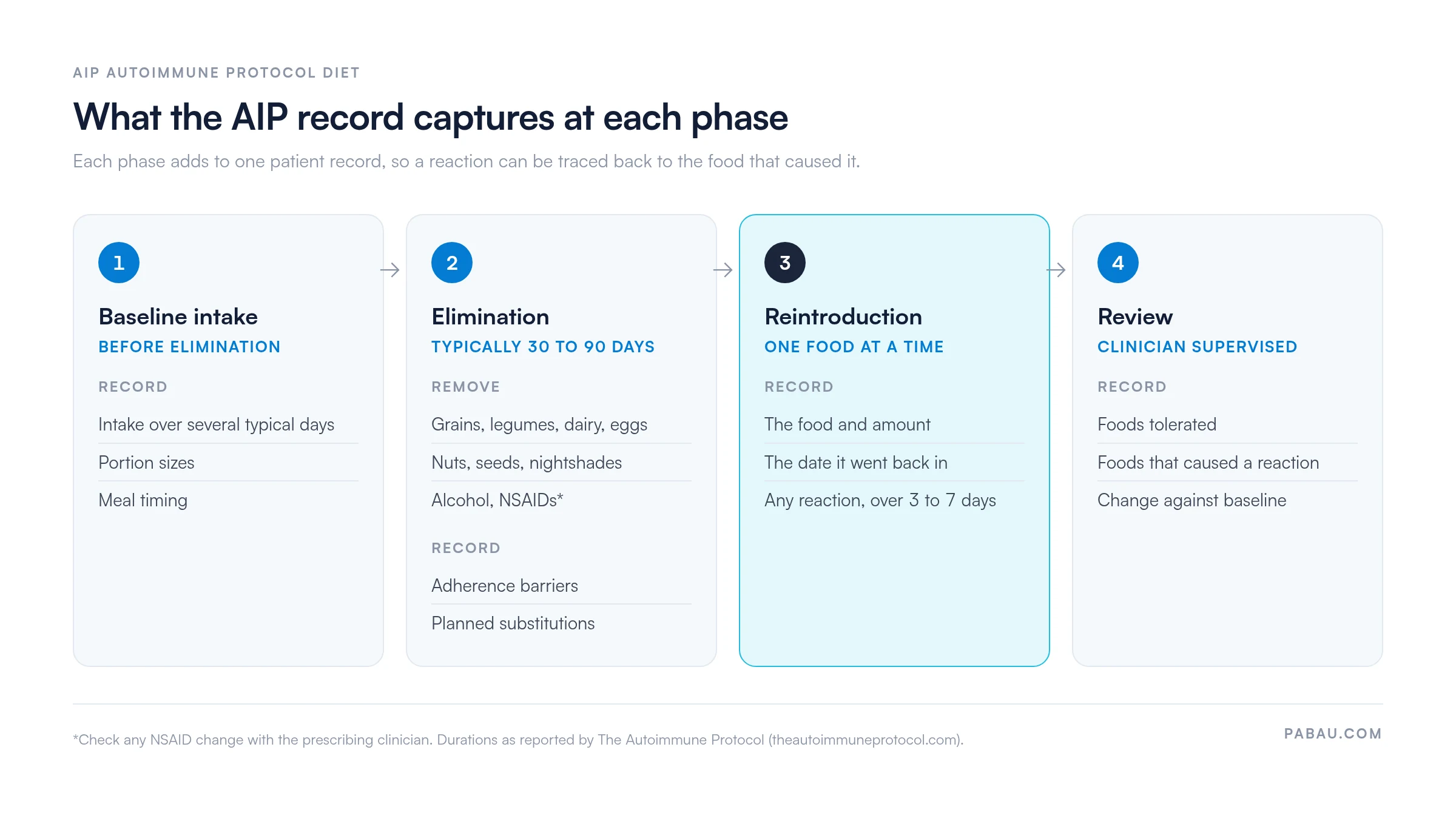
Work through the sections in order, then add the approval and review dates at the foot of the document. Start with baseline intake, so later changes have a clear starting point.
To capture a fuller history at the first visit, pair the protocol with a functional medicine intake form.
Clinicians who write up these notes can speed up the process with AI-powered clinical documentation, leaving more time for the patient conversation.
Reintroduction adds one eliminated food group back at a time and records how the patient responds before the next food is added.
According to The Autoimmune Protocol, each food is usually tested over three to seven days before the next one. Reactions can be delayed by one to three days, so symptoms are logged for the whole window.
For a day-by-day log of each challenge food, an elimination diet reintroduction chart works well alongside this protocol.
Keep this phase under the supervision of a registered dietitian or qualified clinician, particularly where a condition such as Hashimoto’s thyroiditis is involved.
Dietitians, nutritionists and functional medicine practitioners use this template most often.
The main benefit is a complete, comparable record for every patient across review periods.
A written protocol means every clinician records the same details. That makes it easier to see which foods a patient tolerated and where progress stalled.
Review the protocol at the end of each elimination period. Compare recorded exclusions with what the patient reported, then tighten any record that staff regularly skip.
The food list separates the foods generally allowed during the elimination phase from those excluded.
Most non-starchy vegetables, fresh fruit, wild-caught fish, grass-fed meat and coconut products are generally allowed. Nightshades are eliminated mainly because of a proposed mechanism, and direct trial evidence for that mechanism is limited.
For general guidance on balanced eating, see the Dietary Guidelines for Americans. Plan swaps with the patient, and check any NSAID use with the prescribing clinician before changing it.
Patients usually need help with planning and adherence more than with the rules themselves.
Ask about cooking time, eating out and family meals at each review, and note any barrier in the patient record.
The evidence is limited, mostly small pilot studies rather than large randomized trials, so AIP should be treated as supportive care.
Studies indexed in PubMed Central describe promising but limited results in conditions such as inflammatory bowel disease and Hashimoto’s thyroiditis.
Some patients report weight changes, which should be treated as a possible side effect rather than a goal. Sleep, stress management and movement are often discussed alongside AIP, though not every source treats them as core.
On paper, an AIP program means an intake form, handwritten review notes and separate food logs for each patient. Comparing week one with the reintroduction review means searching through all three.
In Pabau, the intake form goes out before the first consultation and lands in the patient record once it’s completed. Review notes, typed or drafted by Pabau Scribe, sit in the same record.
Pabau’s pre- and aftercare instructions send the elimination rules and reintroduction steps to patients between appointments. For teams running AIP inside wider integrative programs, Pabau’s software for longevity practices keep those plans in the same place.

Pabau brings intake forms, patient records and clinical notes into one place for practitioners delivering structured nutrition support.

AIP only tells you something if each reintroduction is recorded the same way. Set the protocol before a patient starts elimination, so week one has a baseline to compare against.
The trade-off is time. A written protocol takes longer to set up. It pays that back when a patient reacts and you need to know which food went back in first.
Keep clinician supervision built into every reintroduction, and treat AIP as support for medical care. Book a demo to see how Pabau keeps AIP intake, review notes and aftercare in one patient record.

Need a day-by-day challenge log? Elimination diet reintroduction chart tracks each food as it goes back in.
Running a broader elimination diet? Elimination diet plan covers the wider exclusion plan beyond AIP.
Assessing gut symptoms first? Gut health checklist gives you a structured symptom screen before elimination starts.
Suspect histamine is the trigger? Histamine food list sorts high- and low-histamine foods for a targeted trial.
Setting up the first consultation? Functional medicine intake form captures the history you need before any diet change.
The autoimmune protocol, or AIP, is an elimination diet used by people with autoimmune conditions. It removes grains, legumes, dairy, eggs, nuts, seeds, nightshades, alcohol and NSAIDs. Foods then go back in one at a time to find individual triggers.
Most people stay in elimination for 30 to 90 days before reintroduction starts. Readiness depends on improvement from the patient’s own baseline. A patient with no change after 90 days should be reviewed by their clinician rather than kept on the restrictions.
No. AIP is supportive dietary management, and the evidence comes mostly from small pilot studies. Patients should keep taking prescribed treatment, and any change to medication, including NSAIDs, needs the prescribing clinician’s approval.
Foods least likely to cause a reaction go back in first. A common sequence starts with egg yolks, green beans, peas, seed spices and ghee, then nuts, seeds and egg whites. Dairy and limited nightshades follow, and grains, most legumes and other nightshades come last.
Test one food at a time and log the amount, the date and any symptoms. Wait three to seven days before the next food, because reactions can be delayed by one to three days. Keep each entry in the patient record, as the protocol’s records section requires.