SIBO diet food list template
A SIBO diet food list sorts foods by their fermentable carbohydrate (FODMAP) con...

3
Last Updated: Oct 6, 2026
A list of vitamins names the 13 essential vitamins the body needs from food or supplements. Four are fat-soluble (A, D, E and K) and nine are water-soluble (the eight B vitamins plus vitamin C).
This reference gives each vitamin’s chemical name, main function, adult RDA, food sources and deficiency signs. Practitioners use it to screen supplement use at intake, record doses consistently and spot the few vitamins that need a clinical check.
A printable reference covering all 13 essential vitamins, with chemical names, primary functions, adult RDA values, food sources and deficiency signs. Use it to structure intake questions and supplement notes in patient records.
Download template
Nutrition science recognizes 13 essential vitamins: four fat-soluble vitamins (A, D, E, K) and nine water-soluble vitamins (eight B vitamins plus vitamin C).
Fat-soluble vitamins need dietary fat for absorption and build up in body tissue, while water-soluble vitamins are stored minimally and need regular intake.
RDA and upper intake limits vary by age, sex and pregnancy status, so check the NIH Office of Dietary Supplements figures when you counsel patients.
In Pabau’s practice management software, digital intake forms capture each patient’s vitamin supplements and deficiency history as structured data in the patient record.
A clinical vitamin list documents the vitamins the body cannot make in sufficient amounts and must get from diet or supplements. Unlike minerals such as calcium, magnesium and zinc, vitamins are organic compounds that drive metabolism, immunity and wound healing.
In practice, the list does three jobs:
The NIH Office of Dietary Supplements publishes the Dietary Reference Intakes (DRIs). These are the intake standards to cite when you counsel patients on adequate levels.
Start with your intake form. Ask about current supplements by name, not just “Do you take any medications?” Many patients leave over-the-counter vitamins off a medication list unless prompted.
When screening points to a likely deficiency, follow up with a full nutrition assessment form before you recommend a supplement. Then store the vitamin list in your digital intake forms, so every clinician on your team uses the same names and fields.

All 13 vitamins fall into two solubility classes, each with its own absorption and storage pattern.
Fat-soluble vitamins need dietary fat for absorption and are stored in body tissue. Excess intake can therefore build up to toxic levels over time. That storage helps patients with patchy diets, but it calls for caution with high-dose supplement protocols.
Water-soluble vitamins are stored in small amounts, and the body excretes the excess in urine. Your patients need a steady intake from food or supplements, and toxicity is uncommon.
The eight B vitamins work together in energy metabolism, nerve function and DNA synthesis. That is why many practitioners recommend a B-complex supplement rather than a single B vitamin.
When a patient reports taking vitamins, record the specific vitamin (not just “multivitamin”), the dose, frequency, duration and reason for use. Add any side effects the patient mentions.
Supplement interactions slip through medication reviews when the record only says “takes vitamins.” Some answers need a clinical check every time, and the table below shows the six this guide covers.
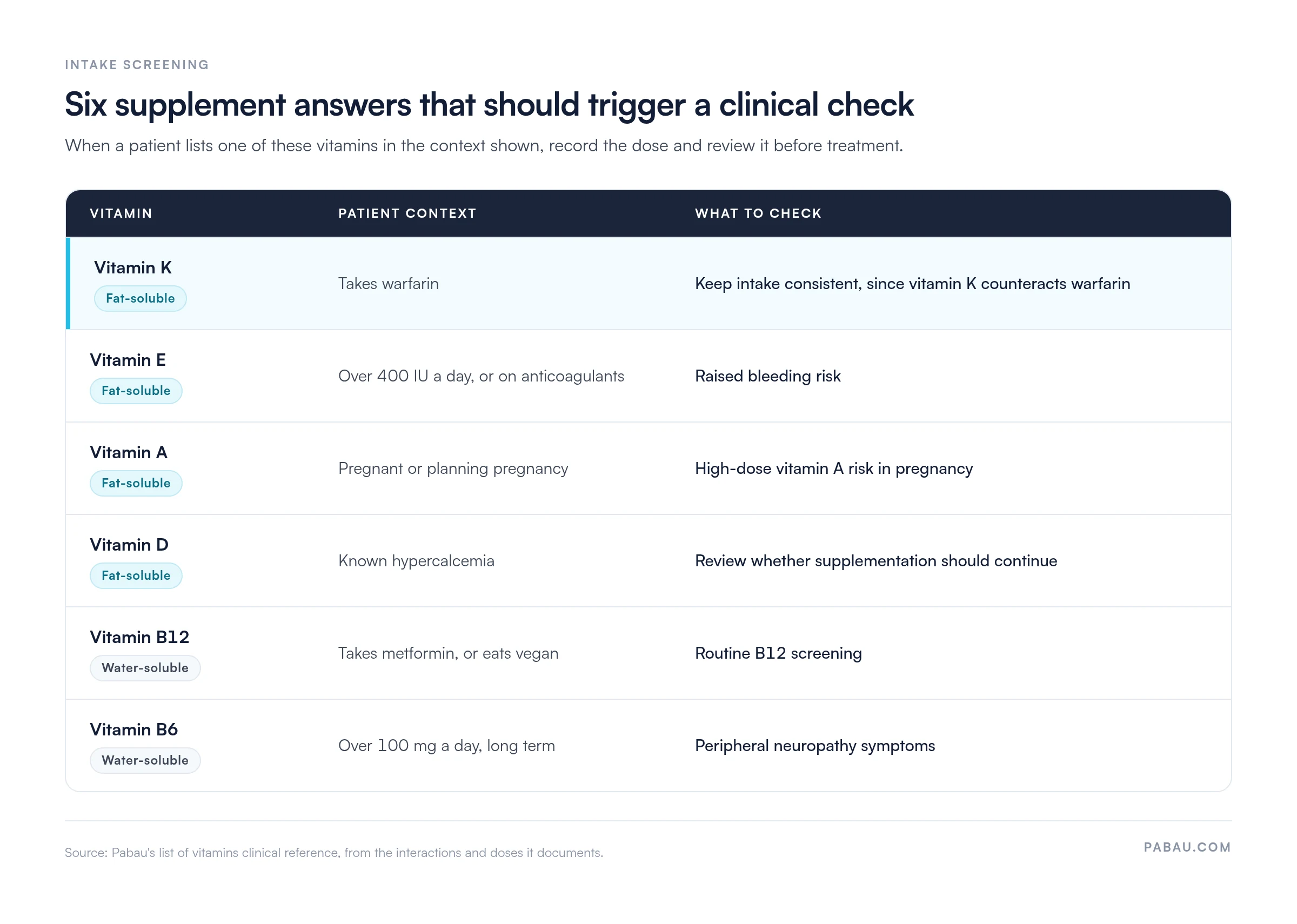
Record supplements next to the patient’s OTC medication list, so one review covers both. A structured supplement section in your patient records system then gives every clinician the same history at the next visit.

A structured vitamin reference makes screening more complete. Many patients don’t think of vitamins as medication, so they leave them out unless a list prompts them.
It also gives your team one vocabulary. Without it, one clinician writes “B12 supplement 1000 mcg weekly” and another writes “cobalamin 1 mg IM monthly.” Notes like these are hard to compare during handoffs and audits.
It grounds patient education in evidence. When a patient asks whether they need a vitamin, you can point to the RDA instead of an opinion. Record the reason for each recommendation so the patient understands it, too.
Finally, consistent supplement records support compliance. They show an inspector or auditor exactly what was recommended, at what dose and why.
Minerals matter just as much for bone health, nerve function and enzyme activity. Many practitioners record vitamins and minerals together on one reference sheet.
Calcium, magnesium, zinc, iron and iodine are the minerals wellness practices supplement most. Each has its own RDA, absorption needs and toxicity threshold. Iron, for example, absorbs better alongside vitamin C.
Weight management practices often use a combined vitamin-and-mineral intake form, because restricted diets can leave patients short on both. Good weight loss clinic software keeps that form next to the patient’s meal plans and progress notes.
For patient-friendly background, see the Mayo Clinic’s vitamins and supplements guide and the MedlinePlus vitamin reference.
In a consultation, the patient’s vitamin list becomes a teaching tool. If a patient reports fatigue, check iron, B12 and vitamin D, since these deficiencies often sit behind low energy. If a patient is pregnant, confirm they take at least 400 mcg of folic acid a day.
Ask about duration (“How long have you taken vitamin D?”) and source (“Who recommended it?”). Patients often keep taking supplements with no clear reason. Asking opens a conversation about whether each one still fits their goals.
Most practices collect supplement answers on a paper form or a free-text field. The answers then sit apart from the treatment notes, and nobody can search them.
Pabau turns the vitamin list into a digital intake form with set fields for name, dose and frequency. Patients complete it before their visit, and their answers flow straight into the patient record.
Your team then sees the supplement history next to treatment notes at every follow-up. You can check what was recommended, how the patient tolerated it and whether their symptoms improved.

Capture vitamin and supplement intake with digital forms, and store each patient’s complete supplement history in one searchable record.

A vitamin list does its work on the intake form, where every patient meets the same questions. Put the 13 vitamins on your form, ask for dose and frequency every time and check the six high-risk answers before treatment.
The trade-off is a few extra intake questions. In return, you get supplement records your whole team can read the same way. Book a demo to see how Pabau turns this list into a digital intake form that files every answer in the patient record.

Need a quick nutrient reference for appointments? Nutrition cheat sheet puts key nutrient targets on one page for busy consultations.
Turning a deficiency into a plan? Nutrition care plan structures goals, interventions and follow-up for each patient.
Documenting a nutrition consultation? Nutrition SOAP note gives you a consistent format for recording assessments and plans.
Building meals around a patient’s needs? Nutritionist meal plan helps you map daily meals to a patient’s targets.
Helping patients track what they eat? Nutrition worksheet gives patients a simple way to log intake between visits.
There are 13 essential vitamins. Vitamin A supports vision and immunity, the eight B vitamins drive energy and nerve function, and vitamin C supports immunity and collagen. Vitamin D supports bone and immune health, vitamin E is an antioxidant and vitamin K handles blood clotting and bone.
Fat-soluble vitamins (A, D, E, K) are absorbed with dietary fat and stored in body tissue, so excess intake can build up to toxic levels. Water-soluble vitamins (the B complex and C) are stored in small amounts and excreted in urine. Toxicity is uncommon, but you need a regular intake.
Water-soluble vitamins (B1, B2, B3, B5, B6, B7, B9, B12 and C) need a regular daily intake because the body stores little of them. Many people with limited sun exposure also take vitamin D daily or weekly.
Vitamin D deficiency causes rickets in children, with soft, weak bones and delayed growth. In adults it causes osteomalacia, with bone pain, muscle weakness and fractures. Research also links low vitamin D to higher infection risk, so screening matters in clinical practice.
The 13 essential vitamins are A, C, D, E, K and eight B vitamins. The B vitamins are B1 (thiamine), B2 (riboflavin), B3 (niacin), B5 (pantothenic acid), B6 (pyridoxine), B7 (biotin), B9 (folate) and B12 (cobalamin).
Patients should list every vitamin supplement with its name, dose, frequency and reason for use. The highest-priority items for clinical review are vitamin D, B12, folate in pregnancy, vitamin K with warfarin and high-dose vitamin E with anticoagulants.