Physician credentialing checklist
A physician credentialing checklist lists every license, certificate, verificati...

Last Updated: Oct 23, 2026
A medical AMA form is a clinical document that records a patient’s decision to leave care against medical advice (AMA). It captures their informed refusal of recommended treatment, the risks explained to them, and their acknowledgment of the consequences. That record protects patient autonomy and gives the clinician evidence that the risks were communicated.
Our free template is a starting intake form for AMA cases, covering patient identifiers, contacts, relevant history, medications, and a signature line. This guide explains what a complete AMA record adds on top of it, how to complete one, and how digital forms simplify the process.
A two-page starter form with patient identifiers, contact details, the reason for the form, relevant history, medications and allergies, confirmations, and a signature line. Add capacity, risk-disclosure, witness, and clinician-signature sections before you use it as a full AMA record.
Download template
A medical AMA form records a patient’s informed decision to refuse treatment and leave. It protects patient autonomy and gives the clinician a defensible record.
A complete AMA record documents capacity, the specific risks explained, follow-up instructions, and signatures from the patient and the clinician.
Our downloadable template is a starting intake form, so add the AMA-specific sections your facility policy requires before you rely on it.
A patient who refuses to sign can still leave AMA, and a narrative note of that refusal in the chart remains protective.
Practice management software like Pabau attaches each completed form to the patient record with a timestamp, so it cannot go missing in paper filing.
A medical AMA form is completed when a patient refuses recommended treatment and chooses to leave. That can happen in a hospital, urgent care center, emergency department, or inpatient unit. The form documents their informed refusal, which separates a deliberate patient choice from routine non-compliance or an administrative discharge.
AMA discharges happen across healthcare settings. An emergency patient may decline admission for chest pain, or an inpatient may want to go home before finishing an antibiotic course. The form serves two purposes. It honors the patient’s right to refuse treatment, and it shows the clinician explained the risks and the patient understood them.
The AMA form is the counterpart to an adult medical consent form, which records a patient agreeing to the treatment offered.
The downloadable PDF is a two-page general intake form that opens the AMA record. It is a starting point rather than a complete AMA discharge document. It includes these sections:
The template has no capacity assessment, risks-disclosed section, follow-up instructions, witness line, or clinician signature block. Add those before you use it for an AMA discharge, using the checklist below. The date fields also print in day/month/year order, so US practices may want to switch them to month/day/year.
Proper AMA documentation reduces clinician liability when a patient’s health deteriorates after leaving against advice, although it cannot remove that liability. Without a signed form and a clear narrative note, clinicians face greater malpractice exposure. A provider who never documented the AMA discharge has no way to prove the risks were explained.
A defensible AMA record contains the elements below, which together demonstrate informed refusal and patient capacity. Use the table to build out our template, or to audit the AMA form your facility already uses. The last column shows which elements our downloadable template already covers.
Capacity and disclosure in that table are the same standards that govern consent itself. Our informed consent template defines both in full, alongside comprehension and voluntariness, the other two core principles.
Completing a medical AMA form is a clinical conversation, so give it time rather than rushing the paperwork. The steps below reflect clinical best practice and risk management guidance.
Those ten steps turn on three decisions, and each answer changes what goes on the form and in the chart.
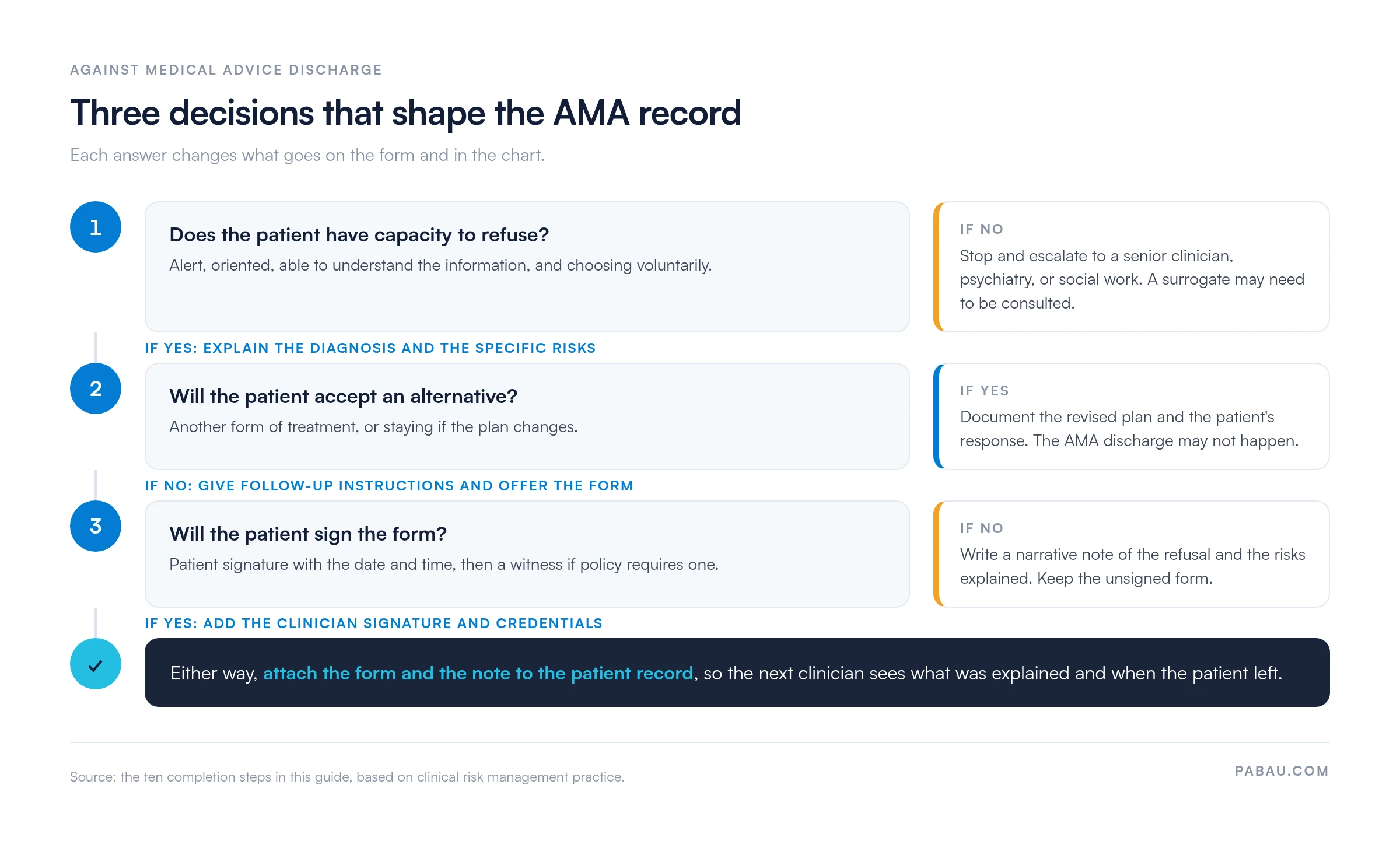
A patient has the right to refuse to sign, and clinicians sometimes worry this removes their legal protection. It does not, provided you document the refusal in the medical record itself.

Write a narrative note in the chart: “Patient refused to sign the AMA form but verbalized understanding of the risks of leaving untreated for [condition]. Patient agreed to seek immediate care if symptoms develop. Patient left the facility at [time] against clinical advice.”
The narrative note and the unsigned form together show that you fulfilled your duty to inform and warn. Risk management guidance treats a documented conversation as evidence the patient was informed, even without a signature.
Always offer the form. If the patient refuses, do not argue. Document the refusal and the conversation in the chart, because a clear record matters more than a signed page.
One persistent myth is that Medicare or private insurance automatically denies payment when a patient leaves AMA. A 2012 study in the Journal of General Internal Medicine found no evidence of insurers denying payment for that reason. The same study found many physicians still believed the myth and repeated it to patients.
For billing, the record should show that treatment happened before the discharge decision, that the patient was informed of the risks, and when they left. Payers may question a vague note such as “Patient left without treatment.” A well-documented AMA discharge supports the claim.
If a family member later requests the chart or files an appeal, check for a signed authorized representative form in the patient’s file. That document names who may act on records and insurance matters, and how far their authority goes.
Marriage alone grants no access to a partner’s chart, so look for written spousal consent before releasing copies.
Paper AMA forms are easy to lose in a chart and need manual scanning and filing. They also leave no record of when the form was completed or by whom. Pabau’s patient intake software replaces that paper with a structured digital form.
You can rebuild this template as a Pabau digital form and add the capacity, risk, witness, and clinician sections your policy needs. The patient signs on screen, and Pabau’s medical records management files the completed form in their record with a timestamp. Every clinician with access then sees the same signed form.
Once the AMA discharge is recorded, Pabau’s automated workflows can send the patient a follow-up message with next steps. That supports continuity of care and adds another documented touchpoint to the record.

Pabau turns paper AMA forms into digital forms that patients sign on screen. Each completed form attaches to the patient record with a timestamp, so your AMA documentation stays complete and easy to find.

Treat the medical AMA form as the written half of a clinical conversation. The signature matters less than the evidence that you assessed capacity, named specific risks, and offered a follow-up plan.
Start with our template for identifiers and history, then add the AMA-specific sections before the next patient asks to leave. A form built in advance holds up far better than one improvised at the bedside.
Book a demo to see how Pabau keeps signed AMA forms and refusal notes attached to every patient record.

Discharging a patient who agreed to the plan? Patient discharge form covers the routine discharge that an AMA form stands in for when a patient leaves early.
Need to brief the next provider? Discharge summary template structures the diagnosis, treatment, and follow-up plan for continuity of care.
Planning discharges from admission? Discharge planning checklist keeps follow-up, medications, and patient education on track before the patient goes home.
Want chart notes that hold up to review? Nursing documentation explains how to write clinical notes that are accurate, timely, and defensible.
AMA stands for “against medical advice”. It describes a patient’s decision to leave a healthcare facility or refuse treatment after being told the medical risks. An AMA discharge is documented on a medical AMA form to create a record of the patient’s informed choice.
A patient should be offered the AMA form whenever they refuse recommended treatment or request discharge before clinical clearance. That includes emergency patients who decline admission and inpatients who want to leave before finishing treatment. It also covers outpatients who refuse a recommended procedure.
A patient’s refusal to sign does not eliminate clinician protection. Document the refusal in the medical record, noting the treatment recommended and the risks explained. Record the patient’s statement that they understand and are choosing to leave anyway. The narrative note plus the unsigned form create a defensible record.
An AMA discharge does not automatically deny insurance coverage or trigger billing rejection. Proper documentation (clear narrative, completed AMA form, patient signature or refusal documented) supports the claim. Coverage varies by payer and policy, so check your specific plan rules.
No. If a patient lacks decision-making capacity (due to sedation, delirium, psychosis, or other impairment), they cannot legally refuse treatment. Escalate to a more senior clinician, psychiatry, social work, or legal counsel. In some cases, a surrogate decision-maker (family member, healthcare proxy) must be consulted.
The patient should sign if they have capacity to make medical decisions. If they lack capacity, a healthcare proxy, surrogate decision-maker such as a spouse or adult child, or a legally appointed representative may sign. State law varies, so consult your facility’s legal and ethics teams if you are unsure.