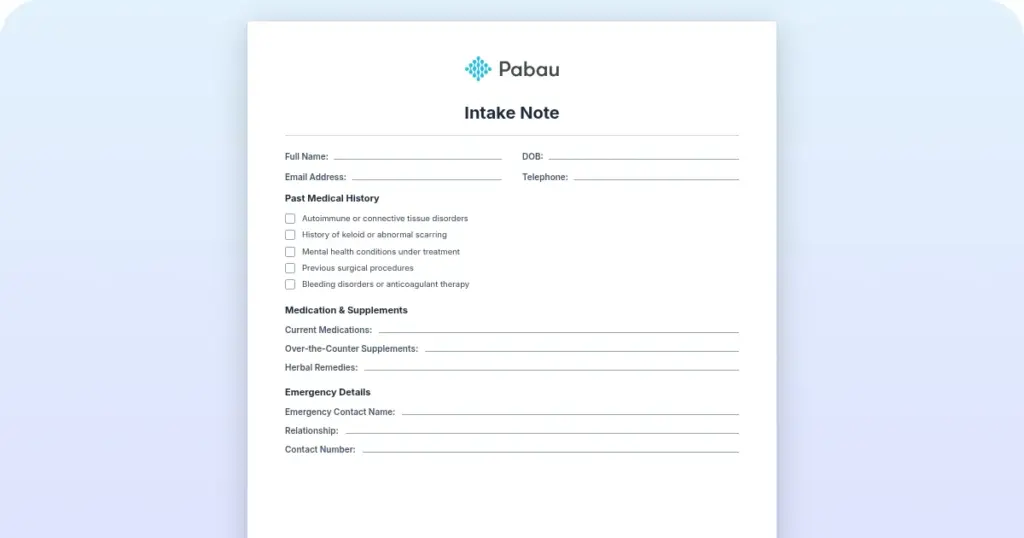
Intake note template
An intake note is the clinical record a therapist or counselor writes at the sta...

2
Last Updated: Oct 22, 2026
SimplePractice vs Alma is a choice between running your own insurance billing and handing most of it to a network. SimplePractice is EHR software you operate yourself, priced from $49 to $99 per month. Alma is a $125 monthly membership that bundles credentialing, claims support, telehealth and an EHR, with no cut of your sessions.
If you’re already on insurance panels, SimplePractice usually costs less and gives you more control. If you aren’t, Alma is the faster route to billing insurance. Choosing wrong can cost you months of credentialing work, or a messy records move later.
Below, we walk through pricing, how a claim moves in each model, documentation, telehealth and a pre-submission checklist.

SimplePractice is EHR software you run yourself, while Alma is a membership network that credentials you and supports your insurance claims.
SimplePractice costs $49 to $99 per month. Alma charges a flat $125 per month and takes no commission on your sessions.
Both platforms include telehealth and a therapy-ready EHR, so neither feature should decide the choice.
Choose Alma if you aren’t on insurance panels yet, since it advertises credentialing in under 45 days.
Choose SimplePractice if you’re already credentialed and want to work your own claims, denials and remittances.
Both platforms serve licensed therapists in private practice, so the table focuses on where they split.
SimplePractice is practice management software built for therapists, counselors and other wellness practitioners. One subscription covers the EHR, telehealth, scheduling, a client portal, intake forms and insurance billing. You hold the billing relationship with each payer, so every claim and remittance passes through your hands.
Alma is a membership network for licensed mental health clinicians. Members get credentialing with insurance payers, automated eligibility checks and an operations team that supports claims processing. Alma also negotiates reimbursement rates on your behalf. The membership includes an EHR, telehealth and a referral community of roughly 30,000 peers and referrers.
So the deciding question is ownership. Do you want to run insurance billing yourself, or share the work with Alma’s team?
SimplePractice sells three solo plans: Starter at $49, Essential at $79 and Plus at $99 per month. Telehealth is included on every plan. Plus adds 35 free insurance claims per month and the Wiley Treatment Planner. Group practices pay $74 per month for each extra clinician on Plus.
Paid add-ons sit on top. Care Aide, which includes AI note-taking, costs $59 per month. ePrescribe costs $49 per month, plus an $89 setup fee. For a plan-by-plan view, see our SimplePractice pricing breakdown.
Alma charges $125 per month, billed monthly, and less if you pay annually. It takes no commission on your sessions, and income from cash-pay patients stays with you. Credentialing is part of the membership, not an extra fee.
For a solo therapist, SimplePractice runs $49 to $99 a month before add-ons. Alma costs $125, so roughly $26 to $76 more. That premium buys credentialing and claims support you’d otherwise handle yourself or pay a specialist for.
Credentialing is the step that keeps many new private practices off insurance panels. Alma handles it for you. Its team submits applications to payers, follows up on status and gets you listed in network. Alma advertises credentialing in under 45 days, and payer timelines vary by state.
SimplePractice offers no credentialing service. You apply to each panel yourself or hire a credentialing specialist. Once you’re in network, SimplePractice gives you direct billing tools. You submit claims from the platform, track their status and manage electronic remittance advice, known as ERA, yourself.
Medicare shows how much paperwork sits behind a panel listing. CMS provider enrollment guidance lists the forms and checks a new provider faces before billing.
Here’s the path a typical in-network therapy claim takes, and who handles each step.
Alma runs automated eligibility checks before sessions. You hold the session and complete the note in Alma’s EHR. From there, Alma’s operations team supports claims processing with the payer, at the rates Alma negotiated. You spend that billing time on sessions instead.
The chart below sets the two workflows side by side.
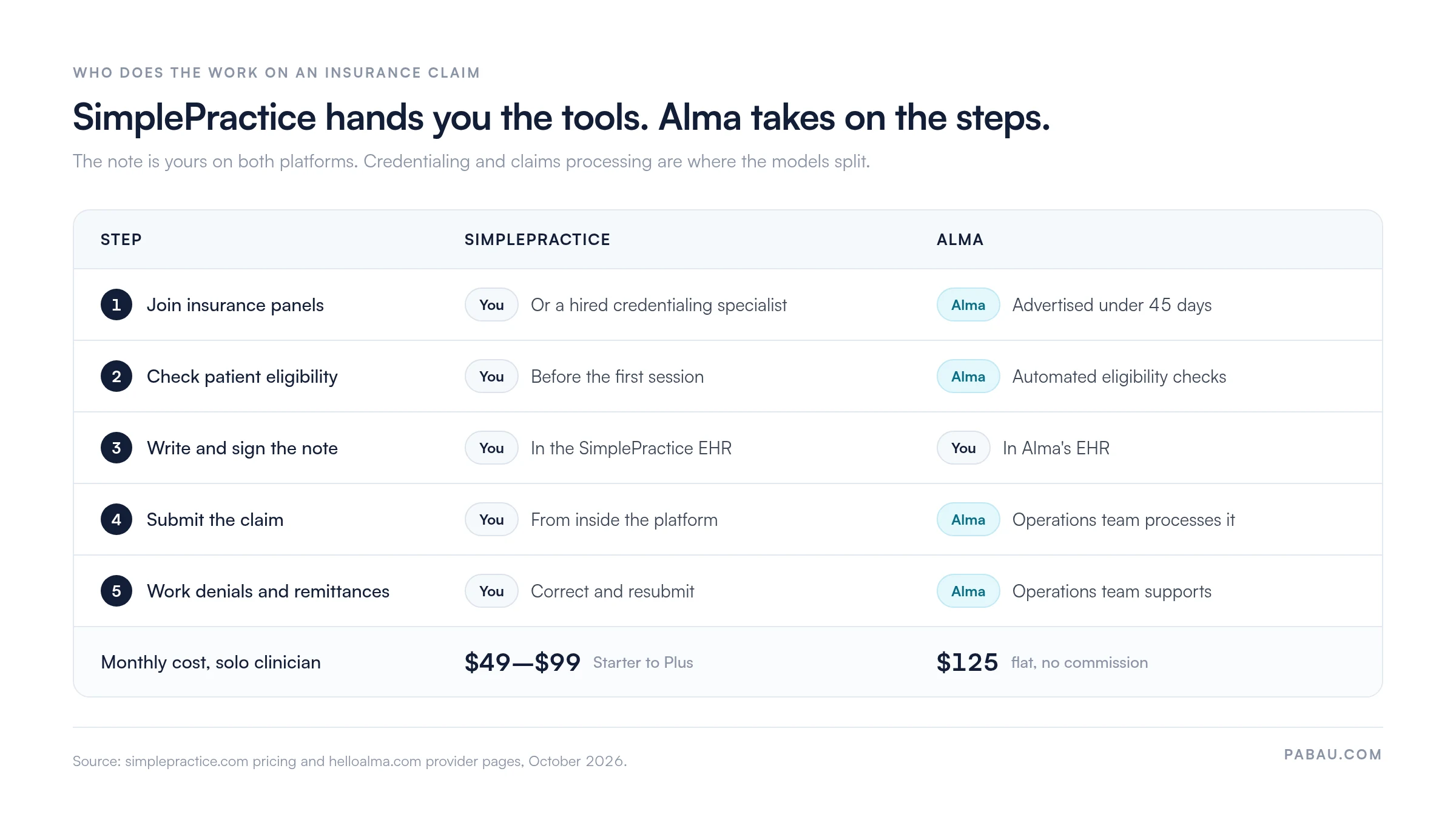
Most therapy claim denials trace back to a handful of avoidable errors. Run through these checks before a claim leaves your hands, whichever platform you use.
On Alma, the operations team carries much of this checklist for you. The note is still yours, so check documented times and diagnoses before you sign.
SimplePractice leads on customization. You get customizable note templates, psychotherapy progress notes, treatment plans and intake forms that patients complete through their portal. Notes are signed, locked and stored in a structured record. Plus adds the Wiley Treatment Planner, and Care Aide adds AI note-taking for a monthly fee.
Alma’s EHR is built around insurance-ready documentation. Its treatment planner includes 1,000+ pre-written interventions, goals and objectives. You also get PHQ-9 and GAD-7 assessments, alerts for high-risk symptoms, AI-assisted progress notes, and intake and consent forms.
Both platforms are built for HIPAA-compliant record keeping. If note depth is your main deciding factor, our SimplePractice vs TherapyNotes comparison weighs another EHR built around documentation.
Video sessions shouldn’t decide this comparison, because both platforms include them. SimplePractice offers telehealth on every plan, and Plus adds group telehealth. The same calendar handles in-person and online sessions, and reminders go out automatically. Plus also adds an appointment request widget for your website.
Alma’s membership includes HIPAA-compliant telehealth as well. You can run remote sessions without paying for a separate video tool.
SimplePractice handles card payments inside the platform. You can collect copays, store cards on file, charge after sessions and generate superbills for out-of-network patients. Each payment is tracked against its appointment and note.
On Alma, the operations team handles insurance claims processing for you. Cash-pay income stays with you, since Alma charges no commission. If you track denials and adjustments closely, ask during onboarding what claim detail members can see.
Alma’s network is the feature SimplePractice can’t match directly. Members get a profile in Alma’s directory, where patients look for in-network therapists. The membership also opens a referral community of roughly 30,000 peers and referrers. That helps most when you’re opening a new practice or leaving agency work.
Monarch is SimplePractice’s separate directory. You can build a profile there so patients can find you.
Headway and Grow Therapy offer similar network-and-credentialing models. Our roundup of SimplePractice competitors covers more options on the software side.
Not on any insurance panels yet? Start with Alma. Credentialing is the slowest step, and Alma does the legwork.
Already in network with your main payers? SimplePractice usually costs less and keeps billing in your hands.
Need a steady flow of new patients? Alma’s directory and referral community give you more reach than Monarch.
Mostly private pay? SimplePractice’s Starter plan covers the basics for $49 a month, with no insurance work to outsource.
SimplePractice and Alma are both built for mental health private practice. Some practices grow past that, adding wellness services, a second location or clinicians from other specialties. At that point, a therapy-only tool can leave you juggling separate systems for each service line.
Pabau, the all-in-one practice management system we build, brings those pieces together. Scheduling, patient records, telehealth, payments and multi-location management run in one platform. Telehealth runs on credits, and every subscription includes every feature. It supports therapy practice management alongside aesthetic, wellness and allied health services.
Pabau doesn’t handle insurance credentialing, so a practice that needs panel help still needs Alma or a specialist. If you’re weighing it as a SimplePractice alternative, look at how it fits your mix of services and locations.

Pabau brings scheduling, patient records, telehealth and payments into one platform, so a growing practice stops juggling a separate tool for each service.

Settle the credentialing question first, and the rest of this comparison falls into place. If payers already know you, SimplePractice keeps more money and control in your practice. If they don’t, Alma’s $125 membership saves you months of paperwork and gets you billing insurance sooner.
Either way, your notes carry the claim. Tight documentation and the checklist above protect your payments on both platforms.
Planning to grow beyond therapy into other services or locations? Book a demo to see how Pabau keeps scheduling, records and payments in one place.

Want a closer look at SimplePractice on its own? SimplePractice review covers its features, strengths and limits for therapy practices.
Comparing SimplePractice with an allied health platform? Jane App vs SimplePractice weighs the two for multi-discipline practices.
Looking for a lower-cost EHR? Carepatron vs SimplePractice compares pricing, notes and scheduling side by side.
Running a wellness or nutrition practice? Practice Better vs SimplePractice shows which suits coaching-style care.
Only need booking software? Acuity Scheduling vs SimplePractice explains when a scheduler is enough.
Yes. You need an individual Type 1 National Provider Identifier, known as an NPI, to bill insurance. It’s free to apply through NPPES, and every payer asks for it during credentialing.
CAQH ProView is the online profile most commercial payers use to collect credentialing details. You enter your license, education and liability insurance once, then share it with each payer. Re-attest every 120 days, or applications can stall.
No. Alma is currently open only to fully licensed clinicians. If you hold an associate or limited license, you’ll need another route to insurance until you’re fully licensed.
Usually not. You bill the same psychotherapy code, such as 90834 or 90837, and flag telehealth with the place of service code. Some payers also want modifier 95, so check each payer’s policy.
Yes. For example, you could bill insurance patients through Alma and keep private-pay patients in SimplePractice. You’d pay both fees and keep records in two EHRs, so weigh that admin first.