Emotional awareness worksheet
An emotional awareness worksheet is a structured psychoeducational tool that hel...

2
Last Updated: Oct 16, 2026
Choices and consequences worksheet (free PDF)
A structured, printable worksheet that walks a client through one decision: the choice they made, the short-term and long-term consequences, who was affected, and what they learned. Print it or complete it digitally.
Download templateA choices and consequences worksheet is a one-page tool that helps someone map a single decision against its short-term and long-term outcomes, so an abstract pattern becomes something they can see and talk through. You can download the free printable PDF above and start using it today.
This guide goes further than a blank template. It walks through how to facilitate each step and shows a filled-in worked example with short-term versus long-term outcomes.
It also lays out how the same worksheet changes between a therapy room and a classroom, and shows how practice management software like Pabau’s digital forms lets you assign and store completed worksheets inside the client record.
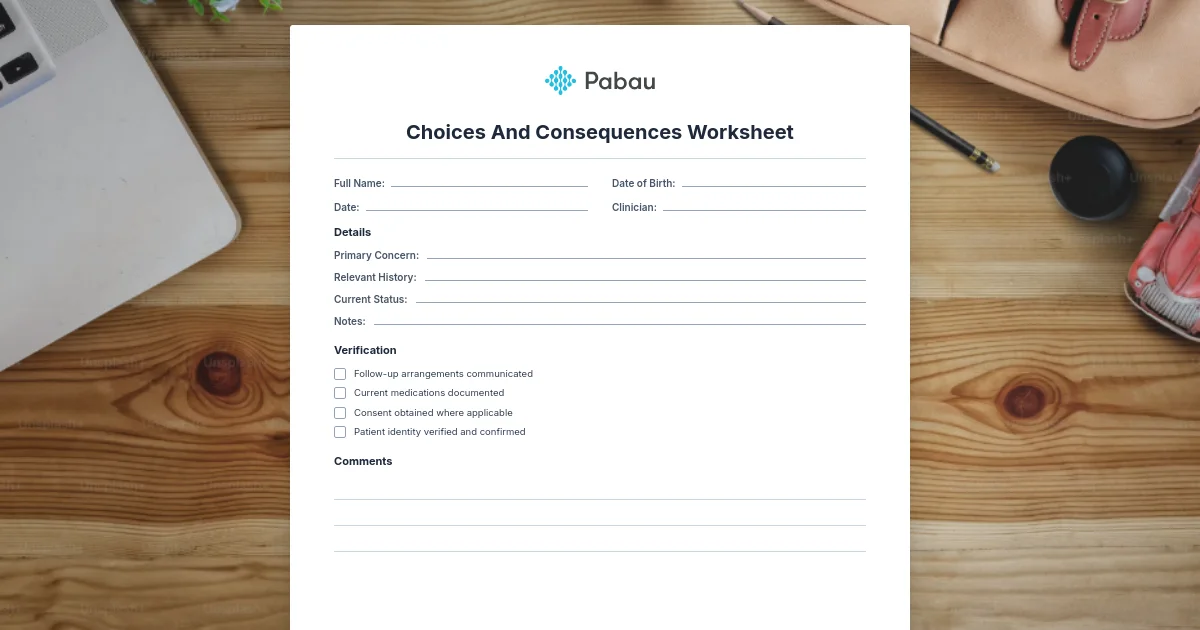
A choices and consequences worksheet is a therapeutic and educational tool that helps someone examine the link between a decision and its outcomes. It structures reflection on both immediate and delayed consequences, so a client can see how one choice affects themselves and the people around them.
Rooted in general cognitive behavioral therapy (CBT) principles, the worksheet asks the person to name a specific choice, map its short-term consequences, project the long-term effects, and reflect on who is affected.
Therapists, school counselors, and educators use it as a core part of social-emotional learning (SEL) and behavior intervention work, often alongside other CBT tools like a cognitive triangle worksheet.
The completed worksheet also creates a documentation trail. In mental health settings it supports HIPAA-compliant record-keeping, and in school-based counseling it aligns with FERPA requirements, giving you a structured record of the therapeutic discussion for supervision or audits.
Work through five sequential steps that move the client from naming a choice to drawing out an insight they can act on.
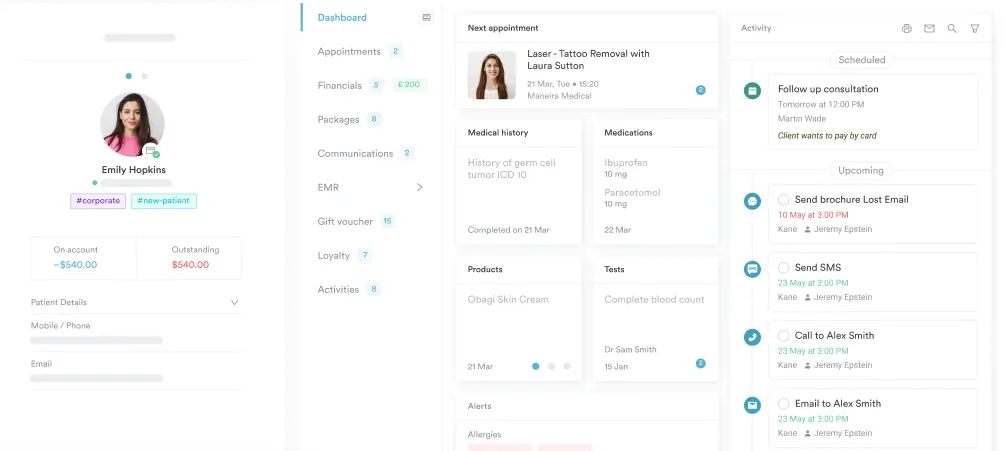
Each step uses structured text areas or checkboxes, so clients can follow it independently or with a facilitator. Pabau’s client record system lets you store completed worksheets alongside session notes, building a longitudinal record of decision-making patterns.
Here is what the worksheet looks like filled in. Most template pages hand you a blank grid, so the table below shows three completed choices and consequences examples across a school, a recovery, and a workplace scenario. Use them as model answers when you introduce the worksheet, or as ready-made scenarios for role-play and group discussion.
| The choice | Short-term consequences | Long-term consequences | Who was affected |
|---|---|---|---|
| Skipped a week of classes to avoid a presentation | Relief, avoided the anxiety, friends covered for me | Grade dropped a letter, had to retake the unit, parents lost trust | Self, parents, teacher, study group |
| Used alcohol to cope with stress instead of calling my sponsor | Felt calmer that night, numbed the pressure | Missed two shifts, strained my relationship, higher relapse risk | Self, partner, employer, recovery group |
| Snapped at a coworker in front of the team | Felt vindicated in the moment | Formal warning, tense team dynamic, reputation to rebuild | Self, coworker, manager |
The pattern the client usually notices is that the short-term column almost always feels good, while the long-term column carries the real cost. Naming that difference out loud is often the moment the worksheet earns its place in a session. If a client asks for a version with answers, these worked rows are the answers, adapted to their own decision.
The worksheet works for anyone from about age 8 upward, with the facilitation style adapting to age and cognitive level. Four groups get the most out of it.
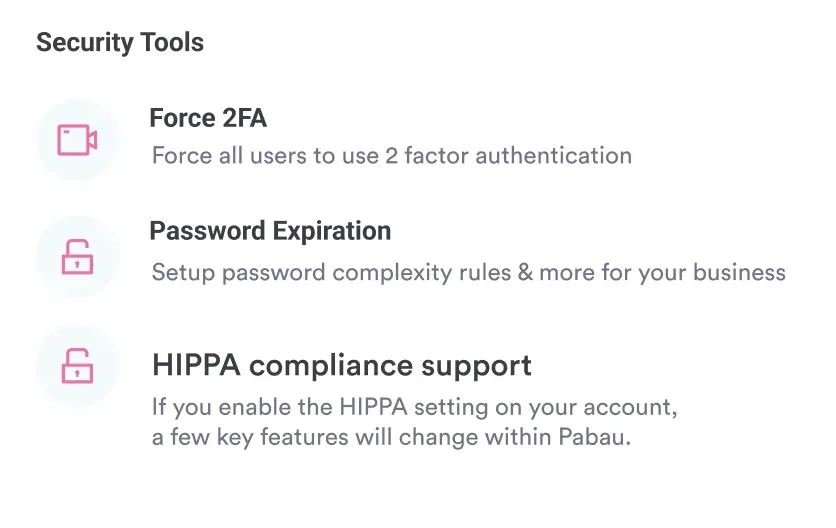
Storing worksheets digitally also means the next practitioner who sees the client can pick up the thread without hunting through paper files, which matters most in group practices and multi-location settings.
Emotions usually come before choices, so adding an emotion-mapping layer makes the worksheet far more revealing. Many clients don’t realize a feeling drove the decision until they see it written down.
Before identifying the choice, ask: “What were you feeling right before you made this decision?” Common answers include frustration, loneliness, pressure, excitement, or numbness. This surfaces the emotional trigger and builds awareness of the emotion-behavior link, the same link an emotional regulation checklist works to strengthen.
Then, for each consequence, ask: “How did this outcome make you feel?” This reveals whether the choice addressed the underlying emotion or only masked it.
A counselor working with a 15-year-old might hear: “I felt left out, so I started rumors to feel in control. It felt good for a day, then I felt guilty and more isolated.” That emotion-consequence link is powerful in therapy where patient care management supports treatment goals.
The same worksheet works in both settings, but what you change is the source of the choice, the depth of reflection, and how you handle privacy. The matrix below maps the practical differences so you can adapt it without redesigning the tool.
| Consideration | Therapy / counseling | Classroom / SEL |
|---|---|---|
| Framing | Collaborative exploration of a real pattern | Whole-class learning activity |
| Source of the choice | The client’s own recent decision | A character in a story or a hypothetical scenario |
| Depth | Emotional triggers plus long-term projection | Cause-and-effect and who is affected |
| Privacy | Stored in the client record under HIPAA | Collected anonymously, FERPA-aware |
| Follow-up | Between-session reflection prompts | Group debrief or journaling |
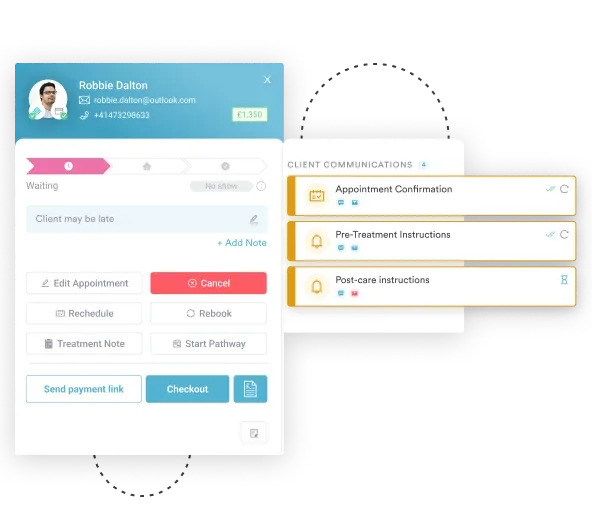
Adapt the language for the grade level and emphasize learning over judgment to reduce shame responses. Collecting anonymized responses helps you spot classroom-level patterns such as impulse-control or peer-pressure trends.
The key facilitation principle: The worksheet is a tool for reflection, not interrogation. A client who feels accused or shamed will disengage and stop showing up. Clear, non-judgmental communication is one of the most effective ways to reduce patient no-shows and keep clients engaged over time.
Decision-making patterns often drive the presenting problems that bring clients to therapy or a school counselor. The choices and consequences worksheet makes those patterns visible, creating a foundation for change.
By mapping choices, consequences, and emotional triggers, you help clients build the reflective pause that leads to better decisions. Paired with Pabau’s AI-assisted clinical documentation, you can track worksheet progress and clinical insights inside the client file, keeping continuity across sessions and locations.
That continuity is what structured therapy practice management is built for — organizing and scaling decision-focused interventions across a full caseload instead of tracking them one file at a time.
A choices and consequences worksheet helps individuals explore the relationship between their decisions and resulting outcomes. It’s used in therapy, counseling, school settings, and substance abuse treatment to build decision-making skills, develop self-awareness, and support behavioral change.
Start by identifying a recent choice the child made (e.g., “I didn’t do my homework”). Use simple language for consequences (“What happened at school?”). Younger children (8-10) benefit from facilitator guidance; older youth (13+) can work more independently.
The worksheet is suitable for children ages 8-9 and above. Younger children need simplified language and facilitator support. Adolescents and adults benefit from deeper consequence mapping and emotional reflection tied to future planning.
Yes. It’s a core cognitive behavioral therapy and behavioral intervention tool. Therapists use it to surface decision-making patterns, build therapeutic alliance, and create measurable progress records aligned with treatment plans.
Yes. The choices and consequences worksheet above is available as a free PDF download, ready to print or complete digitally. Many education sites and government agencies offer free versions for classroom and counseling use.
Social-emotional learning curricula emphasize responsible decision-making as a core competency. The worksheet operationalizes this by having students examine choices, consequences, and affected parties, building empathy, systems thinking, and cause-and-effect reasoning.
Yes. Understanding how addiction choices led to negative consequences is central to recovery programs and relapse prevention. The worksheet helps clients build a concrete narrative of cause-and-effect, essential for behavioral change work in 12-step and SAMHSA-aligned interventions.
Short-term consequences occur within hours or days of a choice (peer reaction, immediate relief). Long-term consequences develop over weeks, months, or years (academic standing, trust erosion, health impacts). Mapping both helps clients see how today’s choices compound into larger life outcomes.
Yes. The same template works for adults, and you simply deepen the reflection: adult clients map longer time horizons and connect decisions to work, finances, and relationships. It fits recovery, anger management, and general counseling caseloads well.
The completed example table on this page functions as the answer key: it shows how the choice, short-term outcome, long-term outcome, and affected parties are filled in across three real scenarios. Use those model responses as a guide when a client works through their own decision.