Stroke impact scale: Free PDF, scoring and MCID by domain
The stroke impact scale (SIS) is a 59-item questionnaire in which stroke survivo...

2
Last Updated: Oct 13, 2026

The hornblower test assesses teres minor and infraspinatus integrity by asking the patient to actively externally rotate at 90 degrees of abduction
A positive sign, meaning no external rotation against gravity, strongly predicts teres minor insufficiency and often a massive posterosuperior cuff tear
Walch et al. reported 100% sensitivity and 93% specificity, so a negative test argues strongly against teres minor insufficiency
False positives occur with axillary nerve palsy and C5/C6 radiculopathy, so imaging must confirm it before surgical planning
Practice management software like Pabau lets physical therapy and sports medicine practices record shoulder assessment findings in a repeatable format
Shoulder assessment relies on a battery of special tests. Knowing which muscle each one targets is what separates a useful finding from a vague one. The hornblower test is one of the most specific tests in that battery. It targets the posterior rotator cuff directly, flagging teres minor insufficiency that imaging alone can miss before surgery.
This guide covers the anatomy behind the test, how to perform it, how to interpret the result, and its diagnostic accuracy. It also shows where the test sits alongside the other shoulder special tests. It is written for physical therapists, sports medicine clinicians, and orthopedic surgeons who want a precise reference they can use the same day.
The hornblower test, also known as the Patte test or Hornblower’s sign, assesses the integrity of the teres minor muscle and, secondarily, the infraspinatus. Both are posterior rotator cuff structures, and both produce active external rotation of the glenohumeral joint.
When either muscle is torn or neurologically compromised, the patient cannot sustain external rotation against gravity at 90 degrees of abduction. The arm then drops into the characteristic “hornblower” posture.
The test earns its place when a massive posterosuperior rotator cuff tear is suspected. Surgeons use it as a pre-operative predictor of teres minor viability, which shapes decisions about tendon transfer candidacy. According to Walch et al. (1998, JBJS Br), a positive Hornblower’s sign is strongly linked to teres minor insufficiency. It also predicts poor outcomes from standard cuff repair alone.
Interpreting the hornblower test correctly depends on knowing what these two muscles do and why their failure produces the picture you see. Therapists treating shoulder injuries at sports medicine practices meet this anatomy all the time, and keeping it precise cuts down on mix-ups on borderline results.
Both muscles converge on the greater tubercle and produce external rotation of the glenohumeral joint. The axillary nerve (C5, C6) supplies the teres minor, and the suprascapular nerve supplies the infraspinatus. A nerve lesion at either level can produce a positive test in a structurally intact cuff, a confounder covered further below.
Standardized technique matters. Small changes in arm position change the muscle activation pattern enough to produce a false result. Practices running software for physical therapists can record the exact arm position used, so repeat exams stay comparable across appointments and clinicians.
The examiner can add gentle resistance to the back of the hand to separate mild weakness from complete teres minor insufficiency. A patient who reaches neutral external rotation but cannot hold it against light resistance is a partial positive, worth noting carefully.
Some patients lift the whole shoulder girdle to get the forearm moving. A short observation test for compensatory girdle elevation checks whether the glenohumeral joint is restricted, and it applies no resistance.
Note the exact degree of external rotation achieved and whether the patient compensated through trunk extension or scapular elevation. These compensatory patterns matter clinically because they signal severe posterior cuff weakness even when the limb just barely reaches a neutral position.
One error accounts for most bad hornblower readings. The clinician records a positive when the patient was in pain rather than truly unable to rotate. Pain inhibition produces a pseudo-positive. Teres minor rupture or axillary nerve palsy produces a true positive, and the distinction drives the surgical plan.
In acute shoulder trauma, run the hornblower test after proper pain management when possible. A positive result under severe pain needs imaging to confirm it.
A confirmed positive changes what the surgical team decides next. Clinicians who understand what follows can prepare the patient for a referral and for an honest sense of what to expect. It also sets the paperwork bar, because the history and the test finding have to reach the surgical team intact.
Physical therapy for confirmed teres minor insufficiency focuses on compensatory strengthening of the posterior deltoid and the remaining external rotators. Add scapular stability work and changes to daily activity while the patient waits for surgical review. Return-to-sport and return-to-work timelines depend on the size of the tear and on the patient’s functional demands.
Published accuracy data for the hornblower test comes mainly from Walch et al. (1998) and later studies that confirm it. Read the figures in context. Sensitivity and specificity shift with the reference standard used, whether that is MRI, ultrasound, or findings during surgery, and with the group of patients studied.
Source: figures reported by Walch et al. (1998) and covered in the Physio-pedia clinical reference. Cross-check against the primary research before applying them in a specific clinical context.
Walch’s series reported 100% sensitivity and 93% specificity, so the test both rules in and rules out. A positive result raises the probability of teres minor insufficiency by a lot. A negative result argues strongly against it. Those figures come from one small single-center cohort, so expect softer numbers in daily practice and confirm with imaging before any surgical decision.
The test is attributed to Daniel Patte, the French orthopedic surgeon who described teres minor insufficiency and its assessment. He wrote about it in the late 1980s and early 1990s.
The name comes from the arm position a positive patient adopts. With the elbow held at shoulder height and the forearm drooping downward, the posture looks like a musician raising a horn toward the lips. The forearm hangs in internal rotation because active external rotation has failed.
The analogy does more than aid recall. It names the functional loss that surgeons and therapists have to explain to patients. Overhead external rotation fails during common tasks such as reaching into a high cupboard, throwing, or combing the back of the hair. Recording those limitations alongside the test result gives the surgical team more than a plain yes-or-no.
Patte’s reasoning also explains the arm position. He noticed that teres minor function becomes the limiting factor for external rotation at 90 degrees of abduction. The infraspinatus’s role falls away at that elevation, so the teres minor carries more of the rotational load.
No single test covers the full rotator cuff. The hornblower test sits alongside three other tests in a standard shoulder examination sequence, each targeting a different cuff muscle. Its closest neighbor is the infraspinatus strength test, and running the two together is what separates the posterior cuff muscles.
The two tests work well together. The infraspinatus strength test runs at the side, at 0 degrees of abduction, where the infraspinatus leads external rotation. Moving to 90 degrees shifts more of the demand onto the teres minor. Running both in sequence separates an isolated infraspinatus tear from combined posterosuperior pathology.
The drop arm test covers the supraspinatus in the same sitting. Pair it with the hornblower test whenever you suspect a tear large enough to involve both regions.
The hornblower test should never be used on its own. Several conditions produce a positive result with no structural rotator cuff tear. Miss them and you get the wrong surgical referral, or you miss a different diagnosis. Noting the differential reasoning matters as much as writing down the result.
MRI or ultrasound scans are required before any surgical decision. The American Academy of Orthopaedic Surgeons (AAOS) recommends imaging as part of the standard rotator cuff tear workup. Clinical tests predict pathology. They do not measure tear size, fatty infiltration grade, or tendon retraction, and those three drive the operative plan.
Working through the confounders in a fixed order keeps the referral decision sound. The path below gathers the checks this article covers into the sequence you would follow at the bedside.
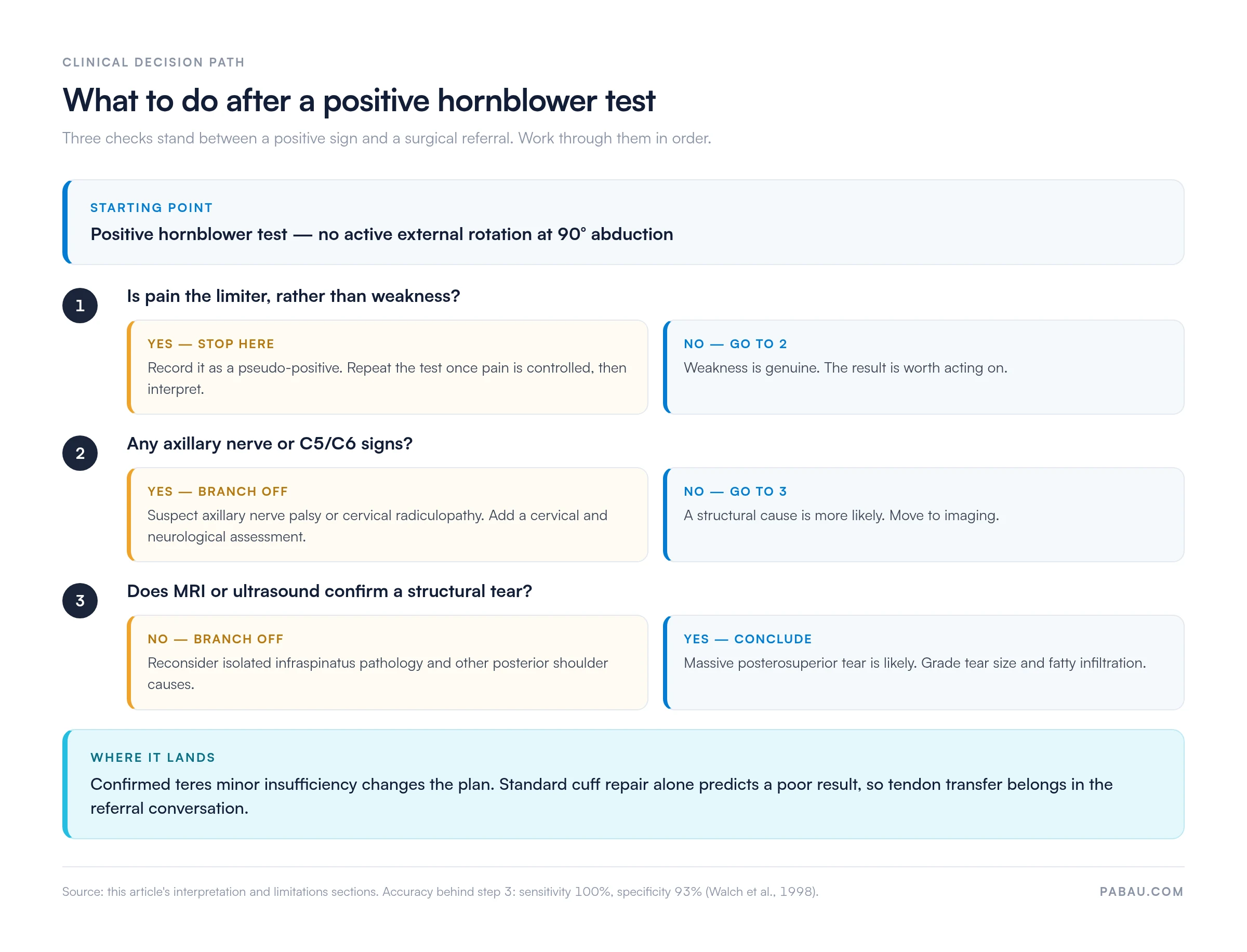
Practices that run shoulder special tests every week get more out of them when the confounder prompts live inside the assessment template. Teams comparing the best physical therapy software should check whether custom assessment templates are included before they commit.
Most practices record a hornblower result as a line of free text in the note. That works for the clinician who wrote it. It stops working when a colleague repeats the test six weeks later, or when a surgeon reads the referral.
Practice management software like Pabau replaces that free text with a structured shoulder assessment template. You capture the arm position, the external rotation reached, the compensation pattern, and the confounders you ruled out. Every field is the same at every visit, so a change in the result means a change in the patient.
Those findings sit in the patient’s clinical record next to the images, the treatment plan, and the referral letter. When the surgical team asks what the shoulder did in the room, the answer travels with the patient instead of staying in somebody’s notebook.


Pabau gives physical therapy and sports medicine practices structured assessment templates. Special test findings stay comparable between visits and travel with the referral.

The hornblower test is worth the 30 seconds it takes, because it answers a question imaging answers slowly. Can this patient produce active external rotation at elevation? An MRI report does not tell you that directly.
Treat the result as a trigger for the next check rather than a verdict. A positive sign sends you through pain control, then a neurological screen, then imaging, before anyone raises tendon transfer. A negative sign was reassuring in Walch’s series, though one small cohort is thin ground for ruling out a massive tear on its own.
The larger win is doing the test the same way every time. A test performed and recorded the same way every time gives the surgical team something to compare against. Book a demo to see how Pabau turns shoulder special test findings into a record your whole team can read.

Testing the subscapularis next? Lift-off test covers the anterior cuff muscle the hornblower test leaves untested.
Need to target the infraspinatus? Infraspinatus test explains why external rotation at 0 degrees behaves differently from 90 degrees.
Screening for impingement as well? Neer’s test walks through the subacromial impingement sign and how to grade what you see.
Running a sports medicine practice? Sports medicine practice software supports the assessment and rehab workflows behind a heavy shoulder workload.
The hornblower test assesses teres minor and infraspinatus integrity. The patient actively externally rotates the arm at 90 degrees of abduction, in the scapular plane. A positive sign (inability to externally rotate against gravity) shows teres minor insufficiency and is linked to massive posterosuperior rotator cuff tears.
A positive Hornblower’s sign appears at 90 degrees of shoulder abduction and 90 degrees of elbow flexion. In that position the patient cannot actively externally rotate the arm, or cannot hold it there against gravity. The forearm droops into internal rotation, making it look like someone raising a horn to the lips.
Yes. The Patte test and Hornblower’s sign refer to the same clinical examination. The test is attributed to French orthopedic surgeon Daniel Patte, who described teres minor insufficiency and its assessment. The “hornblower” name refers to the characteristic arm posture a patient adopts when the test is positive.
Walch et al. (1998) reported 100% sensitivity and 93% specificity for the hornblower test in teres minor insufficiency. Both figures are high, so a positive result raises the post-test probability of pathology sharply and a negative result argues strongly against it. The cohort was small and single-center, so confirm with imaging before any surgical decision.