Nitrates medication list
A nitrates medication list is a point-of-care reference that sets out the main c...

Last Updated: Oct 6, 2026
A digital infant scale is a precision weighing device that measures newborn and infant body weight, usually to the nearest 5 to 10 grams. Capacity normally runs from 20 to 30 kilograms (44 to 66 lbs). Pediatric practices, maternity wards, and home health teams use one to monitor growth, check feeding adequacy with pre- and post-feed weights, and track developmental milestones.
Accurate measurement drives critical clinical decisions: Feeding assessments for breastfed and formula-fed infants, and medication dosing. It also underpins detection of failure to thrive and early identification of growth concerns. CDC growth charts remain the standard reference for judging whether an infant’s weight percentile is age-appropriate. Those percentiles are only as good as the device behind them.
This guide explains what the hardware does and how clinicians use it. It then gives you a free weight log template, so your team can standardize its medical records management.
A ready-to-use form for recording infant weights, pre- and post-feed measurements, intake estimates, and growth percentiles over time. It has fields for the clinician, the timepoint, and the action taken, and it suits pediatric practices, maternity wards, and home health teams.
Download template
Digital infant scales weigh newborns and infants to within 5 to 10 grams, which is precise enough for growth monitoring and feeding assessment.
Look for a hold function, a tare function, and, on some models, Bluetooth logging to a phone or tablet.
Weighted feeds estimate breast milk intake from the difference between pre-feed and post-feed weight. They need a scale that reads to 2 to 5 grams.
The template below structures weight recordings, percentile tracking, and clinical notes in one form that suits pediatric, maternity, and lactation practices.
Weight is one of the most sensitive indicators of infant health. Clinicians track it against WHO Child Growth Standards to identify growth faltering, which can signal inadequate feeding, malabsorption, infection, or a metabolic problem. A newborn is expected to regain birth weight by day 10 to 14. Failure to do so warrants investigation.
The first weight is recorded alongside the rest of the newborn exam, so it helps to keep both in the same place. For breastfed infants, weighted feed measurements help lactation consultants and pediatricians judge whether the infant is transferring enough milk. The difference between pre-feed and post-feed weight estimates intake, and a healthy newborn gains roughly 20 to 30 grams per day in the first weeks.
Several hardware features decide how accurate and how usable a scale is, in a practice or at home.
A weighted feed is a clinical technique where an infant is weighed immediately before and after breastfeeding to estimate milk transfer. The weight difference in grams approximates milliliters of milk consumed, using the 1 gram to 1 milliliter conversion that lactation support has long relied on.
Step-by-step process:
Why accuracy matters: An infant consistently taking under 20 grams per feed may need supplementation, adjusted positioning, or a referral for tongue-tie assessment. A scale that steps in 50-gram increments cannot show a difference that size. The readability you buy sets the limit on what you can detect.
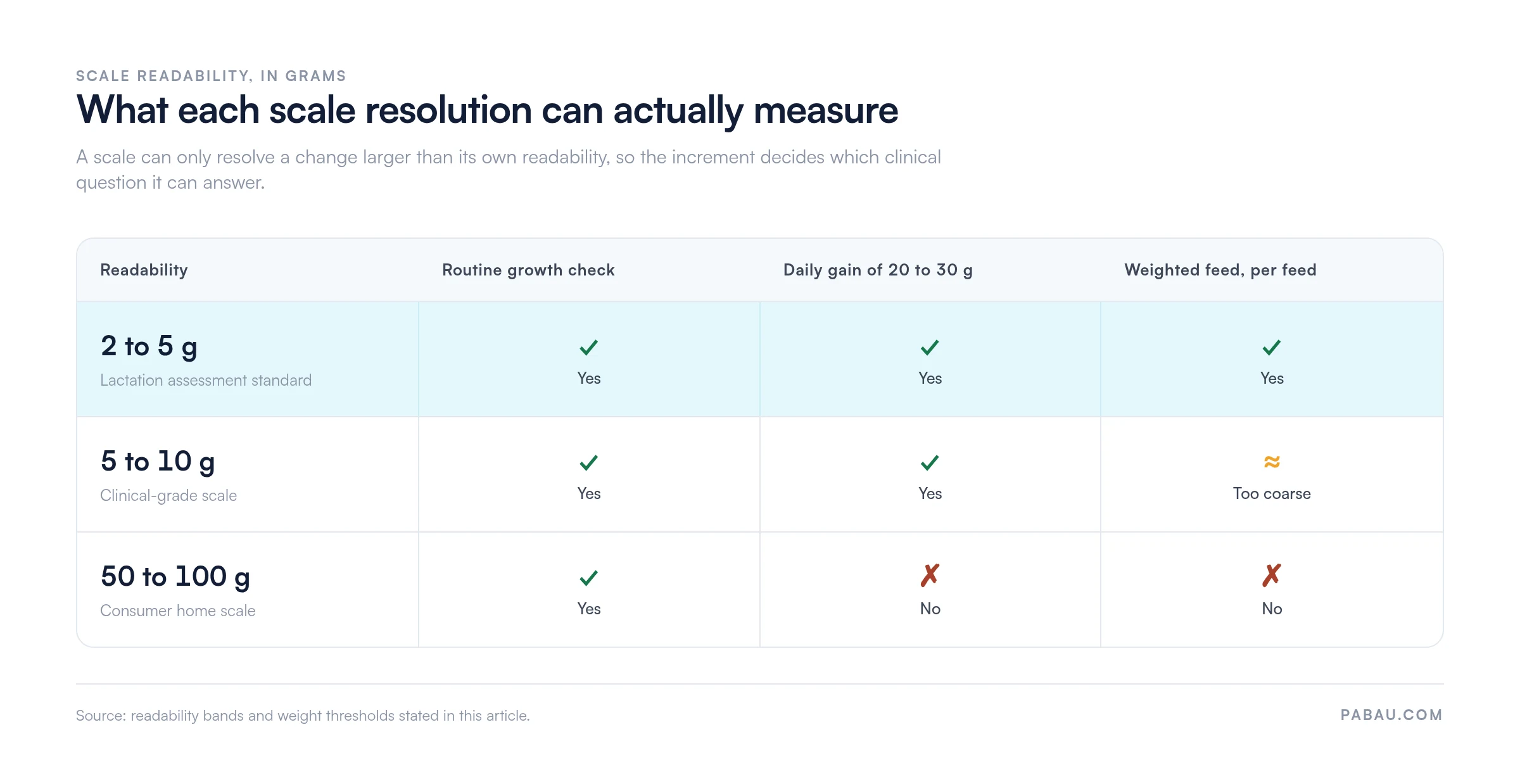
Digital infant scales come in clinical-grade and consumer home models. The split affects accuracy, durability, and what regulators expect of the device.
For pediatric and maternity practices, a medical-grade scale is the standard. Those models hold calibration under high volume and give you the readability that weighted feeds and percentile tracking depend on. A home scale earns its place between visits, when a parent is watching a trend rather than making a treatment decision.
Clinical infant scales need periodic calibration to stay accurate. How often depends on use volume and local rules, though annual or bi-annual calibration is common in busy settings. Record every calibration date, because quality assurance reviews and inspections ask for it.
NTEP (National Type Evaluation Program) certification means a scale meets legal-for-trade standards in the US. It is not a medical device certification, but it is widely used as a proxy for clinical-grade accuracy. Healthcare settings often require it for medicolegal reasons, so verify it before you buy in the US.
The template above structures infant weight documentation in five steps:
A structured form means every clinician on your team records the same fields in the same order. That consistency is what makes a weight trend readable months later, rather than a set of numbers in three different handwritings.

Pediatric and maternity teams need a written protocol for how often infants are weighed, who enters the data, and what triggers an alert. Four habits do most of the work:
Weight is one line in a wider picture. Pair it with a pediatric vital signs chart so heart rate, respiratory rate, and temperature sit on the same record as the growth data.
Pediatric and primary care teams working in GP clinic software can enter each weight straight into the child’s chart. Percentile calculation and trending then happen without a manual review. The template serves practices that have not moved yet. It gives them a paper structure that can be scanned into the chart or typed up afterward.
Most pediatric and maternity teams record an infant weight twice. The figure goes on a paper log at the bedside, then someone types it into the chart later that day. The entries nobody types up stay on the paper.
Practice management software like Pabau removes the second step. Weights, percentile notes, and feeding observations go into the patient record at the point of care, from a tablet at the bedside. Pabau GO, our iOS app, does the same job on a home visit. A community midwife no longer carries loose forms back to the office.
The record then carries the whole series. A colleague opening the chart at the next visit sees the previous weights, the intake estimates, and the action taken after each one. Nobody has to find last month’s form to answer a parent’s question about a feed.

Pabau’s digital patient records and clinical documentation tools help pediatric and maternity teams standardize weight tracking. Each measurement lands in the child’s chart instead of a loose paper form.

The scale you buy sets the ceiling on what your notes can say. A 50-gram increment is fine for a routine weight check and useless for a weighted feed, and no template fixes that afterward. Match the readability to the question you need answered.
Once the device is right, consistency turns single measurements into a trend a clinician can act on. The same form, the same fields, and the same timepoints across your team make a crossing percentile line obvious rather than arguable.
Download the template, run it for a month, and see whether your follow-ups get easier to schedule. Book a demo to see how Pabau keeps infant weights, percentiles, and feeding notes in one patient record.

Documenting the first examination after birth? The newborn exam template covers the head-to-toe checks that sit alongside that first recorded weight.
Need a fuller picture than weight alone? Pediatric assessment walks through how clinicians structure a full review of a child.
Tracking heart rate and temperature at the same visit? The pediatric vital signs chart gives you age-banded reference ranges in one printable form.
Keeping well-child visits on schedule? The immunization record form logs each dose, date, and site, so the next appointment is easy to plan.
Look for a hold function, a tare function, and a display that reads to 5 to 10 grams. The platform should be at least 40 cm wide, with a capacity of 20 to 30 kg. For weighted feeds, a readability of 2 to 5 grams is better.
Use a scale that reads to 2 to 5 grams. Typical milk transfer runs 20 to 30 grams per feed in the first weeks, and a coarser increment hides differences that matter. Accuracy of ±2% is the clinical standard.
Clinical-grade scales should be calibrated annually or bi-annually, depending on use volume. High-volume settings may calibrate every 6 months. Document every calibration date as part of quality assurance and regulatory compliance.
Consumer home scales suit routine home monitoring but lack the accuracy and durability for clinical decision-making. Clinical-grade scales with NTEP certification are recommended for pediatric practices, hospitals, and maternity wards, especially where weighted feeds assess feeding adequacy.
Newborns typically lose 5-10% of birth weight in the first 3 to 5 days. They then gain roughly 20 to 30 grams per day for the first 3 months. Birth weight should be regained by day 10 to 14. Slower gain than this warrants evaluation by a pediatrician or lactation consultant.
Infant scales read to 5 to 10 grams, hold a stable reading when the baby moves, and have a large platform for safe positioning. Bathroom scales typically read to 100 to 500 grams, which is far too coarse for infant weight or weighted feed assessment.