All about me worksheet for adults
An all about me worksheet for adults is a guided self-reflection form that maps ...

2
Last Updated: Oct 14, 2026

An in-depth personality test measures stable traits using frameworks such as Big Five, MBTI, DiSC, or the Enneagram.
The Big Five has the strongest research support for clinical work, while MBTI suits coaching and is weaker on retest.
The template on this page has no scoring key, so you read and discuss the answers instead of calculating scores.
Use it as a conversation starter or an intake supplement, then switch to a validated instrument when you need scores.
Practice management software like Pabau keeps completed questionnaires and their consent records beside the treatment notes they inform.
A two-page self-report questionnaire in four parts: six rated statements, a preference ranking exercise, three decision-style statements, and three open-ended prompts. It carries no scoring key, so you read the answers with your client instead of calculating a score.
Download templateA first session tells you what a client is worried about. It rarely tells you how they handle pressure, structure, or a setback. Those patterns shape the plan you write, so it pays to get them on paper early.
The trouble is that “personality test” covers two very different things. Peer-reviewed instruments sit at one end. Magazine quizzes sit at the other. In a psychology practice, the two are not interchangeable.
Big Five, MBTI, the Enneagram, and DiSC all measure something. They differ in the evidence behind them, in how they score, and in where they belong. The free questionnaire above sits outside all four. It opens a conversation rather than producing a profile. A lighter character match form asks the client to name the fictional character they most resemble.
The template runs to two pages, so you can print it or send it ahead of the appointment. It opens with a short header for name, age, gender, and occupation, then moves through four parts.
What the form leaves out matters just as much. There is no scoring key, no answer bands, and no interpretation table. Nothing maps to Big Five, MBTI, DiSC, or Enneagram categories. Treat a completed copy as material for discussion and for the client record.
An in-depth personality test is a standardized assessment of core traits, built from validated items and a published scoring protocol. That protocol is what separates it from an entertainment quiz.
Validated instruments carry documented psychometric validity and reliability, so they measure what they claim and hold up on repeat administration.
Most of them use self-report questionnaires with Likert-scale items, running from “strongly disagree” to “strongly agree”. You administer them at intake, during treatment planning, or at review. Then you score the answers and interpret them.
The output is a picture of someone’s strengths, likely vulnerabilities, and behavioral patterns. In therapy that supports a formulation as an adjunct, never as a diagnostic test on its own. Coaches and occupational psychologists use the same data for team development and leadership work.
The Big Five, also called the Five-Factor Model or OCEAN, is the most validated framework in everyday use. It measures five dimensions:
Decades of peer-reviewed research confirm this five-factor structure across cultures and populations. The scores also carry predictive weight. They track with therapy engagement, work performance, and relationship quality.
Several free, validated Big Five measures exist, and the International Personality Item Pool is the best known. Our own Big Five personality test template covers the same five dimensions in a printable form.
An occupational therapy platform can store each completed scale beside the patient’s goals and session history.
The Myers-Briggs Type Indicator (MBTI) draws on Jungian theory and sorts people into 16 types. It measures four dichotomies: extraversion or introversion, sensing or intuition, thinking or feeling, and judging or perceiving.
Coaches and organizational consultants use it widely, and its limits are documented. Test-retest reliability is lower than the Big Five, and roughly half of respondents get a different type when retested a few weeks later. The instrument also assumes type stability, which does not always hold up clinically.
Plenty of practitioners still reach for it to open self-exploration or a team discussion, and that works while nobody over-reads the result. A Jungian personality test form covers the same four dichotomies without a licensing fee.
The 16 Personalities test that circulates online borrows the four-letter framework. It is not the official MBTI instrument, and it lacks the validation and clinical governance of the licensed version.
The Enneagram maps personality onto nine types, each with its own motivations, strengths, and growth areas. Its roots are spiritual and philosophical. It now turns up regularly in therapy, coaching, and organizational development.
Standardization is where it gives ground. No single official assessment exists, versions differ in item count and scoring, and academic validation is still emerging. Clinically it earns its place in personal insight work, especially in existential or depth-oriented therapy.
Free and low-cost Enneagram assessments are everywhere, and quality varies widely. Look for versions built on an established framework, such as the Riso-Hudson Enneagram Type Indicator from the Enneagram Institute.
DiSC measures four behavioral dimensions: dominance, influence, steadiness, and conscientiousness. It was designed for workplace and team development. That is why it turns up in hiring, onboarding, conflict resolution, and leadership coaching.
Because it describes behavior rather than pathology, its validation supports non-clinical use. Organizations lean on it to build safer teams and improve day-to-day communication. The branded instrument is proprietary, though generic behavioral frameworks cover similar ground.
Three other workplace assessments come up often:
The four frameworks differ, but they circle the same core traits. Knowing where they overlap keeps you from translating a score into something it cannot say.
Neither MBTI nor DiSC carries an emotional-stability dimension. So neither can stand in for a Big Five neuroticism score. Where distress or emotional regulation is the clinical question, use a measure built for it.
The right assessment depends on your context rather than on a ranking. Five questions usually settle it:
Once you have picked a framework. Consent then stays attached to the notes, and comparison over time stays possible.
Five minutes of preparation saves an awkward session. Work down this list before the questionnaire goes out.
The form gives you a structured set of prompts for an intake or review session. Because there is no scoring key, the work sits in reading the answers and talking them through.
If you need trait scores or norms, administer a validated instrument alongside this form. The IPIP Big Five gives you numbers you can defend. For tracking distress over time.
Four errors show up again and again with forms like this one. Each has a simple fix.
The form suits any practitioner who wants a structured way into a first conversation about temperament. Therapists and counselors can send it before intake, so the session starts with material already on the page.
Coaches and occupational health practitioners use it to frame goal-setting or a development discussion. A coaching intake form handles the practical details, and this one covers how the client works. Both belong in the same client file.
Two situations call for something else. If you need a scored profile for a report, a referral, or an employment decision, use a licensed instrument with published norms. Where the question concerns distress, risk, or a specific disorder, a validated symptom measure is the right call.
A structured form standardizes how you ask, which reduces bias and keeps intake consistent across the practice. It also builds shared vocabulary. Clients start to recognize their own patterns and get better at saying what they need.
Documentation carries its own benefit. Stored with consent, the responses protect continuity of care and give you something concrete to bring to supervision. Less guesswork in case formulation is also one small brake on clinician burnout.
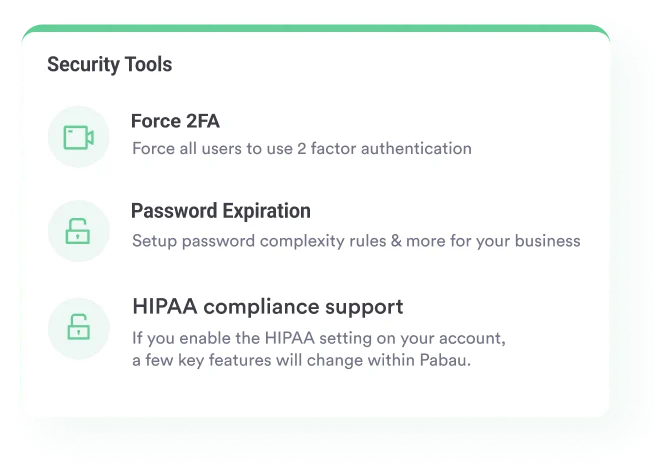
Treat completed forms as sensitive personal information. In the US, HIPAA applies if you are a covered entity, such as a mental health provider, hospital, or health plan. Store the forms in your practice management system, restrict access to authorized staff, and release nothing without written consent.
In the UK and EU, the position under GDPR depends on what the responses reveal. Special category rules cover data concerning health. Personality answers fall into that class when they indicate something health-related, such as mental health difficulties.
ICO guidance turns on the information revealed rather than the title of the form. In a therapeutic setting, the safe assumption is special category status. That means recording a lawful basis and an Article 9 condition, such as explicit consent or the provision of health care.
Pabau handles that side of the job. Its compliance tools keep consent, access history, and the completed form in one encrypted client record.
Right now that form probably has a messy life. It gets emailed as a PDF, printed, filled in by hand, scanned, and filed somewhere away from the clinical notes. By the time you want last year’s answers, you are hunting through attachments.
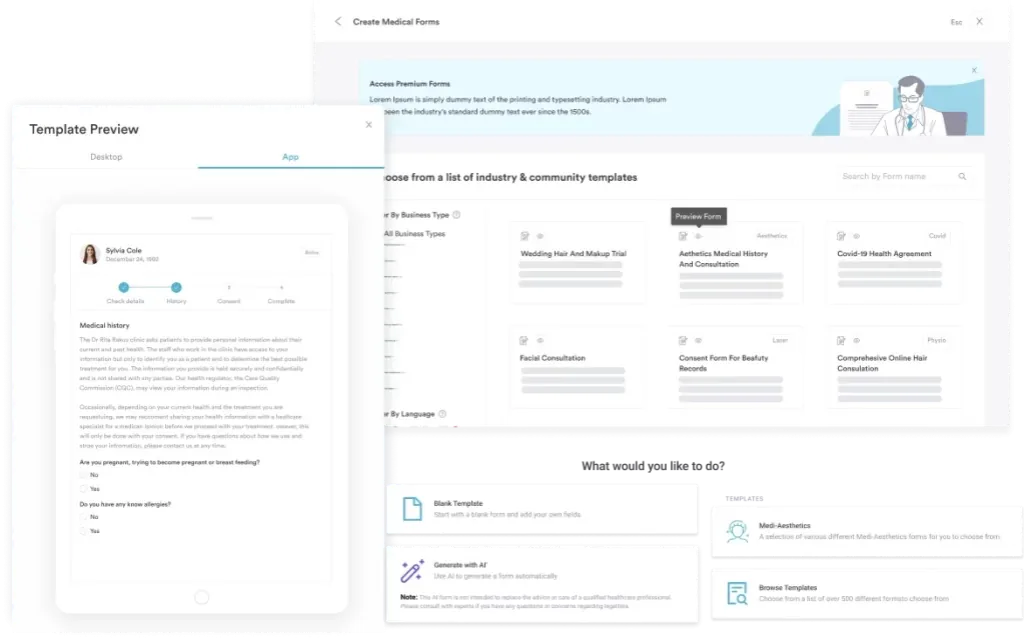
Pabau removes those steps. You rebuild the questionnaire once as a digital form, then send it with the appointment confirmation. The client completes it before arriving, and the answers land in the client record with an e-signed consent.
So the session starts with the material already in front of you, and a review becomes a scroll rather than a search. Forms, consent, and records come with every subscription, which makes this a setup task rather than an upgrade.

Pabau turns your intake questionnaires into digital forms clients complete before the visit. The answers and their consent file straight into the client record, beside the treatment notes they inform.

Match the instrument to the decision in front of you. A score that has to hold up in a report or a referral needs the Big Five, or another validated measure with published norms. For a way into a conversation, an unscored questionnaire gets you there faster.
The trade-off is worth naming. An unscored form gives you rich material and no benchmark. Its value depends on the discussion that follows, and on what you write down afterwards. That is also its protection, because nobody mistakes a hand-filled page for a diagnosis.
Whichever route you take, the client record carries the value forward. Book a demo to see how Pabau keeps personality questionnaires, consent, and treatment notes in one file.

Want another unscored way in? Draw personality test uses a drawing task rather than rated statements, which suits clients who freeze on questionnaires.
Looking at how clients handle feelings? Emotional intelligence test covers self-awareness and regulation, which trait questionnaires only touch on.
Client describes themselves as easily overwhelmed? Highly sensitive person scale measures sensory processing sensitivity as a trait in its own right.
Need a scored measure to sit alongside it? Perceived stress scale gives you a short validated score you can repeat at review.
Running a coaching session instead? Core values exercise turns the same self-reflection into goal-setting material.
No. It is an unscored self-report questionnaire with rated statements, a preference ranking, three decision-style statements, and open-ended prompts. Read the answers with your client, and add a validated instrument such as the IPIP Big Five when you need scores.
It depends on the instrument. Licensed tools such as MBTI, DiSC, and Hogan restrict administration to certified practitioners. Free measures like the IPIP Big Five carry no certification requirement, although interpretation still needs relevant training.
Yes. Social desirability bias pushes people toward answers that look good, especially in hiring or custody contexts. Watch for uniformly positive responses, then check them against what you observe in session.
Traits shift slowly, so once a year or at major review points is usually enough. Repeating a measure every few weeks mostly captures mood. Use an outcome or symptom measure for shorter intervals.
The wording suits adults, and the open-ended prompts assume some self-reflection. For under-18s, choose an age-validated tool and take consent from a parent or guardian alongside the young person’s own agreement.
Not quite. Psychometric is the broader term, and it covers ability and aptitude tests as well as personality measures. A personality test looks at traits and preferences rather than at what someone can do.