Fun journal prompts for adults
Fun journal prompts for adults are short, open-ended questions that make sitting...

Last Updated: Oct 6, 2026
A DISC personality types chart maps four behavioral styles onto a two-axis grid. The styles are Dominance, Influence, Steadiness, and Conscientiousness. Each one sits in its own quadrant, set by how fast a person works and whether they lead with the task or the people. Read the quadrant and you know how that person prefers to communicate, decide, and handle pressure.
The framework comes from psychologist William Moulton Marston, who set it out in his 1928 book Emotions of Normal People. More than a million people now complete a DISC assessment every year, which puts it alongside MBTI and the Enneagram in everyday use.
This guide covers the four styles, how to read a score chart, and how to apply the results with a team. The free chart below is built for practice managers, therapists, coaches, and HR leads to use in a session.
A four-quadrant chart with trait profiles, motivators, and communication preferences for each of the four DISC styles. Print it and plot a team member’s or client’s results straight onto it.
Download template
DISC sorts behavior into four styles, set by a person’s pace and by whether they prioritize the task or the people.
Most assessments also report 8 or 12 blended sub-types, because pure single-style profiles are rare.
Reading a chart means checking the two axes and the score bands. A score of 70 or above is very high, and 30 or below is very low.
DISC earns its keep at work by clarifying roles, adapting how you give feedback, and defusing conflict between styles.
The chart is a communication tool, so never use it to screen candidates or to support a diagnosis.
The DISC model is a behavioral framework that sorts personality into four dimensions. Each dimension describes how someone approaches a task, communicates, and responds to pressure. DISC stands for Dominance, Influence, Steadiness, and Conscientiousness, and each style carries its own cluster of traits, motivators, and fears.
William Moulton Marston, an American psychologist, introduced the theory in 1928. He noticed that people show steady patterns in how they weigh control against collaboration. He saw a second split in pace, between working fast and direct and working cautiously.
Modern assessments build on that with questionnaires that place a person on a two-axis grid. Most report both a natural style and an adapted one, which is the style the person moves into at work.
DISC is not a clinical tool. It does not measure mental health, pathology, or intelligence, and it should never be used to screen job candidates or support a diagnosis. What it maps is communication and decision-making preference, which is why coaches, therapists, and practice managers reach for it.
Two questions fix a style’s place on the chart. The vertical axis is pace, running from fast-paced and outspoken at the top to cautious and reflective at the bottom. The horizontal axis is priority, with task-focused styles on the left and people-focused styles on the right.
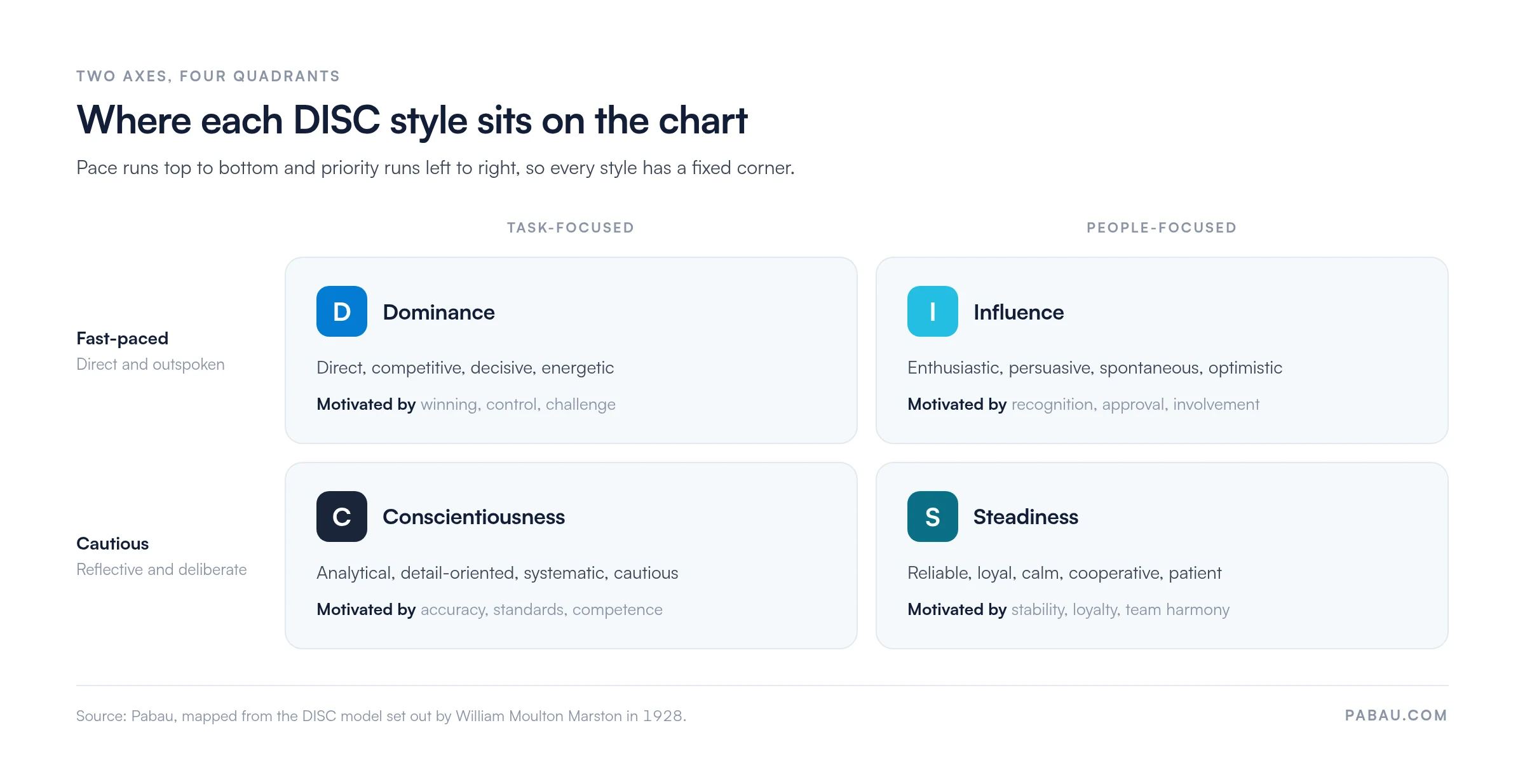
The table below fills in what each quadrant means day to day.
Each style brings something a team needs, and each carries a predictable blind spot. Knowing both is what lets you adapt instead of react.
Dominance (D) people are driven by control, results, and challenge. They decide quickly, push tasks to a finish, and often prefer to lead or work alone. Competition energizes them, and delay frustrates them.
Influence (I) people are expressive and people-oriented, and recognition is what moves them. They build relationships quickly and get a room excited about an idea. Approval and social connection matter more to them than detail.
Steadiness (S) people are stable, loyal, and focused on keeping the peace. They work methodically, dislike sudden change, and build deep ties with colleagues. They are usually the team’s anchor.
Conscientiousness (C) people are analytical and driven by accuracy. They work systematically, interrogate decisions thoroughly, and put quality ahead of speed. They set a high bar for evidence and catch errors early.
Pure single-style profiles are rare. Most people come out as a blend of two adjacent styles. Common pairings are D-I, I-S, S-C, and C-D, and the blend gives a more accurate picture of how someone behaves.
Some frameworks, notably TTI Success Insights, split these further into 12 styles using secondary traits. The practical point is that a secondary style explains behavior a pure type cannot. Someone who reads as a hard D at work may be running a D-I profile underneath.
A DISC report shows a graph of a person’s score on each of the four dimensions. Reading that graph correctly is what turns a result into something you can act on.
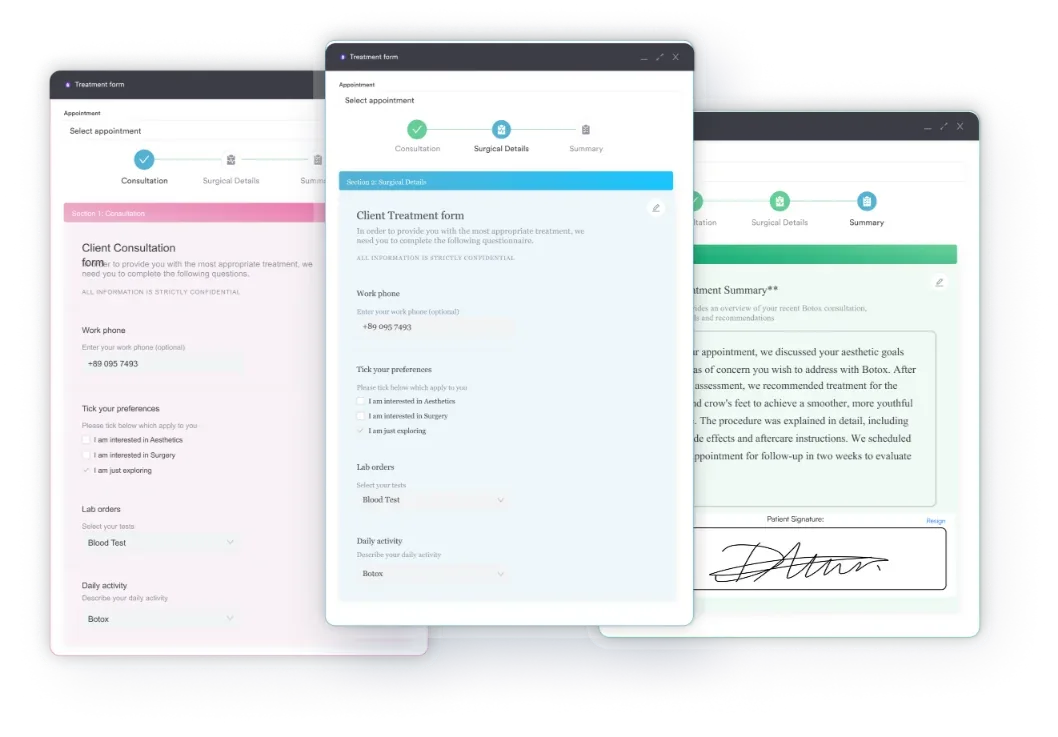
If your practice already collects information through digital intake forms, a short DISC self-assessment can ride along with them. The answers land in the record instead of on a printout that gets lost.
The model earns its keep when it is pointed at how a team actually works together. Knowing each person’s style, including your own, changes how you brief, how you give feedback, and who you pair with whom.
D-style leaders drive projects forward but can steamroll the room, so pairing them with an S or I colleague restores balance. I-style practitioners are excellent with clients and patchy with paperwork, which a C-style colleague offsets. Keeping those pairings, schedules, and notes in one practice management system means the arrangement survives a busy week.
In therapy and psychology practices, DISC usually shows up in three places.
Whatever you agree in those conversations is worth writing down. Carrying each person’s style into their annual review template keeps the feedback consistent from one year to the next.
Some pairings work better than others. Knowing which ones rub means you can structure roles around the difference, rather than arguing about it every quarter.
Mixed teams beat uniform ones, as long as the differences get named out loud. A room full of D’s moves fast and leaves people behind. A room full of C’s checks the work and never ships it.
DISC, MBTI, the Enneagram, and the Big Five answer different questions. Picking the wrong one wastes a session, so it helps to know what each is built to do.
Key difference: DISC describes behavior you can see, and it describes it now. MBTI describes how a person prefers to think. The Enneagram goes after core fear and desire. For a quick team session or a role conversation, DISC converts into action fastest.
For deeper personal work or therapy, the Enneagram or the Big Five will give you more to hold on to. Plenty of practitioners run two frameworks side by side, one for team dynamics and one for personal growth.
The downloadable chart is built for a session, not a filing cabinet. Here is the workflow that gets the most out of it.
For repeat coaching work, the 8 or 12 style models from TTI Success Insights or Everything DiSC give you more resolution. If you are assessing managers rather than whole teams, a leadership style quiz is the better starting point.
A DISC session usually ends with a printout and good intentions. Within a month the profiles are in somebody’s inbox, the role decisions are in a meeting note, and the next manager starts from scratch.
Practice management software like Pabau keeps that work attached to the people it describes. A staff member’s profile sits with their schedule and their permissions. A client’s sits with their intake form and their treatment notes.
Because intake forms are customizable, the DISC questions go into the same questionnaire a client already completes. The results land in the record, so whoever runs the next session can see the style before the conversation starts.
For a team spread across sites, that matters more. Every location works from the same staff records, so a schedule built around complementary styles holds up when a manager is away.

Pabau stores staff and client records, intake forms, and clinical notes in one system. DISC profiles stay attached to the person they describe, so role and communication decisions survive staff changes.

A DISC chart is worth exactly as much as the conversation that follows it. Plot the styles, agree on one behavior change each, and the chart has done its job. Skip that step and it is a poster.
The trade-off worth remembering is precision. DISC gives you something usable within an hour, which is why it beats deeper frameworks for team work. It will not tell you why someone behaves the way they do, and it was never built to.
Download the chart, run it with your team, then put the results somewhere they will still be in a year. Book a demo to see how Pabau keeps staff and client profiles alongside the schedules and notes they belong to.

Need a structured way to assign team roles? Team management software for multi-location practices lets you record each person’s profile and match them to the work that suits it.
Assessing a manager rather than a whole team? The leadership assessment template scores the competencies DISC leaves out, from delegation to decision-making.
Need to document a difficult conversation? An employee counseling form gives you a consistent record when a style clash turns into a performance issue.
Want to compare leadership styles across your team? A leadership style quiz plots managers on a scale you can set next to their DISC results.
Dominance (D) is direct, competitive, and results-focused. Influence (I) is enthusiastic, persuasive, and people-oriented. Steadiness (S) is calm, loyal, and cooperative. Conscientiousness (C) is analytical, systematic, and quality-focused.
No. DISC looks at observable behavior under pressure. MBTI looks at cognitive preferences and how you think. The Enneagram looks at core motivations and fears. Many practitioners use two of them side by side.
Yes. Most modern assessments identify 8 blended sub-types (D, D-I, I, I-S, S, S-C, C, C-D) or 12 extended styles built from primary and secondary traits. Pure single-style profiles are rare, so most people come out blended.
Yes, several providers offer free or low-cost online DISC assessments, including discprofile.com and onlinediscprofile.com. Many give you a basic quiz free and charge for the detailed report. The printable chart above works with any provider’s results.
It is used for team building, role assignment, conflict resolution, and communication training. Teams that know each member’s style adapt how they talk to each other and lose less time to friction. Managers also use it to shape feedback.
Yes. Profiles shift with stress, life changes, or deliberate effort to develop a different style. Many people score differently under high stress (adapted style) than in normal conditions (natural style). Retesting every two to three years is common.