Getting along with siblings worksheet
A getting along with siblings worksheet is a printable that helps children and t...

2
Last Updated: Oct 23, 2026

Imposter syndrome is a pattern of persistent self-doubt in which someone credits their success to luck, timing, or other people.
Valerie Young’s five types (Perfectionist, Expert, Natural Genius, Soloist, Superhero) give clients a name for the pattern they recognize in themselves.
The worksheet runs three CBT exercises: a trigger log, a five-column thought record, and an evidence file the client builds from their own achievements.
Most clients finish it in 20 to 30 minutes, which makes it workable as homework between two sessions.
Practice management software like Pabau stores completed worksheets in the client record, so week one and week eight sit side by side.
A three-part CBT worksheet that logs self-doubt triggers, runs each automatic thought through a five-column record, then builds affirmations from documented achievements. Print it, or assign it as homework between sessions.
Download templateImposter syndrome arrives in therapy under other names. Clients present with perfectionism, fear of evaluation, or achievement anxiety, then explain away clear evidence of their own competence. Written down, that pattern becomes something a client can examine rather than only feel.
This page gives you a free imposter syndrome worksheet built for clinical use. Below it you will find the five types worth screening for, a session-by-session workflow, and the CBT mechanism sitting behind each of the three exercises.
Imposter syndrome, also called impostor phenomenon, is a pattern in which someone persistently doubts their accomplishments and fears being exposed as a fraud. It holds despite objective evidence of competence, success, and expertise. Psychologists Pauline Clance and Suzanne Imes first described it in 1978, in a study of high-achieving women.
It is not a clinical diagnosis, but a constellation of thoughts and feelings. The often-quoted 70% figure comes from a later review by Sakulku and Alexander, published in the International Journal of Behavioral Science. That review reports that around 70% of people feel like impostors at one time or another.
The imposter syndrome worksheet works on three mechanisms at once. It surfaces automatic negative thoughts such as “I’m not good enough.” It names the situations that switch the self-doubt on. Then it applies cognitive reframing, so the client’s self-assessment starts to match the evidence in front of them.
Mental health EMR software keeps completed worksheets in the client record. That lets you set week one’s thought record beside week eight’s, instead of relying on either of you to remember it.
Five patterns show up often enough during assessment to be worth listening for.
Valerie Young’s framework names five patterns. Asking a client which one sounds like them turns a vague feeling into something specific. It also tells you which core belief to challenge first.
Imposter syndrome develops from a mix of personality traits and environment. Clinicians are not exempt. The perfectionist thinking behind therapist burnout is the same pattern many clients bring to session.
Clients can work through it alone or with you in the room. Assign it as homework, or complete it together in session. The clinical workflow runs like this.
The three exercises below map onto the worksheet’s own sections, and each one hands the client a different kind of written evidence.
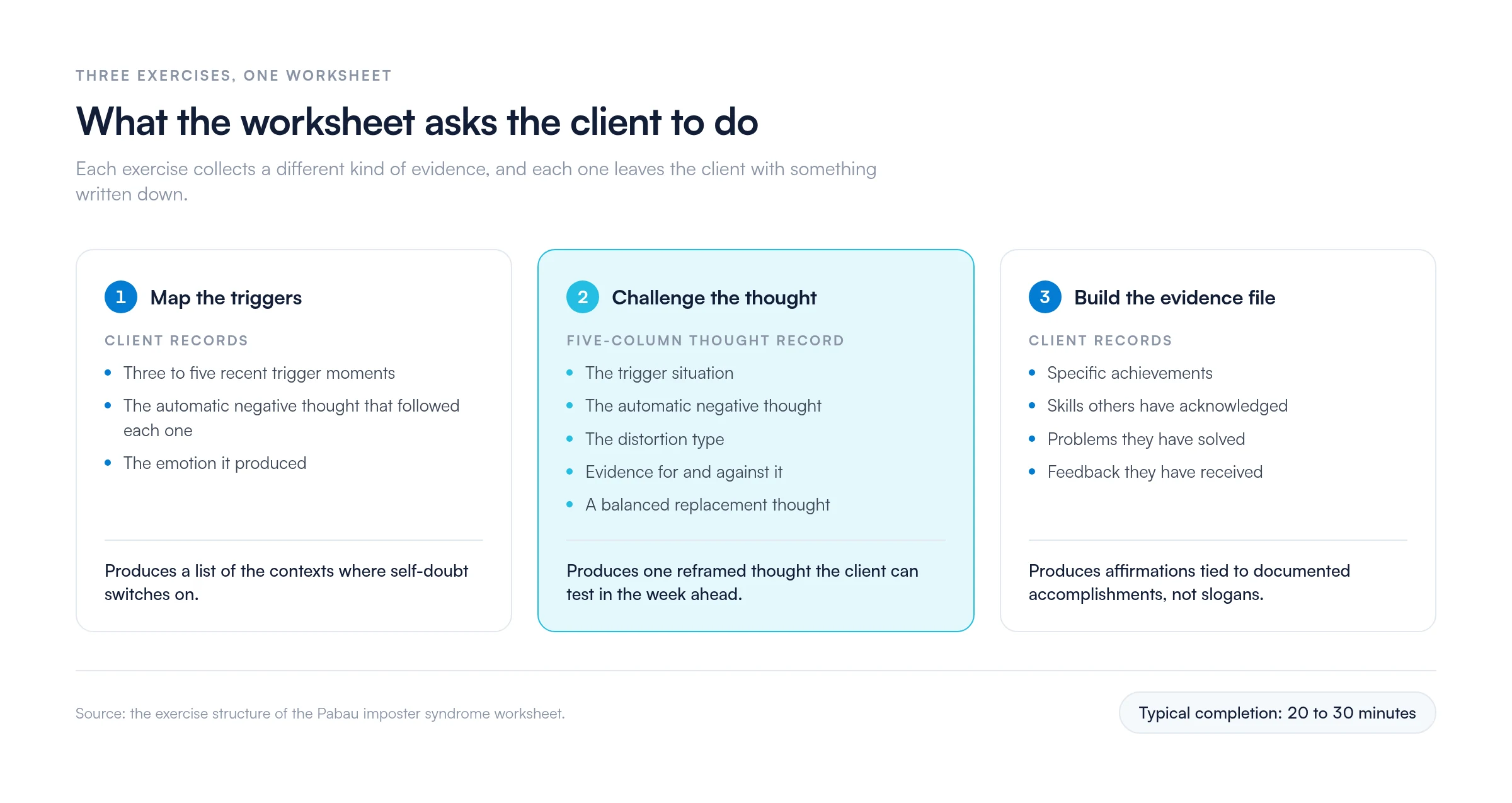
The first exercise maps the contexts where self-doubt switches on. Common triggers include performance reviews, public speaking, praise or promotion, comparison to peers, new responsibilities, and working with authority figures.
Ask the client to write down three to five recent trigger moments, plus the automatic negative thought that followed each. If they need more logging space than this form gives, a standalone thought record worksheet extends the same exercise.
This exercise carries the core CBT mechanism. The worksheet gives the client a five-column thought record. The columns are the trigger situation, the automatic negative thought, the distortion type, the evidence for and against it, and a balanced replacement thought.
Naming the distortion is the column clients find hardest. Catastrophizing, mind-reading, and personalization each need a different counter, so a cognitive distortions worksheet gives them the full list to match against.
Guide the reframing with Socratic questions. “What would you tell a colleague in this situation?” and “What is the evidence against this thought?” both do the job well.
The last section anchors a documented narrative. Rather than generic affirmations, the worksheet asks the client for concrete evidence of competence. That means specific achievements, skills others have acknowledged, problems they have solved, and feedback they have received.
Clients then write affirmations rooted in that record. “I have treated 50 clients with positive outcomes” does work that “I am a good therapist” cannot.
Assign it early with clients presenting perfectionism, self-doubt, or achievement anxiety. Reviewing it across sessions is what makes it stick. The client watches their own pattern recognition improve, rather than taking your word for it.
Store completed worksheets where the rest of the client’s file lives. Therapy practice management software keeps them beside the notes, so improved reframing and reduced distortion can be read as progress indicators rather than impressions.
Two extensions are worth trying. Pair the worksheet with a behavioral experiment, asking the client to act as if the balanced thought were true for a week. Some clinicians also run it in supervision, with trainees working through their own imposter experiences.
The usual route is a PDF or a printout. It comes back on paper, gets scanned or filed somewhere, and by session eight week one’s thought record takes ten minutes to find. Progress you cannot pull up is progress the client never sees.
Practice management software like Pabau turns the same worksheet into a digital form you assign from the client’s record. The client completes it through our online booking portal before the session, and the answers land in their file rather than your inbox.
The responses sit with the treatment notes. You can open week one and week eight together, and show the client how their reframing has changed. Every Pabau subscription includes the digital forms, the client records, and the reporting, so none of this depends on which plan you are on.

Assign the worksheet as a digital form, see who has completed it, and store every answer beside the treatment notes. Reviewing a client’s progress then takes seconds rather than a search through scans.

Imposter syndrome is a learned thinking pattern, so it responds to practice rather than reassurance. Telling a client their fears are unfounded rarely lands. Handing them a form that makes them collect the counter-evidence themselves usually does.
The trade-off is time. Three exercises take 20 to 30 minutes of the client’s own effort. The value only shows up if you review the pages together in a later session. Assign it and schedule that review at the same time.
Download the worksheet and use it in your next session with a client who minimizes their own results. Book a demo to see how Pabau assigns, stores, and tracks client worksheets inside the record you already keep.

Need a dedicated form for the self-talk itself? The negative self-talk worksheet gives clients more room to catch and rewrite the running commentary.
Working with a client whose self-doubt runs deeper? The self-esteem worksheet for adults addresses the baseline self-view underneath the imposter pattern.
Ready to work at the belief level? The core belief worksheet traces automatic thoughts back to the rule the client is living by.
Looking for more reframing practice between sessions? The reframing negative thoughts worksheet drills the same skill as exercise 2 on new material.
Storing assessments and notes in one place? Psychology practice software keeps worksheets, clinical notes, and outcome measures in one compliance-ready system.
Imposter syndrome is a pattern in which someone persistently doubts their accomplishments and fears being exposed as a fraud, despite clear evidence of competence. It is not a clinical diagnosis. A review in the International Journal of Behavioral Science reports that around 70% of people feel like impostors at one time or another. The pattern is rooted in perfectionism, anxiety, and distorted thinking.
Valerie Young identified five types. The Perfectionist believes success requires flawlessness, and the Expert equates competence with exhaustive knowledge. The Natural Genius expects mastery to come easily. The Soloist treats asking for help as weakness, and the Superhero believes they must succeed in every role at once. Most clients recognize one or two dominant types.
CBT teaches clients to catch automatic negative thoughts such as “I’m a fraud” and name the distortion driving them. From there they gather the evidence that contradicts the thought and write a balanced alternative. This worksheet embeds those reframing steps as a five-column thought record. Clients can practice the skill in session and again on their own.
It can fade a long way. Because imposter syndrome is a learned thinking pattern, clients can interrupt it through awareness, cognitive reframing, and behavioral change. Many report that consistent practice with structured tools cuts both the frequency and the intensity of self-doubt. Occasional doubt during a genuinely new challenge stays normal.
It is designed for clinical use with clients. You can assign it as homework, complete it collaboratively in session, or use it to identify which of the five types fits a particular client. Storing the completed pages in a practice management system lets you track the same client’s answers across months.
Most clients need 20 to 30 minutes to work through the full form on their own. You can also split the three exercises across one or two sessions. Repeating the thought record over several weeks is what deepens the reframing skill, so treat the first pass as a starting point.