Psychotropic Medication List
A psychotropic medication list records the mental health medications a practice ...

Last Updated: Oct 8, 2026

A mood stabilizer medication list groups the drugs used in bipolar and schizoaffective disorder by class, with indications, dosing, and monitoring in one place.
Three classes carry almost all prescribing: lithium, the anticonvulsants valproate, lamotrigine and carbamazepine, and the atypical antipsychotics.
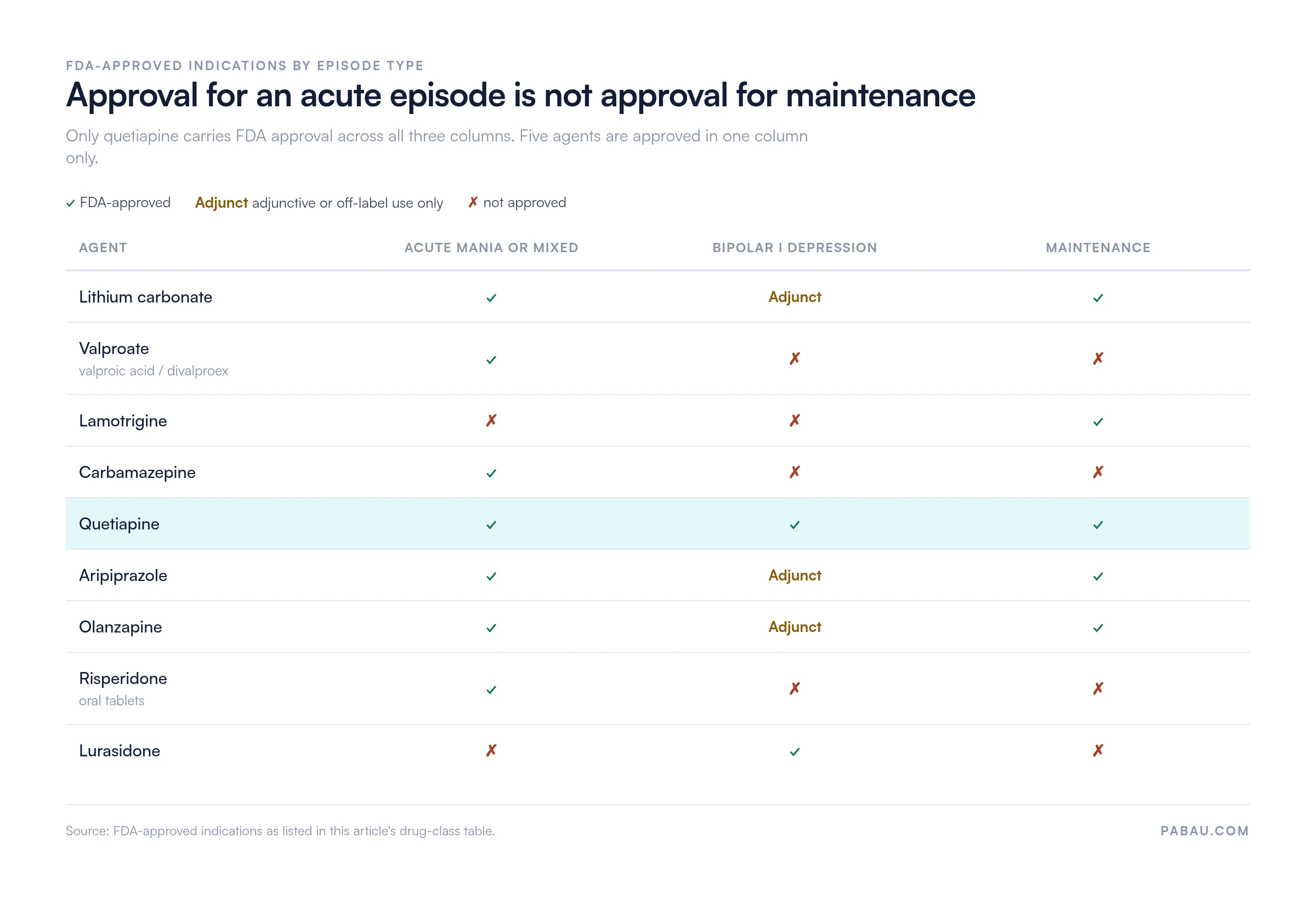
Approval for an acute episode is separate from approval for maintenance, so oral risperidone covers acute mania only and lamotrigine covers maintenance only.
Monitoring differs by drug. Lithium needs serum levels plus renal and thyroid checks, valproate needs liver function tests, and the atypicals need metabolic panels.
The downloadable chart holds all nine agents, so a prescriber can check a dose range or a monitoring interval without leaving the room.
A mood stabilizer medication list is a clinical reference that groups the drugs used in bipolar and schizoaffective disorder by class.
Each entry carries the generic and brand names, the FDA-approved indication, a typical dose range, and the monitoring the drug requires.
Three classes cover almost all prescribing: lithium, the anticonvulsants (valproate, lamotrigine, carbamazepine), and the atypical antipsychotics (quetiapine, aripiprazole, olanzapine, risperidone, lurasidone). That is nine agents in total, each with its own monitoring burden. Dedicated psychiatry EMR software can hold those dates against the prescription, but the reference data comes first.
One distinction runs through the whole list. Approval for an acute episode and approval for maintenance are two separate FDA decisions. Oral risperidone is approved for acute manic or mixed episodes and not for maintenance. Lurasidone is approved for bipolar I depression and not bipolar II. The chart below keeps those apart, because a switch decision turns on them.
A one-page clinical reference covering all nine agents across the three drug classes. Every row carries the generic and brand names, the FDA-approved indication, the typical dose range, and the baseline and ongoing monitoring the drug requires.
Download templateA mood stabilizer medication list is a single-page clinical reference that pulls nine separate FDA labels into one grid. Prescribers, mental health clinicians, and practice teams use it during consultations and treatment planning, where the alternative is nine separate lookups.
Mood stabilizers are the foundation of drug treatment for bipolar disorder and related conditions. The three classes work through different neurochemical mechanisms. They share one goal, which is to reduce the frequency and severity of manic, depressive, and mixed episodes.
The list also records what the prescriber considered. Accurate medication and monitoring records are what compliance frameworks and the professional standards set by the American Psychiatric Association ask for. They also defend a prescribing decision during an audit or an inquiry. That is why therapy practice management systems keep the two together.
The three classes differ in mechanism, in FDA-approved indication, in dosing, and in what has to be monitored. The table below covers the agents prescribed most often in psychiatric practice.
Note: dosing reflects typical ranges from FDA labeling and American Psychiatric Association guidance. Individual dosing needs prescriber judgment and titration against clinical response and tolerability. Treat this table as a reference, not a prescribing directive.
Read the indication column by episode type and a pattern separates out. Approval for acute mania, approval for bipolar depression, and approval for maintenance rarely travel together.
Lithium is the most extensively studied treatment for bipolar I disorder and remains first-line. It comes as lithium carbonate, and as lithium citrate in a liquid form for patients who need precise dose adjustments.
Lithium’s mechanism in bipolar disorder is still incompletely understood. It is thought to modulate serotonin and noradrenaline activity, stabilize circadian rhythms, and support neuroprotection.
The FDA-approved indications are acute mania in bipolar I disorder and maintenance therapy to prevent manic recurrence. Off-label augmentation for bipolar depression and treatment-resistant depression is common in practice.
Lithium has a narrow therapeutic window. Maintenance serum levels run 0.6 to 1.2 mEq/L, and toxicity typically begins above 1.5 mEq/L. Dosing usually starts at 600 mg daily in divided doses. Titrate upward every five to seven days against levels drawn 12 hours post-dose, with steady state reached at five to seven days.
Lithium’s renal effects and narrow therapeutic index mean four things get checked on a fixed schedule.
Anticonvulsants with mood-stabilizing properties give an alternative to lithium. They are often preferred in bipolar II disorder, in rapid cycling, and where lithium is contraindicated.
Second-generation antipsychotics hold FDA approval across bipolar mania, bipolar depression, and maintenance, though quetiapine is the only agent approved in all three. They are used as monotherapy or as augmentation, and are often chosen in first-episode bipolar disorder.
Metabolic monitoring applies to every atypical antipsychotic: weight, waist circumference, blood pressure, fasting glucose or HbA1c, and a lipid panel. Take them at baseline, at 4, 8 and 12 weeks, then annually.
Each class carries a distinct side-effect profile, and those profiles shape the choice as much as the indication does. They also set what the patient needs to hear at consent.
Lithium toxicity presents as coarse tremor, confusion, ataxia, slurred speech, vomiting, diarrhea, and muscle weakness. It is a medical emergency that needs hospitalization and supportive care.
Laboratory monitoring runs for years, and the intervals differ for every drug. Prescription management software can hold each schedule with the prescription, so the next due date surfaces while the patient is still in front of you.

Documentation tip: log baseline values and every monitoring date in the clinical record rather than a side spreadsheet. Pair that with a daily mood chart the patient completes between visits. The record then holds both the labs and the response they are meant to explain.
Mood stabilizers interact heavily with common medications. Check the interaction profile before adding a new drug to a regimen that already includes one.
Carbamazepine is a potent inducer of CYP3A4 and other cytochrome P450 enzymes. That lowers levels of oral contraceptives, so advise backup contraception. It also lowers warfarin, lamotrigine, and valproate levels. Phenytoin and phenobarbital in turn reduce carbamazepine levels.
The template is built for use at the point of care. Five steps put it into a prescribing and documentation workflow.

The template also creates an audit trail. It records when the reference was consulted, what was reviewed with the patient, and what monitoring was ordered. That matters during a clinical audit, or if a prescribing decision is questioned later. From there the next document is usually a bipolar treatment plan, which sets out the agent chosen, the target dose, and the review date.
A printed chart on the wall, baseline labs in a scanned PDF, and the next monitoring date in a personal calendar is a common setup. The three are not connected, so a lapsed interval tends to surface at the next appointment rather than before it.
Practice management software like Pabau holds them together. The prescription, the baseline values captured at intake, and the monitoring dates sit on the same patient record. Recalls surface the next lithium level or metabolic panel when it falls due, and the chart shows what was ordered and when.

Digital intake forms replace the paper baseline sheet, so weight, blood pressure, and lab results arrive already in the record. Every subscription includes the full feature set, so a solo prescriber gets the same monitoring tools as a multi-clinician group.

Pabau holds each prescription with its baseline labs and monitoring dates on one patient record. Recalls surface a due lithium level or metabolic panel before the interval lapses.

Choose the agent by the episode you are treating, then let the monitoring schedule follow the drug rather than the appointment calendar. That is most of the discipline in mood stabilizer prescribing, and it is where errors tend to appear.
The trade-off worth remembering is that the best-evidenced agent often carries the heaviest monitoring burden. Lithium has the strongest evidence and the narrowest therapeutic window. Lamotrigine needs almost no labs but cannot treat acute mania. The chart does not make that call for you, but it puts both halves of it on one page.
Download the chart, add your own intervals, and store it where every prescriber in the practice can reach it. Book a demo to see how Pabau keeps prescriptions, baseline labs, and monitoring dates on a single record.

Documenting the assessment behind the prescription? Psychiatric evaluation template gives you a structured way to capture presenting concerns, symptom severity, and treatment response at initial and follow-up visits.
Writing the plan once the agent is chosen? Bipolar disorder nursing care plan sets out the nursing interventions, goals, and evaluation criteria that sit alongside a mood stabilizer regimen.
Need consistent wording for mood and affect? Mood and affect list supplies the descriptors that keep mental status entries comparable from one review appointment to the next.
Tracking side effects on a stimulant or a mood stabilizer? ADHD medication side effects monitoring sheet shows the monitoring format that works for any medication where tolerability decides whether the patient stays on it.
A mood stabilizer is a psychiatric medication used in bipolar disorder, schizoaffective disorder, and treatment-resistant depression. It reduces the frequency and severity of manic, depressive, and mixed episodes. The three classes are lithium, the anticonvulsants (valproate, lamotrigine, carbamazepine), and the atypical antipsychotics (quetiapine, aripiprazole, olanzapine, risperidone, lurasidone).
Lithium usually shows benefit within five to seven days of reaching a therapeutic serum level, with full effect at two to three weeks. Anticonvulsants work within days to weeks, depending on how fast the titration runs. Atypical antipsychotics often respond within three to five days, though the dose may need adjusting. Response varies between patients, and some need a longer trial at a therapeutic dose.
Lithium, lamotrigine, quetiapine, aripiprazole, and olanzapine hold FDA approval for maintenance treatment of bipolar I disorder. Valproate, carbamazepine, oral risperidone, and lurasidone do not. Oral risperidone is approved for acute manic or mixed episodes only, and the maintenance approval belongs to the long-acting injectable form. Approval for an acute episode and approval for maintenance are separate FDA decisions, so check both before a switch.
Lithium needs a serum lithium level drawn 12 hours after the last dose, plus serum creatinine, TSH, and a baseline ECG. Valproate needs a serum valproate level, liver function tests, and a complete blood count. Lamotrigine needs clinical monitoring for rash but no routine labs. Carbamazepine needs a serum level, liver function tests, and a CBC. Atypical antipsychotics need weight, blood pressure, fasting glucose, and a lipid panel. The monitoring table in this guide carries the intervals.
Safety in pregnancy varies by agent. For bipolar disorder, valproate is pregnancy category D. That means restricted use with a documented risk-benefit assessment, rather than an absolute contraindication. The FDA category X contraindication applies to valproate prescribed for migraine prevention. Lithium carries a risk of Ebstein anomaly and needs close monitoring of serum levels and renal function. Lamotrigine is relatively safer but still needs an individual risk-benefit assessment. Atypical antipsychotics such as quetiapine, aripiprazole, and olanzapine are increasingly used as alternatives. Any decision here belongs with reproductive psychiatry and obstetric colleagues.
Stopping abruptly raises the risk of relapse or recurrence significantly. Lithium withdrawal can trigger rebound mania within days to weeks. Anticonvulsants and antipsychotics should be tapered under prescriber supervision to limit withdrawal effects and reduce relapse risk. Never stop a mood stabilizer without instruction from your prescriber, even if side effects appear. A dose adjustment or a medication change is usually preferable to stopping.
No. Gabapentin is an anticonvulsant sometimes used off-label for anxiety or insomnia in bipolar disorder. It holds no FDA approval for mood stabilization, and the evidence does not support it as monotherapy. It may have an adjunctive role for sleep or anxiety alongside an established agent. It should not replace lithium, valproate, lamotrigine, or an atypical antipsychotic.