OSHA respirator medical evaluation questionnaire
The OSHA respirator medical evaluation questionnaire is the mandatory health for...

1
Last Updated: Oct 15, 2026
An HIV AIDS medication list is a structured record of the antiretroviral drugs a patient is prescribed, covering drug name, strength, route, frequency and monitoring. Clinicians use it to keep medication documentation complete, comparable across visits and easy to evidence at review.
A consistent template means each consultation starts from the same set of fields. A strength or a review date is then less likely to go unrecorded.
This article explains what the template captures and how to adapt it for your practice. It also covers where to check current drug information before you rely on it. You can download the template below.
A two-page A4 PDF with 22 medication rows. Each row captures drug name, strength, route, frequency, monitoring requirements, next review date and a clinician sign-off, alongside patient details and a notes box.
Download template
Each row records drug name, strength, route, frequency, monitoring requirements, next review date and a clinician sign-off.
Consistent fields make medication histories comparable across visits and reviewers.
Always confirm current prescribing information before recording dosing or interactions.
Pabau, our practice management software, keeps the completed list on the patient record beside their notes.
An HIV AIDS medication list is a documented record of every antiretroviral medication a patient currently takes. It captures what the patient is prescribed, how it is given and when it is reviewed. Any clinician reading the record sees the full regimen at a glance.
Good documentation matters for safety and continuity. When a patient changes practice, is seen by a covering clinician or is reviewed for interactions, a complete list prevents duplicated or missed therapy. Where regimens are reviewed on a schedule, a dated review field shows when the list was last checked.
A medication list records what is prescribed. Where your team also logs each dose as it is given, a separate medication administration form does that job.
The template is a two-page A4 PDF, with twelve medication rows on page one and ten more on page two. Print it, complete it by hand, or adapt the fields to your own documentation. Work through them in the order below to keep each entry complete.
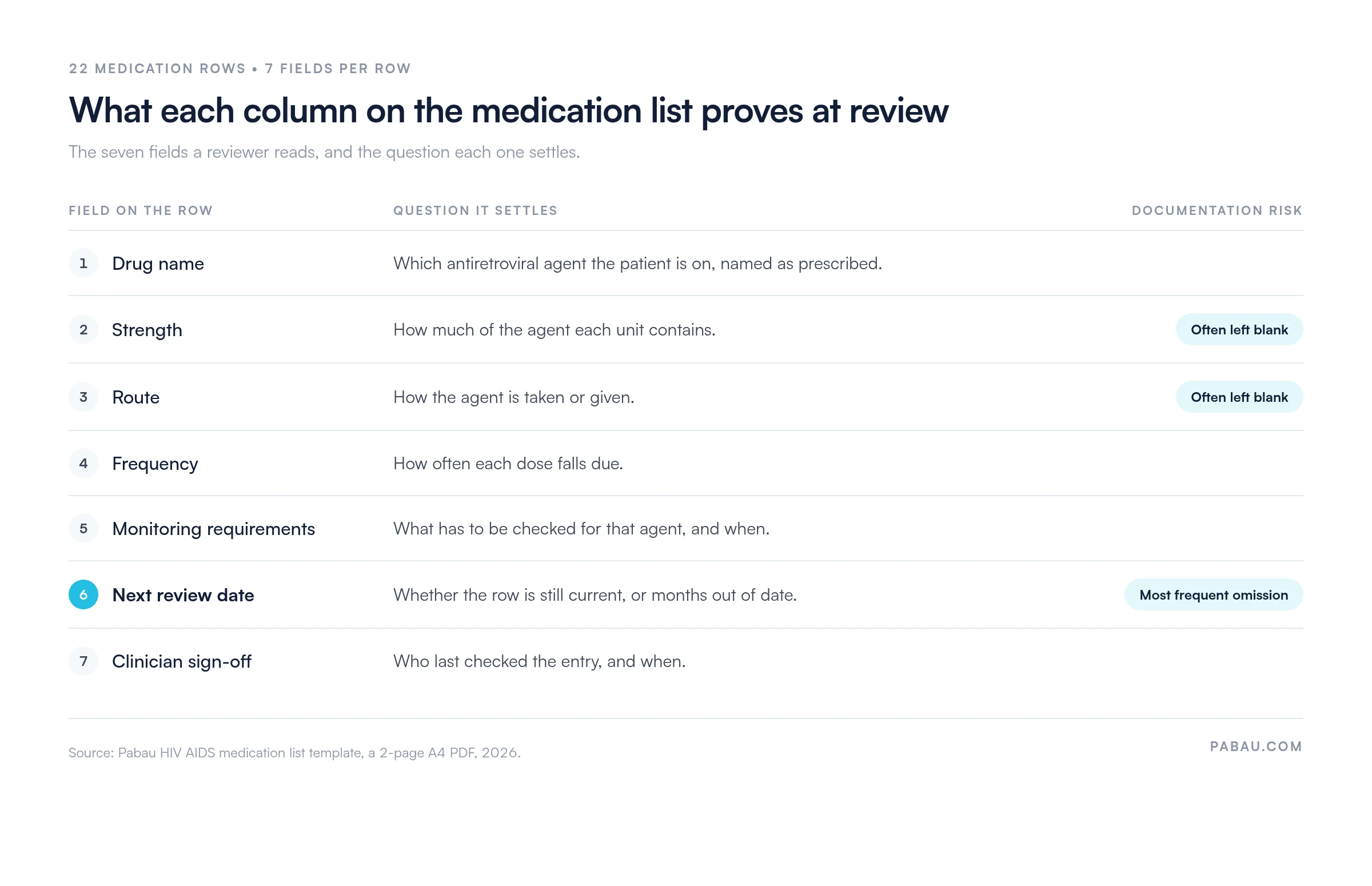
Each column answers a different question when someone reads the record later. Two of them are also the fields most likely to be left empty.
Page two repeats the patient name and record number, so a long regimen stays legible across both sheets. Before recording dosing, interactions or suitability for a specific patient, check the current prescribing information for each agent. The template is a structure for recording decisions, not a source of clinical guidance.
The template suits any team that prescribes, dispenses or reviews antiretroviral therapy. Sexual health and HIV services use it at intake and at each review. Primary care teams use it when they co-manage a patient with a specialist service. Pharmacists use it to check that a regimen is documented completely. Dispensing itself is logged separately, and a pharmacy record template covers that side.
Clinicians in international or community settings often use the abbreviation ARV rather than HIV AIDS. The template is written to be usable under either term.
A standard structure reduces the chance that a field is skipped during a busy consultation. Every entry follows the same order, so a reviewer knows where to look for the drug name, the route and the next review date.
Consistent records also help during audit. When every list shows the same fields and a signed review date, it is easier to show that medication was checked and by whom.
The most frequent omission is a missing review date. A list without one looks current even when it is months old, so set the next review date at the point of completion.
The second is a drug name recorded without its strength or route. Those two fields are what make a regimen unambiguous, so treat them as required on every row.
The NIH’s ClinicalInfo.HIV.gov publishes current guidance on antiretroviral agents, and the FDA’s drug information pages list approved products and labeling. Check both before updating a list.
For prevention medications, the CDC’s HIV resources set out current guidance on PrEP and PEP. Use these sources to confirm eligibility and dosing rather than relying on a list alone.
Update the list at the point a prescription changes, rather than waiting for the next review. A row edited weeks later leaves the record unclear about what the patient was taking in between.
Where the practice collects a history in advance, patient intake software can capture the current regimen. The clinician then checks a list rather than building one.
Name one person per patient who owns that update. Where several teams prescribe, the sign-off column shows who last checked each row, which makes the handover question easy to answer.
Fill the notes box even when the regimen is unchanged. One line confirming that the list was checked, and left as it stood, tells the next clinician the record is current. A blank page leaves them guessing.
Completed lists usually sit as paper in a folder, or as a PDF on a shared drive. The clinician seeing the patient next has to find the file first. The copy in front of them may not be the one that was last updated.
Pabau stores the list on the patient record itself. Medical records and treatment notes sit against the same patient file. The current regimen, its monitoring and its review date open with the rest of the notes.
That gives each patient one list instead of several. Anyone covering a practice, reviewing for interactions or preparing for audit reads the same regimen. The sign-off column shows who checked it last.
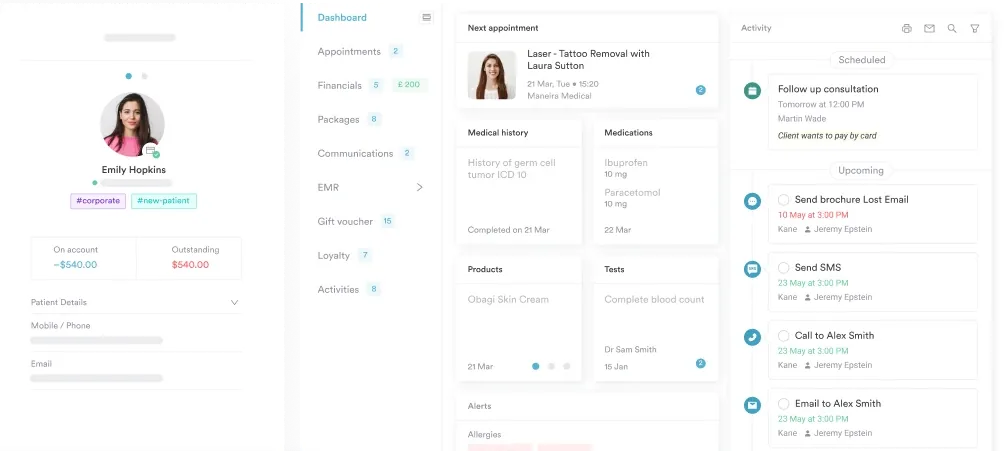

See how Pabau stores medication records, treatment plans and review dates in one patient record, so your team works from a single up-to-date list.

A complete, dated medication list protects patients and makes every review faster. The template gives your team one structure to follow at each visit, and one place to show who checked the regimen last.
If you want the completed list stored with each patient’s notes, book a demo. You will see how Pabau keeps medication documentation on one patient record.

Writing up the visit as well as the regimen? Medical notes covers how to write clinical notes faster and keep them legible.
Caring for a patient at risk of infection? Risk for infection nursing care plan sets out the assessments and interventions worth recording.
Taking a patient over from another provider? Medical record request form gives your team a structured way to ask for their history.
An HIV AIDS medication list is a dated record of the antiretroviral medications a patient takes, with drug name, strength, route, frequency and monitoring. It gives every clinician the same view of the regimen.
The template is a two-page A4 PDF with 22 medication rows. Each row records drug name, strength, route, frequency, monitoring requirements, next review date and a clinician sign-off, alongside patient details and a notes box.
Check the FDA’s drug information pages and the NIH’s ClinicalInfo.HIV.gov database for current approval status. Approval status can change, so verify it before updating a list.
Record the dose exactly as prescribed, and check current prescribing information for dosing rules. The template is a documentation structure, not a source of dosing guidance.
Review the list whenever a prescription changes and on the schedule set by the treating team. Record the next review date on the template so the timing is visible.