Antipsychotic medication list
An antipsychotic medication list is a structured reference that organizes psychi...

2
Last Updated: Oct 13, 2026

The health triangle splits wellness into three connected sides: physical health, mental health, and social health.
The worksheet asks you to rate each side from 1 to 5, then compare the three averages against each other.
A side averaging 2.4 or below needs attention, and a spread of 1.5 points or more means the triangle is lopsided.
Work the lowest side first, because a weak side drags the other two down faster than a strong one lifts them.
Practice management software like Pabau can send the worksheet as a digital form and keep every score in the patient record.
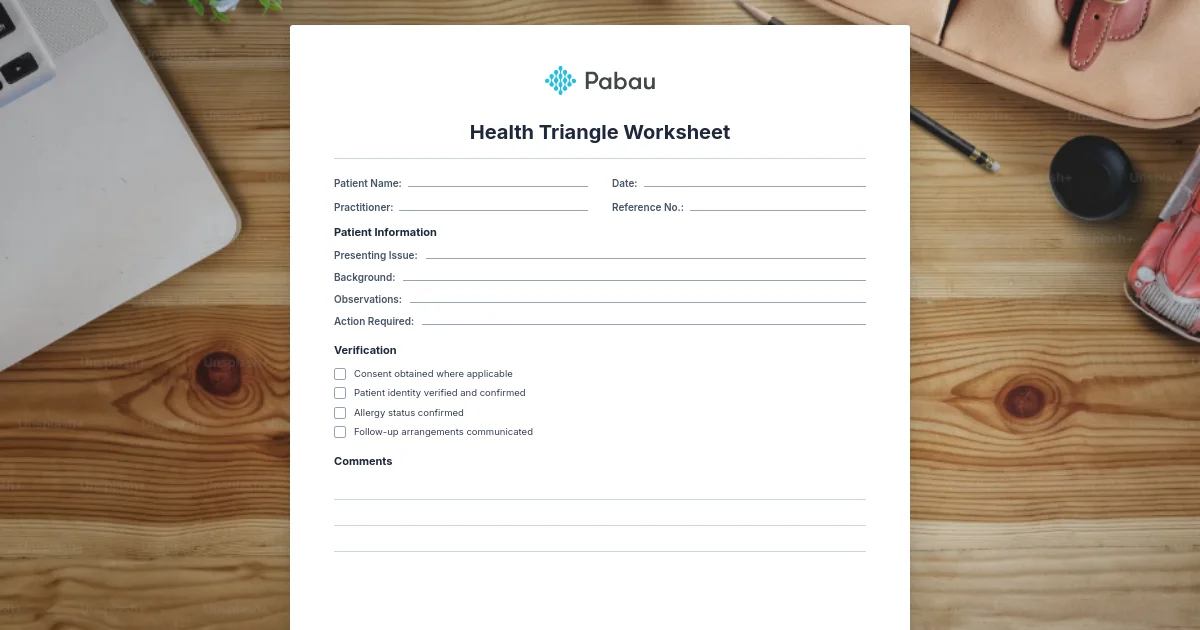
A printable health triangle worksheet PDF with 1 to 5 rating prompts for all three sides of health. It covers exercise, sleep and nutrition, stress and mood, and relationships, and it leaves a goal line under each side.
Download templateA health triangle worksheet asks you to rate three sides of your health: physical, mental, and social. Then it asks you to compare them. Most health worksheet PDF downloads stop right there and leave you holding three numbers with no idea which one to act on.
This page closes that loop. The worksheet above is free to print. Below it sits a side-by-side table showing what each side looks like when it works and when it slips. You can spot your own pattern in one pass.
You also get a scoring key that turns a 1 to 5 rating into a decision about what to do next. Health teachers hand these out as health class worksheets, therapists use them at intake, and plenty of people fill one in for themselves.
The health triangle is a wellness model that splits health into three sides: physical, mental, and social. Each side is one leg of the triangle, and the shape only stands up when all three are roughly equal. Shorten one leg and the whole thing tips.
You will also see this called the wellness triangle. Health class diagrams label the three sides in exactly this order. A common exam question, “what are 3 aspects of health”, is asking for the same list.
The names matter less than the interaction. Sleep debt flattens your mood. A flat mood makes you cancel on people, and canceling removes the support that would have helped you sleep in the first place.
Most health triangle examples describe each side in a separate section, several screens apart. Reading them next to each other is faster, because imbalance only shows up in the comparison.
| Side of the triangle | What it covers | Daily example actions | Signs of imbalance | Quick fix this week |
|---|---|---|---|---|
| Physical | Movement, nutrition and hydration, sleep, hygiene, preventive care | A 30-minute walk, seven hours of sleep, water on the desk, a checkup booked | Afternoon energy crashes, waking unrefreshed, skipped meals, a checkup you keep postponing | Set one fixed bedtime and hold it for seven nights before changing anything else |
| Mental | Mood, stress response, self-esteem, focus, coping strategies | Five minutes of mindfulness, three journaled lines, one request turned down | Snapping at small things, replaying conversations at night, no off switch after work | Journal three lines each evening for a week, then read them back as a set |
| Social | Support network, communication, boundaries, sense of belonging | One real conversation, a message you actually answer, a standing weekly meetup | Declining invitations by default, nobody to call at 10 PM, contact only through screens | Pick one person and put a recurring 30-minute call in the calendar |
Read the “signs of imbalance” column first. People are far better at recognizing a symptom than at naming the side of the triangle it belongs to.
The physical side is the easiest one to rate honestly, because most of it is countable. Count the nights you slept under six hours last week. Count the days you moved for half an hour. Count the meals you sat down for.
Two patterns turn up constantly on completed worksheets. The first is the gym regular running on five hours of sleep. A sleep hygiene handout would do that person more good than a new training program.
The second is the good sleeper who hasn’t seen a physician in four years. Both patterns score high on one prompt and low on another.
That’s why you rate each prompt separately before averaging anything. An average of 3.5 can hide a 5 and a 2 sitting next to each other, and the 2 is the one worth your attention.
The mental-health side of the health triangle measures what you do with pressure, not whether you feel it. Everyone feels it. The rating is about the tools you reach for when you do.
Four prompts work better here than a general sense of how you have been:
The mental side is the one people over-rate, because a rough couple of weeks feels like a character flaw rather than a score. The entries worth writing down are behaviors, not moods. Mindfulness and journaling move this number fastest, mostly because both are countable. A thought record gives the journaling a shape, which makes it easier to keep up.
Self-care belongs on this side too, and the version that works is unglamorous. It looks like a canceled commitment, an early night, or a phone left in another room during dinner.
Social health measures the strength of your support network, not its size. One person you could call at 10 PM outranks 400 contacts. The social side is the one people skip, because rating it feels like grading your own likability.
Rate the structure instead, using prompts you can answer with a name or a date:
Weak scores here show up as declining invitations by default, and as contact that only happens through a screen. Both respond to a recurring calendar entry, which is a low bar and still works. Boundaries are the other common weak spot.
The health triangle matters because a weak side drags the other two down faster than a strong side lifts them. Fitness doesn’t compensate for isolation. A close family doesn’t compensate for untreated depression. Balance beats excellence in one corner.
That asymmetry is why the model turns up in health classes, at counseling intake. Rating one side tells you how that side is doing. Rating all three tells you what to do first.
So why is the health triangle important to a practitioner with a 15-minute appointment? It sequences the work. You treat the lowest side first, then re-rate a month later and check whether the other two moved with it.
It travels well outside the treatment room too. Most health articles for students explain sleep or nutrition in isolation, which leaves a 14-year-old holding facts and no framework. The triangle gives them somewhere to put the facts.
Fill in the worksheet in three passes: rate every prompt from 1 to 5, average each side, then compare the three averages. It takes about 12 minutes. Here is the order that works.
There’s no health triangle worksheet answer key, because every rating is self-reported. The only wrong answer is a flattering one. What the sheet does need is an interpretation key, and few printable versions include one.
| Average score for one side | What it means | Your next step |
|---|---|---|
| 4.0 to 5.0 | Balanced. This side is carrying its share and is not what is holding you back. | Leave it alone and protect the habit that got you here. |
| 2.5 to 3.9 | At some risk. It holds up in a normal week and slips under pressure. | Change one habit, keep it for four weeks, then re-rate. |
| 1.0 to 2.4 | Needs attention. This side is now limiting the other two. | Make it the only goal this month, and tell someone else about it. |
Then compare the averages against each other, which is the step the bands alone will not give you. If the highest and lowest sit 1.5 points apart or more, the triangle is lopsided. The lowest side is your constraint whatever band it landed in.
A 4.6 physical score sitting next to a 2.9 social score is a poor result. It usually means one side is being used to avoid another, which is the exact pattern a single-domain questionnaire will never surface.
One exception overrides the whole key. If a prompt about hopelessness or self-harm scores a 1, treat it as urgent. Speak to a physician or a crisis line, whatever the averages say. A recovery action plan is the right document at that point, not this one.
With a tool that tracks clinical measurements, baseline and follow-up scores sit side by side in the patient record.
The worksheet is a 12-minute exercise, which leaves most of a lesson unspent. These health triangle project ideas extend it into a unit without asking anyone to read their own scores out to the class.
Pair the sheet with whatever health topics you already teach. It sits well in front of a nutrition or sleep unit, because it gives students a reason to care before the facts arrive. Health teacher resources built around one behavior land harder when the triangle frames them first.
For a full health triangle lesson plan, budget one period for the worksheet and discussion. Add a second for the chosen project, then a short re-rate six weeks later. Districts running health and wellness programs for schools often keep the re-rate and drop the project, which is the wrong half to cut.
Graded health triangle assignments work best when the grade covers the reasoning and never the scores themselves. A student who rates social health at 1.5 and explains why has done better work than one who reports a flattering 5.
A very low social rating is worth a private follow-up rather than a grade. A bullying worksheet is one way to open that conversation.
One goal per side. Three in total. The most common mistake on a completed worksheet is nine goals, which in practice is the same as none.
Write each one so a stranger could tell whether you did it. “Sleep better” fails that test. “Lights out at 11 PM on weeknights” passes it, because it can only be true or false.
Put the re-rate date in the calendar on the same day you set the goals. Without it the worksheet stays a snapshot, and the trend is where the useful information lives.
Re-rate every quarter, not every year. Wellness moves with the seasons, workload, and life stage. A check-in at the start of each quarter catches a sliding side while it is still a habit problem rather than a health problem. Keep the old sheets. Three dated triangles side by side tell you far more than any single score.
The health triangle is a stripped-back version of the biopsychosocial model, which George Engel set out in the journal Science in 1977. His argument was that biology alone does not explain patient outcomes. The triangle is that argument with the terminology removed.
That lineage tells you how much weight the result can carry. The worksheet isn’t a diagnostic instrument, and it doesn’t replace a screening tool or a physical exam. A validated measure such as the objectified body consciousness scale goes far deeper on one domain. The triangle gets three domains onto one page so the conversation can start somewhere useful. Reading change across appointments depends on consistent recording, which psychology practice software enforces.
In practice that is most of its value. A patient presenting with fatigue who rates social health at 1.8 has handed you a line of questioning. A symptom checklist wouldn’t have produced it. A structured psychiatric evaluation often opens on the same three domains.
It’s worth rating your own triangle before you hand it to anyone else. Practitioners score low on the social side more often than their patients do.
A paper worksheet is fine once. The trouble starts at the second appointment. The first sheet is filed away somewhere, and nobody remembers whether the social score went up or down.
Pabau, an all-in-one practice management system, handles this as a digital form. You send the worksheet out before the appointment and the patient completes it on their phone. The responses land in their record without anyone retyping them, so the three averages sit beside the treatment notes.
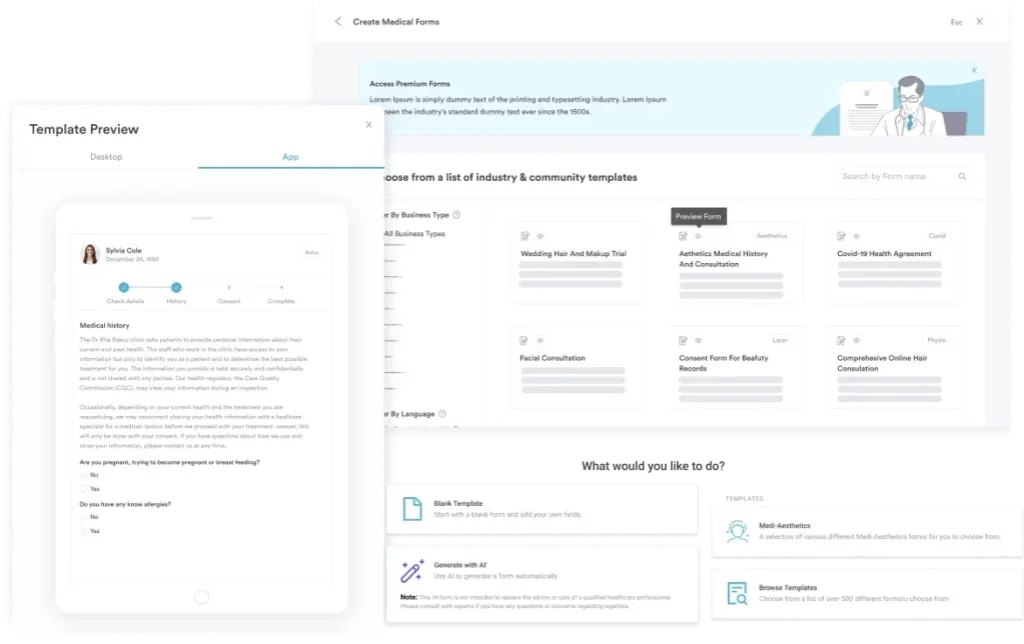
Because every submission is dated, the scores build a timeline. A wellness or behavioral health practice can pull up four quarters of triangles at once. Physical health holding steady while social health slides is exactly the pattern a single visit hides.
That timeline is also what you reach for when a patient says nothing has changed. Two sheets six months apart settle it in seconds, and the conversation moves on to why.
Setup is a one-off. You build the form once, attach it to the appointment types that need it, and it goes out on its own after that. Digital forms and patient records come with every subscription, so there is no higher tier to reach first.

Pabau’s digital forms send the health triangle worksheet before the appointment and file the responses in the patient record. Dated submissions build a timeline, so you can see which side of the triangle is actually moving.

The distance between the three numbers is where this worksheet earns its keep. That distance forces a decision the numbers alone never will.
Rate honestly, average each side, work the lowest one, and re-rate in a quarter. Do nothing else with the sheet and that loop will still tell you more than a fitness tracker will.
The trade-off worth remembering is that self-rating drifts. People grade themselves generously in a good week and harshly in a bad one. That is precisely why the trend across several sheets matters more than any single one.
If you hand this worksheet to patients, the tracking is the hard part. Book a demo to see how Pabau sends wellness assessments and keeps every score in the patient record.

Working on a value the client already knows matters? honesty worksheet guides clients through self-reflection, understanding patterns, and setting goals around honesty.
Turning a low score into something you will do? Action plan template breaks one goal into steps, owners, and review dates.
Want deeper reflection prompts for the mental side? Proust questionnaire asks about values and identity rather than daily habits.
Need a quick way to teach feeling statements? I feel statements worksheet runs five sections from an emotion check-in to rehearsal, with a four-part formula taught in twenty minutes.
Running wellness coaching sessions? Life coach intake form sets a baseline before you agree on goals with a new client.
The health triangle worksheet is a self-assessment tool that rates wellness across three connected sides. Physical health covers exercise, nutrition, and sleep. Mental health covers emotional regulation and stress. Social health covers relationships and belonging. Averaging each side shows you which one to work on first.
The three parts are physical health, mental health, and social health. Physical, mental, and social health examples include sleep and exercise, stress management and mood, and your support network. The worksheet rates all three, so you can compare them and see which side is lagging.
It gives students a framework before it gives them facts. A lesson on sleep or nutrition lands differently once they can see how physical health feeds mood, and how mood feeds their friendships. Learning those connections early is what makes the individual habits stick.
Every three months is the practical rhythm. A quarterly re-rate catches a sliding side while it is still a habit problem. Many health classes run it once a year, which gives a snapshot but no trend. Keep the old sheets and compare them side by side.
That is the finding, not a failure. If your weakest side sits 1.5 points or more below your highest, treat it as the constraint. Make it the only goal this month, pick one small action, hold it for four weeks, then re-rate.
Yes, as a conversation opener rather than a diagnostic tool. Therapists, primary care physicians, and wellness coaches use it to get three domains onto one page at intake. It aligns with the biopsychosocial model and surfaces causes a single-domain screening would miss.
Most assessments measure one domain, so a strong result there can hide a weak one elsewhere. The health triangle rates all three sides on the same scale and then compares them. That comparison explains why someone can be physically fit and still feel unwell.