List of vitamins: All 13 with RDAs and deficiency signs
A list of vitamins names the 13 essential vitamins the body needs from food or s...

10
Last Updated: Oct 8, 2026

The Dr. Sebi food list is an alkaline, plant-based system built on non-hybrid foods he called electric.
Approved foods fall into 7 categories, from vegetables and fruits through to oils, herbal teas, and spices.
Only walnuts, sesame, hemp, and Brazil nuts qualify as approved nuts and seeds, so almonds are out.
Four standing rules apply to every meal, starting with spring water only and no alcohol.
Protein, B12, and calcium can run low on this diet, so involve a dietitian before anyone starts.
A printable chart covering all 7 approved food categories and the foods Dr. Sebi ruled out. It also lists the four rules that apply to every meal. Print it, or send it straight to a patient.
Download templateThe Dr. Sebi food list is short, strict, and easy to get wrong. It names the plant foods that herbalist Alfredo Bowman called electric. Those foods are non-hybrid, naturally grown, and free of animal products.
The approved diet fits into 7 categories, and one of them holds just four nuts and seeds. Copycat lists online quietly add almonds, pumpkin seeds, and sunflower seeds, which he excluded. Get a category wrong and your patient believes they are following the plan when they aren’t.
Below you’ll find the accurate list, the foods to avoid, the four standing rules, and a printable chart.
It is a list of plant foods that Dr. Sebi classified as electric, meaning non-hybrid and naturally grown. Alfredo Bowman, a self-taught herbalist, spent decades assembling it from botanical research. No animal product appears on it.
The exclusions do most of the work. Meat, dairy, and eggs are out. So are hybrid vegetables, processed foods, alcohol, seedless fruit, iodized salt, and caffeinated tea.
Behind the list sits a specific belief. Only plants unchanged for thousands of years carry what Dr. Sebi called an electric charge. Conventional nutrition science does not recognize the idea. It still decides what goes on the list, and how the 7 categories are drawn.
Lists are fine for shopping. A chart works better when a patient needs to see the excluded foods sitting next to the approved ones. The table below does that for all 7 categories.
The pattern is easier to hold than the list itself. Hybrid or processed foods come out, and whole non-hybrid plants stay in. That is why iceberg lettuce fails while dandelion greens pass.
Run any food through four questions and you land on the right answer without the chart. Three of them rule a food out. The fourth confirms it belongs.
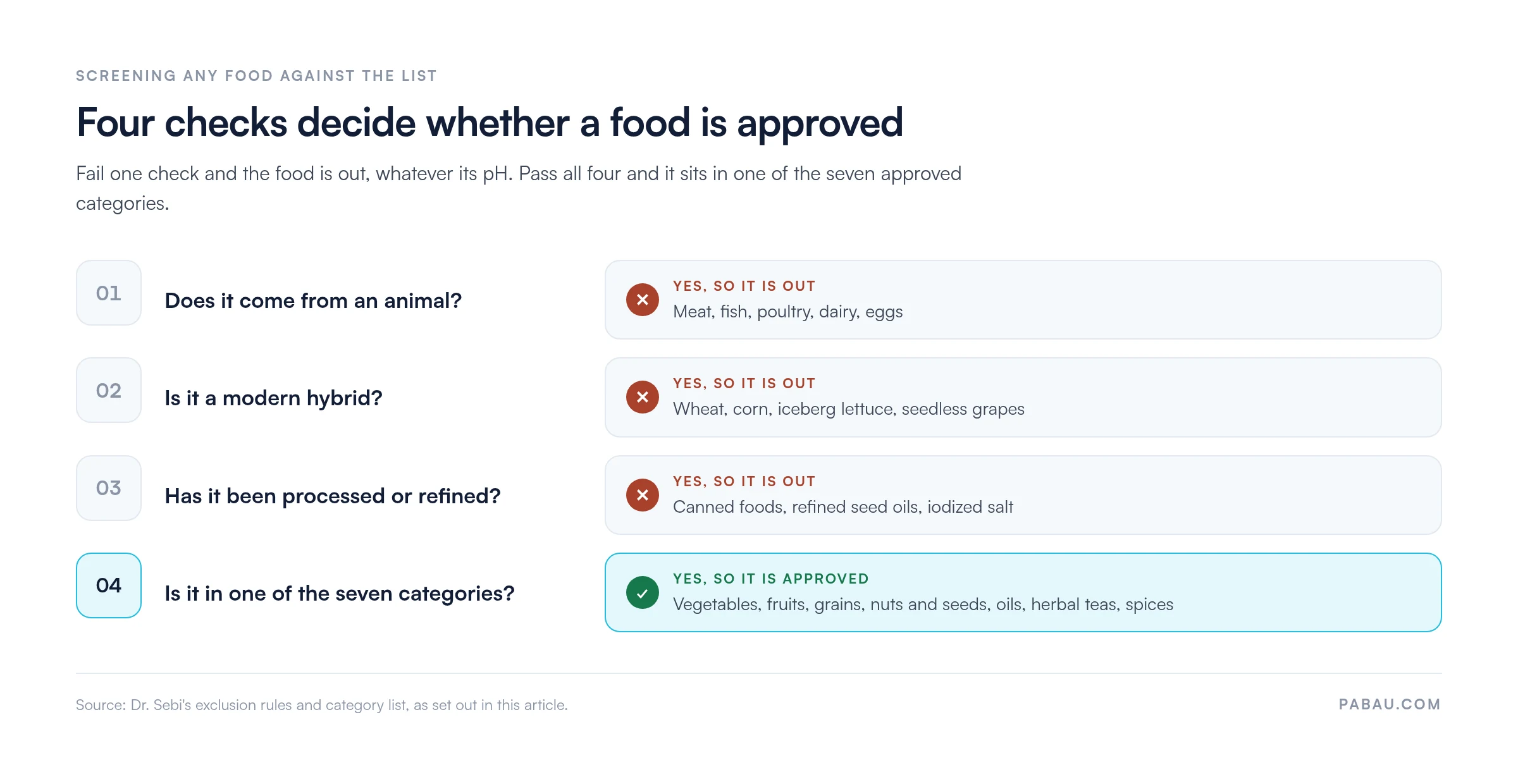
The order matters when you teach this to a patient. Animal origin is the fastest check, so start there. Hybrid status is the one people forget, and it catches corn, wheat, and every seedless fruit.
One example shows the speed. A patient asks about oatmeal with almond milk and blueberries. Oats never made the approved grain list, so check four rules them out. Almonds are excluded too, which takes out the milk. Blueberries pass. Swap in spelt and a homemade hemp seed milk, and the bowl clears all four checks.
The chart earns its keep in the consultation room, not the filing cabinet. Five steps cover the handover:
Some practices add a one-page quick reference listing the 20 foods a patient reaches for most. It cuts the mental load in the first two weeks, which is when adherence usually slips.
Wellness centers, functional medicine providers, and integrative medicine practices hand this out most often. Nutritional counselors and health coaches use it as a teaching sheet. Interest runs highest in the US, the UK, and other English-speaking markets.
Patients arrive from two directions. Some research Dr. Sebi themselves after finding him online. Others were handed the framework by a practitioner already using it. Practices running structured nutrition programs usually track both groups inside weight loss clinic software.
Dr. Sebi put lymphatic system health at the center of his philosophy. He believed electric foods keep lymph moving and help the body clear waste. Peer-reviewed evidence does not support that mechanism.
The broader point holds up better. High-fiber, whole-food plant diets do support digestive and immune function. Mainstream nutrition science documents that well. Leafy greens, fresh fruit, and herbal infusions supply potassium, magnesium, and phytonutrients.
So give patients the honest version. Nutrient-dense foods may well change how someone feels day to day. The detox mechanism behind them is unproven, and saying so protects your credibility.
No regulator has evaluated this framework, and no clinical trial has tested it. Dr. Sebi claimed the diet cured AIDS and cancer. Evidence does not support those claims, and they were contested in court.
Treat the chart as educational material, not medical advice. Anyone with a chronic condition, or who is pregnant, nursing, or on medication, should see a dietitian or physician first.
Protein, B12, calcium, and omega-3s all need checking on a diet this narrow. If the restrictions are too tight, a broader whole food diet plan keeps the unprocessed principle. It drops the hybrid rules.
Handing out a paper chart works until the patient loses it. Then the next appointment repeats last month’s conversation. Nobody is sure which version they were given.
Practice management software like Pabau keeps the chart attached to the patient instead. You send the PDF from the client record, then log what was agreed. Their questions and food swaps land in the same file.
Pabau’s medical records management stores the food list beside consultation notes. Any practitioner who opens that record can see what the patient was told, and when.
Automated workflows then handle the check-ins. A short message at week one and week three keeps the plan in front of the patient. Your team does not have to remember to send it.


Pabau’s client records and digital forms let you send the food list and log what the patient agreed to. Schedule the follow-up from the same screen.

Dr. Sebi’s food list works well as a reference, and that is where its value stops. Whole, unprocessed foods are a genuine benefit on their own. The health claims wrapped around them have no clinical evidence behind them.
So use the chart for the job it does. It gives a patient a yes or no on any food. That takes the argument out of a grocery run. Pair it with a dietitian’s read on protein, B12, and calcium. Then the plan is clear and safe.
Want the food list and the follow-up sitting in one patient record? Book a demo and see how Pabau handles patient education for wellness practices.

Want a gentler plant-based start? 30-day plant-based diet plan maps four weeks of meals without the non-hybrid rules.
Need a plan with fewer restrictions? Clean eating meal plan keeps the whole-food principle and drops the hybrid test.
Starting with produce first? 30-day fruit and vegetable diet plan builds a month of meals around the two easiest categories.
Is the patient also managing weight? Vegan meal plan for weight loss pairs plant-based eating with a calorie structure.
Most alkaline diets sort food by its acid or alkaline effect on the body. Dr. Sebi added a second filter, whether the plant is a modern hybrid. That rule is his own. It removes foods other alkaline plans allow, such as seedless grapes and seedless watermelon.
Health food stores and Caribbean or African grocers carry most of them. Fonio, burro bananas, and sea moss are the hardest to find. Frozen and dried versions count, as long as nothing was added.
Swap the grains and oils first, since spelt, quinoa, and cold-pressed olive oil are simple to source. Drop animal products next. Leave the herbal teas until last, because they cost the most.
No. The food list stands on its own, and the compounds are sold separately. Skipping them removes a significant cost and a product line with no clinical evidence behind it.
The nutritional guide is the original one-page document naming approved foods. Our chart follows it, then adds the exclusions and the four standing rules in the same view.