HIPAA compliant texting: What you can send patients & how to communicate securely
HIPAA compliant texting is possible when a text holds no protected health inform...

Last Updated: Oct 16, 2026

A customer satisfaction survey measures how satisfied patients are with your practice, your staff and the visit as a whole.
CSAT scores a single visit, NPS measures referral loyalty, and CES measures how much effort a task took.
This page lists 24 survey questions grouped by theme, and the free template gives you a shorter form you can send today.
A survey sent within a day or two of the appointment gets better response rates, because the visit is still fresh.
Practice management software like Pabau can trigger a survey after every appointment and invite happy patients to leave a review.
A one-page patient satisfaction form you can print or send as it is. It covers seven rated questions, from overall experience and quality of care to wait time and referral likelihood. Three open-text prompts collect comments, staff mentions and service requests.
Download templatePatients rarely tell you what went wrong at the front desk. They just stop rebooking. A short survey after the appointment is the cheapest way to hear about the wait, the explanation or the price. You find out before it costs you the next visit.
This page gives you a bank of 24 survey questions grouped by theme, plus the one-page template above. It walks through building your own survey, and shows how Pabau sends one automatically after each appointment.
A customer satisfaction survey is a structured feedback tool. It measures how satisfied patients are with your practice, your staff and the visit as a whole. In healthcare and aesthetic practices, the survey usually goes out right after an appointment or treatment. That timing shows you what worked and where the visit fell short.
Satisfaction surveys look at specific touchpoints rather than the whole patient journey. That means consultation quality, treatment results, administrative efficiency or practitioner communication. Collecting the answers on a schedule closes the feedback loop. Patients feel heard, and you get evidence for the changes you decide to make.
Satisfied patients return more often, refer friends and leave positive reviews. Strong online reputation management builds trust and attracts new clients, but you cannot improve what you never measure. Surveys show you the blind spots. Your treatment results can be excellent while booking waits quietly frustrate patients.
For CQC-regulated UK practices, satisfaction data demonstrates patient-centered care and supports inspection readiness. For US practices, the same data gives you an early warning on complaints and on staff under pressure. Either way, feedback works as both a compliance signal and a retention tool.
Three satisfaction frameworks dominate, and each one measures a different dimension of patient experience.
For most practices, a post-appointment CSAT survey is the fastest win. One or two questions capture overall satisfaction while the visit is still fresh. Sending it through automated email and SMS campaigns keeps response rates up and takes no manual effort.
Five steps take a survey from an idea to a change patients notice. The flow below shows the number that constrains each step.
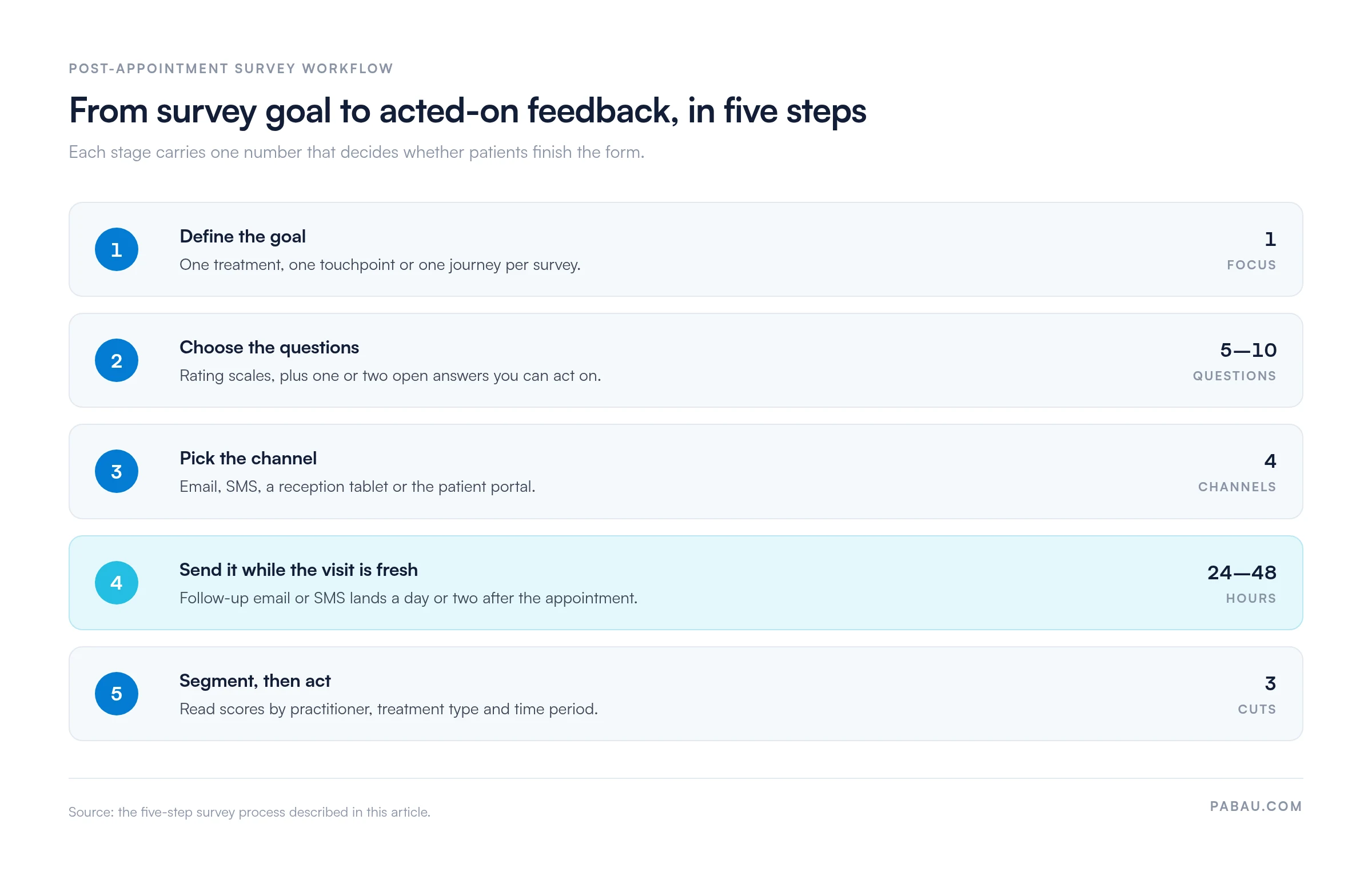
Before you write a single question, decide what you want to learn. You might be measuring satisfaction with one treatment, or checking how the front desk handles new patients. A CES survey might test whether your online booking software feels easy to use. A clear goal shapes every question and keeps the results usable.
Mix rating scales with one or two open questions. A 1-5 scale is quick to answer and easy to trend over time. Open answers tell you why a score was low, which is the part you can act on. Avoid yes or no questions, because they rarely capture enough nuance.
Aim for five to ten questions. Completion rates drop as surveys get longer, so every extra question costs you responses. Set a post-appointment trigger in Pabau and the timing takes care of itself.
Email suits follow-up surveys sent 24 to 48 hours after the appointment. SMS gets opened faster. A tablet at reception catches feedback before the patient leaves. A patient portal link lets clients answer on their own schedule. Pabau runs all of these channels from one workflow, so there are no manual exports and no second tool.
Read scores as a trend against your own baseline rather than against an industry average. Segment the results by practitioner, treatment type and time period to see where the pattern sits. Then act on them. Follow up with unhappy patients, fix the complaint that keeps repeating, and share the wins with your team.
The 24 questions below are grouped into six themes. Pick four to eight of them for any single survey rather than sending the whole bank at once. The downloadable template covers the same ground in a shorter form you can send today.
How you build and send the survey decides how honest the answers are. Six habits do most of the work.
Plenty of practices still send satisfaction surveys by hand. The form goes out in the quiet weeks and gets forgotten in the busy ones. Pabau’s automated workflows trigger the survey once the appointment is marked complete, so the timing never depends on who remembered.
Answers come back attached to the client record. That lets you read a score next to the treatment, the practitioner and the appointment history behind it. When a patient rates the visit highly, Pabau can invite them to post a public review on Google. That turns private feedback into a signal new clients can see.
Low scores are worth just as much, as long as somebody sees them quickly. Route them to whoever handles complaints and you get the chance to fix the visit while the patient still remembers it.

Pabau’s automated workflows send your survey once an appointment is complete. Every answer lands on the client record, and happy patients get an invitation to leave a public review. Your team reads satisfaction scores without running a single export.

A satisfaction survey earns its place when it is short, sent quickly and read by someone who can act on it. Pick a handful of questions from the bank above, send them within two days of the visit, and keep the same core questions every quarter.
The trade-off is worth remembering. The more you ask, the fewer patients finish, so depth costs you response rate. Ask less, act on what comes back, and tell patients what changed as a result. That last step is what turns feedback into rebookings.
Book a demo to see how Pabau sends satisfaction surveys automatically and keeps every response on the client record.

Ready to move surveys off paper? 7 best patient satisfaction survey software compares the tools that collect and score responses for you.
Not sure which score to track? Measuring patient satisfaction walks through the metrics worth reporting each quarter.
Want feedback from more than a form? Best 5 ways to collect patient feedback covers the channels patients actually answer on.
Wondering how the two differ? Patient satisfaction vs patient experience explains why a high score can still hide a poor journey.
Turning feedback into repeat visits? 7 patient retention strategies shows what to change once the scores come back.
A focused customer satisfaction survey should include five to ten questions covering overall satisfaction, staff professionalism, booking ease and likelihood to return. Add one or two open-ended questions so you learn why a score was low. The question bank on this page lists 24 examples grouped by theme.
CSAT measures satisfaction with one appointment on a 1-5 scale. NPS measures loyalty and referral likelihood on a 0-10 scale, where scores of 9 and 10 count as promoters. CES measures how much effort a process such as booking took, on a 1-5 scale. Most practices start with CSAT, because it is the fastest to act on.
Keep the survey to five to ten questions. Completion rates fall as surveys get longer, so a form that takes about two minutes balances depth against the number of patients who finish it.
Sending a survey after every appointment captures the most data, though monthly or quarterly waves also work. If the frequency feels high, alternate the questions by treatment type or practitioner, so the same patient never answers the same form twice. Pabau handles that scheduling for you.
On a 1-5 scale, an average above 4.0 is a strong result for most practices. On a 0-10 scale, aim for 8 or higher. Track your own baseline over time, because the direction of travel matters more than the absolute number. Rebooking and referral rates then confirm what the scores suggest.
The template is a one-page form with space for patient details, then seven rated questions. They cover overall experience, quality of care, staff interactions, wait time, treatment explanation, cleanliness and referral likelihood. Three open-text prompts collect general comments, feedback on individual staff, and requests for new services.