Journal prompts for mental health
Journal prompts for mental health are guided questions that help people process ...

2
Last Updated: Oct 13, 2026

A personality questionnaire is a standardized psychometric form that measures traits and behavior patterns for intake, treatment planning, and outcome tracking.
The Big Five (OCEAN) model carries the strongest validation evidence, while MBTI and DISC stay popular but were built for different jobs.
Clinicians need informed consent, secure storage under GDPR and HIPAA, and interpretation that stays inside their own scope of practice.
This template is a 25-item Big Five (OCEAN) questionnaire, with five items per domain and eight reverse-worded items to flip before scoring.
Score each domain out of 20 instead of reporting one total, because a single number hides the profile you came for.
A 25-item Big Five (OCEAN) questionnaire with a patient information header and five items per domain, each answered on an always-to-never scale. Use it to build a documented baseline that supports treatment planning and a sharper conversation in session two.
Download templateA personality questionnaire is a standardized form that measures how a patient typically thinks, feels, and behaves. It hands you a documented baseline instead of an impression formed in one session.
The template above is a 25-item Big Five (OCEAN) questionnaire. Patients answer each item on a five-point frequency scale that runs from always down to never, and most finish in about 10 minutes.
Below you get what the file contains, the frameworks worth knowing, the five steps of administering it, and how to score each domain. Start with the file.
The form opens with a patient information header: name, age, gender, profession, and date of assessment. Then it runs 25 items grouped into the five OCEAN domains.
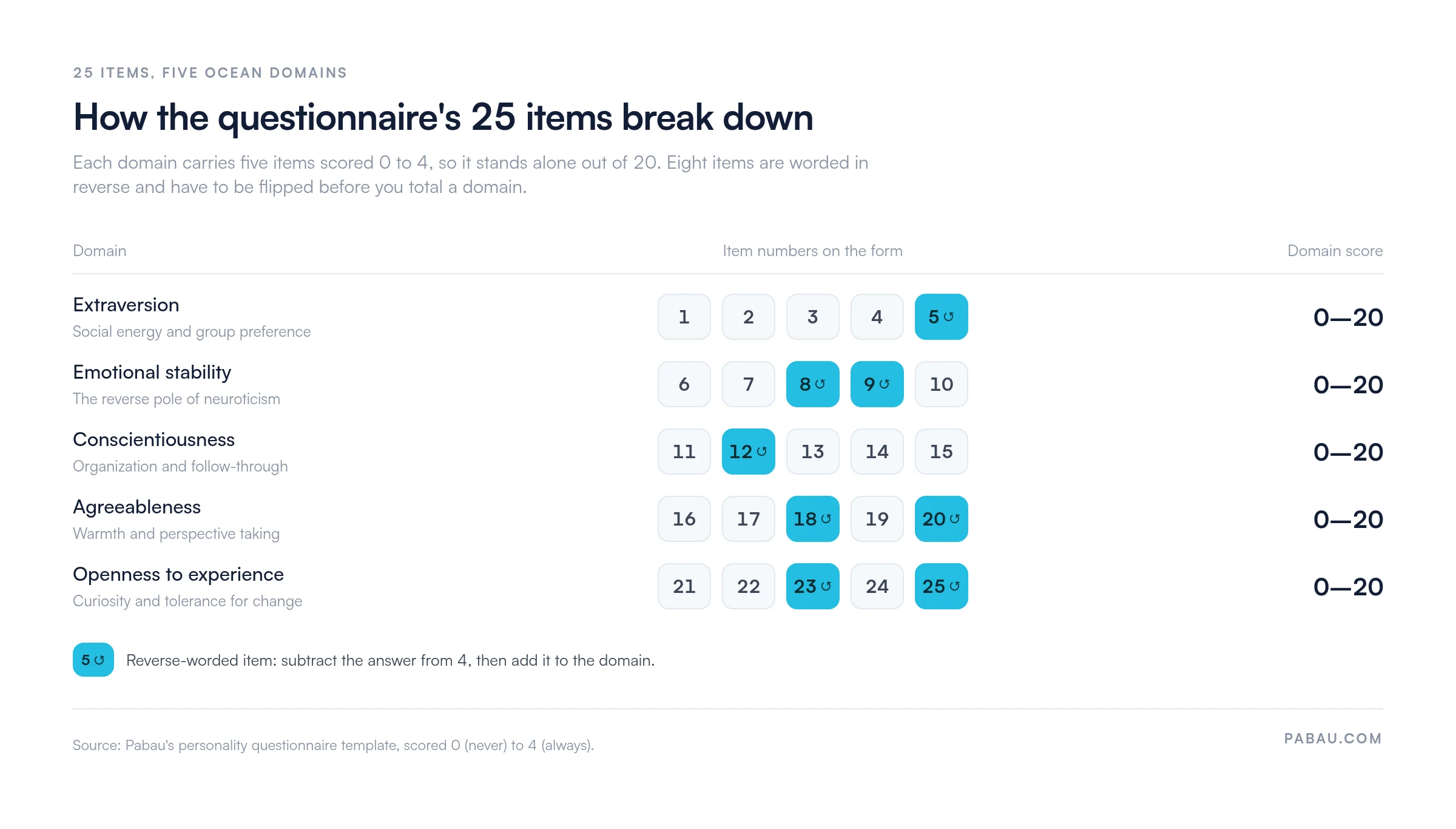
Each domain carries five items, so each one scores out of 20 on its own. Eight of the 25 items are worded in reverse, which means a high answer counts toward a low domain score.
That is the part the form does not spell out. It prints a single Total Score line at the end, but a total across five independent domains has no clinical meaning. Score the domains separately and read the five numbers as a profile.
A personality questionnaire is a standardized psychometric assessment tool that measures personality traits, behavioral tendencies, and psychological characteristics.
Clinical questionnaires differ from casual personality quizzes. They are grounded in psychological research and use validated response formats. Their scores are built to inform clinical decisions.
In healthcare settings, the same form does several jobs at once:
Questionnaires work alongside clinical interviews and observation, never as standalone diagnostic tools. They describe how a patient tends to think, feel, and behave, not whether that patient has a disorder.
The American Psychological Association sets out how personality assessment should meet professional ethics and informed consent standards. Data protection law sits on top of that.
Psychological data is special category data under GDPR, and protected health information under HIPAA, so both consent and storage need to be documented.
Clinicians have several validated frameworks to choose from. Each carries its own item format, evidence base, and clinical use, so the one you pick depends on your setting and your patient population.
The Big Five (OCEAN) model is the standard in clinical psychology, because decades of peer-reviewed research support its validity and reliability. Each trait sits on a continuum, which suits therapy planning and outcome measurement. Our Big Five personality test goes deeper into the model itself.
Longer inventories exist for diagnostic work. The MMPI-2 runs to hundreds of items and includes validity scales that flag over-reporting, which a 25-item form cannot do.
In a practice workflow, the questionnaire is a structured entry point for understanding who your patient is. Instead of relying on unstructured interview notes, you get a documented baseline that points toward the treatment considerations that matter.
Questionnaires work best when they sit inside digital intake forms rather than on paper. Practice management software like Pabau captures responses straight into the patient’s file, so nobody retypes a score.
Look for therapy practice management tools that keep the form, the score, and the consent together.
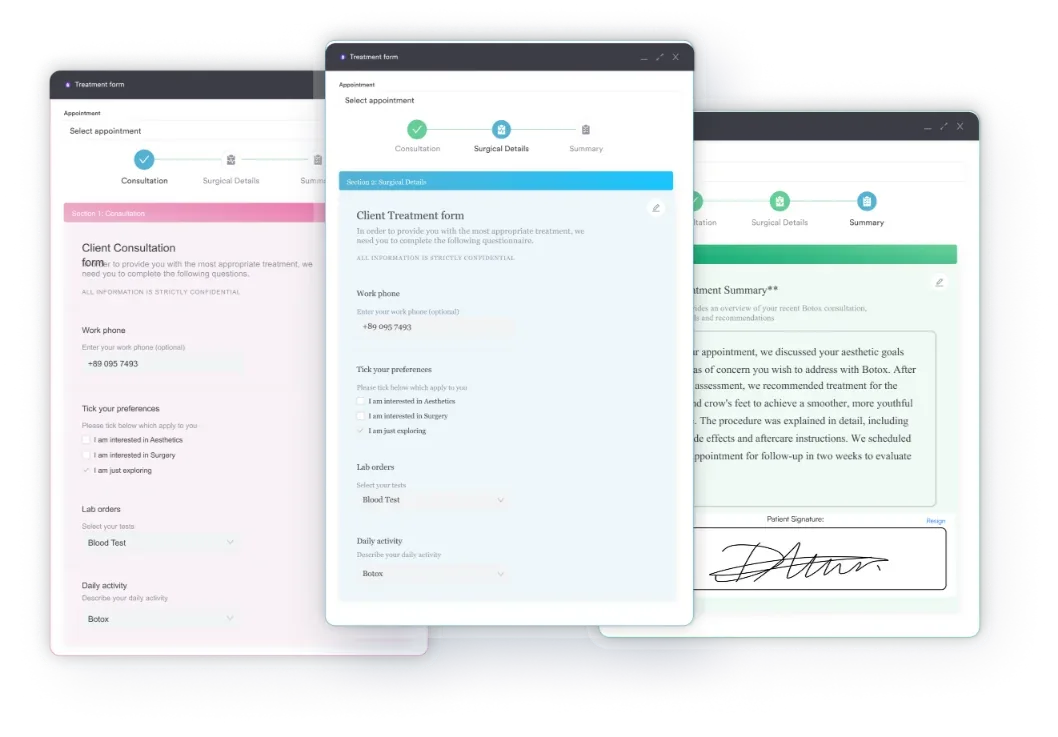
Handing over the form looks like the whole job, but clinical best practice runs through five deliberate steps. They protect both the consent and the quality of the data.
Score each domain by summing its five items after flipping the reverse-worded ones. That leaves you with five numbers between 0 and 20, one per OCEAN domain.
Interpretation is about what each number means for this patient. A conscientiousness score of 17 out of 20 suggests organization, reliability, and self-discipline. In therapy, that patient will probably follow through on homework and benefit from structure.
A low extraversion score points to introversion, which is no kind of deficit. It signals a preference for quieter contact in smaller groups, and it shapes how you pace early sessions.
Watch the pole this template uses. It scores emotional stability rather than neuroticism, so a high number means steadier regulation. If you compare it against a neuroticism scale, the two read in opposite directions.
Other frameworks score differently. MBTI produces a four-letter type code from either-or answers, while DISC uses forced-choice items plotted on a grid.
Avoid overgeneralizing. Trait scores are correlates, not causes. Low emotional stability correlates with depression and anxiety, but plenty of patients who score low develop neither. Use the profile to refine your hypotheses, not to diagnose.
The template suits mental health clinicians whose care decisions improve with personality data. Practices running it inside mental health practice software get the scores filed automatically. Specific roles include:
Psychiatrists who need symptoms, history, and differential diagnosis in one document should start from the psychiatric evaluation template. Add these 25 items to it.
If your practice runs psychological assessments or keeps detailed intake documentation, the form drops into that workflow with no licensing fee and no vendor lock-in.
A clinician-ready template saves time and sharpens clinical decisions in three ways.
Compliance and data protection: Psychological data counts as special category data under GDPR Article 9, and as protected health information under HIPAA. Storing it encrypted and access-controlled in your practice management system satisfies both. A paper form in a filing cabinet does not.
Clinical efficiency: Patients complete the form at check-in or before they arrive. Scores land in the chart, and you read the profile before the session starts. No manual entry, no lost forms, no week-long wait for scoring.
Measurement continuity: Readminister the same 25 items at set points, such as session eight, discharge, and a three-month follow-up. Comparable numbers give you something concrete for outcome documentation and supervision.
Customize the form from validated item pools such as IPIP Big Five, which is free and open source. A therapist treating anxiety can add emotional stability items, and a coach can add achievement items. That flexibility is what a fixed, commercially licensed instrument cannot give you.
Personality questionnaires are not regulated medical devices in most jurisdictions. They are psychological tools, so professional ethics standards and data protection law govern their use rather than FDA or MHRA clearance. That freedom comes with responsibility.
UK (GDPR and professional standards): GDPR requires a lawful basis and explicit consent before you process psychological data. The British Psychological Society recommends that qualified practitioners administer and interpret these questionnaires. A therapist using the form in session is fine. An administrator scoring it without training is not.
US (HIPAA and professional licensing): HIPAA requires you to encrypt psychological data and limit access to authorized staff. Your state licensing board for psychology, counseling, or social work sets which instruments you can use and how you must store the results.
In both jurisdictions, questionnaire results form part of the patient’s medical record. Treat them with the same confidentiality and security as your clinical notes.
Most practices still run this form on paper. The patient fills it in at reception. A clinician scores it by hand between appointments. The numbers get typed into the chart days later, if at all.
Pabau replaces the paper step. You rebuild the 25 items as a digital intake form and send it out with the appointment confirmation. The answers arrive in the client record before the session opens.
Because the scores live next to the treatment notes, comparing session one against session eight takes seconds instead of an archive search. Consent is captured in the same flow, and every view of the record is logged for a GDPR or HIPAA audit.
Setup is part of structured onboarding, so your team builds the form once with help and then reuses it for every new patient.

Pabau’s digital intake forms collect personality questionnaires, store the scores in the client record, and capture consent in the same flow. Your team stops chasing paper and stops retyping numbers into charts.

Pick the framework before you pick the form. If you want a validated read on how a patient generally operates, the Big Five earns its place in intake. For a diagnostic-grade profile you need a licensed inventory instead.
The trade-off worth remembering is scope. Twenty-five items buy you a fast, documented baseline and a better conversation in session two. They do not buy you a diagnosis, and one combined total throws away the detail that made the exercise worthwhile.
So score the five domains, file them with your notes, and readminister at a fixed point so the numbers mean something later. Book a demo to see how Pabau turns this questionnaire into a digital intake form that scores itself.

Want the model behind this template? Big Five personality test walks through each OCEAN trait, the item formats in common use, and how to read a domain score.
Need a longer trait profile? 16PF questionnaire scores 16 primary factors, with notes on where the free version stops and a licensed edition becomes necessary.
Assessing a patient’s temperament? Temperament test template covers the reaction patterns that show up early and shape how a patient responds to structure.
Building a full psychology intake pack? Psychology intake form collects history, presenting problem, and consent, so the personality items slot into a complete record.
Curious about type-based tools? Jungian personality test explains where the MBTI tradition came from and what its type codes can and cannot support clinically.
A personality questionnaire is a standardized psychometric form that measures personality traits and behavior patterns through validated items and scoring. Clinical versions rest on peer-reviewed research, and their scores inform treatment planning, intake assessment, and outcome measurement.
The terms get used interchangeably. In practice, a questionnaire is a structured form answered on a scale, while a test implies pass or fail scoring. Personality questionnaires measure traits on a continuum, so no answer is right or wrong.
Validity varies by framework. The Big Five (OCEAN) model holds the strongest peer-reviewed evidence for clinical use. MBTI is popular but scores lower on test-retest reliability, DISC is validated for occupational settings, and the Enneagram lacks peer-reviewed validation.
Yes. Personality questionnaires are standard in mental health intake for establishing a baseline profile and planning treatment. You need informed consent, a clear explanation of how results will be used, and secure storage under GDPR and HIPAA.
Add up the five items in each domain after flipping the eight reverse-worded ones. Those are items 5, 8, 9, 12, 18, 20, 23 and 25. Every domain then scores out of 20. Report the five domain scores rather than one total.
No. Trait scores describe how a patient tends to think, feel, and behave, and no cut-off on this form marks a disorder. Diagnosis needs a clinical interview, history, and criteria from a manual such as the DSM-5.