Treatment summary
A treatment summary is a written record of what care was delivered during an epi...

Last Updated: Oct 16, 2026
A migraine prevention medication list groups the prescription preventives clinicians use by drug class: beta-blockers, anticonvulsants, tricyclic antidepressants, CGRP-targeting drugs and onabotulinumtoxinA (Botox). Propranolol, timolol, topiramate and divalproex are the long-standing FDA-approved oral options. Since 2018, CGRP antibodies and gepants have added drugs designed for migraine itself.
Clinicians usually consider preventive therapy at four or more headache days a month. The right agent depends on comorbidities, pregnancy potential, cost and insurance coverage. Below you’ll find each drug’s route, dose, FDA status and main cautions. You’ll also see what to record at every trial, so a later prior authorization request holds up.
A two-page printable form with patient details, tick-box checklist sections, blank item rows with quantity and confirmation fields, and a notes page. Fill it in with your patient and keep it in their record.
Download template
Preventive migraine medication reduces headache frequency, severity and disability in patients with four or more headache days a month or acute medication overuse.
Beta-blockers (propranolol, timolol) and anticonvulsants (topiramate, divalproex) remain first-line options (largely FDA-approved) with decades of safety data.
Valproate is contraindicated in pregnancy for migraine prevention, and topiramate carries a serious fetal-risk warning.
CGRP-targeting drugs such as Aimovig, Qulipta and Nurtec ODT were approved from 2018 onward and offer improved tolerability.
Pabau, the practice management platform we build, captures each regimen in digital forms and treatment notes, and its appointment reminders keep follow-ups on schedule.
Preventive migraine therapy is a medication taken daily or on a fixed schedule to reduce the frequency, severity and impact of migraine attacks. The patient takes it whether or not they have a headache that day. Acute medications, such as triptans and NSAIDs, work differently: you take them during an attack to stop it.
Prophylactic therapy suits patients whose migraines significantly impair quality of life or occur four or more days a month. It is also used when acute medication overuse creates a cycle of rebound headaches. Older data suggested preventives worked best for episodic migraine. Newer evidence shows they also work in chronic migraine, defined as 15 or more headache days a month.
Initiation criteria vary by guideline and by individual burden. The most widely cited threshold is four or more migraine days a month, or recurrent migraines that cause significant functional disability. Other reasons to start therapy include:
Before you prescribe, a focused headache physical exam helps rule out a secondary cause. Then agree the plan with the patient. Expect 2 to 4 weeks for an initial effect and 8 to 12 weeks for the full effect. Explain that the dose will rise in steps, with follow-up visits along the way.
The table organizes FDA-approved and widely used off-label preventives by drug class. Use it as a starting point for prescribing and documentation.
Record the chosen agent’s dose, titration plan and side effects in treatment notes. Pabau’s e-prescribing software keeps every prescription on the patient file for review.

Major guidelines from the American Academy of Neurology and the American Headache Society list beta-blockers and anticonvulsants as first-line preventives. Their case rests on decades of clinical experience, predictable dosing and generic availability.
Beta-blockers (propranolol, timolol): Start low, with propranolol at 20-40 mg twice daily, and titrate every 2 to 4 weeks. Efficacy usually emerges around 80 mg a day. Monitor for bradycardia, fatigue and sexual dysfunction. Beta-blockers are contraindicated in asthma and COPD. Widespread generic availability makes them the most cost-effective option.
Anticonvulsants (topiramate, divalproex): Topiramate needs slow titration to limit cognitive side effects. Start at 25 mg at bedtime, increase by 25 mg weekly, and aim for 50-100 mg daily. Divalproex starts at 250-500 mg nightly and rises weekly to 500-1,500 mg daily.
Divalproex requires liver function and platelet monitoring, while topiramate warrants bicarbonate monitoring and kidney-stone awareness. Valproate is contraindicated in pregnancy for migraine prevention. Topiramate carries a serious fetal-risk warning, so discuss reliable contraception before prescribing it to anyone who could become pregnant.
Amitriptyline and nortriptyline are widely used off-label for migraine prevention, especially in patients with comorbid depression, anxiety or chronic pain. Start amitriptyline at 10 mg at bedtime and titrate by 10-25 mg every 1 to 2 weeks, targeting 30-100 mg daily. Nortriptyline is less sedating and follows similar dosing.
Tricyclics cause anticholinergic side effects such as dry mouth, constipation and urinary retention. Weight gain and orthostatic hypotension are also common. They are contraindicated after a recent myocardial infarction and in uncontrolled arrhythmias. Their efficacy is similar to beta-blockers and anticonvulsants, which makes them a solid first-line choice when depression or anxiety is present.
Since erenumab’s approval in May 2018, CGRP inhibitors have widened the choice of preventives. These monoclonal antibodies and oral receptor antagonists block calcitonin gene-related peptide (CGRP), a key messenger in the migraine pain pathway.
Monoclonal antibodies (injectable or infused): The options are Aimovig (erenumab, 70-140 mg SC monthly) and Ajovy (fremanezumab, 225 mg SC monthly or 675 mg quarterly). Emgality (galcanezumab) takes a 240 mg loading dose, then 120 mg SC monthly. Clinicians give Vyepti (eptinezumab) as a 100 or 300 mg IV infusion every 3 months.
All four are FDA-approved for episodic and chronic migraine. Their effect often appears within the first month, sometimes in the first week. The main barriers are insurance prior authorization and cost (~$500-800/month without coverage).
Oral CGRP receptor antagonists (gepants): Patients take Qulipta (atogepant, 10-60 mg daily) and Nurtec ODT (rimegepant) by mouth. That suits patients who prefer to avoid injections.
Rimegepant is the only one with both acute and preventive indications. For prevention, the dose is 75 mg every other day. As an acute treatment, patients take 75 mg as needed, up to 75 mg in 24 hours.
Botulinum toxin injections are FDA-approved for chronic migraine only, defined as 15 or more headache days a month. The PREEMPT protocol divides 155-195 units across forehead, temporal, occipital and cervical sites. Patients receive injections every 12 weeks. Onset takes 2 to 3 weeks, and the full effect appears by week 6 or 7.
In the PREEMPT trials, it reduced headache days by roughly 8 per month, against about 6.6 for placebo. Adverse effects include injection-site reactions and temporary weakness in nearby muscles. Prior authorization is standard, and cost and access can be barriers.
Consider it for chronic migraine when oral preventives fail or are not tolerated. It can be used alongside or ahead of CGRP antibodies.
Several new preventive classes have reached the market since 2018. Erenumab launched in May 2018, and fremanezumab and galcanezumab followed. Eptinezumab, the IV antibody, received approval in 2020, and rimegepant gained its preventive indication in 2021. Atogepant gained approval for episodic migraine in 2021 and chronic migraine in 2023.
These agents offer faster onset, fewer drug interactions and better tolerability than first-line anticonvulsants. Cost and insurance approval still slow access for many patients. A patient who has failed traditional preventives should have access to CGRP inhibitors as the next step.
Most first-line preventives have generic equivalents, which cuts out-of-pocket costs dramatically. Generic propranolol, topiramate, divalproex, amitriptyline and nortriptyline are low-cost staples. CGRP monoclonal antibodies (Aimovig, Ajovy, Emgality, Vyepti) have no generics, and the gepants (Qulipta, Nurtec ODT) also carry high brand-name prices.
Set expectations with patients up front. Starting with a generic first-line agent keeps costs down. If that fails, prior authorization and a specialty pharmacy referral for a CGRP drug usually follow.
The list supports three clinical workflows:
Review each regimen on a fixed schedule with a structured medication review template. Every dose change, side effect and response then becomes part of the patient record, which supports insurance appeals and keeps care consistent across the team.
Set up a prescribing protocol for your practice that covers first-line agent choice, dose range, titration timeline and expected check-in dates. Review it quarterly as new evidence and products appear. A shared protocol means no patient waits while prescribers debate the next step.
Insurers often require a documented trial of one or more first-line agents before approving a CGRP inhibitor. This is known as a step-therapy or “step-edit” requirement, and your clinical record carries the case. For a topiramate trial, record the dose, the time at that dose, any side effects or lack of response, and why it was stopped.
The steps below show what to capture at each stage, so the history is ready when the prior authorization request goes in.
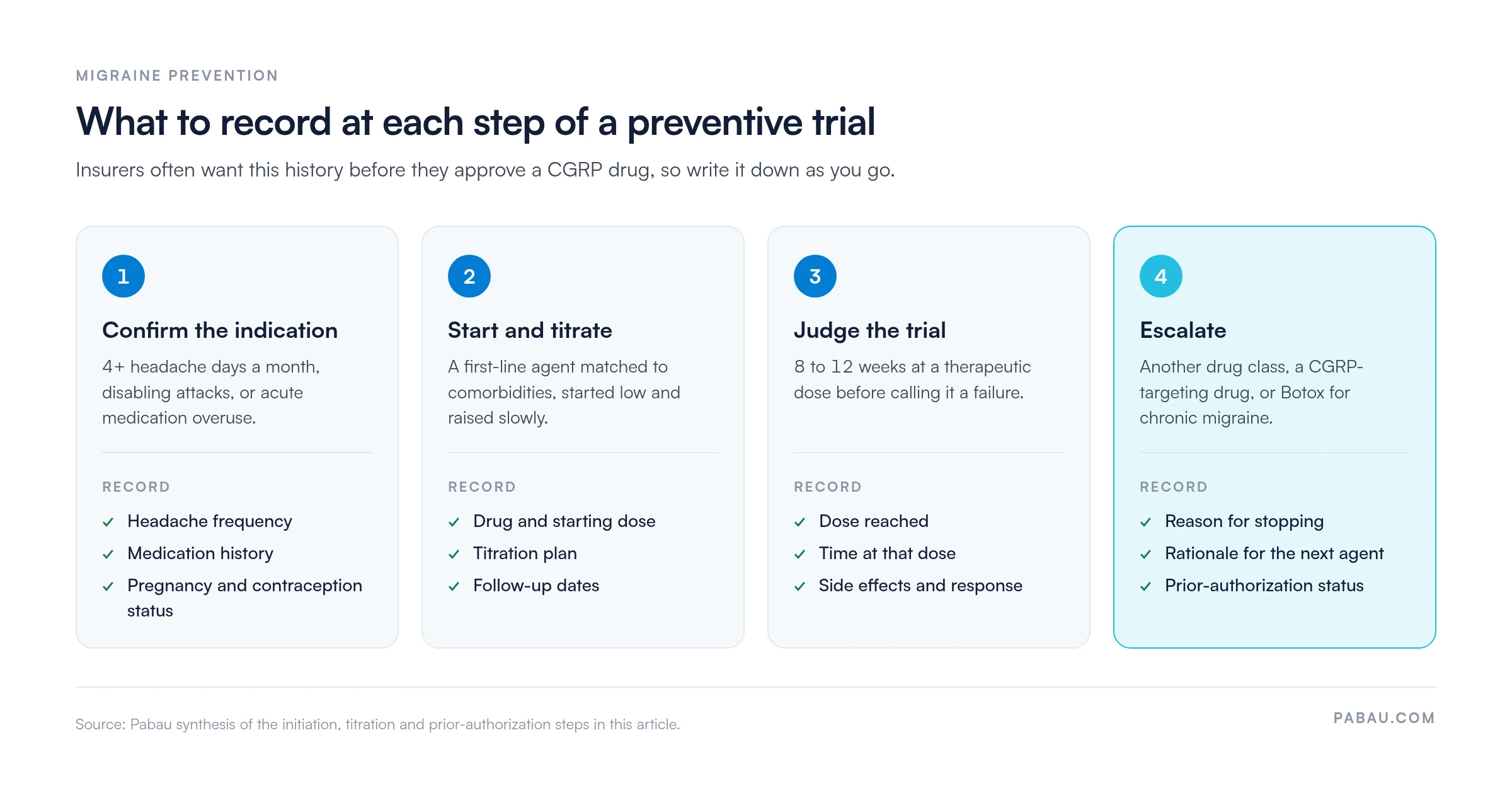
Pabau’s claims management software submits and tracks claims through its Claim.MD integration. Record prior authorization status in the patient’s clinical notes, so the whole team can see where each request stands.
Labels and guidance for migraine preventives change as new indications are approved. Three sources keep your list current:
Preventive migraine care runs over months. Many practices track it across paper notes, a spreadsheet of titration dates and phone calls to chase follow-ups. When a payer then asks for proof of a failed trial, someone has to rebuild the history by hand.
In Pabau, intake forms capture headache frequency, medication history and contraception status before the first visit. Treatment notes hold each dose change and side effect, and appointment reminders bring the patient back for every titration check. Practices running Pabau as their GP clinic software keep these records on the same patient file as their claims.
The result is a trial history that is already written when the prior authorization request goes in, so patients reach the next option sooner.

Pabau’s intake forms, treatment notes and appointment reminders keep each migraine preventive trial on record and on schedule. When a payer asks for step-therapy evidence, the history is already in the patient’s file.

Pick the preventive that fits the patient’s comorbidities, pregnancy potential and coverage, in that order. For many patients a generic first-line agent is the cheapest place to start. CGRP-targeting drugs suit those who can’t tolerate or don’t respond to older options.
Whichever agent you choose, judge it at a therapeutic dose for 8 to 12 weeks and write down the dose, duration and outcome. That record decides how quickly the next option is approved.
Book a demo to see how Pabau keeps migraine treatment notes, follow-up visits and claims in one patient record.

Assessing a new headache patient? Headache physical exam walks through the step-by-step exam that screens for secondary causes before you prescribe.
Reviewing a patient’s full regimen? Medication review template gives you a structured checklist for periodic reviews of every drug a patient takes.
Monitoring neurological status? Neurological vital signs covers assessment, the Glasgow Coma Scale and when to escalate.
Choosing a system for your practice? Primary care software compares the platforms primary care practices use for records, scheduling and billing.
CGRP monoclonal antibodies (Aimovig, Ajovy, Emgality, Vyepti) and gepants (Qulipta, Nurtec ODT) show strong efficacy and good tolerability in clinical trials. For chronic migraine, onabotulinumtoxinA (Botox) reduced headache days by roughly 8 per month in PREEMPT, against about 6.6 for placebo. Response varies, so the strongest option depends on the patient’s profile rather than the drug alone.
Traditional preventives (beta-blockers, anticonvulsants, tricyclics) take 2 to 4 weeks for an initial effect. Full efficacy at a therapeutic dose takes 8 to 12 weeks. CGRP monoclonal antibodies often work within the first month, sometimes in the first week. Oral gepants often show an effect within 1 to 2 weeks. Botox takes 2 to 3 weeks to start working and reaches its maximum effect by week 6 or 7.
CGRP inhibitors are often better tolerated than older preventives, but not every patient needs them. Many patients respond well to generic beta-blockers or topiramate at a fraction of the cost. Insurers often approve CGRP inhibitors only after a documented first-line trial, so many practices start there to balance efficacy, cost and access.
Effectiveness varies by individual and comorbidity profile. Guidelines list beta-blockers (propranolol 80+ mg daily) and anticonvulsants (topiramate 100+ mg daily) as first-line. They have consistent efficacy, decades of safety data and generic availability. For patients who fail these, CGRP inhibitors (erenumab, fremanezumab, atogepant) are the most effective next step. Trial and adjustment matter, because no single medication works for every patient.