Trauma response test: Free template for clinicians
A trauma response test is a structured screening questionnaire that helps clinic...

3
Last Updated: Oct 15, 2026

GIRP stands for Goals, Interventions, Response, and Plan, a progress note format built around what the client is working toward.
Each section has one job. Goals names the target, Interventions records what you did, Response reports what changed, and Plan sets the next step.
Payers read the note for medical necessity, so a note that ties every intervention back to a goal is much harder to deny.
Write the note within 24 hours of the session, while the detail is still accurate.
Practice management software like Pabau puts the four fields inside the client record, so the note never starts on a blank page.
A one-page clinical form with a dated header, a session summary line, and labeled space for each of the four sections. Print it for the room, or fill it in on screen after the session.
Download templateGIRP stands for Goals, Interventions, Response, and Plan.
It’s a progress note format that organizes a therapy session around what the client is working toward, rather than around their symptoms.
A full caseload produces hundreds of these notes a year. A fixed shape keeps them consistent and quick to write. It also keeps them defensible when a payer asks why the session was necessary.
Below you’ll find what belongs in each of the four sections, three worked examples across different presentations, and a free template to download.
A GIRP note is a structured progress note used in mental health and behavioral health settings to document a therapy session. Each of the four parts captures one aspect of the encounter, and the four have to agree with each other.
The format grew out of the limits of SOAP notes, which are built around subjective and objective symptom description. GIRP starts from the client’s treatment goals instead. That suits evidence-based models where progress is measured against specific, stated objectives.
It also travels well. The same four sections work whether the session runs 30 minutes or 60. They hold up across CBT, DBT, and motivational interviewing.
Each section answers a different question, and the four answers have to line up. If the intervention doesn’t point back to a goal, the note stops explaining itself. The panel below shows what each section records, with one line taken from the anxiety example further down this guide.
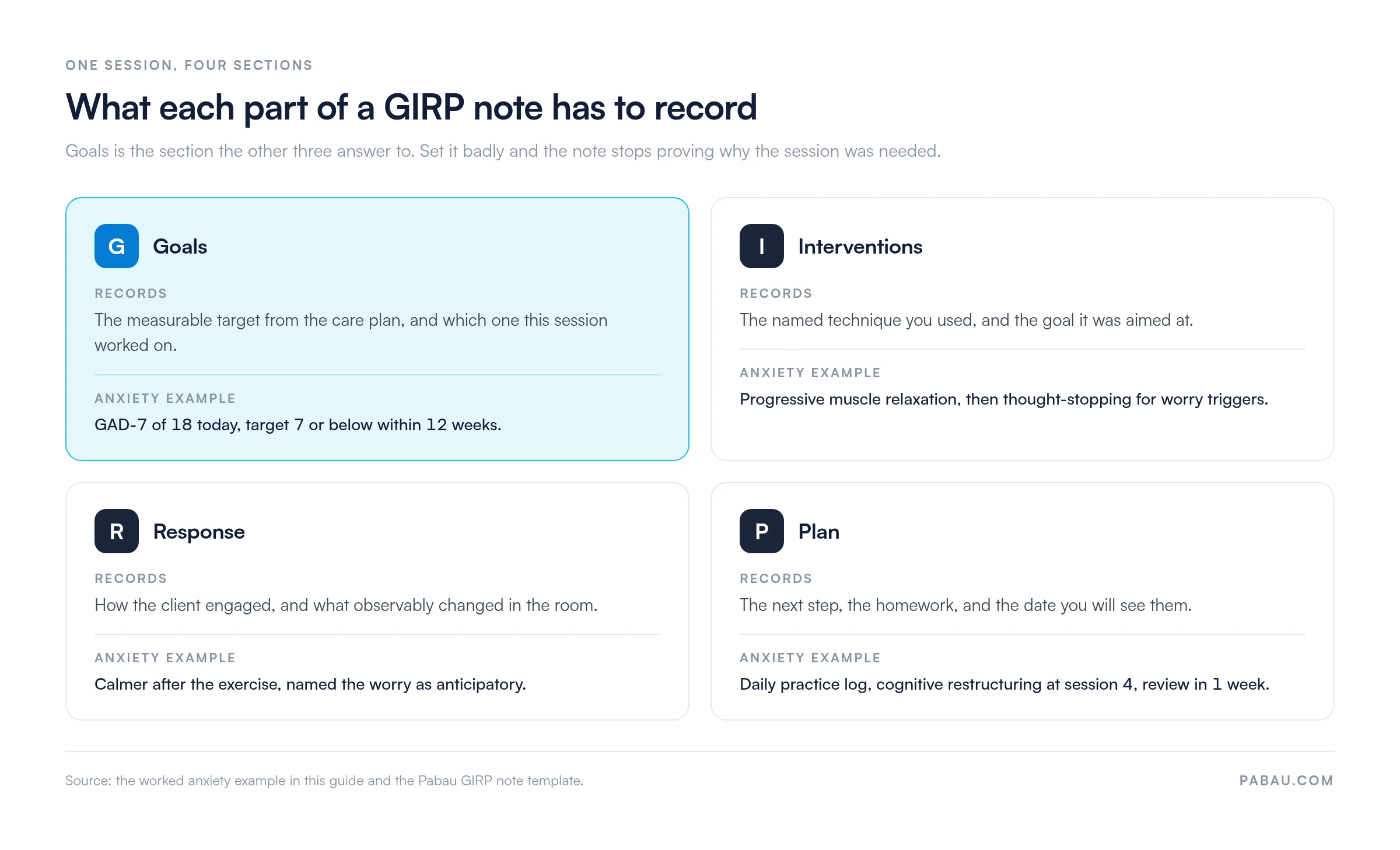
The Goals section records the client’s treatment objectives as they’re written in the care plan. Name the specific, measurable target, then say briefly where this session left it.
Interventions record what you did. Name the technique, modality, or approach with enough precision that another clinician could picture the session.
Response records how the client met the intervention and what shifted. Affect, insight, engagement, and any movement in symptoms all belong here.
Plan records what happens next. Follow-up appointments, homework, referrals, treatment plan changes, and any other decision made in the session go here.
Detail is the hardest part to calibrate. These three notes show the level that satisfies a supervisor and a payer without turning into a transcript.
Example 1: Anxiety
Example 2: Depression
Example 3: Substance use disorder
GIRP is the working format across several disciplines, though it’s most common in mental health and behavioral health.
What these disciplines share is a caseload measured against stated goals. If you run a therapy practice, GIRP gives every clinician on the team the same four questions to answer.
GIRP covers the session, not the intake. Pair it with a psychiatric evaluation template when a client is new or a diagnosis is being revisited.
A weak note is usually vague rather than short. It describes an activity without naming the technique, or reports effort without reporting change.
Insurance reviewers aren’t reading for prose quality. They’re checking that the session was medically necessary and that the treatment matched the diagnosis.
That’s where a loose note fails. When the diagnosis, the goals, the intervention, and the response don’t connect, a reviewer has nothing to approve.
Four things make a note easier to pay:
Notes written this way do more than clear an audit. They give you the record you need on appeal and in supervision. They also give the next clinician somewhere to start.
Three formats dominate mental health documentation. The choice comes down to what your setting has to prove.
DAP is the lightest of the three, and it works where diagnosis isn’t the organizing question. If that describes your caseload, a DAP note removes a section you weren’t using.
SOAP is the opposite trade. It carries more diagnostic reasoning, which is what an integrated primary care team usually needs. A SOAP note template adapted for therapy keeps that reasoning without the medical framing.
Most practices land on GIRP or SOAP. GIRP wins where success is measured against client goals. SOAP wins where differential diagnosis and medical necessity carry the weight.
Most therapists write the note after the client leaves, from memory and a few scribbles. It’s the work that keeps a full day going after the last session ends.
Practice management software like Pabau puts the GIRP structure inside the client record itself. The four fields are already there when you open the note, so it never starts on a blank page.
Because the note sits with the appointment and the invoice, billing staff can check the documentation before the claim goes out. Supervisors can review notes for quality in the same place, without asking anyone to export a file.
Pabau Scribe, our AI scribe, drafts the note from the session audio and lays it out in your GIRP fields. You review and edit it, so the clinical judgment stays yours. Our mental health EMR includes it in every subscription, along with the note templates.

Pabau keeps the GIRP fields, the treatment plan, and the invoice in one client record. Pabau Scribe, our AI scribe, drafts the note from your session audio, so you review instead of type.

The template does the structuring. It can’t make you specific, and specificity is what separates a note that gets paid from one that gets queried.
So use the same four sections every time, name your techniques, and write down what changed rather than what you attempted. Six months in, the chart reads as one continuous piece of clinical reasoning rather than a pile of separate afternoons.
Download the GIRP note template above and use it on your next session. Book a demo if you’d rather have those four fields waiting inside the client record, with the note already drafted for you.

Documenting a behavior-first session? BIRP note template swaps Goals for Behavior, which suits sessions led by what the clinician observed.
Working a problem-focused caseload? PIRP note template opens on the presenting problem instead of the treatment goal.
Want the formats side by side? Therapy progress notes cheat sheet puts the common note structures on one page.
Need language for longer-term work? Psychotherapy progress notes covers phrasing for open-ended therapy where goals move slowly.
GIRP stands for Goals, Interventions, Response, and Plan. It is a progress note format that structures documentation around the client’s treatment goals rather than their diagnostic symptoms.
GIRP notes center on client goals and treatment progress. SOAP notes center on symptom description and diagnostic assessment. GIRP suits goal-oriented therapy, and SOAP suits medical and diagnostic settings.
A typical GIRP note runs 150 to 300 words. That is long enough to carry the clinically relevant detail and short enough to write between sessions. Padding weakens it.
No format is required by name. Payers require progress notes that document medical necessity, treatment justification, and clinical progress. A well-written GIRP note meets that standard.
SIRP (Situation, Interventions, Response, Plan) is a related format used in some behavioral health settings. It replaces Goals with Situation, describing the client’s current clinical state. GIRP stays more goal-focused.
Yes. The goal-centered structure works with CBT, DBT, psychodynamic therapy, motivational interviewing, and others. What changes between modalities is the intervention names and the clinical focus, not the four sections.