Maja Popovska

Mental health self-care checklist
A mental health self-care checklist is a structured daily tool for tracking the ...

7
Last Updated: Oct 20, 2026
Free PDF 7 pages, print-ready Clinician-reviewed
A nursing care plan for aggressive behavior is a structured clinical document for patients who show aggressive tendencies. It helps nurses assess, plan, deliver, and evaluate their care.
It records the patient’s triggers and risk level, nursing diagnoses, measurable goals, least-restrictive interventions, and how each goal is reviewed. Every shift then starts from the same page.
You can also build it as a digital form in Pabau, the practice management platform we build. It then stays with the patient record.
A structured PDF that walks clinicians through assessing, planning, implementing, and evaluating care for patients with aggressive tendencies.
Upload this PDF, or any form you already use, and Pabau's AI Form rebuilds it with tick boxes, text fields and a signature. Attach it to the treatment once, and every patient gets it on time.
AI Form rebuilds the consent, history and aftercare forms you already use. You review each one, then publish.
Patients complete forms on their phone before they arrive, so the front desk stops retyping paper.
Every signed form is versioned and attached to the treatment record, ready when you need it.
Set how long a consent stays valid. Returning patients skip forms they have already signed.
Supports HIPAA and GDPR compliance AES-256 encryption 4.8 on G2 4.7 on Capterra Trusted by 4,000+ practices worldwide

The plan links assessment, diagnoses, goals, interventions, and evaluation in one record.
Write down this patient’s own triggers and warning signs in the order they usually appear.
Least restrictive measures come first, and restraint or seclusion needs a qualified order.
Use current NANDA-I labels, such as Maladaptive Coping and Excessive Anxiety.
Pabau digital forms keep the plan with the patient record and incident notes.
Every shift should work from the same plan. Start with a clear problem statement: What the patient does, when it happens, and what has already been tried. Each entry then links a finding to a goal, an intervention, and a check.
It also shows that less restrictive options came before restraint. It doesn’t replace a prescriber’s orders or a formal risk assessment.
Work through the plan in five stages, and keep it with the patient’s chart so the next shift picks up from the last entry.
Psychiatric and mental health nurses on inpatient and crisis units are the main users. Community nurses and psychiatry practices adapt it too, and the structure works elsewhere with different triggers:
Practices that want software built for this work can see how Pabau’s psychiatry EMR software organizes assessments and notes.
A written plan gives the team one agreed approach. Staff know which triggers to watch for and which response comes first, so fewer decisions are improvised. It also gives handovers, audits, and incident reviews one record to work from.
Review the plan after every aggressive incident, not only at scheduled reviews. Record the trigger and what worked, so the next nurse starts better informed.
Most aggressive incidents build in stages. The plan works best when it names this patient’s own triggers, which usually fall into three groups:
Early warning signs often appear minutes or hours before an incident. Watch for pacing, clenched fists, a raised voice, rapid speech, and prolonged staring. Verbal threats or thrown objects mean escalation is already underway.
Record the signs this patient showed before past incidents, in their usual order. “Starts pacing near the nurses’ station, then raises voice” tells the next shift far more than “becomes agitated.”
Assessment comes first, because the interventions depend on what it finds. Where your facility provides one, use a validated tool such as the Brøset Violence Checklist for short-term risk.
It checks for six behaviors: Confusion, irritability, boisterousness, verbal threats, physical threats, and attacking objects. Each one present adds to the score. Your facility protocol sets the response for each score band, so record both the score and the action taken.
A score is only part of the picture, so the full assessment also covers these points:
A psychiatric evaluation template can structure the wider history and mental status review that sits alongside the risk tool.
A common starting point is the NANDA-I label Risk for Other-Directed Violence, supported by related diagnoses that describe the underlying need.
Confirm each label against the current NANDA-I edition, because labels change. Goals should be specific, observable, and time-bound. “Patient remains calm” is hard to evaluate, while “patient asks for a quiet room when angry, by day three” gives the team something to check.
The entry below follows one fictional patient through each stage. Replace every detail with your own patient’s findings and your facility’s protocols.
A 34-year-old man was admitted to an acute psychiatric unit two days ago. He has shouted at peers during group. Yesterday he paced and clenched his fists, then threw a chair after a refused phone call.
His Brøset Violence Checklist recorded irritability, boisterousness, and verbal threats. He has no recorded history of assault and denies substance use.
Risk for Other-Directed Violence, as evidenced by verbal threats, pacing, clenched fists, and a recent episode of throwing furniture. Maladaptive Coping is added as a secondary diagnosis, because frustration over his admission drives most escalations.
On day three, he asked for the quiet room twice when frustrated and had no further incidents. The first short-term goal is met, and the second is partly met. The team keeps the plan and reassesses risk at the next scheduled review.
De-escalation lowers arousal through calm, predictable communication: A steady voice, personal space, simple choices, and clear limits without threats. Write the steps into the plan in the order the team should try them:
Restraint and seclusion sit at the bottom of the ladder. For hospitals, 42 CFR 482.13 requires an order from a physician or other licensed independent practitioner and monitoring when restraint or seclusion is used. Less restrictive interventions must be judged ineffective first. Medication decisions belong to the prescriber, so the plan records only what was ordered and how the patient responded.
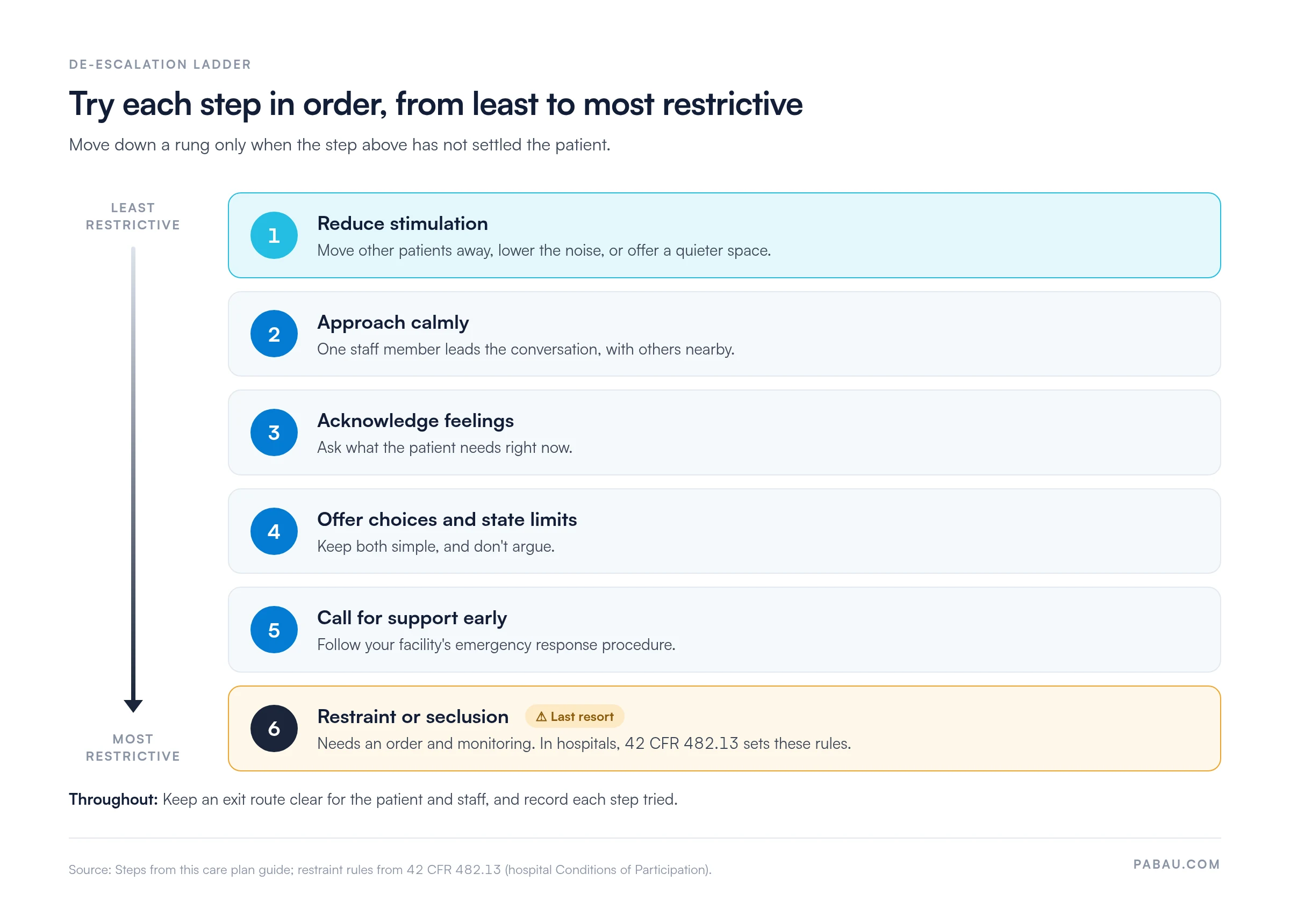
Keep an exit route clear throughout. The National Library of Medicine’s guide to de-escalating aggressive behavior covers verbal and non-verbal approaches in more detail. For the wider picture, see our crisis intervention strategies for clinicians.
Record each incident factually, without judgmental language. Each incident note should cover these details:
Describe behavior rather than labeling it. “Shouted at a peer and threw a cup at the wall” tells the next clinician what to expect. “Was hostile and uncooperative” does not, and it reads as a judgment of the patient.
A short debrief after each incident shows what worked. Feed those findings back into the triggers and interventions the same day.
Many teams keep the care plan on paper and incident notes elsewhere. When a patient escalates, the nurse on shift has to hunt for the last entry.
Pabau’s therapy practice management software lets you build the care plan as a digital form and save it to the patient’s record. It sits next to clinical notes and past incidents.
Pabau Scribe, our AI scribe, can help draft and structure clinical notes after a review or debrief. The next shift then opens one record and sees the current plan, the latest incident, and what changed.

Book a demo to see how Pabau handles digital forms and clinical notes in one place.

Aggressive behavior changes quickly, so the plan only helps if the next nurse can act on it within seconds. That means naming this patient’s own triggers and ranking interventions from least to most restrictive.
Treat every incident as new assessment data, and update the plan the same day. A few extra minutes of documentation per shift buys fewer improvised decisions in a crisis.
Book a demo to see how Pabau keeps care plans, incident notes, and clinical records together for every shift.

Caring for a patient with psychosis? Schizophrenia nursing care plan covers NANDA diagnoses and interventions for psychotic symptoms.
Is mood instability driving the escalation? Bipolar disorder nursing care plan sets out goals and interventions across mood episodes.
Is withdrawal part of the picture? Alcohol withdrawal nursing care plan helps you plan monitoring and safe care during withdrawal.
Need a structured mental state review? Mental status exam template records appearance, mood, thought, and cognition in one form.
Teaching coping skills after an incident? Worksheet on anger management gives patients structured exercises to practice between sessions.
A nursing care plan for aggressive behavior is a structured document that records a patient’s aggression risk, nursing diagnoses, measurable goals, interventions, and evaluation. Update it after every significant incident and whenever the patient’s status changes.
Yes, as a starting point. Dementia changes the triggers and the communication approach, so tailor the interventions to the patient’s cognitive status.
Review it after every aggressive incident and at the review point your facility sets. Reassess sooner if the patient’s presentation changes.
No. The plan documents planning and least-restrictive steps. Restraint and seclusion still need an order and must follow facility policy and, in hospitals, federal requirements.
Common early signs include pacing, clenched fists, a raised voice, rapid speech, and prolonged staring. Record each patient’s usual sequence in the plan.
Risk for Other-Directed Violence is usually the priority when the assessment points to possible harm to others. Related diagnoses, such as Maladaptive Coping or Excessive Anxiety, describe the underlying need and guide longer-term goals.
Measurable goals name an observable behavior and a time frame. Examples include “patient causes no harm to others during the shift” and “patient tells staff when feeling angry, within 48 hours.”
Record the time, place, trigger, and warning signs, and describe the patient’s words and actions factually. Add each intervention in order, the response, any injuries, and who was notified.