VI Peel aftercare instructions
How VI Peel aftercare works VI Peel aftercare follows a set order: leave the pee...

1
Last Updated: Nov 16, 2026
Healthcare KPIs are the measurable indicators a private practice tracks against a target to see whether it is meeting its clinical, financial, and operational goals. The core set is no-show rate, collections rate, accounts receivable (AR) days, schedule fill rate, patient retention, and net operating margin.
Each has a typical range and a warning line that says when to act. The Medical Group Management Association (MGMA) publishes practice operations benchmarks for the same indicators, from appointment scheduling and no-shows to billing and collections. This guide covers 14 KPIs across four groups, how to measure each one, and where a healthy number turns into a warning sign.

Healthcare KPIs are measurable indicators tied to a target, so each one tells a practice whether it is on track or needs to act.
Most private practices group their KPIs into four areas: patient experience, clinical quality, financial performance, and operational efficiency.
A no-show rate above 15% and a collections rate below 95% are two of the most common warning signs in private practice data.
Start with six to eight KPIs, and review operational ones weekly and financial and clinical ones monthly or quarterly.
Practice software such as Pabau reports appointment, revenue, and patient retention KPIs in real time, without manual data exports.
Healthcare KPIs are quantifiable measures that show whether a healthcare organization is reaching its strategic and operational goals. What separates a KPI from a general metric is a specific objective and a threshold that defines success. Tracking appointment volume is a metric. Tracking whether that volume reaches a 90% schedule fill rate is a KPI.
Private practices use healthcare KPIs across four broad domains: patient experience, clinical quality, financial performance, and operational efficiency. Each domain reflects a different side of practice health. A practice can be financially strong while its clinical quality slips, or run efficiently while poor satisfaction scores push patients elsewhere.
A well-designed KPI framework covers both. A dashboard of lagging indicators alone keeps you reacting to last month. Leading indicators give you enough warning to step in before a problem compounds.
Every KPI is a metric, but only some metrics are KPIs. The difference is strategic intent. A metric measures something, and a KPI measures progress toward a defined goal. Blurring the two is one of the most common mistakes practices make when they set up reporting.
When every data point gets called a KPI, the term loses meaning. Practices end up monitoring 40 numbers and acting on none of them. The discipline is narrowing the list to the 8–12 indicators that best reflect your priorities at your current stage of growth.
The KPIs that matter most depend on your practice model, specialty, and growth stage. Most fall into four groups: patient-facing, clinical, financial, and operational. The split mirrors how CMS defines quality measures, as tools that quantify healthcare processes, outcomes, patient perceptions, and organizational systems.
Patient-facing KPIs measure how patients experience your practice, from first contact through ongoing care. They predict future revenue, and they reflect the quality of care patients feel they received.
Clinical KPIs measure the quality and safety of the care you deliver. They take more setup than the other groups, because the practice has to define what a good outcome looks like for each treatment.
Financial KPIs tell you whether the practice earns enough to cover its costs, grow, and pay staff fairly. A weak financial KPI usually traces back to scheduling, billing, or retention, so read it alongside the operational numbers.
Operational KPIs measure how well the practice uses its time, rooms, and staff. A practice manager controls these numbers more directly than any others.
Measuring healthcare KPIs takes four things: a clear definition of each indicator, a reliable data source, a baseline, and a review cadence. Miss one and the KPI turns into a vanity number.
Industry benchmark ranges give practices a calibration point. These figures are drawn from MGMA and AHRQ publications and represent median ranges for outpatient and private-practice settings. The chart shows how much room each KPI leaves between its typical range and its warning line.
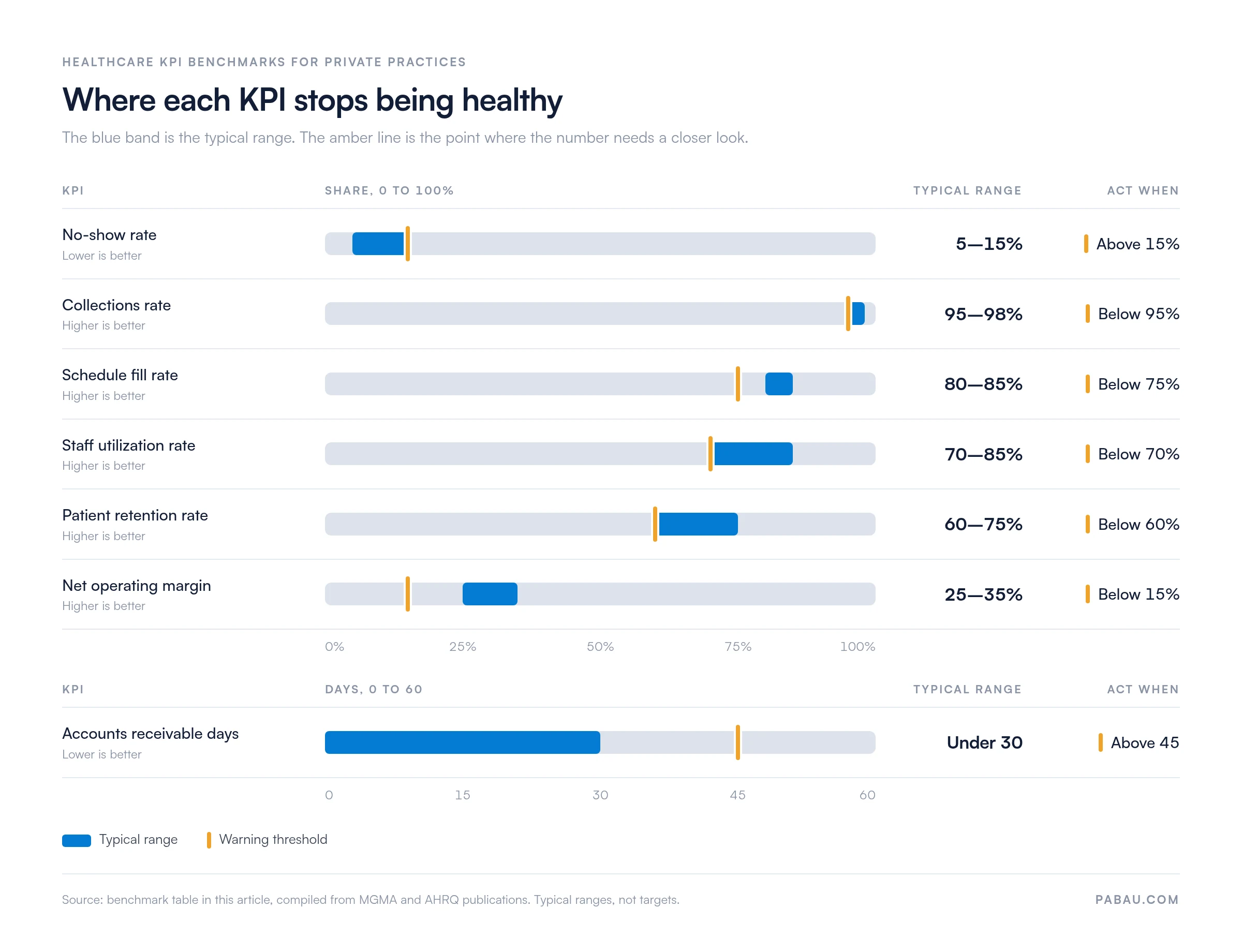
For collections, staff utilization, and retention, the bottom of the typical range is the warning line itself. One soft month on any of those three already deserves a look. Treat every range here as a starting point for your own targets. A solo primary care practice runs on different economics from a multi-practitioner med spa.
A KPI dashboard pulls your most important indicators into one view, updated in real time or on a set schedule. Its job is to shorten the time between data and decision. Without one, owners rely on end-of-month reports that arrive too late to act on.
A well-structured healthcare KPI dashboard covers four layers:
Each layer works only when someone owns it and reads it on schedule. For six worked layouts, see our healthcare dashboard examples.
Five mistakes come up again and again when practices start tracking KPIs. Each one makes the data less useful.
Run your first KPI review as a team exercise rather than a solo management task. Share the benchmark table from this article and ask each team member to pick two numbers they want to improve. Build your first KPI shortlist from that conversation, so the clinical team reads numbers it helped choose.
Many practices still measure KPIs the hard way. Bookings sit in one tool, invoices in another, and treatment notes on paper or in a third system. A basic monthly review then takes hours of exporting and reconciling before anyone looks at a number.
Pabau, the all-in-one practice management platform we build, runs booking, billing, and patient records in one system. Its practice performance reporting draws on that same data, with 80+ built-in reports that update the moment a booking or payment happens.
A custom report builder covers any KPI the built-in reports don’t, and a multi-site practice can view all locations together or one at a time. You share a report by link and decide who sees it. The owner, practice manager, and clinical lead each get the numbers their role needs.
Still comparing platforms? Our ranking of the best practice management software puts 10 tools side by side.

Pabau’s reports track appointment, revenue, and patient retention KPIs in real time, from the same system you book and bill in. Book a demo to see the reports for your practice type.

Pick fewer KPIs than you think you need, and give each one a target and an owner. Six numbers reviewed every week will change more in a practice than 30 numbers nobody reads.
Watch the KPIs with no buffer first. Collections, staff utilization, and retention hit their warning line at the bottom of the typical range. A dip in any of them calls for a conversation that week. Margin and AR days give you more room, and more time to find the cause.
Your monthly review should start with the numbers, not with the spreadsheet that produces them. Book a demo to see how Pabau tracks these KPIs in real time for your practice type.

Deciding which reports to run each month? Medical practice management reports covers eight reports that practice owners rely on.
Comparing reporting software for your practice? Healthcare reporting tools explains what these tools do and how to choose one.
Want to reduce no-shows before they affect your KPIs? Reducing no-show rates outlines the reminder workflows and policies that cut missed appointments.
Healthcare KPIs are measurable indicators that link a practice’s day-to-day activity to its goals in patient experience, clinical quality, finances, and operations. Unlike a general metric, each KPI has a defined target and a threshold that shows whether the practice is on or off track.
Five KPIs most private practices should track are no-show rate, collections rate, accounts receivable days, schedule fill rate, and patient retention rate. Together they cover patient experience, finances, and operations. Clinical KPIs such as documentation completeness come next, and the exact set varies by specialty.
A healthcare metric measures any observable data point. A KPI is a metric tied to a strategic goal and a performance threshold. Total appointments booked is a metric, while appointment fill rate against an 85% target is a KPI. Treating every metric as a KPI buries the numbers that need action.
Start by defining each indicator with a formula and a data source. Measure a baseline over your first period, then set targets from MGMA or specialty association benchmarks. Review operational KPIs weekly, and financial and clinical KPIs monthly. Practice management software that holds scheduling, billing, and clinical notes together tracks most of them without manual exports.
Start with six to eight KPIs tied to your top priorities. For most practices, the core set is no-show rate, schedule fill rate, patient retention rate, collections rate, AR days, and net operating margin. Add patient satisfaction and staff utilization once the core set is reviewed every cycle. Keep the total under 10–12 KPIs until a regular review habit is in place.