CRM for chiropractors: how to manage patients, bookings and marketing
A CRM for chiropractors is a patient relationship management system built around...

Last Updated: Oct 13, 2026

Delusional disorder is a psychotic disorder marked by one or more nonbizarre delusions lasting at least a month, classified in DSM-5 under schizophrenia spectrum and other psychotic disorders.
DSM-5 lists five diagnostic criteria (A through E), including a specifier for whether the delusion’s content is bizarre, that clinicians must document to reach the diagnosis.
Seven subtypes, erotomanic, grandiose, jealous, persecutory, somatic, mixed, and unspecified, describe the delusion’s theme and help guide treatment and risk planning.
Practice management software like Pabau, including its Echo AI documentation tool, helps structure this assessment and keep criterion-by-criterion documentation consistent.
A comprehensive diagnostic assessment tool designed to help clinicians evaluate and document symptoms consistent with delusional disorder according to DSM-5 criteria. Includes structured assessment guide, symptom checklist, tiered diagnostic criteria, and differential diagnostic considerations for accurate mental health diagnosis and documentation.
Download templateA patient sits across from you, utterly convinced a coworker has been tracking their movements for months, yet calm and reasonable about everything else in their life.
That split, one fixed false belief sitting inside an otherwise intact mind, is the signature of delusional disorder, and it’s exactly what makes it so easy to misdiagnose as schizophrenia or a mood disorder with psychotic features.
DSM-5 sets out five specific criteria for the diagnosis, and how well you document each one against mental health practice documentation standards shapes the treatment plan and how the note reads to whoever picks up the chart next.
Delusional disorder is a psychotic disorder characterized by the presence of one or more delusions lasting at least one month.
According to DSM-5, individuals maintain relatively preserved functioning outside the delusional belief system, a key distinction from schizophrenia, where functioning is typically more impaired across multiple domains.
The delusions in delusional disorder are nonbizarre, meaning they describe things that could plausibly happen even though they’re false: a spouse’s infidelity, a coworker’s conspiracy, a hidden illness, a secret talent.
Schizophrenia, by contrast, can involve bizarre delusions, a separate specifier covered in more detail below, on top of hallucinations and disorganized thinking that delusional disorder doesn’t include.
Delusional disorder sits within the schizophrenia spectrum and other psychotic disorders chapter of DSM-5.
DSM-5 lays out five diagnostic criteria (A through E) for delusional disorder:
Clinicians must document the specific onset date, duration in months or years, and any triggering events.
Criterion B is the one that trips people up most. A patient reporting the sensation of bugs under their skin, tied directly to a somatic delusion of infestation, doesn’t rule out delusional disorder on its own.
What rules it out is a hallucination unrelated to the delusional theme, or the presence of disorganized speech, catatonia, or negative symptoms. Treating theme-consistent hallucinations as automatically exclusionary is one of the most common documentation errors on this diagnosis.
DSM-5 classifies delusional disorder into seven subtypes based on the predominant theme of the delusion:
Alongside the subtype, DSM-5 asks you to specify with bizarre content or without bizarre content, a separate call from the subtype itself.
Bizarre content means the delusion is clearly implausible, not something a same-culture peer would understand, and not drawn from ordinary life experience, closer to believing you’ve been replaced by a double than believing your spouse is cheating.
Most delusional disorder presentations are without bizarre content, since a delusion has to be at least plausible to fit the diagnosis in the first place. Content that reads as bizarre should prompt a hard second look at whether schizophrenia fits better instead.
Identifying the subtype also matters for risk planning. Persecutory delusions can escalate into confrontation with whoever the patient believes is responsible, and somatic delusions tend to drive repeated medical visits and second opinions.
Jealous-type delusions, in particular, carry a well-documented risk of harm toward a partner. A structured tool like a danger assessment gives you a formal way to screen for that risk rather than relying on a gut feeling during the interview.
The delusional disorder DSM-5 template integrates into your clinical assessment workflow using Pabau’s digital forms system. Import the template into your intake forms or progress notes structure to streamline assessment during patient consultations.

Step 1: Add the template to your intake process. Import the delusional disorder DSM-5 PDF as a digital form in Pabau. When a patient presents with suspected psychotic symptoms, clinicians access the form directly from the client record.
Step 2: Document onset and duration. Use the template’s timeline section to record the exact date delusions began and duration to the present. This directly satisfies DSM-5 Criterion A requirements.
Step 3: Complete criterion-by-criterion checklist. Walk through criteria A through E, documenting presence or absence of each. The template prompts clinicians to check for schizophrenia-spectrum symptoms (Criterion B), functional impairment (Criterion C), and mood episodes (Criterion D), flagging the theme-consistent hallucination exception under Criterion B so it doesn’t get miscoded as automatically exclusionary. Client sessions produce more data than a paper file holds, so software for psychology practices keeps it retrievable.
Step 4: Specify subtype based on delusional theme. Document which of the seven subtypes the patient’s delusions match, along with whether the presentation is with or without bizarre content. Both specifiers appear in the diagnostic formulation.
Step 5: Generate clinical notes with Echo AI.
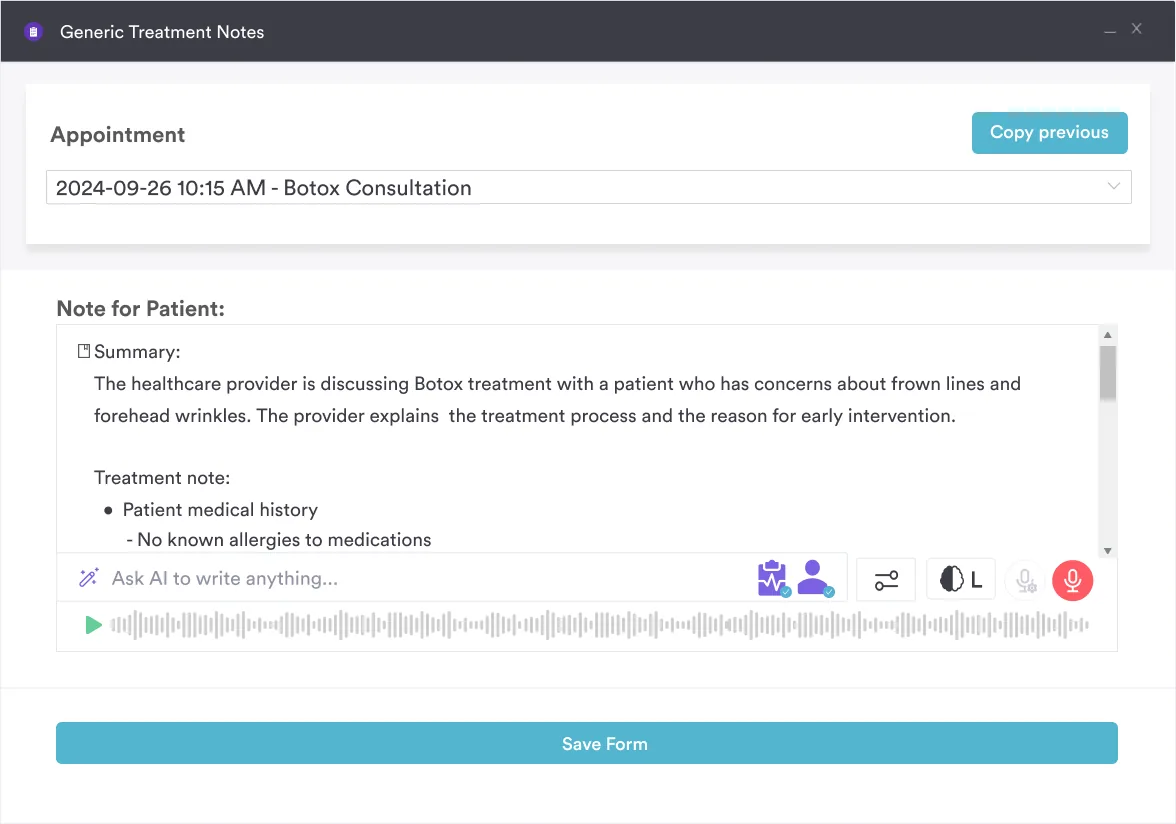

Digital forms, AI-powered documentation, and integrated client records make delusional disorder assessment faster and more compliant.

For billing and compliance, delusional disorder is coded as ICD-10-CM F22.
Payers and auditors expect documentation that ties clinical observations directly to DSM-5 criteria. Record the specific delusional statements the patient makes, the impact on functioning, and the timeline.
All psychiatric assessment forms are encrypted, access-controlled, and timestamped for regulatory compliance.
Layering a signed counseling informed consent form into the same digital chart keeps the treatment-planning conversation on record alongside the diagnostic workup.
Before you close out the note, run it against a quick sign-off list:
Delusional disorder diagnosis requires excluding other psychotic and mood disorders. Use this checklist during assessment:
Criterion D is often the quiet tie-breaker, since bipolar disorder and major depressive disorder with psychotic features both hinge on how long any mood symptoms lasted relative to the delusion itself.
A short.
Document delusional content in the patient’s own words where possible. Rather than ‘patient has paranoid delusions,’ write ‘Patient reports belief that neighbors are monitoring through walls and poisoning food. Denies hearing voices. Maintains job and pays bills on time.’ Specific language ties assessment directly to DSM-5 criteria and supports a defensible note.
Delusional disorder is a narrow diagnosis by design, one theme, five criteria, and a diagnosis built mostly on what you rule out. Get the one-month duration on record, keep Criterion B’s hallucination exception straight, and note both the subtype and the bizarre-content specifier, and the rest of the chart tends to fall into place.
Practice management software like Pabau, including its Echo AI documentation tool, keeps that criterion-by-criterion structure built into the patient record itself rather than living on a separate PDF. If you want to see how a template like this fits inside an actual chart, book a demo with Pabau.

Want a broader personality picture during intake? In-depth personality test is a free two-page tool to run in an intake or coaching session without over-reading it.
Want to streamline informed consent? Group therapy informed consent guide covers confidentiality limits, rules, and boundaries to include in the form.
Assessing a client for prolonged grief? Inventory of Complicated Grief is a 19-item scale with a 25-point cutoff that flags clinically significant grief.
Yes, though response is often partial. Antipsychotics, typically second-generation agents such as risperidone or olanzapine, are the mainstay. Pimozide has a long history of use, particularly for somatic-type presentations like delusional parasitosis, but it’s no longer first-line given its side-effect profile (EPS, QTc prolongation) and no proven advantage over newer agents. Supportive therapy or CBT helps with adherence and functioning. Reported response rates vary widely across studies, with no single agreed-upon figure.
It’s rare. Estimates in the literature vary, generally landing somewhere between roughly 0.05% and 0.2% of the population, and the true figure is likely undercounted since many people with a single, encapsulated delusion never come into contact with psychiatric care.
It can. Follow-up studies show delusional disorder is less diagnostically stable than schizophrenia itself, with a meaningful minority of patients later meeting full criteria for schizophrenia as hallucinations or disorganized symptoms emerge. Most, though, keep the same diagnosis over time, with the delusional theme persisting largely unchanged for years.
Usually not, at least about the delusion itself. Insight is often the missing piece: patients can reason clearly about everything else and still be fully convinced the belief is true. That’s what separates the condition from someone being merely stubborn or mistaken, the conviction doesn’t bend to contrary evidence.
There’s no single cause. Recognized risk factors include a family history of psychotic disorders, sensory impairment such as hearing or vision loss, prolonged social isolation, immigration with language barriers, and older age. Many cases, though, have no clear trigger, which is part of why the diagnosis leans so heavily on ruling other things out first.