Monika Lazarevska

Musculoskeletal review of systems: Questions and template
Download your free musculoskeletal review of systems A ready-to-use musculoskele...

3
Last Updated: Oct 30, 2026
Free PDF 2 pages, print-ready Clinician-reviewed
An anaphylaxis nursing care plan is the record a nurse uses to assess, treat and monitor a patient through a severe allergic reaction. Its sequence is to call for help, remove the trigger, position the patient and give IM epinephrine without delay. A repeat dose follows after 5 minutes if there is no response. Observation then lasts from 2 to at least 12 hours after symptoms resolve, depending on risk, because the reaction can return.
The free two-page template has fields for assessment, vital signs, diagnosis, goals, interventions and evaluation. It has no time fields, so this guide shows where the timed log goes.
Start from scratch, or upload this PDF or any form you already use, and Pabau's AI Form rebuilds it with tick boxes, text fields and a signature. Attach it to the treatment once, and every patient gets it on time.
AI Form rebuilds the consent, history and aftercare forms you already use. You review each one, then publish.
Patients complete forms on their phone before they arrive, so the front desk stops retyping paper.
Every signed form is versioned and attached to the treatment record, ready when you need it.
Set how long a consent stays valid. Returning patients skip forms they have already signed.
Supports HIPAA and GDPR compliance AES-256 encryption 4.8 on G2 4.7 on Capterra Trusted by 4,000+ practices worldwide

An anaphylaxis nursing care plan links assessment findings to nursing diagnoses, interventions and measurable outcomes in one record.
Call for help, remove the trigger and lay the patient flat, then give IM epinephrine without delay.
Repeat IM epinephrine after 5 minutes if there is no response, and get expert help if two doses fail.
Routine corticosteroids are no longer advised, and antihistamines are third-line, for skin symptoms once the patient is stable.
The template has no time fields, so keep a timed log of every dose, reading and sample in its Interventions box.
An anaphylaxis nursing care plan is the working record a nurse builds from the first sign of a reaction to discharge. It links what you observe to a nursing diagnosis, then to the interventions and the outcomes you expect.
Anaphylaxis is a severe, rapidly progressing allergic reaction, so the plan has to work under pressure. In an outpatient practice, that often means one nurse treating and charting at once while help is on the way. The plan has four working parts.
Anaphylaxis presents across several body systems at once, which is why one symptom rarely confirms it. Look for sudden airway, breathing or circulation problems, usually alongside skin changes. Skin signs often appear first, but respiratory and cardiovascular signs carry the greatest risk.
Common triggers include foods, medications, insect stings and latex. In a practice setting, check first whether the patient has just received an injection or infusion. Note the suspected allergen in the plan, because it shapes immediate care and the education that follows.
Assessment starts with airway and breathing because obstruction can progress within minutes. Take a baseline set of vital signs as early as treatment allows, then repeat them at defined intervals. Never delay epinephrine to finish the assessment.
If your team wants a fuller checklist for the first look, an emergency nursing assessment follows the same airway-first order.
NANDA-I diagnoses give the plan a standard language that other clinicians can read. Select only the labels the assessment supports, and confirm each against the edition your organization uses. These three come up most often.
The template leaves the diagnosis as a free-text field, so you write the label and the findings behind it. When hypotension persists, a decreased cardiac output plan offers ready-made circulatory goals to adapt.
Intramuscular (IM) epinephrine is the first-line treatment, and nothing else on the list should delay it. The sequence below follows the 2021 Resuscitation Council UK (RCUK) algorithm, which puts positioning just before the first dose. Positioning takes seconds, and in practice one nurse often does both at once.
US guidance agrees on the priority. The 2023 anaphylaxis practice parameter from the AAAAI and ACAAI joint task force calls prompt epinephrine injection the cardinal treatment.
Each of those actions needs a timed entry. The PDF has no time fields, so those entries go in a running log in its Interventions box. The sequence below pairs every step with what to write down.
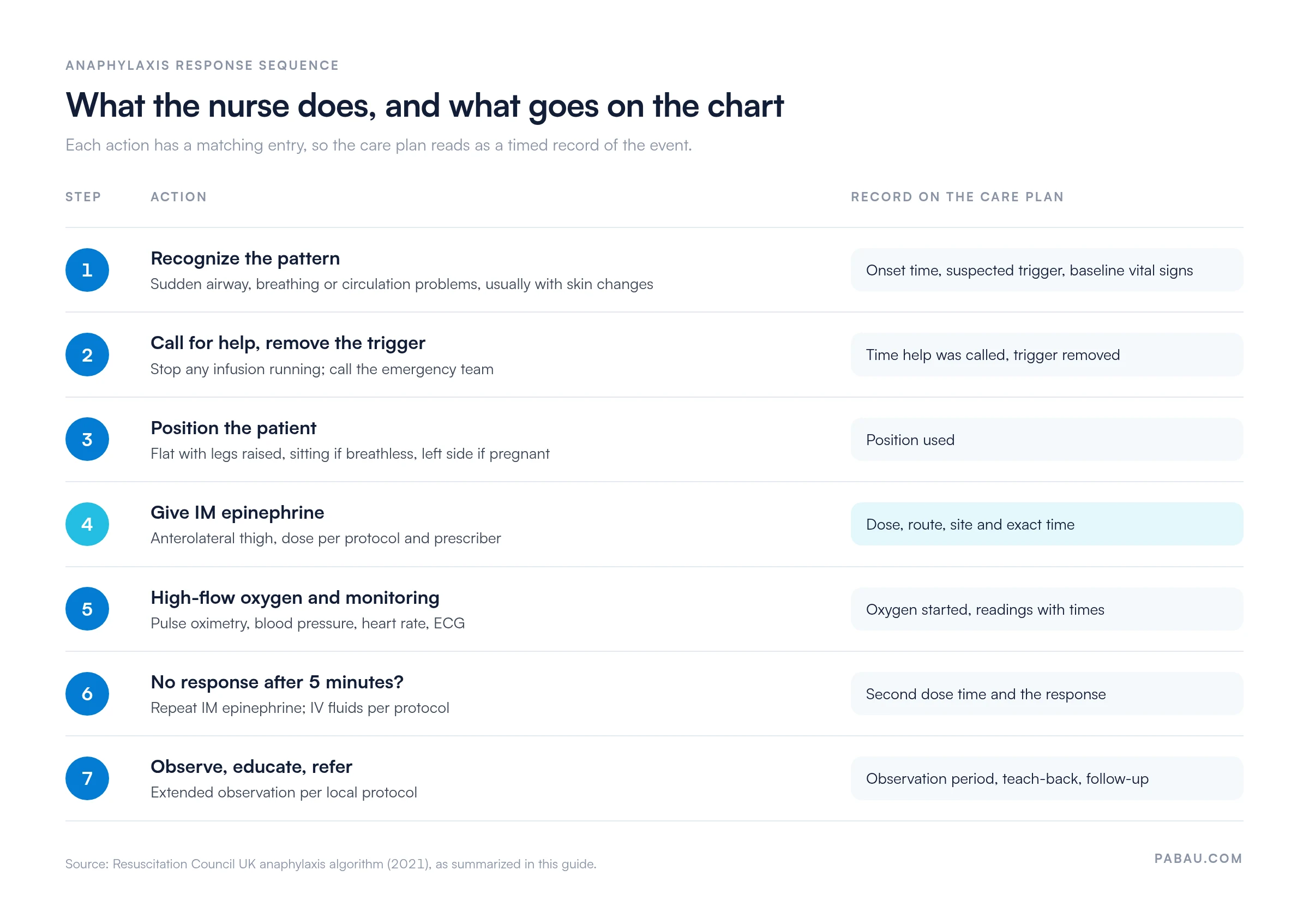
Nurses confirm the dose and route against the prescription or standing order, record the exact time, and watch for a response. Document the response after each dose, because the 5-minute repeat decision depends on it.
RCUK sets the IM dose by age, using the 1 mg/mL (1:1000) strength. Post these figures beside the kit so nobody has to recall them under pressure.
IM injection only, into the anterolateral middle third of the thigh. Source: Resuscitation Council UK anaphylaxis algorithm, 2021. Verify every dose against your local protocol and the prescriber’s order.
RCUK treats antihistamines as third-line, never as treatment for airway, breathing or circulation problems. Once the patient is stable, a non-sedating oral antihistamine such as cetirizine can ease lingering hives or swelling.
Routine corticosteroids are no longer advised for anaphylaxis. RCUK keeps them for refractory reactions or ongoing asthma or shock, given after initial resuscitation and never ahead of epinephrine. Record each adjunct drug with its dose and time.
Outcomes state what improvement looks like and when you expect to see it. Write them as measurable goals tied to the diagnoses above, and review each one at every reassessment.
Symptoms can return hours after the first reaction has settled, which is known as a biphasic reaction. RCUK says this affects around 5% of patients. Its 2021 guidance sets observation by risk, counted from when symptoms resolve rather than from onset.
All periods run from the resolution of symptoms. RCUK also advises 12 hours for ongoing allergen absorption, late-night presentation or poor access to emergency care. Source: Resuscitation Council UK, Emergency treatment of anaphylaxis, May 2021.
RCUK expects this observation in a clinical area that can treat airway, breathing and circulation problems. Your local protocol and discharge criteria take precedence, so confirm the figures your practice works to.
Education starts before discharge and covers allergen avoidance, auto-injector use and when to seek emergency care. Patients without a clear plan may delay treatment at the next exposure. Teach-back is a useful way to check understanding. Ask the patient to show you the injector steps rather than describe them.
A structured nursing teaching plan keeps these points consistent between nurses and shifts.
Documentation should show what you observed, what you did and how the patient responded, in the order events occurred. Record times for every assessment and every medication. Where staffing allows, ask a second team member to call out and write the times while you treat.
The template’s single tryptase line holds a result, not a timeline. Tryptase peaks 1 to 2 hours after onset and falls quickly, so each result is read against the time it was drawn. RCUK recommends three timed samples where possible.
If you can only take one sample, RCUK advises drawing it within 2 hours of onset and no later than 4 hours. Never hold treatment back to take it.
Charting problems tend to surface at review, when someone tries to rebuild the timeline. These are the ones to watch for, with the entry that prevents each one.
If the reaction followed a drug or product your practice gave, complete an adverse reaction form as well. That way the event is reported and the trigger is flagged for future visits.
The care plan only works if the kit and the team are ready before a reaction starts. Run this check at the start of each session where injections or infusions are given.
The free template is a two-page form you can print or keep on file. It follows the structure of this guide, but it has no time fields, so decide where the timed record goes before an emergency.
The form has no field for the date and time of onset, and no medication table for dose times. Each vital sign gets one line, so there is no room for repeat readings. It has no observation start or end time either.
Turn the Interventions box into a timed log, one line per action, starting with the time symptoms began. If it fills up, keep a separate record alongside the plan. A medication administration record gives each dose its own line, and a vital signs record holds repeat readings in one timed table.
Use it as a reference aid that your organization adapts to local protocols. It does not replace clinical judgment or your prescriber’s orders.
Paper care plans get filled in at different speeds by different nurses, and some never reach the patient file. When a reaction happens mid-session, the record is often pieced together from memory afterward.
Pabau, the practice management platform we build, keeps your care plan as a digital form inside the patient record. Its patient intake forms capture allergies before the appointment, so the trigger history is on screen when a reaction starts.
Epinephrine times, the observation period and education notes then sit on one record. A colleague reviewing the event the next morning sees the same timeline you charted.

Pabau helps practices store structured care documentation, so the same template is used every time, with a clear audit trail. Book a demo to see how it fits your workflow.

Anaphylaxis gives you minutes, not hours, so the care plan has to be settled before the reaction happens. Decide now who gives epinephrine, who keeps the timed log, and which observation tier your practice applies afterward.
With those three answers in your protocol, the plan becomes a matter of filling fields during an emergency. The trade-off is a few minutes of preparation each session, which costs far less than rebuilding a chart from memory.
Book a demo to see how Pabau keeps anaphylaxis records, allergies and follow-up in one patient file.

Writing the diagnosis field? Nursing diagnosis handbook lists NANDA-I labels with the defining characteristics that support each one.
Charting doses across a shift? Medication administration record gives every dose, time and route its own line.
Repeating observations at set intervals? Vital signs record keeps each set of readings in one timed table.
Preparing the patient to go home? Discharge planning checklist covers education, medicines and follow-up before the patient leaves.
Handing over after the event? SBAR nursing handoff structures the handover so the next nurse knows the timeline.
Anaphylaxis affects the airway, breathing or circulation, usually alongside skin changes. A mild reaction stays limited to hives, itching or local swelling. If airway, breathing or circulation are involved, treat it as anaphylaxis and give epinephrine.
It depends on your state or country and your practice’s protocols. Many settings use standing orders that let trained nurses give IM epinephrine in an emergency. Confirm your scope before you need it.
Mast cell tryptase rises after anaphylaxis, so timed samples support the diagnosis. RCUK advises one as soon as feasible, one 1 to 2 hours after onset, and a baseline at follow-up. Log each sample time, because results are read against onset.
Yes. Resuscitation Council UK advises referring every patient who presents with anaphylaxis to an allergy clinic. The specialist confirms the trigger, which shapes avoidance advice and future treatment.
Many guidelines advise carrying two, because a second dose may be needed before help arrives. Follow the prescriber’s instructions and local guidance, and show the patient how to use both.