Monika Lazarevska

Exercise worksheet to download: What it is and what to record on the worksheet
An exercise worksheet is a structured document that records a patient’s ex...

4
Last Updated: Oct 27, 2026
Free PDF 2 pages, print-ready Clinician-reviewed
A compound exercise workout plan builds each session around multi-joint lifts, such as squats, deadlifts, presses, and rows. Because each lift trains several muscle groups at once, three full-body sessions a week can cover the whole body. Beginners usually start with 2 to 3 sets of 8 to 12 reps at a moderate load and add weight slowly. Plans tend to stall when load climbs before form is ready and nobody records what changed.
The free printable is a two-page care plan for goals, actions, warning signs, and dated reviews. Pair it with a separate log of each session's loads and reps.
A two-page printable care plan with patient details, a background box, up to five goals, and seven dated actions. Page two holds a support checklist, warning signs and contacts, and a five-entry review record with signatures.
Start from scratch, or upload this PDF or any form you already use, and Pabau's AI Form rebuilds it with tick boxes, text fields and a signature. Attach it to the treatment once, and every patient gets it on time.
AI Form rebuilds the consent, history and aftercare forms you already use. You review each one, then publish.
Patients complete forms on their phone before they arrive, so the front desk stops retyping paper.
Every signed form is versioned and attached to the treatment record, ready when you need it.
Set how long a consent stays valid. Returning patients skip forms they have already signed.
Supports HIPAA and GDPR compliance AES-256 encryption 4.8 on G2 4.7 on Capterra Trusted by 4,000+ practices worldwide

A compound exercise workout plan builds strength and muscle with lifts that move several joints and muscle groups at once.
Six lifts anchor the plan: the squat, deadlift, bench press, row, overhead press, and pull-up.
Three full-body sessions a week is the starting point most commonly recommended for beginners.
Results depend on progressive overload, which means adding weight, reps, or sets over time.
Logging every set tells you when to add load, when to hold, and when to deload.
A compound exercise workout plan is a training program built around multi-joint lifts. In each one, two or more joints move together and several muscle groups share the work. The squat, deadlift, bench press, pull-up, barbell row, and overhead press are the classic examples.
Each of those lifts loads a large share of the body at once. That’s why three sessions a week can train the whole body, which is hard to manage with isolation work alone.
The American College of Sports Medicine (ACSM) recommends muscle-strengthening activity for every adult at least two days a week. A three-day compound plan clears that bar and leaves room to progress.
Isolation exercises, such as a biceps curl or a leg extension, target one muscle at a time. They still have a place, but they work best after the compound lifts rather than in place of them.
Compound movements earn their place at the front of a program for a handful of practical reasons.
Six big lifts do most of the work, and the lunge family adds single-leg strength. Learn these seven and you can build any version of the plan.
The squat and deadlift give you the most lower-body work per set. The bench press and row balance horizontal pushing and pulling, which helps keep your shoulders healthy. Pull-ups and the overhead press cover the vertical versions. Lunges, split squats, and hip thrusts train each leg on its own and add extra glute work.
Ten minutes of setup saves weeks of stalled progress. Run through this list before the first session.
Programming comes down to four variables: frequency, sets and reps, rest, and progression. Set the first three here, and the 4-week block further down handles the fourth.
Three full-body sessions per week is the starting point most commonly recommended, giving each muscle group 48-72 hours of recovery. Experienced lifters can move to a four- or five-day upper/lower or push-pull-legs split. For most people training a few times a week, full-body sessions are hard to beat.
Strength
1-5 reps
3-6 sets per exercise, 3-5 minutes of rest
Strength-hypertrophy
6-10 reps
3-5 sets per exercise, 2-3 minutes of rest
Hypertrophy
8-15 reps
3-4 sets per exercise, 2-3 minutes of rest on compound lifts and 60-90 seconds on isolation lifts
Muscular endurance
15-20+ reps
2-3 sets per exercise, 30-60 seconds of rest
For most lifters, 6-10 reps is a good middle ground between strength and muscle growth. Start with three working sets per exercise, and add a set every two to three weeks as your recovery allows.
Rest longer than you might expect on the big lifts, even when muscle is the goal. In a 2016 trial of trained men, three-minute rests built more strength and thigh muscle than one-minute rests. The evidence is still limited, but two minutes or more is a sensible default for squats, deadlifts, presses, and rows. Shorter rests of 60-90 seconds suit isolation work.
Always start with the most technical, heaviest compound lift. Squats and deadlifts go before rows, and the bench press goes before flyes. Fatigue builds fast, so your most important lifts get your freshest effort.
This full-body split is the structure most commonly recommended for newer lifters. Train Monday, Wednesday, and Friday, or any three non-consecutive days. Each day leads with a different main lift, so no single pattern takes the heaviest work twice in a row.
Day 2 keeps heavy hinging to the deadlift alone. The lighter Romanian deadlift moves to Day 3, which gives the lower back a rest day between the two.
This table is the plan’s standard week. Once you start the 4-week block below, its sets and reps take over for the back squat and the deadlift. Every other lift stays as listed. The 90-second rests on the lighter compound lifts keep each session near an hour, so stretch them to two minutes when you have the time.
Warm up with 5-10 minutes of light movement, such as rowing, cycling, or dynamic stretching, before every session. Then do two warm-up sets of your first lift at 40-60% of your working weight. They get your joints moving, lower your injury risk, and make the first working set feel lighter.
Progressive overload is what turns a plan into results. This 4-week block applies it in three steps, then backs off for a week. For the two primary lifts, the back squat and the deadlift, its sets and reps replace the ones in the day-by-day table.
The chart shows what each week trades: total working reps per primary lift against the load you’re moving.
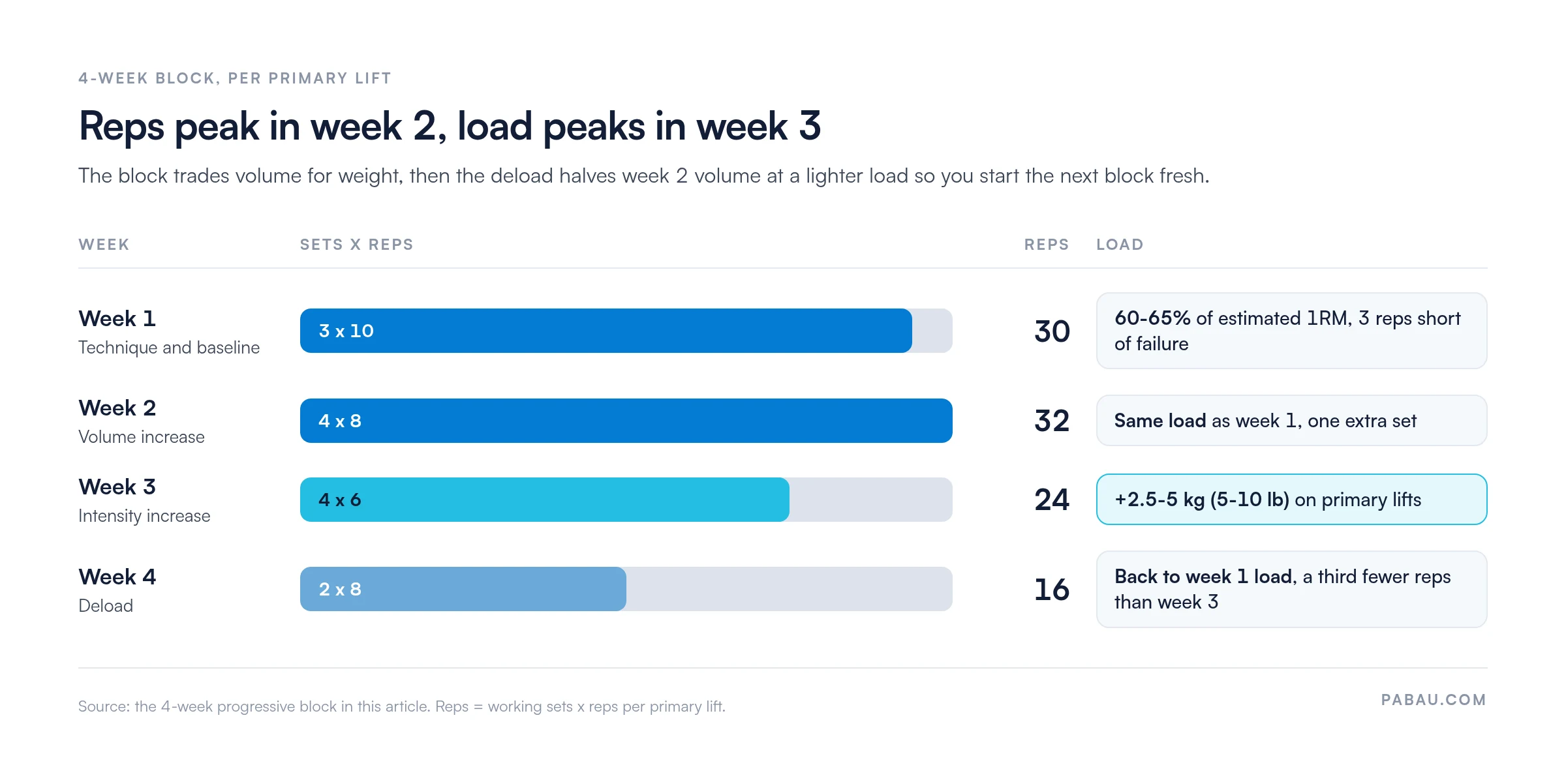
After the week 4 deload, repeat the block with slightly heavier starting weights. This simple linear approach is a common choice for lifters in their first year or two of consistent training.
Here’s how one primary lift moves through the block. Say a lifter’s estimated one-rep max (1RM) on the back squat is 100 kg (220 lb).
These loads are an illustration, so work from your own estimated 1RM.
Missed reps in week 3? Repeat the same load next session before you move on. Forcing a heavier week on missed reps usually means grinding through bad form.
Form breaks before the last rep? That set does not count toward progression. Hold the load until every rep looks like the first one.
Sore or in pain? Muscle soreness that peaks a day or two after training is normal. Sharp pain or joint pain during a lift is a reason to stop and get it checked.
No notes from last week? Without a log, you’re guessing what you lifted. Writing down the load, the reps, and how the set felt takes ten seconds.
The free PDF is a two-page care plan for agreeing goals with a patient and reviewing them over time. It has no exercise list or set-by-set log, so use it alongside the tables in this article rather than in place of them.
Keep the loads and reps on a separate sheet. A printout of the day-by-day table works well, with each session’s load and reps written beside every lift. Bring that sheet to each review, so every change on the plan rests on what was lifted.
Beginners have an edge, because almost any structured compound plan produces fast strength gains in the first 6-12 months. Lifters call it “newbie gains.” Three full-body sessions a week, at moderate loads with a focus on technique, is the starting point most commonly recommended.
Once weekly jumps stall too, move to the 4-week block. If you would rather train five days, a beginner gym exercise plan spreads similar lifts across a longer week.
Compound training works for women on the same principles as it does for men. The worry that squats and deadlifts make women “bulky” rarely plays out. Women have much lower testosterone levels, so the usual result is a stronger, leaner build rather than large muscle mass.
For glute and posterior-chain goals, adjust the exercise selection. Hip thrusts, Romanian deadlifts, Bulgarian split squats, and sumo squats all load the glutes heavily.
Keep the squat and conventional deadlift as they are, and swap an accessory lift instead. The walking lunges on Day 2 are the easiest swap. Replace them with hip thrusts, and the glutes get heavy work on Day 1 and Day 2.
Rep ranges of 8-15 sit in the hypertrophy zone and suit glute work well. A workout plan for women lays out a four-week version for beginners.
A home version works with a pair of adjustable dumbbells, or even bodyweight alone. Every main compound pattern has a home-friendly equivalent.
At home, take bodyweight sets closer to failure to make up for the lighter load. Push-ups taken to one or two reps short of failure can give a stimulus similar to a moderate bench press set.
If you prescribe sessions like these to patients, a written home exercise program keeps them on track between visits.
When a plan stops working, one of these is usually the cause.
Physical therapy, sports medicine, and wellness practices that prescribe strength work often run it on paper. The plan sits in a printout, the loads live in the patient’s notebook, and each review depends on someone remembering what changed.
Pabau, the practice management platform we build, keeps that history in one patient record. Patients complete intake and screening forms online before the first session. Treatment notes capture each session and every review, so the next clinician can see where the patient stands.
Online booking and automated reminders keep the three weekly sessions on the calendar, so fewer patients drift off the plan. Teams treating athletes can see the full workflow in our sports medicine software.

Pabau keeps patient records, treatment notes, and appointment reminders in one place for physical therapy and sports medicine practices. Your team spends more time coaching patients and less time on admin.

A compound plan doesn’t need clever exercise selection to work. Squat, hinge, push, pull, and lunge three days a week, and add load only when your log says you’ve earned it.
The trade-off is patience. The first four weeks feel easy on purpose, and lifters who rush them tend to stall by week three. Start lighter than your ego wants, write down every set, and let the block do its job.
If you prescribe plans like this to patients, the tracking is usually harder than the programming. Book a demo to see how Pabau keeps each patient’s loads, reviews, and appointments in one record.

Training for an event? Strength training plan for runners fits lower-body strength work around a running schedule.
Want more upper-body volume? Upper body weight workout plan focuses a full plan on pressing and pulling.
Need a longer runway? 6-week exercise plan stretches a structured program across six weeks.
Taking on someone new? Personal trainer intake form captures health history and goals before the first session.
Teaching the basics? Principles of exercise sets out the core training principles behind plans like this one.
Most sessions in this plan take about 45 to 60 minutes, including the warm-up. Four lifts at three or four sets, with 60 seconds to three minutes of rest, fill that window.
Not the same heavy lifts. Each muscle group needs roughly 48-72 hours between hard sessions, which is why the plan uses three non-consecutive days. Walking or mobility work on rest days is fine.
Yes, in moderate doses. The ACSM pairs strength work with at least 30 minutes of moderate aerobic activity on five days a week. Keep hard cardio away from squat and deadlift days.
Pick a load you could lift for two or three more reps than the set asks for. Log it, then let the 4-week block raise it from there.
Yes. Evidence suggests compound lifts can drive hypertrophy without isolation work, especially for newer lifters. Add curls or lateral raises later if a muscle group lags behind.
The squat, deadlift, bench press, overhead press, barbell row, and pull-up. Together they cover the squat, hinge, push, and pull patterns, both horizontal and vertical.