Orthopedic examination template: Free 6-stage form (PDF)
An orthopedic examination is a structured physical assessment of the bones, join...

3
Last Updated: Oct 16, 2026

A structured strength plan reduces injury risk, improves running economy by 2 to 8%, and builds the glute and core strength endurance running demands.
Runners should prioritize glutes, hip stabilizers, core stability, hamstrings, and calves, because those muscle groups drive running efficiency.
Two sessions a week is the evidence-based minimum, and phase-based periodization aligns the strength work with your race calendar.
The four phases run Foundation, Build, Peak, then Taper across 16 weeks, with load rising as running volume allows.
The downloadable template gives you all four phases on five printable pages, with sets, reps, rest, warm-ups, and a session log.
Five printable pages. Page one holds the race details, the phase overview, and the warm-up protocol. Pages two to four give every Foundation, Build, Peak, and Taper session with sets, reps, rest, and coaching cues. Page five adds injury-prevention work, no-gym swaps, and a blank session log.
Download templateA strength training plan for runners is a lifting schedule that rises and falls with your mileage instead of competing with it. That structure is the whole point. Running loads one leg at a time, with impact forces up to 2.5 times your body weight per stride. Mileage alone never teaches your legs to absorb that.
Research puts the payoff at a 2 to 8% gain in running economy and up to half the overuse injury risk. Get the phasing wrong and heavy lifting steals recovery from your long run.
Below, the plan breaks down phase by phase, with the exercises, the session frequency, and the swaps for training without a gym.
Running builds endurance, not the stabilizer strength that keeps your stride honest. Without dedicated strength work, your quads and lower back start covering for glutes that aren’t pulling their weight, and injury risk climbs from there.
A well-designed plan builds the muscular resilience your running already demands. The return shows up in five places:
Not all strength work pays the same dividend for a runner. The work that counts targets the muscles driving running efficiency, and the ones that fail first. Those are the glutes, hip stabilizers, core, hamstrings, and the calf and ankle complex.
The glutes are the powerhouse of running. Weak glutes force the quads and lower back to compensate, which leads to knee pain, IT band syndrome, and lower back trouble.
The exercises that work here are glute bridges, clamshells, lateral band walks, and split squats. Even two sessions a week of glute work improves stride mechanics and running stability.
Running-specific core strength is anti-rotation and single-leg stability work, not crunches. A strong core keeps the pelvis stable, reduces side-to-side sway, and improves efficiency.
Plank variations, dead bugs, pallof presses, and single-leg farmer carries all do the job. Core endurance, meaning holding tension for 30 to 60 seconds, matters more for runners than raw strength.
Hamstring strength balances dominant quads and protects the knee. Romanian deadlifts and single-leg deadlifts are the gold standard here.
Calf raises and ankle stability work build resilience against Achilles tendinopathy and plantar fasciitis, the two injuries most likely to sideline a runner. Include both two-leg and single-leg calf work.
Start with compound movements, which work several muscle groups at once and carry directly into running. These six come first, before any weight goes on the bar:
As the phases progress you add external load, bring in single-leg variations, and introduce plyometrics. That progression is what delivers the result, because your body adapts quickly to the same stimulus.
Two sessions a week is the evidence-based minimum. Each one runs 30 to 45 minutes, which is enough to improve running economy, cut injury rates, and lift race performance. More is fine if you have the recovery capacity for it. Fewer than two gives diminishing returns.
Fitting them around your mileage is the harder part. During peak mileage, many runners scale back to one session a week to protect the running workouts, which is both normal and appropriate.
Which days? Keep the two sessions at least 48 hours apart, and put the heavier one as far from your long run as the week allows. Only got 20 minutes? Do the two heaviest compound lifts and drop the accessory work. A short session you finish beats a full one you postpone.
Five details are worth settling before the first session, because each one gets harder to fix mid-block:
Page five of the template covers the fourth point, and page one covers the first. Settle the other three yourself before Monday.
The plan is periodized, meaning it is structured into phases that match your race calendar. This 16-week template is built around a marathon cycle. Half marathon runners use weeks 1 to 12, and 5K runners use weeks 1 to 8.
The shape matters more than any single session. Weekly strength minutes climb to their highest point in Build, then step back as running mileage takes over.
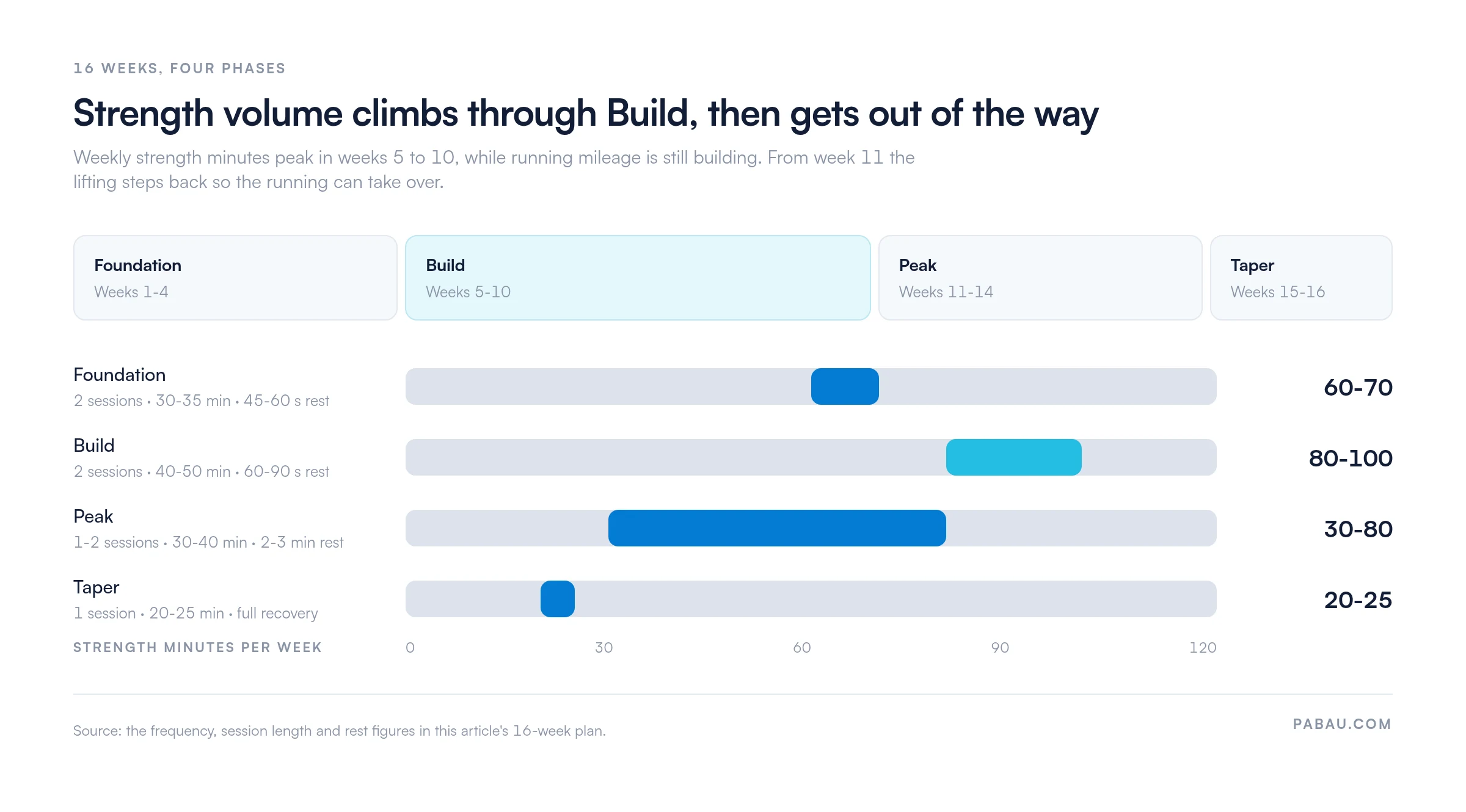
Focus: movement quality, mobility, and activation. Load is light and reps are higher. The job of these four weeks is learning proper form, building work capacity, and priming the nervous system.
Focus: progressive loading and single-leg strength. You add external weight, using dumbbells, barbells, or resistance bands, and bring in single-leg work that challenges balance. Most of the strength gain across the plan happens here.
Here is how a Build week sits around four running days:
The two lifting days sit as far from Sunday as the week allows, which is what keeps the long run intact.
Focus: power and peak strength. Plyometrics come in here, with jump squats, box steps, and bounding prep, while volume drops slightly and the load stays heavy. The phase is short because running volume peaks at the same time, so recovery capacity is the limiting factor.
Focus: maintenance. Reduce volume significantly but hold the intensity. The goal is preserving the neural adaptation from Peak without inducing fatigue, because your body needs recovery before race day.
Phasing protects the training, and targeted work protects the runner. The most common running injuries are largely preventable, because each one traces back to a weak point you can train.
If an injury has already stopped you running, this work sits alongside a graded return to running protocol rather than replacing it.
Consistency and progressive challenge drive the adaptation, not the kit you own. Every phase in this plan has a bodyweight version, so no gym membership is required to run it properly.
The essentials are pistol squats or assisted single-leg squats, glute bridges, and single-leg deadlifts. Add push-ups, plank holds, lateral lunges, and step-ups on a bench or stairs. Load them with a weighted backpack, resistance bands, or a filled water jug.
Rest periods follow the same phase structure whatever you are lifting. Keep the short rests in Foundation and the long rests in Peak.
Progressive overload, meaning a systematic increase in demand, is what drives continued improvement. Apply one of these each week or every other week, and only one:
Strength blocks rarely fail because the exercises were wrong. They fail for one of these four reasons:
Coaches and sports medicine practices usually run a plan like this out of a spreadsheet and a group chat. The plan sits in one place, the session notes in another, and the athlete’s history with whoever last wrote it down.
A physical therapy EMR solves half of that, because the athlete’s history sits in one file instead of three. Practice management software like Pabau, which doubles as sports medicine software, adds the plan to the same file.
You attach the 16-week template to the client file. Anyone opening it then sees the same phase, the same load, and the same progression rules.
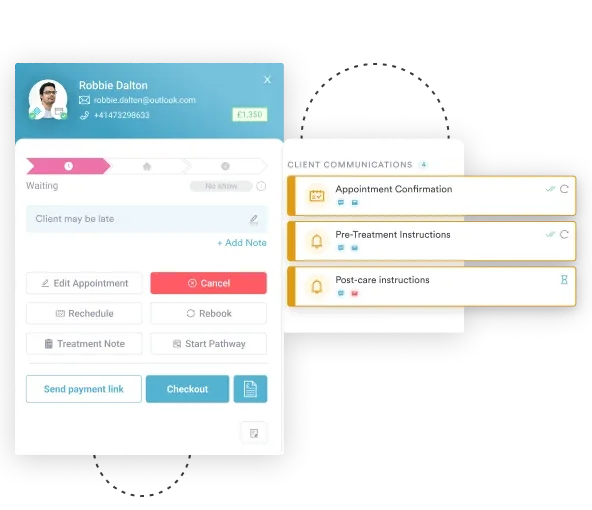
Session notes write straight back into the client record, so week 12 can be compared with week 1 without rebuilding the history by hand. You can see which runners stalled in Build and which are ready for plyometrics.
When a race cycle finishes, an automated reminder brings the athlete back for a retest. The next block then starts from recorded data rather than memory.

Attach the 16-week plan to the client file, log each session as you go, and pull a progress report without rebuilding the history by hand.

The phases are the point. Foundation earns you the right to load, Build is where the strength arrives, Peak converts it into power, and Taper protects it. Start heavy in week one and you invite the injury you were training to avoid.
The trade-off worth remembering is time. Two sessions of 30 to 45 minutes is a serious claim on a week that is already full. Take it out of easy mileage rather than out of your long run.
Download the template above, fill in your race date, and put the first two sessions in the calendar this week. Book a demo to see how Pabau keeps an athlete’s plan, session log, and progress in one record.

Coming back from an injury layoff? Return to running protocol sets the mileage progression this strength plan runs alongside.
Programming for a client rather than yourself? Home exercise program gives you a format for sending sessions home between appointments.
Need a baseline before week one? Fitness assessment form records the numbers you will retest at week 16.
Screening a new runner? Personal trainer assessment covers the history and movement checks to run before you load anyone.
Working around a groin strain? Adductor strain exercises handout shows how a phase-based rehab plan progresses week by week.
After, on most days. Running on legs that are already tired from lifting changes your form, and that is where injuries start. If your day allows, put six hours or more between the two sessions.
No. Running volume blunts the muscle growth that heavy lifting causes on its own, so runners gain strength without much size. The 2 to 8% economy improvement comes from better force production, not bigger muscles.
Strength gains show up in four to six weeks, mostly from better neural recruitment. Running economy changes take longer, usually 8 to 12 weeks of consistent work, which is why the plan runs 16.
Swap the run for a rest day or easy cross-training, and keep the next strength session lighter. Muscle soreness in the first two weeks is normal. Sharp joint pain is not, and it needs assessing.
The phases stay the same, but the emphasis shifts. Add more single-leg and lateral work, plus eccentric step-downs. Uneven ground loads you sideways, and downhill running loads the muscle as it lengthens.